Indemnification Clause: Meaning, Examples, and Tips
Indemnification Clause: Meaning, Examples, and Tips
Indemnification Clause: Meaning, Examples, and Tips
Indemnification Clause: Meaning, Examples, and Tips
indemnification clause, contract clauses, contract negotiation, clause library, risk management

An indemnification clause answers one of the most consequential questions in any contract: if something goes wrong and a third party brings a claim, who pays? These clauses decide who covers damages, judgments, settlements, and attorneys’ fees, yet they rank among the most misunderstood provisions in commercial agreements.
One important note before you read on: nothing here is legal advice. Indemnification enforceability varies significantly by jurisdiction, industry, and contract type. Verify every position described below with qualified legal counsel before acting on it.
Key Takeaways
Indemnification clauses decide who pays when a third-party claim arrives, and scope comes down to drafting choices.
The obligations differ: duty to defend pays for counsel now, indemnification reimburses losses once established, and hold harmless blocks the other party from bearing covered losses.
Enforceability shifts by jurisdiction, and several industries carry anti-indemnity statutes that void certain provisions.
Negotiate from a documented playbook with preferred positions, pre-approved fallbacks, and a floor.
Track every accepted variation in a clause library plus extraction-driven fields, so ‘what did we agree to?’ has an answer.
What is an indemnification clause?
An indemnification clause is a risk-allocation mechanism, not boilerplate. It shifts financial responsibility for specified losses from one party (the indemnified party) to the other (the indemnifying party) when defined events occur. Covered losses typically include damages, liabilities, judgments, settlements, and attorneys’ fees.
Scope depends almost entirely on drafting. A narrow clause might cover only third-party claims arising from breach of a specific representation. A broad one might reach all losses of any kind, even losses partly caused by the indemnified party’s own negligence.
Two contracts can look nearly identical yet create very different exposure through this one provision. That is why experienced legal teams treat indemnity as a negotiated risk decision, not a formality.
Defend, indemnify, and hold harmless
Most indemnification clauses combine three distinct obligations:
Obligation | What it means |
|---|---|
Defend | Pay for the legal defense of covered claims |
Indemnify | Reimburse the other party for covered losses |
Hold harmless | Protect the other party from bearing those losses at all |
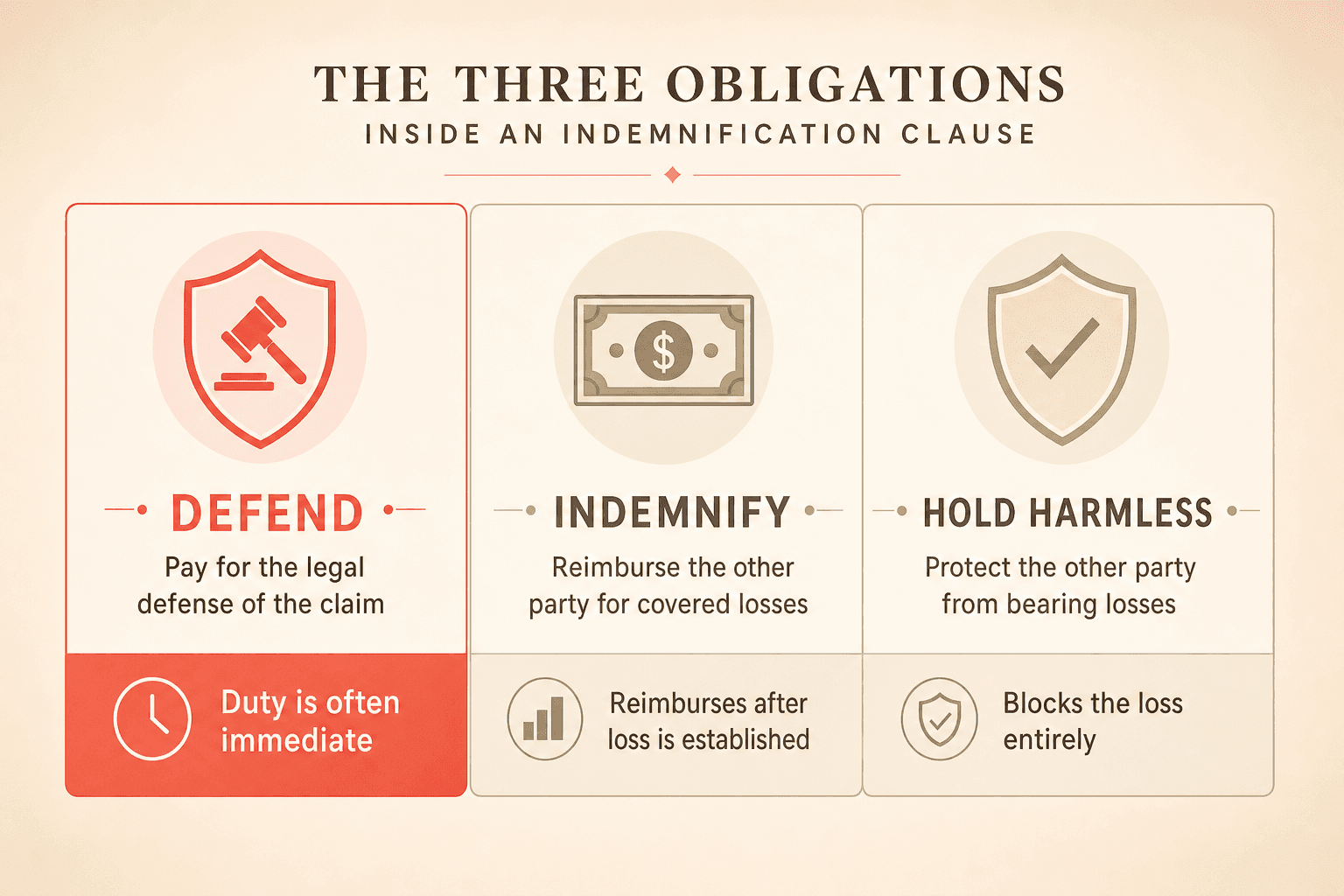
The duty to defend deserves special attention because it stands apart from the duty to indemnify. Indemnification reimburses losses after they are established. Defense decides who pays for, and who controls, the lawyers when a claim arrives, often before liability has been determined.
Defense costs add up quickly, so timing matters. Some clauses make the defense obligation immediate once a claim is tendered; others stay silent and invite disputes. On the indemnifying side, one common concession is accepting indemnity while narrowing defense, such as reimbursing reasonable defense costs subject to a cap.
Indemnification clause example
Concrete language helps. A standard unilateral formulation reads something like this:
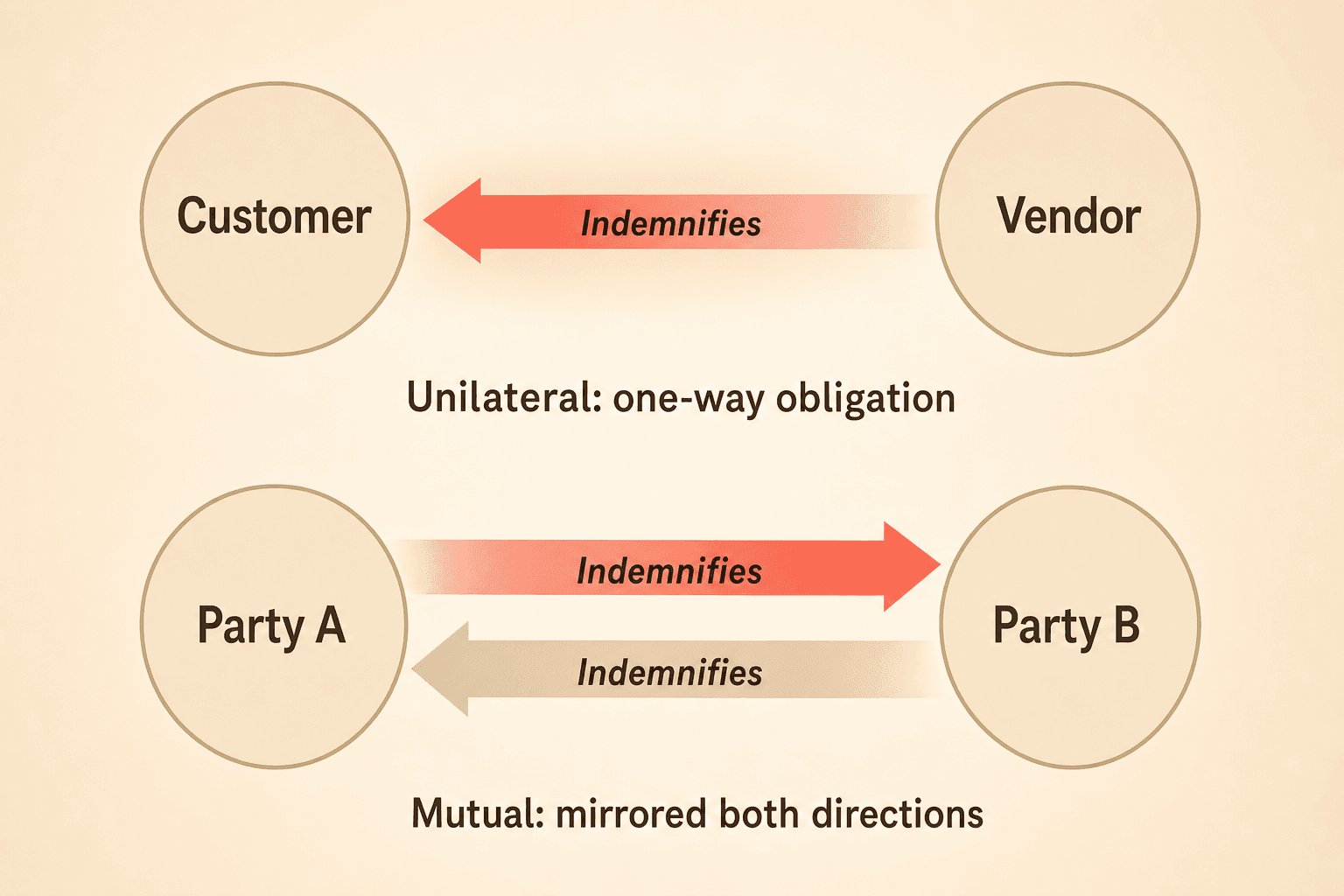
“Supplier shall indemnify, hold harmless, and defend Customer and its officers, directors, employees, and agents against any and all losses, damages, liabilities, claims, judgments, settlements, fines, costs, and expenses, including reasonable attorneys’ fees, arising out of Supplier’s breach of this agreement or its negligent acts or omissions.”
A mutual indemnification clause mirrors the same obligation in both directions: each party covers claims arising from its own acts, omissions, or negligence. Common triggers include breach of representations or covenants, violation of law, and negligent or willful misconduct.
Treat these examples as illustrations, not templates. Much of the sample language circulating online is vendor-drafted and skews toward the indemnified party. The right wording for your agreements depends on your risk profile, industry, and governing law.
Mutual vs. unilateral indemnification
A unilateral indemnification clause runs in one direction: one party indemnifies the other. A mutual clause mirrors the obligation both ways, and mutuality is often a reasonable opening position.
Symmetry in text does not guarantee balance in practice. Consider a vendor handling sensitive customer data under a formally mutual clause. The vendor carries far more exposure surface area, so the clause will likely be triggered in one direction no matter how even-handed the language reads.
Skilled negotiators think past the direction of the clause. They ask who controls the underlying risk and who is best positioned to insure against it, then calibrate scope to match.
Limitation of liability vs. indemnification
An indemnification clause never operates in isolation. Its practical effect depends on how it interacts with the contract’s limitation-of-liability provision, and that interaction is where many negotiations are actually decided.
A general liability cap, such as a multiple of annual fees, may or may not apply to indemnification obligations depending on how the two clauses work together. Sophisticated contracts often carve certain indemnities out of the general cap entirely, with IP infringement and data breach as frequent candidates. The rationale is that the indemnifying party controls those risks and is best positioned to manage them.
Expect the indemnifying side to push the other way. Typical asks include excluding consequential, incidental, and special damages from covered losses, and applying the general cap to indemnity unless a specific carve-out says otherwise. For a closer look at caps, read The complete guide to contract clause types and examples.
Enforceability varies by jurisdiction
Indemnification clauses are not automatically enforceable as written. Courts in many U.S. jurisdictions apply heightened scrutiny to clauses that indemnify a party for its own negligence, frequently requiring that intent in clear and unequivocal language. A broadly worded hold-harmless provision may not be enough.
In Pacific Gas & Electric Co. v. Thomas Drayage & Rigging Co., 69 Cal.2d 33 (1968), the California Supreme Court drew a distinction courts still apply: “general” indemnity clauses do not explicitly address the indemnitee’s negligence, while “specific” clauses do.
Statutes add another layer. Several states have enacted anti-indemnity laws that restrict or void certain provisions in specific industries, most notably construction and oil and gas. A clause that holds up in a software agreement may be partially void in a construction subcontract governed by another state’s law, and choice-of-law provisions can surprise parties who drafted under one jurisdiction’s assumptions.
The takeaway: identical text can produce very different legal effects depending on context. Confirm your language with counsel who knows the governing law.
Negotiation tips: work from fallback positions
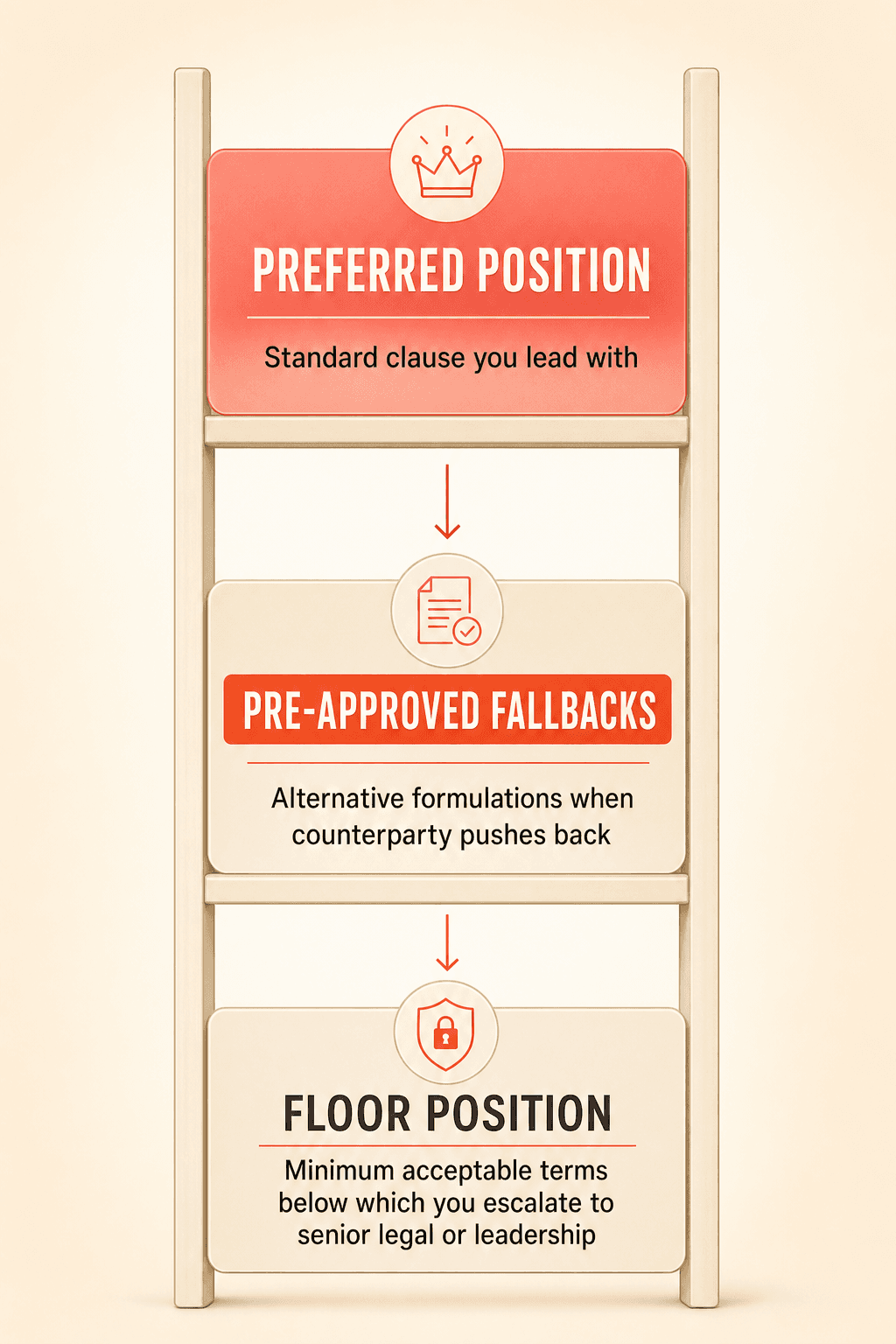
Mature legal teams negotiate indemnification from a playbook, not from improvisation. A workable structure has three tiers:
1. Preferred position: the standard clause you lead with.
2. Pre-approved fallbacks: alternative formulations you can offer when the counterparty pushes back.
3. Floor position: the minimum acceptable terms, below which you escalate to senior legal or executive leadership.
Documented fallbacks keep deals moving and keep your risk posture consistent. Teams working through email and Word documents commonly describe the opposite pattern: one negotiator accepts a broad mutual indemnity while another holds out for narrower language, with no record of why. Over time, the portfolio fills with inconsistent terms nobody can report on.
A few practical points for your playbook:
• Anchor indemnity on third-party claims tied to the indemnifying party’s conduct.
• Tie fallbacks to caps and carve-outs, not just base language.
• Set escalation thresholds for red flags like unlimited liability or coverage of the other party’s gross negligence.
• Revisit positions periodically as law and risk tolerance evolve.
For a broader framework, see our contract negotiation guide.
Want to negotiate indemnification from a playbook instead of improvising? See clause fallback language in action.
Track what you agree to across your portfolio
Negotiating well is only half the job. If a customer accepted a non-standard indemnity scope three years ago, does anyone at your company know today?
Legal ops leaders frequently report that negotiated variations, a shorter notice window here, a modified indemnity scope there, end up in email threads or redlined files rather than any system of record. When a dispute or data breach hits, answering “what did we agree to?” means reading contracts one by one.
Transcript: “The idea behind key terms is simple: if a contract carries language that is not standard to you, maybe a high limitation of liability or a non-standard indemnity, you can flag it and call it out from the contract.”
Transcript: “Beyond the standard fields, you can create custom extraction fields that pull out specifics like the indemnification clause, limitation of liability, governing law, total contract values, termination rights, and pretty much anything else you track.”
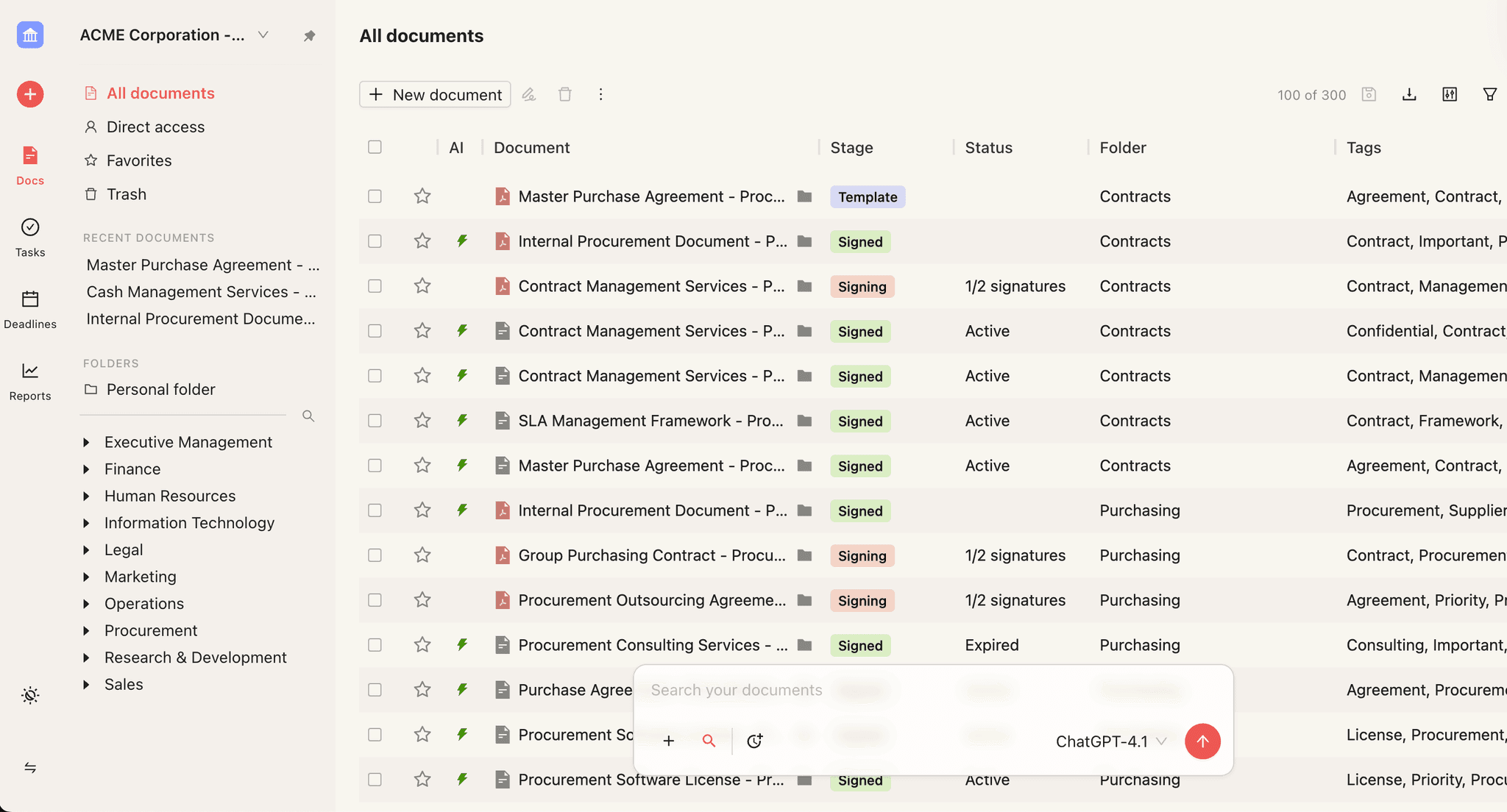
Clause management infrastructure addresses this gap. With Concord, you can build a clause library that holds your preferred indemnification language alongside pre-approved fallbacks, clearly labeled so negotiators know which variations they can offer and which require escalation. Reviewers working through third-party paper can pull the approved alternative instead of drafting from scratch under time pressure.
Standardizing how indemnification language enters your agreements also reduces copy-paste errors and wrong-version mistakes, a persistent worry for teams managing documents manually. When someone modifies a clause linked to existing templates, Concord surfaces a confirmation showing the change’s impact before it applies, so a small edit does not quietly propagate across your template set.
Teams building an indemnification playbook for the first time can start from Concord’s sample agreements, then customize them to reflect preferred positions. Explore Concord’s contract templates for more.
The bottom line
Indemnification clauses decide who pays when third-party claims arise, and their real-world effect turns on drafting details: scope, defense obligations, caps, carve-outs, and governing law. Treat them as negotiated risk decisions, document your fallback positions, and keep a searchable record of what you accept across your portfolio.
A final reminder: this article is educational, not legal advice. Confirm every indemnification position with qualified counsel before you sign.
Ready to bring structure to your indemnification playbook? See how Concord’s clause library works.
An indemnification clause answers one of the most consequential questions in any contract: if something goes wrong and a third party brings a claim, who pays? These clauses decide who covers damages, judgments, settlements, and attorneys’ fees, yet they rank among the most misunderstood provisions in commercial agreements.
One important note before you read on: nothing here is legal advice. Indemnification enforceability varies significantly by jurisdiction, industry, and contract type. Verify every position described below with qualified legal counsel before acting on it.
Key Takeaways
Indemnification clauses decide who pays when a third-party claim arrives, and scope comes down to drafting choices.
The obligations differ: duty to defend pays for counsel now, indemnification reimburses losses once established, and hold harmless blocks the other party from bearing covered losses.
Enforceability shifts by jurisdiction, and several industries carry anti-indemnity statutes that void certain provisions.
Negotiate from a documented playbook with preferred positions, pre-approved fallbacks, and a floor.
Track every accepted variation in a clause library plus extraction-driven fields, so ‘what did we agree to?’ has an answer.
What is an indemnification clause?
An indemnification clause is a risk-allocation mechanism, not boilerplate. It shifts financial responsibility for specified losses from one party (the indemnified party) to the other (the indemnifying party) when defined events occur. Covered losses typically include damages, liabilities, judgments, settlements, and attorneys’ fees.
Scope depends almost entirely on drafting. A narrow clause might cover only third-party claims arising from breach of a specific representation. A broad one might reach all losses of any kind, even losses partly caused by the indemnified party’s own negligence.
Two contracts can look nearly identical yet create very different exposure through this one provision. That is why experienced legal teams treat indemnity as a negotiated risk decision, not a formality.
Defend, indemnify, and hold harmless
Most indemnification clauses combine three distinct obligations:
Obligation | What it means |
|---|---|
Defend | Pay for the legal defense of covered claims |
Indemnify | Reimburse the other party for covered losses |
Hold harmless | Protect the other party from bearing those losses at all |
The duty to defend deserves special attention because it stands apart from the duty to indemnify. Indemnification reimburses losses after they are established. Defense decides who pays for, and who controls, the lawyers when a claim arrives, often before liability has been determined.
Defense costs add up quickly, so timing matters. Some clauses make the defense obligation immediate once a claim is tendered; others stay silent and invite disputes. On the indemnifying side, one common concession is accepting indemnity while narrowing defense, such as reimbursing reasonable defense costs subject to a cap.
Indemnification clause example
Concrete language helps. A standard unilateral formulation reads something like this:
“Supplier shall indemnify, hold harmless, and defend Customer and its officers, directors, employees, and agents against any and all losses, damages, liabilities, claims, judgments, settlements, fines, costs, and expenses, including reasonable attorneys’ fees, arising out of Supplier’s breach of this agreement or its negligent acts or omissions.”
A mutual indemnification clause mirrors the same obligation in both directions: each party covers claims arising from its own acts, omissions, or negligence. Common triggers include breach of representations or covenants, violation of law, and negligent or willful misconduct.
Treat these examples as illustrations, not templates. Much of the sample language circulating online is vendor-drafted and skews toward the indemnified party. The right wording for your agreements depends on your risk profile, industry, and governing law.
Mutual vs. unilateral indemnification
A unilateral indemnification clause runs in one direction: one party indemnifies the other. A mutual clause mirrors the obligation both ways, and mutuality is often a reasonable opening position.
Symmetry in text does not guarantee balance in practice. Consider a vendor handling sensitive customer data under a formally mutual clause. The vendor carries far more exposure surface area, so the clause will likely be triggered in one direction no matter how even-handed the language reads.
Skilled negotiators think past the direction of the clause. They ask who controls the underlying risk and who is best positioned to insure against it, then calibrate scope to match.
Limitation of liability vs. indemnification
An indemnification clause never operates in isolation. Its practical effect depends on how it interacts with the contract’s limitation-of-liability provision, and that interaction is where many negotiations are actually decided.
A general liability cap, such as a multiple of annual fees, may or may not apply to indemnification obligations depending on how the two clauses work together. Sophisticated contracts often carve certain indemnities out of the general cap entirely, with IP infringement and data breach as frequent candidates. The rationale is that the indemnifying party controls those risks and is best positioned to manage them.
Expect the indemnifying side to push the other way. Typical asks include excluding consequential, incidental, and special damages from covered losses, and applying the general cap to indemnity unless a specific carve-out says otherwise. For a closer look at caps, read The complete guide to contract clause types and examples.
Enforceability varies by jurisdiction
Indemnification clauses are not automatically enforceable as written. Courts in many U.S. jurisdictions apply heightened scrutiny to clauses that indemnify a party for its own negligence, frequently requiring that intent in clear and unequivocal language. A broadly worded hold-harmless provision may not be enough.
In Pacific Gas & Electric Co. v. Thomas Drayage & Rigging Co., 69 Cal.2d 33 (1968), the California Supreme Court drew a distinction courts still apply: “general” indemnity clauses do not explicitly address the indemnitee’s negligence, while “specific” clauses do.
Statutes add another layer. Several states have enacted anti-indemnity laws that restrict or void certain provisions in specific industries, most notably construction and oil and gas. A clause that holds up in a software agreement may be partially void in a construction subcontract governed by another state’s law, and choice-of-law provisions can surprise parties who drafted under one jurisdiction’s assumptions.
The takeaway: identical text can produce very different legal effects depending on context. Confirm your language with counsel who knows the governing law.
Negotiation tips: work from fallback positions
Mature legal teams negotiate indemnification from a playbook, not from improvisation. A workable structure has three tiers:
1. Preferred position: the standard clause you lead with.
2. Pre-approved fallbacks: alternative formulations you can offer when the counterparty pushes back.
3. Floor position: the minimum acceptable terms, below which you escalate to senior legal or executive leadership.
Documented fallbacks keep deals moving and keep your risk posture consistent. Teams working through email and Word documents commonly describe the opposite pattern: one negotiator accepts a broad mutual indemnity while another holds out for narrower language, with no record of why. Over time, the portfolio fills with inconsistent terms nobody can report on.
A few practical points for your playbook:
• Anchor indemnity on third-party claims tied to the indemnifying party’s conduct.
• Tie fallbacks to caps and carve-outs, not just base language.
• Set escalation thresholds for red flags like unlimited liability or coverage of the other party’s gross negligence.
• Revisit positions periodically as law and risk tolerance evolve.
For a broader framework, see our contract negotiation guide.
Want to negotiate indemnification from a playbook instead of improvising? See clause fallback language in action.
Track what you agree to across your portfolio
Negotiating well is only half the job. If a customer accepted a non-standard indemnity scope three years ago, does anyone at your company know today?
Legal ops leaders frequently report that negotiated variations, a shorter notice window here, a modified indemnity scope there, end up in email threads or redlined files rather than any system of record. When a dispute or data breach hits, answering “what did we agree to?” means reading contracts one by one.
Transcript: “The idea behind key terms is simple: if a contract carries language that is not standard to you, maybe a high limitation of liability or a non-standard indemnity, you can flag it and call it out from the contract.”
Transcript: “Beyond the standard fields, you can create custom extraction fields that pull out specifics like the indemnification clause, limitation of liability, governing law, total contract values, termination rights, and pretty much anything else you track.”
Clause management infrastructure addresses this gap. With Concord, you can build a clause library that holds your preferred indemnification language alongside pre-approved fallbacks, clearly labeled so negotiators know which variations they can offer and which require escalation. Reviewers working through third-party paper can pull the approved alternative instead of drafting from scratch under time pressure.
Standardizing how indemnification language enters your agreements also reduces copy-paste errors and wrong-version mistakes, a persistent worry for teams managing documents manually. When someone modifies a clause linked to existing templates, Concord surfaces a confirmation showing the change’s impact before it applies, so a small edit does not quietly propagate across your template set.
Teams building an indemnification playbook for the first time can start from Concord’s sample agreements, then customize them to reflect preferred positions. Explore Concord’s contract templates for more.
The bottom line
Indemnification clauses decide who pays when third-party claims arise, and their real-world effect turns on drafting details: scope, defense obligations, caps, carve-outs, and governing law. Treat them as negotiated risk decisions, document your fallback positions, and keep a searchable record of what you accept across your portfolio.
A final reminder: this article is educational, not legal advice. Confirm every indemnification position with qualified counsel before you sign.
Ready to bring structure to your indemnification playbook? See how Concord’s clause library works.
Need to know
Frequently Asked Questions

Take the "management" out
of contract management.
Customer Support
Legal
Compare
Resources
Customer Support
Company
Legal
Compare
Resources
Customer Support
Company
Legal
Compare
© 2025 Concord. All rights reserved.