The Complete Guide to Contract Clause Types and Examples
The Complete Guide to Contract Clause Types and Examples
The Complete Guide to Contract Clause Types and Examples
The Complete Guide to Contract Clause Types and Examples
contract management

Every contract clause carries weight. A single provision can dictate when you can walk away from an agreement, who pays if something goes wrong, or how long you stay locked into a vendor relationship. Understanding contract clause types gives you a mental model for reading any agreement, whether you sit in legal, procurement, finance, or HR.
This guide walks through the major clause types, organized by contract category. Each section includes a plain-language definition, an example, and a note on why the clause matters during negotiation and after signature. At the end, you will see how modern contract management turns this knowledge into action.
Key takeaways
Clauses are the atomic unit of contract risk. Every obligation, deadline, and negotiation traces back to a specific provision.
Recognition comes first. You cannot standardize, extract, or report on a clause you cannot name.
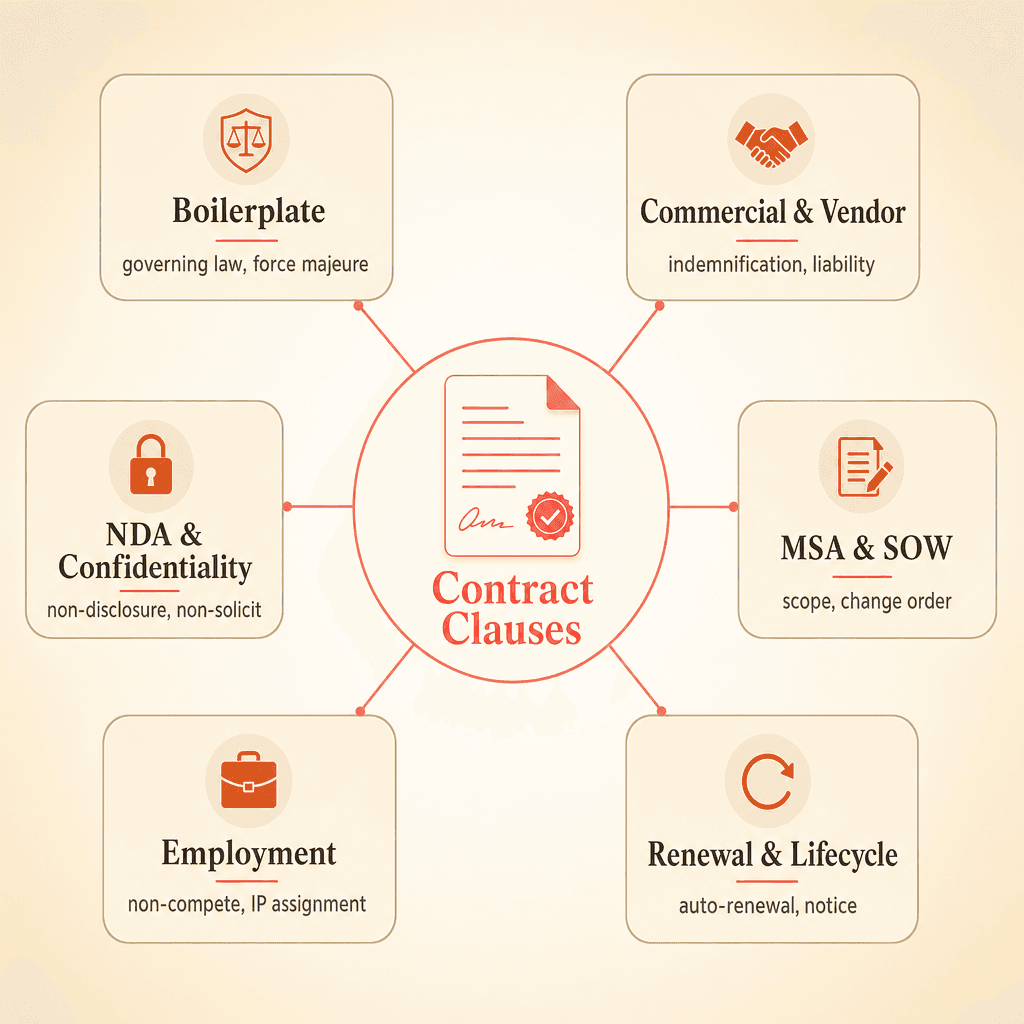
This guide groups clauses into six categories: boilerplate, commercial and vendor, NDA and confidentiality, MSA and SOW, employment, and renewal and lifecycle.
A clause library holds your own vetted language, not generic boilerplate, so teams reuse an approved standard instead of drafting from scratch.
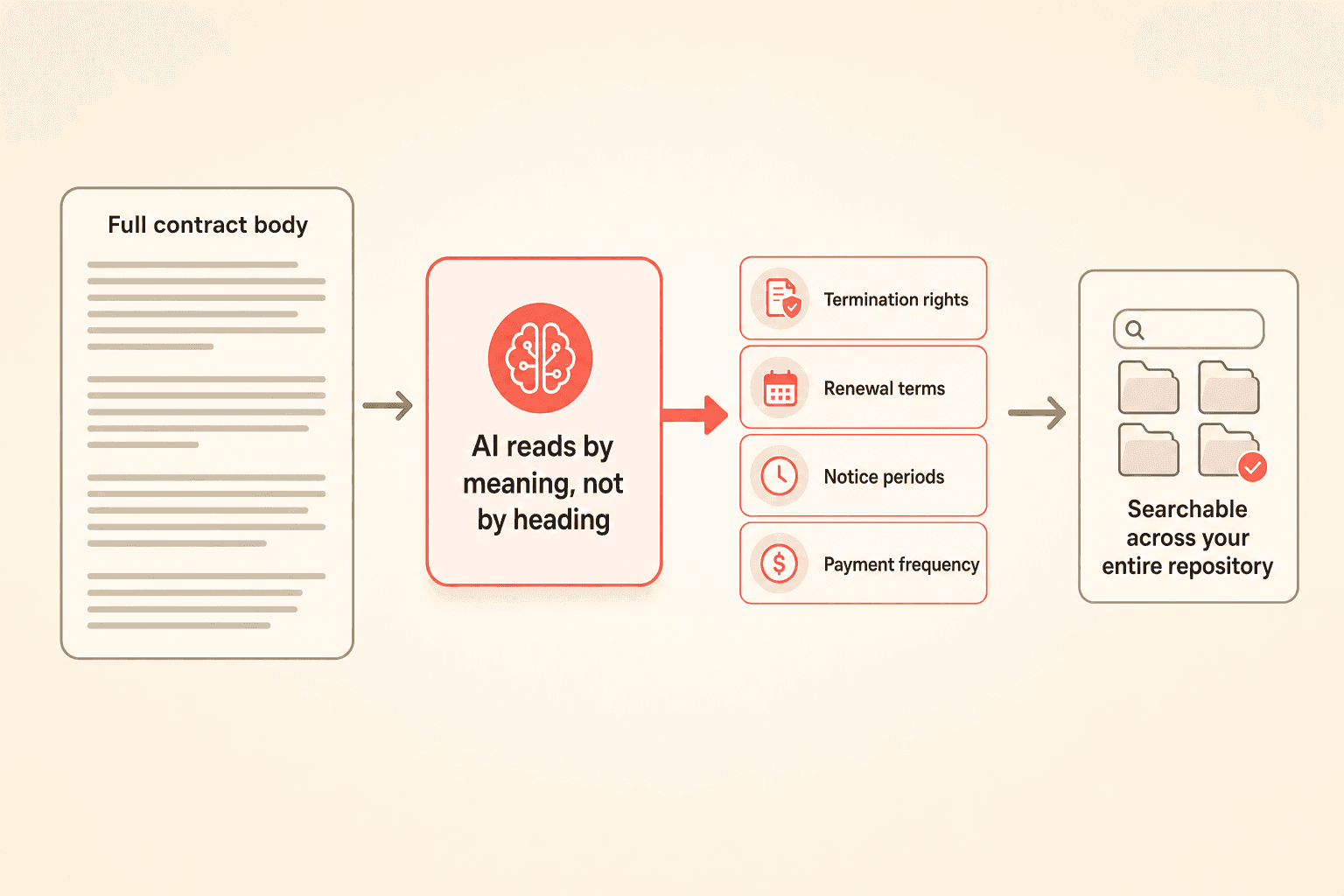
AI extraction reads the full contract body by meaning, surfacing termination rights, renewal terms, and notice periods even when a clause is not titled.
What is a contract clause?
A contract clause is a distinct provision within an agreement that governs one specific topic, such as payment, confidentiality, or termination. Clauses are the building blocks of every contract. Each one creates a right, an obligation, or a condition, which is why reading a contract really means reading its clauses.
Category | Clause | What it does | Why it matters |
|---|---|---|---|
Boilerplate | Governing law | Names the jurisdiction whose laws apply | Shapes where and how disputes get resolved |
Boilerplate | Force majeure | Excuses performance during uncontrollable events | Scope, such as pandemics and cyberattacks, is negotiated |
Boilerplate | Severability | Keeps the contract valid if one part fails | Prevents collapse over a single flawed line |
Boilerplate | Entire agreement | States the written contract is the complete deal | Blocks claims based on side conversations |
Commercial and vendor | Indemnification | Shifts responsibility for certain losses | Decides who pays when a third party sues |
Commercial and vendor | Limitation of liability | Caps how much one party can owe | Sets the ceiling on financial exposure |
Commercial and vendor | Payment terms | Sets amounts, schedules, and late penalties | Finance wants these dates pulled automatically |
Commercial and vendor | Warranty | Promises quality of goods or services | Often paired with disclaimers of implied warranties |
NDA and confidentiality | Confidentiality | Defines protected information and how to handle it | A weak definition leaves valuable data exposed |
NDA and confidentiality | Non-solicitation | Restricts poaching employees or customers | Enforceability varies by jurisdiction |
NDA and confidentiality | Term and survival | States which duties outlast the agreement | Confidentiality often survives for years after termination |
MSA and SOW | Scope of work | Defines exactly what will be delivered | Vague scope is a leading cause of disputes |
MSA and SOW | Change order | Governs mid-project changes to scope or price | Stops informal requests from expanding obligations |
MSA and SOW | Termination for convenience | Ends the agreement without cause, on notice | Notice windows must be surfaced so no one misses them |
MSA and SOW | Termination for cause | Ends the agreement after an uncured breach | The cure period is the key negotiation lever |
Employment | Non-compete | Limits competing work for a period after leaving | Enforceability has narrowed, so review it regularly |
Employment | At-will employment | Lets either party end employment at any time | Sets baseline expectations for the relationship |
Employment | Intellectual property assignment | Assigns work product to the employer | Protects ownership of what employees build |
Renewal and lifecycle | Auto-renewal | Extends the contract unless a party opts out | Missing the notice window is a common, costly mistake |
Renewal and lifecycle | Notice | Sets how formal communications must be delivered | A notice sent the wrong way may not count |
Renewal and lifecycle | Assignment | Governs transferring rights to another entity | Becomes important during mergers and acquisitions |
Why clause literacy matters more than ever
Contracts no longer live only in legal. Procurement teams, talent acquisition, HR, and department managers now create and handle agreements from templates every day. That shift raises the stakes for standardized, well-understood clause language across a wider internal audience.
Clauses are the atomic unit of contract risk. Every negotiation, obligation, and downstream deadline traces back to a specific provision. You cannot standardize, extract, or report on a clause you cannot name, so recognition comes first.
Boilerplate clauses: the foundation of most agreements
Boilerplate clauses appear in nearly every contract regardless of category. They are often placed near the end and easy to skim past, but they govern how the entire agreement behaves.
Governing law clause
This clause names which jurisdiction’s laws apply if a dispute arises. Example: “This Agreement shall be governed by the laws of the State of Delaware, without regard to conflict of law principles.” It matters because it determines where and how disputes get resolved, which can shape legal cost and outcome.
Force majeure clause
Force majeure excuses performance when events outside a party’s control make it impossible. Example: “Neither party shall be liable for delay or failure to perform caused by fire, flood, war, or other events beyond reasonable control.” Negotiators often debate whether pandemics, supply disruptions, or cyberattacks belong on the list.
Severability clause
If one part of a contract is found unenforceable, severability keeps the rest intact. Example: “If any provision of this Agreement is held invalid, the remaining provisions shall continue in full force.” It protects the overall agreement from collapsing over a single flawed line.
Entire agreement clause
Also called an integration clause, this states the written contract represents the complete understanding between parties. It prevents either side from claiming that side conversations or earlier drafts still apply.
Commercial and vendor agreement clauses
Commercial contracts, including vendor and supplier agreements, carry the clauses most tied to money and risk. These deserve close reading every time.
Indemnification clause
An indemnification clause shifts responsibility for certain losses from one party to another. Example: “The Vendor shall indemnify and hold harmless the Client against any third-party claims arising from the Vendor’s negligence.” It matters because it decides who absorbs the cost when a third party sues.
Legal teams frequently push back on broad indemnification language and negotiate carve-outs. Having a standard version plus pre-approved alternatives lets reviewers respond quickly instead of drafting from scratch.
Limitation of liability clause
This clause caps how much one party can owe the other. Example: “In no event shall either party’s total liability exceed the fees paid in the twelve months preceding the claim.” It is one of the most heavily negotiated provisions in any commercial deal because it defines the ceiling on financial exposure.
Payment terms clause
Payment clauses set amounts, schedules, and consequences for late payment. Example: “Client shall pay all invoices within thirty days of receipt; overdue amounts accrue interest at 1.5 percent per month.” Payment frequency is a clause-driven data point that finance teams want pulled automatically for tracking.
Warranty clause
Warranties are promises about the quality or performance of goods or services. Example: “The Provider warrants that Services will be performed in a professional and workmanlike manner.” Disclaimers of implied warranties often sit alongside this language.
NDA and confidentiality clauses
Non-disclosure agreements protect sensitive information shared between parties. The clauses below also appear inside larger commercial contracts.
Confidentiality clause
A confidentiality clause defines what information is protected and how each party must handle it. Example: “Each party agrees to hold the other’s Confidential Information in strict confidence and not to disclose it to any third party.” It matters because a weak definition can leave valuable information unprotected.
Non-solicitation clause
This clause restricts one party from poaching the other’s employees or customers for a set period. Example: “During the term and for twelve months after, neither party shall solicit the other’s employees.” Enforceability varies by jurisdiction, which ties back to the governing law clause.
Term and survival clause
Confidentiality obligations often outlast the agreement itself. A survival clause states which obligations continue after termination. Example: “The obligations in Section 5 shall survive termination for a period of three years.”
MSA and SOW clauses
Master service agreements set the overarching terms, while statements of work define specific projects under them. This structure separates stable terms from project-specific detail. You can learn more in our guide to MSAs and SOWs.
Scope of work clause
The scope clause defines exactly what will be delivered. Example: “Provider shall deliver the services described in each executed Statement of Work.” Vague scope language is a leading cause of disputes, so precision here prevents downstream conflict.
Change order clause
Change orders govern how the parties adjust scope, timeline, or price mid-project. Example: “Any change to the scope requires a written change order signed by both parties.” It keeps informal requests from quietly expanding obligations.
Termination for convenience clause
This lets a party end the agreement without cause, usually with notice. Example: “Either party may terminate this Agreement for convenience upon sixty days’ written notice.” Early-termination notice periods are exactly the kind of deadline teams want surfaced automatically so they never miss a window.
Termination for cause clause
Termination for cause allows a party to exit when the other breaches. Example: “Either party may terminate if the other materially breaches and fails to cure within thirty days of notice.” The cure period is the negotiation lever here.
Employment agreement clauses
As HR and talent teams self-serve contracts from templates, clarity on employment clauses matters across non-legal users.
Non-compete clause
A non-compete restricts an employee from working for competitors for a period after leaving. Example: “Employee agrees not to engage in competing business within the region for twelve months after separation.” Enforceability has narrowed in many jurisdictions, so this clause needs regular review.
At-will employment clause
This confirms that either party may end employment at any time. Example: “Employment is at-will and may be terminated by either party with or without cause.” It sets baseline expectations about the working relationship.
Intellectual property assignment clause
This clause assigns work created during employment to the employer. Example: “All work product created within the scope of employment shall be the sole property of the Company.” It protects the organization’s ownership of what employees build.
Renewal and lifecycle clauses
Some clauses exist specifically to control what happens over time. These connect directly to obligations and deadlines you need to track.
Auto-renewal clause
An auto-renewal, or evergreen, clause extends the contract automatically unless a party opts out. Example: “This Agreement renews for successive one-year terms unless either party gives ninety days’ notice of non-renewal.” Missing that notice window is one of the most common and costly clause-driven mistakes. See our guide to contract renewal tracking for more.
Notice clause
The notice clause specifies how formal communications must be delivered. Example: “All notices shall be in writing and sent by certified mail or email to the addresses listed above.” It matters because a notice sent the wrong way may not count.
Assignment clause
This governs whether a party can transfer its rights or obligations to another entity. Example: “Neither party may assign this Agreement without the prior written consent of the other.” It becomes important during mergers and acquisitions.
From understanding clauses to managing them
Recognizing clause types is only step one. The harder problem is governing them consistently across every agreement your teams create.
Ad hoc clause drafting creates a governance gap. When language is generated inconsistently, especially outside a system of record, you lose the ability to enforce a standard and to know what you actually agreed to. Prospects repeatedly raise concern about generic AI tools producing clause language with no oversight, and the downstream legal and financial exposure that follows.
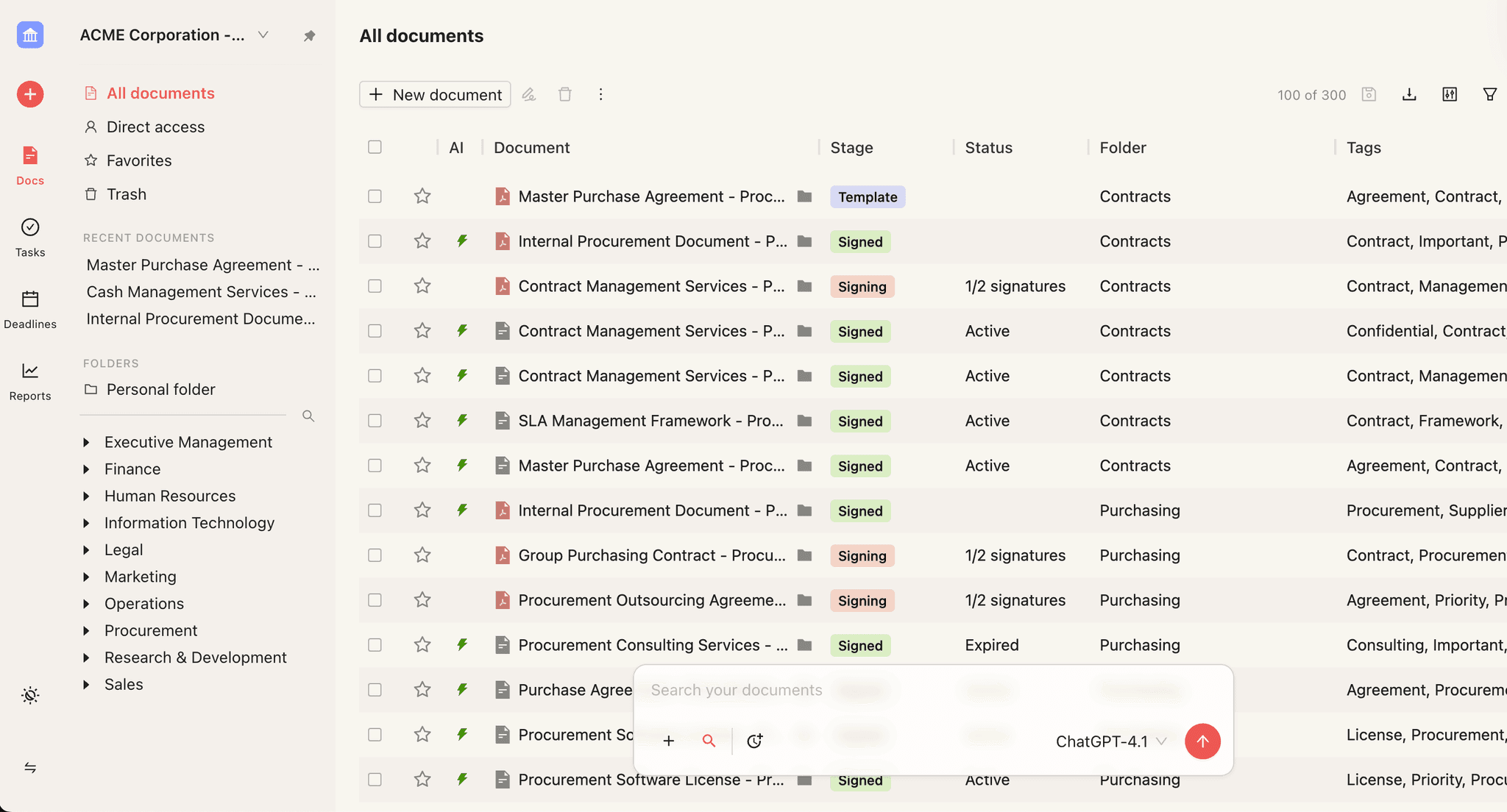
A clause library closes that gap. With Concord’s clause management, your team maintains a centralized library of your own vetted provisions, not generic third-party boilerplate. You create, organize, edit, and reuse standard clauses, and you keep a default plus pre-approved alternatives ready for negotiation.
Want to see a clause library on your own agreements? Book a Concord demo and watch AI extraction pull termination, renewal, and notice terms across your repository.
Concord also sorts agreements automatically into predefined business categories and classifies documents by type, so your contracts stay organized the same way this guide is structured. That gives non-legal users a consistent starting point when they build from templates.
How AI extraction reads clauses by meaning
Clauses matter functionally, not by their heading. A provision can carry the weight of a liability clause without ever being titled one. Reading the contract body itself, rather than relying on tags or headings, is what makes clause-level search reliable across a large repository.
Concord’s AI contract extraction reads the full contract body to identify clauses and key terms, including provisions that are not conventionally titled. It surfaces termination rights, renewal terms, notice periods, and payment frequency for search and reporting across your entire database. That means you can find every contract containing a specific provision without opening each one by hand.
Ready to turn clause knowledge into consistent action? See how Concord’s clause management and AI extraction work together.
Every contract clause carries weight. A single provision can dictate when you can walk away from an agreement, who pays if something goes wrong, or how long you stay locked into a vendor relationship. Understanding contract clause types gives you a mental model for reading any agreement, whether you sit in legal, procurement, finance, or HR.
This guide walks through the major clause types, organized by contract category. Each section includes a plain-language definition, an example, and a note on why the clause matters during negotiation and after signature. At the end, you will see how modern contract management turns this knowledge into action.
Key takeaways
Clauses are the atomic unit of contract risk. Every obligation, deadline, and negotiation traces back to a specific provision.
Recognition comes first. You cannot standardize, extract, or report on a clause you cannot name.
This guide groups clauses into six categories: boilerplate, commercial and vendor, NDA and confidentiality, MSA and SOW, employment, and renewal and lifecycle.
A clause library holds your own vetted language, not generic boilerplate, so teams reuse an approved standard instead of drafting from scratch.
AI extraction reads the full contract body by meaning, surfacing termination rights, renewal terms, and notice periods even when a clause is not titled.
What is a contract clause?
A contract clause is a distinct provision within an agreement that governs one specific topic, such as payment, confidentiality, or termination. Clauses are the building blocks of every contract. Each one creates a right, an obligation, or a condition, which is why reading a contract really means reading its clauses.
Category | Clause | What it does | Why it matters |
|---|---|---|---|
Boilerplate | Governing law | Names the jurisdiction whose laws apply | Shapes where and how disputes get resolved |
Boilerplate | Force majeure | Excuses performance during uncontrollable events | Scope, such as pandemics and cyberattacks, is negotiated |
Boilerplate | Severability | Keeps the contract valid if one part fails | Prevents collapse over a single flawed line |
Boilerplate | Entire agreement | States the written contract is the complete deal | Blocks claims based on side conversations |
Commercial and vendor | Indemnification | Shifts responsibility for certain losses | Decides who pays when a third party sues |
Commercial and vendor | Limitation of liability | Caps how much one party can owe | Sets the ceiling on financial exposure |
Commercial and vendor | Payment terms | Sets amounts, schedules, and late penalties | Finance wants these dates pulled automatically |
Commercial and vendor | Warranty | Promises quality of goods or services | Often paired with disclaimers of implied warranties |
NDA and confidentiality | Confidentiality | Defines protected information and how to handle it | A weak definition leaves valuable data exposed |
NDA and confidentiality | Non-solicitation | Restricts poaching employees or customers | Enforceability varies by jurisdiction |
NDA and confidentiality | Term and survival | States which duties outlast the agreement | Confidentiality often survives for years after termination |
MSA and SOW | Scope of work | Defines exactly what will be delivered | Vague scope is a leading cause of disputes |
MSA and SOW | Change order | Governs mid-project changes to scope or price | Stops informal requests from expanding obligations |
MSA and SOW | Termination for convenience | Ends the agreement without cause, on notice | Notice windows must be surfaced so no one misses them |
MSA and SOW | Termination for cause | Ends the agreement after an uncured breach | The cure period is the key negotiation lever |
Employment | Non-compete | Limits competing work for a period after leaving | Enforceability has narrowed, so review it regularly |
Employment | At-will employment | Lets either party end employment at any time | Sets baseline expectations for the relationship |
Employment | Intellectual property assignment | Assigns work product to the employer | Protects ownership of what employees build |
Renewal and lifecycle | Auto-renewal | Extends the contract unless a party opts out | Missing the notice window is a common, costly mistake |
Renewal and lifecycle | Notice | Sets how formal communications must be delivered | A notice sent the wrong way may not count |
Renewal and lifecycle | Assignment | Governs transferring rights to another entity | Becomes important during mergers and acquisitions |
Why clause literacy matters more than ever
Contracts no longer live only in legal. Procurement teams, talent acquisition, HR, and department managers now create and handle agreements from templates every day. That shift raises the stakes for standardized, well-understood clause language across a wider internal audience.
Clauses are the atomic unit of contract risk. Every negotiation, obligation, and downstream deadline traces back to a specific provision. You cannot standardize, extract, or report on a clause you cannot name, so recognition comes first.
Boilerplate clauses: the foundation of most agreements
Boilerplate clauses appear in nearly every contract regardless of category. They are often placed near the end and easy to skim past, but they govern how the entire agreement behaves.
Governing law clause
This clause names which jurisdiction’s laws apply if a dispute arises. Example: “This Agreement shall be governed by the laws of the State of Delaware, without regard to conflict of law principles.” It matters because it determines where and how disputes get resolved, which can shape legal cost and outcome.
Force majeure clause
Force majeure excuses performance when events outside a party’s control make it impossible. Example: “Neither party shall be liable for delay or failure to perform caused by fire, flood, war, or other events beyond reasonable control.” Negotiators often debate whether pandemics, supply disruptions, or cyberattacks belong on the list.
Severability clause
If one part of a contract is found unenforceable, severability keeps the rest intact. Example: “If any provision of this Agreement is held invalid, the remaining provisions shall continue in full force.” It protects the overall agreement from collapsing over a single flawed line.
Entire agreement clause
Also called an integration clause, this states the written contract represents the complete understanding between parties. It prevents either side from claiming that side conversations or earlier drafts still apply.
Commercial and vendor agreement clauses
Commercial contracts, including vendor and supplier agreements, carry the clauses most tied to money and risk. These deserve close reading every time.
Indemnification clause
An indemnification clause shifts responsibility for certain losses from one party to another. Example: “The Vendor shall indemnify and hold harmless the Client against any third-party claims arising from the Vendor’s negligence.” It matters because it decides who absorbs the cost when a third party sues.
Legal teams frequently push back on broad indemnification language and negotiate carve-outs. Having a standard version plus pre-approved alternatives lets reviewers respond quickly instead of drafting from scratch.
Limitation of liability clause
This clause caps how much one party can owe the other. Example: “In no event shall either party’s total liability exceed the fees paid in the twelve months preceding the claim.” It is one of the most heavily negotiated provisions in any commercial deal because it defines the ceiling on financial exposure.
Payment terms clause
Payment clauses set amounts, schedules, and consequences for late payment. Example: “Client shall pay all invoices within thirty days of receipt; overdue amounts accrue interest at 1.5 percent per month.” Payment frequency is a clause-driven data point that finance teams want pulled automatically for tracking.
Warranty clause
Warranties are promises about the quality or performance of goods or services. Example: “The Provider warrants that Services will be performed in a professional and workmanlike manner.” Disclaimers of implied warranties often sit alongside this language.
NDA and confidentiality clauses
Non-disclosure agreements protect sensitive information shared between parties. The clauses below also appear inside larger commercial contracts.
Confidentiality clause
A confidentiality clause defines what information is protected and how each party must handle it. Example: “Each party agrees to hold the other’s Confidential Information in strict confidence and not to disclose it to any third party.” It matters because a weak definition can leave valuable information unprotected.
Non-solicitation clause
This clause restricts one party from poaching the other’s employees or customers for a set period. Example: “During the term and for twelve months after, neither party shall solicit the other’s employees.” Enforceability varies by jurisdiction, which ties back to the governing law clause.
Term and survival clause
Confidentiality obligations often outlast the agreement itself. A survival clause states which obligations continue after termination. Example: “The obligations in Section 5 shall survive termination for a period of three years.”
MSA and SOW clauses
Master service agreements set the overarching terms, while statements of work define specific projects under them. This structure separates stable terms from project-specific detail. You can learn more in our guide to MSAs and SOWs.
Scope of work clause
The scope clause defines exactly what will be delivered. Example: “Provider shall deliver the services described in each executed Statement of Work.” Vague scope language is a leading cause of disputes, so precision here prevents downstream conflict.
Change order clause
Change orders govern how the parties adjust scope, timeline, or price mid-project. Example: “Any change to the scope requires a written change order signed by both parties.” It keeps informal requests from quietly expanding obligations.
Termination for convenience clause
This lets a party end the agreement without cause, usually with notice. Example: “Either party may terminate this Agreement for convenience upon sixty days’ written notice.” Early-termination notice periods are exactly the kind of deadline teams want surfaced automatically so they never miss a window.
Termination for cause clause
Termination for cause allows a party to exit when the other breaches. Example: “Either party may terminate if the other materially breaches and fails to cure within thirty days of notice.” The cure period is the negotiation lever here.
Employment agreement clauses
As HR and talent teams self-serve contracts from templates, clarity on employment clauses matters across non-legal users.
Non-compete clause
A non-compete restricts an employee from working for competitors for a period after leaving. Example: “Employee agrees not to engage in competing business within the region for twelve months after separation.” Enforceability has narrowed in many jurisdictions, so this clause needs regular review.
At-will employment clause
This confirms that either party may end employment at any time. Example: “Employment is at-will and may be terminated by either party with or without cause.” It sets baseline expectations about the working relationship.
Intellectual property assignment clause
This clause assigns work created during employment to the employer. Example: “All work product created within the scope of employment shall be the sole property of the Company.” It protects the organization’s ownership of what employees build.
Renewal and lifecycle clauses
Some clauses exist specifically to control what happens over time. These connect directly to obligations and deadlines you need to track.
Auto-renewal clause
An auto-renewal, or evergreen, clause extends the contract automatically unless a party opts out. Example: “This Agreement renews for successive one-year terms unless either party gives ninety days’ notice of non-renewal.” Missing that notice window is one of the most common and costly clause-driven mistakes. See our guide to contract renewal tracking for more.
Notice clause
The notice clause specifies how formal communications must be delivered. Example: “All notices shall be in writing and sent by certified mail or email to the addresses listed above.” It matters because a notice sent the wrong way may not count.
Assignment clause
This governs whether a party can transfer its rights or obligations to another entity. Example: “Neither party may assign this Agreement without the prior written consent of the other.” It becomes important during mergers and acquisitions.
From understanding clauses to managing them
Recognizing clause types is only step one. The harder problem is governing them consistently across every agreement your teams create.
Ad hoc clause drafting creates a governance gap. When language is generated inconsistently, especially outside a system of record, you lose the ability to enforce a standard and to know what you actually agreed to. Prospects repeatedly raise concern about generic AI tools producing clause language with no oversight, and the downstream legal and financial exposure that follows.
A clause library closes that gap. With Concord’s clause management, your team maintains a centralized library of your own vetted provisions, not generic third-party boilerplate. You create, organize, edit, and reuse standard clauses, and you keep a default plus pre-approved alternatives ready for negotiation.
Want to see a clause library on your own agreements? Book a Concord demo and watch AI extraction pull termination, renewal, and notice terms across your repository.
Concord also sorts agreements automatically into predefined business categories and classifies documents by type, so your contracts stay organized the same way this guide is structured. That gives non-legal users a consistent starting point when they build from templates.
How AI extraction reads clauses by meaning
Clauses matter functionally, not by their heading. A provision can carry the weight of a liability clause without ever being titled one. Reading the contract body itself, rather than relying on tags or headings, is what makes clause-level search reliable across a large repository.
Concord’s AI contract extraction reads the full contract body to identify clauses and key terms, including provisions that are not conventionally titled. It surfaces termination rights, renewal terms, notice periods, and payment frequency for search and reporting across your entire database. That means you can find every contract containing a specific provision without opening each one by hand.
Ready to turn clause knowledge into consistent action? See how Concord’s clause management and AI extraction work together.
Need to know
Frequently Asked Questions

Take the "management" out
of contract management.
Customer Support
Legal
Compare
Resources
Customer Support
Company
Legal
Compare
Resources
Customer Support
Company
Legal
Compare
© 2025 Concord. All rights reserved.