Contract Retention Policy: How Long to Keep Business Contracts
Contract Retention Policy: How Long to Keep Business Contracts
Contract Retention Policy: How Long to Keep Business Contracts
Contract Retention Policy: How Long to Keep Business Contracts

Key takeaways
No single law sets a universal retention period. A defensible policy calculates the clock from a trigger event (expiration, termination, or final payment), not the signing date.
Four regimes drive most schedules: IRS tax rules (three to seven years), Sarbanes-Oxley (seven years), HIPAA (six years), and GDPR (shortest period necessary).
Manual tracking in spreadsheets and calendars collapses at volume. A repository with automated metadata and triggers applies the schedule consistently.
A legal hold overrides every schedule. Suspend deletion instantly when litigation or an investigation is reasonably anticipated, and lift the hold formally.
What is a contract retention policy?
A contract retention policy is a documented schedule that defines how long your organization keeps each category of contract and when those records are destroyed. It calculates the retention clock from a trigger event rather than the signing date, maps each contract type to the longest applicable legal obligation, and treats defensible deletion as the default once that period runs.
Ask ten lawyers how long to keep a signed contract and you will likely get ten different answers. No single statute sets a universal clock for every agreement your company signs. A defensible contract retention policy balances tax rules, audit mandates, privacy law, and statutes of limitation, then applies that math consistently across every agreement you manage.
This guide breaks down the major regulatory drivers, explains why manual retention tracking fails at volume, and shows how to build a schedule your legal, finance, and compliance teams can defend in an audit.
Why no single retention period exists
Retention rules come from multiple regulators with conflicting goals, so no universal period exists. Tax authorities want records kept long enough to verify income and deductions, while privacy regulators expect personal data deleted as soon as it stops being necessary.
A blanket five-year rule fails in both directions. Keep everything too long and you violate the GDPR storage limitation principle while inflating discovery costs and cluttering your repository. Purge too early and you lose the records needed to defend tax positions, support audits, or enforce indemnity claims.
The practical fix is to calculate retention from a trigger event rather than the signing date. The clock starts at expiration, termination, or final payment, then runs for the longest applicable limitation period. For most commercial agreements, practitioners land on the active term plus six years as a defensible baseline.
Key regulatory drivers for your contract retention policy

Four regimes shape most contract record retention schedules. Each one measures time differently, which is exactly why your policy needs to track obligations by category instead of applying one flat rule.
Federal tax rules: three to seven years
IRS recordkeeping guidance requires businesses to keep records long enough to prove the income or deductions on a return. The baseline runs three years from filing and stretches to six or seven years in specific situations, such as claims involving bad debt or worthless securities. Contracts that support tax positions, including leases, loans, and purchase agreements, fall under this umbrella.
Sarbanes-Oxley: seven years for audit records
For public companies, the Sarbanes-Oxley Act requires auditors to retain audit workpapers for at least seven years and makes it a crime to destroy records to obstruct federal proceedings. Most public companies align financial and vendor contract retention with these audit expectations.
HIPAA: six years for required documentation
The HIPAA audit protocol requires covered entities and business associates to retain required documentation for six years from creation or the date it was last in effect, whichever is later. Business associate agreements sit squarely in that category, so a six-year floor applies regardless of what your general schedule says.
GDPR: keep data only as long as necessary
The GDPR storage limitation principle pulls in the opposite direction. Personal data inside contracts must be deleted once it is no longer necessary for the purpose collected, unless a legal obligation or legal claim justifies keeping it longer. Your policy needs a documented retention period for each data category, not a “keep everything” default.
The gap between policy and practice
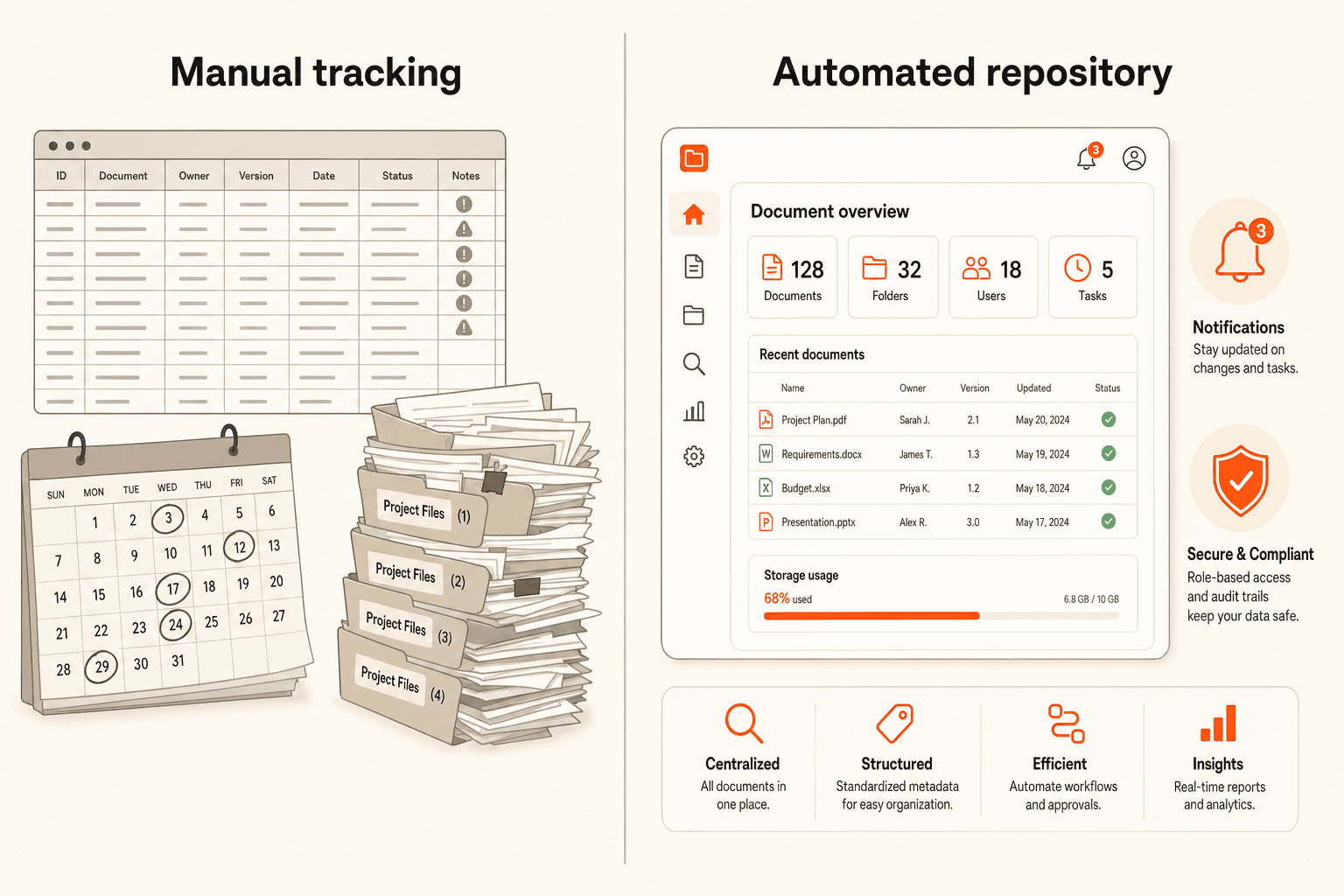
The schedule itself is the easy part. Applying it across thousands of agreements is where most programs break down.
Teams running contracts in shared drives commonly describe the same failure: no reliable way to separate active obligations from expired agreements. Multiple versions of a single vendor contract sit side by side, forcing a manual review of each file before anyone can say which one is enforceable.
Legal ops leaders frequently report that key dates live in individual calendars instead of a central system. Termination notice windows of 30, 60, or 90 days pass unnoticed, auto-renewals lock in for services nobody uses, and the retention trigger date never gets recorded. When the person tracking those dates leaves, the knowledge leaves with them.
Records managers flag a related problem: duplicate accumulation. Without metadata comparison, basic file storage cannot tell two copies of the same agreement apart, so counts of active contracts skew and the authoritative record for retention purposes stays ambiguous. Lean teams confirm that retention slips to the bottom of the list until an audit or dispute forces the issue.
Automate retention in your contract repository
Manual tracking collapses under volume. When hundreds of contracts approach expiration in the same quarter, human review alone cannot keep pace.
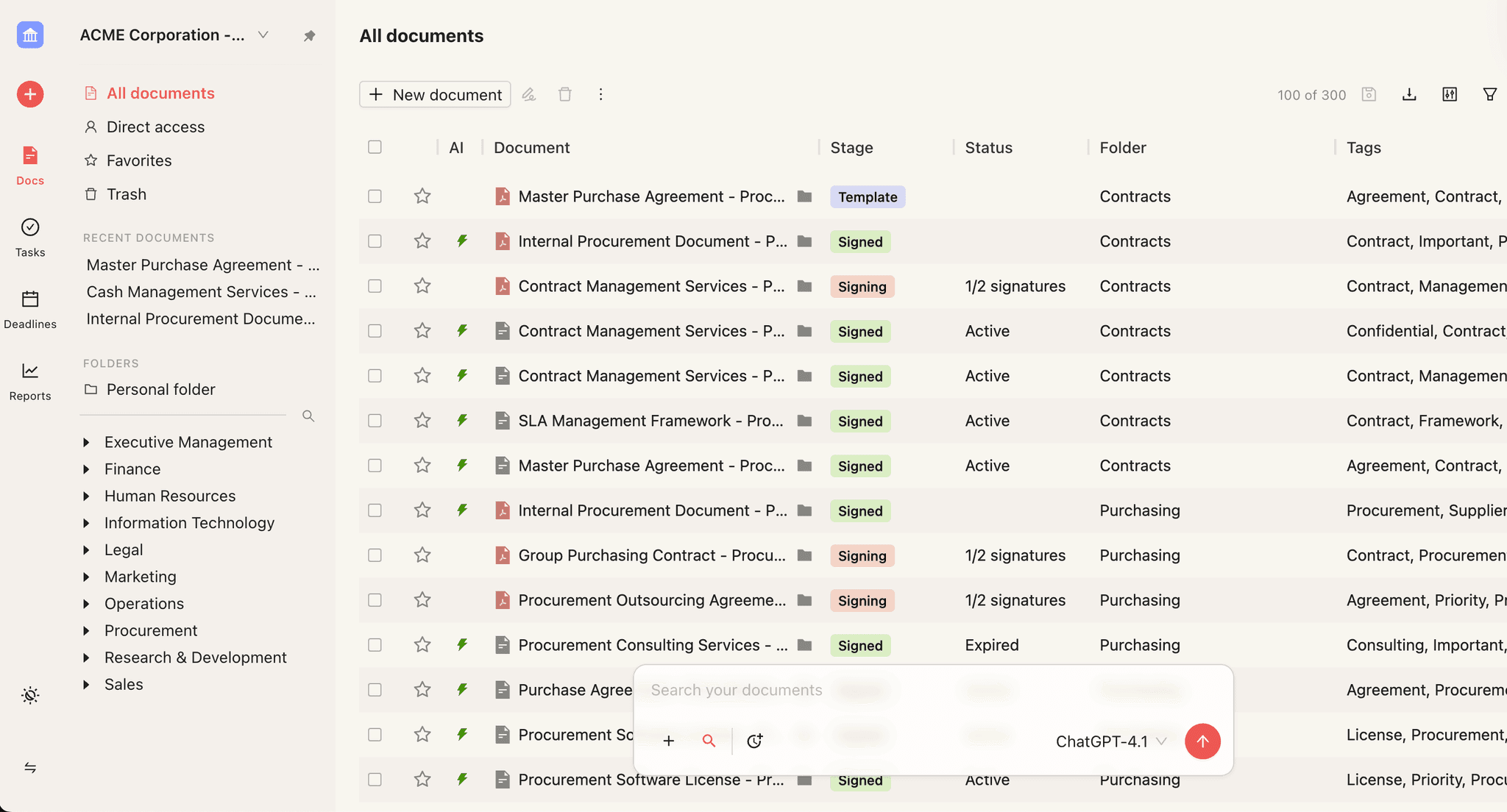
A contract lifecycle management platform replaces memory with metadata. With automated deadline tracking, expiration dates, renewal windows, and termination notice periods live as structured data, so contracts approaching end of life surface for retention review without anyone checking a spreadsheet. That same date discipline powers sound contract renewal management, which keeps unwanted auto-renewals from quietly extending your obligations.
Custom agreement properties let you tag each contract with the fields your schedule depends on: governing law, regulatory category, data classification, and retention trigger date. Retention eligibility then follows contract type instead of folder location, ending the archive-folder sprawl that plagues shared drives.
Strong reporting closes the loop. Contract audit trails document what was retained, what was destroyed, when, and under whose authority, which is exactly what auditors request. Paired with data lifecycle management that supports soft deletion, your team can suspend records in a recoverable state during appeal windows rather than destroying them outright.
Clip transcript: “Archive in Concord does not mean that we are putting it into an archive folder, like a specific place in the system for archive. What archive actually means is that we are just taking it out of your specific inbox. Each user in the system has their own inbox with the documents they are currently working on, and each of them can archive from their specific inbox. It does not mean putting it somewhere different. It is still in the same folder it was always in. It just takes it out of your inbox view.”
See how automated retention rules, deadline tracking, and audit trails work on your own contracts. Request a demo.
Legal holds override every retention schedule
A legal hold suspends your retention schedule the moment litigation, a government investigation, or a regulatory audit becomes reasonably anticipated. That trigger is broader than a served complaint: demand letters, whistleblower reports, and agency inquiries can all start it.
Under Federal Rule of Civil Procedure 37(e), courts can sanction a party when electronically stored information that should have been preserved is lost because reasonable steps were not taken. The duty reaches beyond the signed contract to drafts, approval records, related communications, and metadata.
Your repository has to respond the moment a hold lands. Suspend automated purge jobs, stop archival compression and metadata overwrites for flagged records, and notify every custodian. Tag the held contracts so scheduled deletion cannot touch them until the hold is released.
Plan for the release as carefully as the hold itself. Lift holds formally once a matter and its appeals conclude, and resume routine retention on a documented date. A hold that never expires becomes quiet over-retention, with all the privacy exposure and discovery cost that brings.
Build a cross-industry contract record retention schedule
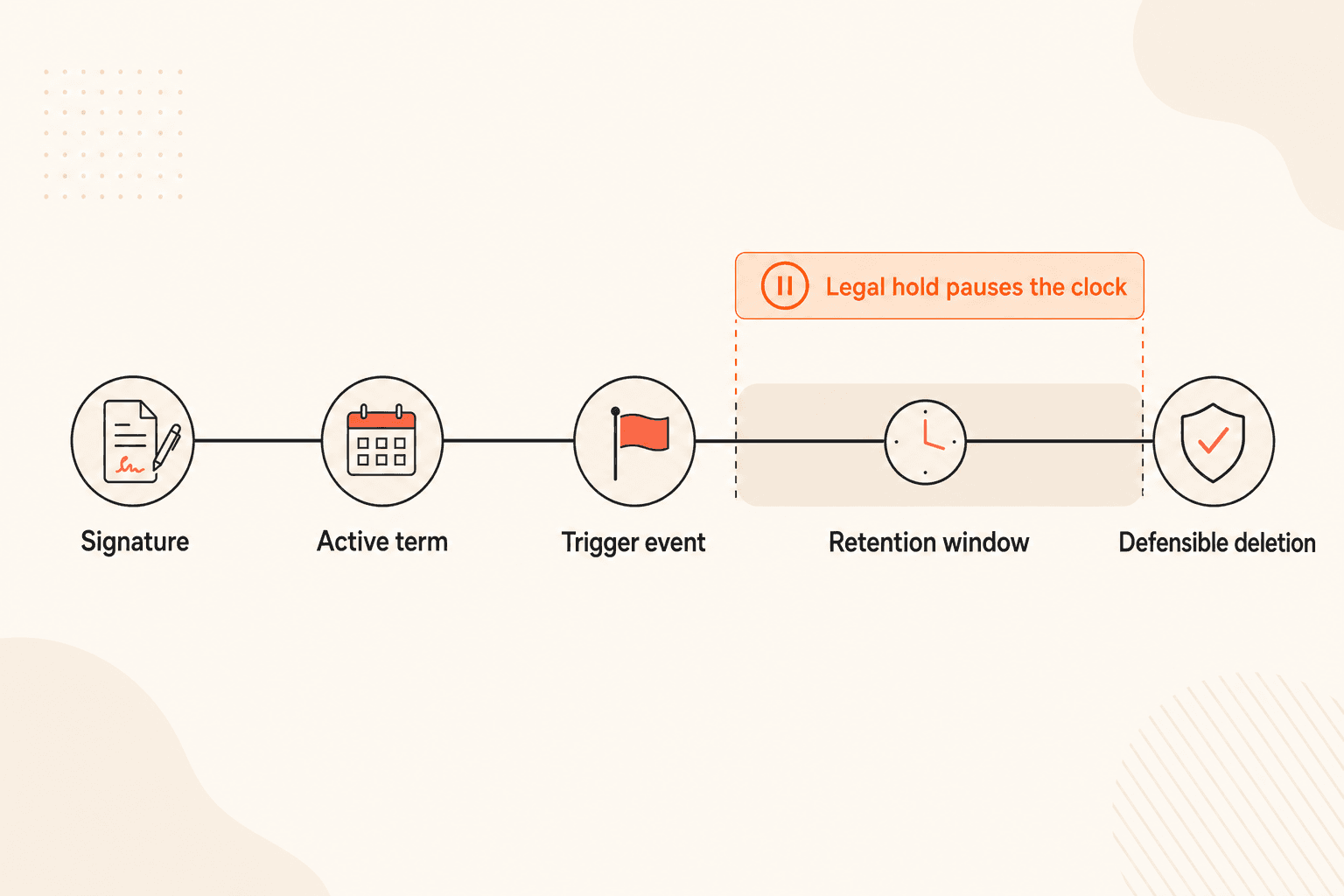
A workable schedule maps each contract category to the longest applicable obligation, then treats disposal as the default once that period runs. The framework below gives you a starting point to review with counsel.
Contract type | Common retention baseline | Primary driver |
|---|---|---|
Tax-supporting records such as leases and loans | Three to seven years after filing | IRS rules |
Vendor and commercial agreements | Active term plus six years | Statutes of limitation |
Business associate agreements | Six years from creation or last effective date | HIPAA |
Public-company financial contracts | Seven years | Sarbanes-Oxley |
Contracts containing personal data | Shortest period legal obligations allow | GDPR |
Formation documents and IP assignments | Permanent | Corporate governance |
Four steps turn the framework into daily practice:
Inventory your portfolio and classify each contract by type, jurisdiction, and regulatory category.
Set trigger-based rules so the clock runs from expiration, termination, or final payment, never from signature.
Layer in legal hold controls that suspend deletion instantly for flagged records.
Document every disposal decision so you can show auditors a complete chain of custody.
This content is for informational purposes only and does not constitute legal advice. Retention requirements vary by jurisdiction, industry, and specific contractual obligations. Readers should consult with qualified legal counsel to determine applicable retention periods and to establish compliant retention schedules for their specific circumstances.
Key takeaways
No single law sets a universal retention period. A defensible policy calculates the clock from a trigger event (expiration, termination, or final payment), not the signing date.
Four regimes drive most schedules: IRS tax rules (three to seven years), Sarbanes-Oxley (seven years), HIPAA (six years), and GDPR (shortest period necessary).
Manual tracking in spreadsheets and calendars collapses at volume. A repository with automated metadata and triggers applies the schedule consistently.
A legal hold overrides every schedule. Suspend deletion instantly when litigation or an investigation is reasonably anticipated, and lift the hold formally.
What is a contract retention policy?
A contract retention policy is a documented schedule that defines how long your organization keeps each category of contract and when those records are destroyed. It calculates the retention clock from a trigger event rather than the signing date, maps each contract type to the longest applicable legal obligation, and treats defensible deletion as the default once that period runs.
Ask ten lawyers how long to keep a signed contract and you will likely get ten different answers. No single statute sets a universal clock for every agreement your company signs. A defensible contract retention policy balances tax rules, audit mandates, privacy law, and statutes of limitation, then applies that math consistently across every agreement you manage.
This guide breaks down the major regulatory drivers, explains why manual retention tracking fails at volume, and shows how to build a schedule your legal, finance, and compliance teams can defend in an audit.
Why no single retention period exists
Retention rules come from multiple regulators with conflicting goals, so no universal period exists. Tax authorities want records kept long enough to verify income and deductions, while privacy regulators expect personal data deleted as soon as it stops being necessary.
A blanket five-year rule fails in both directions. Keep everything too long and you violate the GDPR storage limitation principle while inflating discovery costs and cluttering your repository. Purge too early and you lose the records needed to defend tax positions, support audits, or enforce indemnity claims.
The practical fix is to calculate retention from a trigger event rather than the signing date. The clock starts at expiration, termination, or final payment, then runs for the longest applicable limitation period. For most commercial agreements, practitioners land on the active term plus six years as a defensible baseline.
Key regulatory drivers for your contract retention policy
Four regimes shape most contract record retention schedules. Each one measures time differently, which is exactly why your policy needs to track obligations by category instead of applying one flat rule.
Federal tax rules: three to seven years
IRS recordkeeping guidance requires businesses to keep records long enough to prove the income or deductions on a return. The baseline runs three years from filing and stretches to six or seven years in specific situations, such as claims involving bad debt or worthless securities. Contracts that support tax positions, including leases, loans, and purchase agreements, fall under this umbrella.
Sarbanes-Oxley: seven years for audit records
For public companies, the Sarbanes-Oxley Act requires auditors to retain audit workpapers for at least seven years and makes it a crime to destroy records to obstruct federal proceedings. Most public companies align financial and vendor contract retention with these audit expectations.
HIPAA: six years for required documentation
The HIPAA audit protocol requires covered entities and business associates to retain required documentation for six years from creation or the date it was last in effect, whichever is later. Business associate agreements sit squarely in that category, so a six-year floor applies regardless of what your general schedule says.
GDPR: keep data only as long as necessary
The GDPR storage limitation principle pulls in the opposite direction. Personal data inside contracts must be deleted once it is no longer necessary for the purpose collected, unless a legal obligation or legal claim justifies keeping it longer. Your policy needs a documented retention period for each data category, not a “keep everything” default.
The gap between policy and practice
The schedule itself is the easy part. Applying it across thousands of agreements is where most programs break down.
Teams running contracts in shared drives commonly describe the same failure: no reliable way to separate active obligations from expired agreements. Multiple versions of a single vendor contract sit side by side, forcing a manual review of each file before anyone can say which one is enforceable.
Legal ops leaders frequently report that key dates live in individual calendars instead of a central system. Termination notice windows of 30, 60, or 90 days pass unnoticed, auto-renewals lock in for services nobody uses, and the retention trigger date never gets recorded. When the person tracking those dates leaves, the knowledge leaves with them.
Records managers flag a related problem: duplicate accumulation. Without metadata comparison, basic file storage cannot tell two copies of the same agreement apart, so counts of active contracts skew and the authoritative record for retention purposes stays ambiguous. Lean teams confirm that retention slips to the bottom of the list until an audit or dispute forces the issue.
Automate retention in your contract repository
Manual tracking collapses under volume. When hundreds of contracts approach expiration in the same quarter, human review alone cannot keep pace.
A contract lifecycle management platform replaces memory with metadata. With automated deadline tracking, expiration dates, renewal windows, and termination notice periods live as structured data, so contracts approaching end of life surface for retention review without anyone checking a spreadsheet. That same date discipline powers sound contract renewal management, which keeps unwanted auto-renewals from quietly extending your obligations.
Custom agreement properties let you tag each contract with the fields your schedule depends on: governing law, regulatory category, data classification, and retention trigger date. Retention eligibility then follows contract type instead of folder location, ending the archive-folder sprawl that plagues shared drives.
Strong reporting closes the loop. Contract audit trails document what was retained, what was destroyed, when, and under whose authority, which is exactly what auditors request. Paired with data lifecycle management that supports soft deletion, your team can suspend records in a recoverable state during appeal windows rather than destroying them outright.
Clip transcript: “Archive in Concord does not mean that we are putting it into an archive folder, like a specific place in the system for archive. What archive actually means is that we are just taking it out of your specific inbox. Each user in the system has their own inbox with the documents they are currently working on, and each of them can archive from their specific inbox. It does not mean putting it somewhere different. It is still in the same folder it was always in. It just takes it out of your inbox view.”
See how automated retention rules, deadline tracking, and audit trails work on your own contracts. Request a demo.
Legal holds override every retention schedule
A legal hold suspends your retention schedule the moment litigation, a government investigation, or a regulatory audit becomes reasonably anticipated. That trigger is broader than a served complaint: demand letters, whistleblower reports, and agency inquiries can all start it.
Under Federal Rule of Civil Procedure 37(e), courts can sanction a party when electronically stored information that should have been preserved is lost because reasonable steps were not taken. The duty reaches beyond the signed contract to drafts, approval records, related communications, and metadata.
Your repository has to respond the moment a hold lands. Suspend automated purge jobs, stop archival compression and metadata overwrites for flagged records, and notify every custodian. Tag the held contracts so scheduled deletion cannot touch them until the hold is released.
Plan for the release as carefully as the hold itself. Lift holds formally once a matter and its appeals conclude, and resume routine retention on a documented date. A hold that never expires becomes quiet over-retention, with all the privacy exposure and discovery cost that brings.
Build a cross-industry contract record retention schedule
A workable schedule maps each contract category to the longest applicable obligation, then treats disposal as the default once that period runs. The framework below gives you a starting point to review with counsel.
Contract type | Common retention baseline | Primary driver |
|---|---|---|
Tax-supporting records such as leases and loans | Three to seven years after filing | IRS rules |
Vendor and commercial agreements | Active term plus six years | Statutes of limitation |
Business associate agreements | Six years from creation or last effective date | HIPAA |
Public-company financial contracts | Seven years | Sarbanes-Oxley |
Contracts containing personal data | Shortest period legal obligations allow | GDPR |
Formation documents and IP assignments | Permanent | Corporate governance |
Four steps turn the framework into daily practice:
Inventory your portfolio and classify each contract by type, jurisdiction, and regulatory category.
Set trigger-based rules so the clock runs from expiration, termination, or final payment, never from signature.
Layer in legal hold controls that suspend deletion instantly for flagged records.
Document every disposal decision so you can show auditors a complete chain of custody.
This content is for informational purposes only and does not constitute legal advice. Retention requirements vary by jurisdiction, industry, and specific contractual obligations. Readers should consult with qualified legal counsel to determine applicable retention periods and to establish compliant retention schedules for their specific circumstances.
Need to know
Frequently Asked Questions

Take the "management" out
of contract management.
Customer Support
Legal
Compare
Resources
Customer Support
Company
Legal
Compare
Resources
Customer Support
Company
Legal
Compare
© 2025 Concord. All rights reserved.