Manufacturing Contract Management Software Guide
Manufacturing Contract Management Software Guide
Manufacturing Contract Management Software Guide
Manufacturing Contract Management Software Guide
manufacturing contract management software, supplier contract management, purchase order contract management, manufacturing compliance software, supplier agreement management, contract management for manufacturers, quality agreement software, manufacturing contract lifecycle management, supplier compliance tracking, manufacturing contract repository, PO contract management

Managing supplier agreements, quality addenda, and purchase orders across email and shared drives creates version chaos manufacturing teams know too well. Manufacturing contract management software centralizes these documents, automates approval routing, and tracks deadlines that manual spreadsheets can’t reliably handle.
Supplier relationships generate families of related documents that must stay aligned: a master agreement, a quality addendum, statements of work, and purchase orders issued against them. As separate files with no hierarchical link, version control breaks down.
In short: Manufacturing contract management software centralizes, routes, and tracks supplier agreements — master agreements, quality addenda, SOWs, and POs — so approvals, deadlines, and audit records stay accurate as those documents change.
Key takeaways
Manufacturing supplier contracts form interconnected families — MSAs, quality addenda, SOWs, and POs — that must stay aligned as terms change.
Manual tracking in email and spreadsheets creates approval bottlenecks, scattered storage, and compliance gaps that surface during audits.
ERP and contract management systems are complementary: ERP handles transactions, contract management handles the legal framework governing them.
What makes manufacturing contract management different
Manufacturing supplier relationships create contract families, not isolated agreements. A tier-one automotive supplier might have a master agreement covering payment terms and liability, a quality addendum specifying ISO 9001 requirements, multiple SOWs, and hundreds of POs issued against those frameworks.
Changes to parent documents affect child agreements: when legal renegotiates the liability cap in a master agreement, that touches every active SOW and future PO. Teams managing these relationships in shared drives describe the same pattern — quality updates an addendum, but procurement keeps issuing POs against outdated terms until an audit surfaces it.
Manufacturing contract management software supports these hierarchical relationships, surfaces related agreements from any point in the family, and helps teams identify which child agreements may need review when a parent document changes.
The hidden costs of manual supplier contract processes
Teams running supplier contracts through email and spreadsheets describe compounding inefficiency: every contract type gets the same manual handling — printing, signing, scanning, filing, updating trackers — so a $5,000 PO for packaging consumes nearly as much effort as a $500,000 master agreement.
Approval bottlenecks emerge from multi-department coordination. Contracts need input from legal, quality, procurement, and operations, but teams lack visibility into where delays occur, so requests sit idle while stakeholders assume someone else is reviewing.
Scattered storage makes retrieval nearly impossible during audits or disputes — agreements live across inboxes, laptops, SharePoint, and ERP systems, and some disappear when employees leave. Compliance tracking goes stale the same way, leaving gaps in the record.
Managing contract families: MSAs, quality agreements, and POs
Manufacturing contract management software treats supplier agreements as connected families, not separate files. The master agreement sits at the top; quality agreements branch from it; SOWs define deliverables; POs trigger transactions governed by the parent agreements.
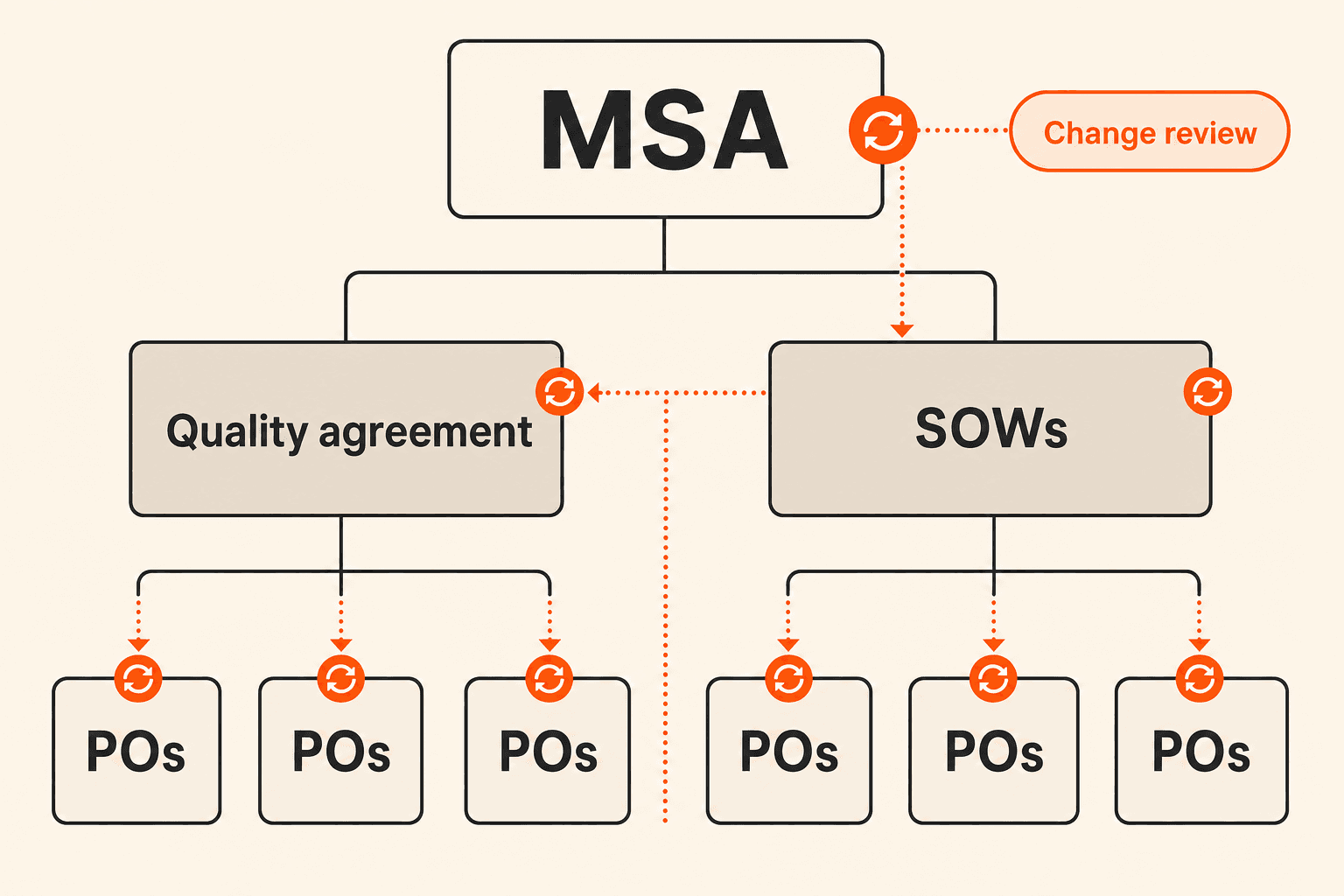
This hierarchy matters day to day. Opening a PO should show which master agreement governs it and which quality requirements apply, and updating the MSA should make affected SOWs and POs easy to identify.
Centralized document and agreement management eliminates the scattered file problem: all supplier contracts live in one searchable repository, filterable by supplier, contract type, status, or expiration window.
Approval workflows that match manufacturing risk profiles
Manufacturing approval complexity scales with contract risk, not dollar value alone — a $5,000 PO for safety-critical components may warrant more scrutiny than a $50,000 PO for commodity packaging. Routing needs to reflect contract type, supplier criticality, and regulatory requirements.
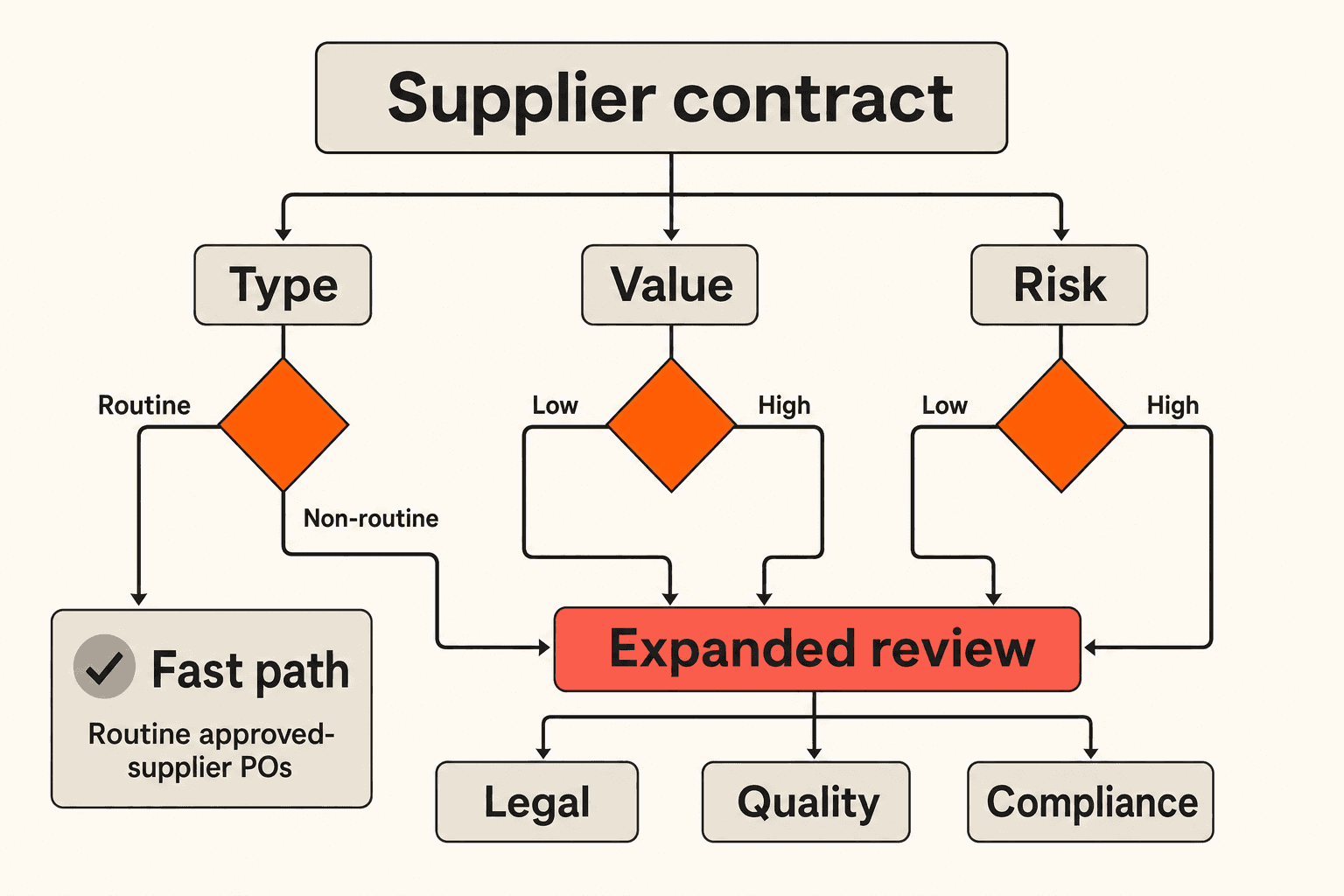
Teams describe frustration with both over- and under-engineered approval chains: routing everything through legal creates bottlenecks, while letting high-risk agreements execute without quality or compliance input creates exposure. The fix is conditional workflow logic.
Effective approval management lets you define chains matching your real risk model — routine POs to approved suppliers follow a fast path, while new suppliers or quality-critical specs route through legal, quality, and compliance review regardless of value. Visibility into stalled contracts lets you escalate before it’s a problem.
Compliance tracking and audit readiness
Compliance obligations live in contract language but must become structured, trackable data to be actionable — a quality agreement’s ISO 9001 requirement with 60 days’ notice before lapse is only useful if it’s tracked as a deadline with alerts, not left to memory.
Contract deadline management tracks insurance expirations, certification renewals, audit schedules, and auto-renewal windows, with alerts before critical dates arrive. Version history showing who changed what and who approved it gives you a producible audit record.
Integration with ERP and procurement systems
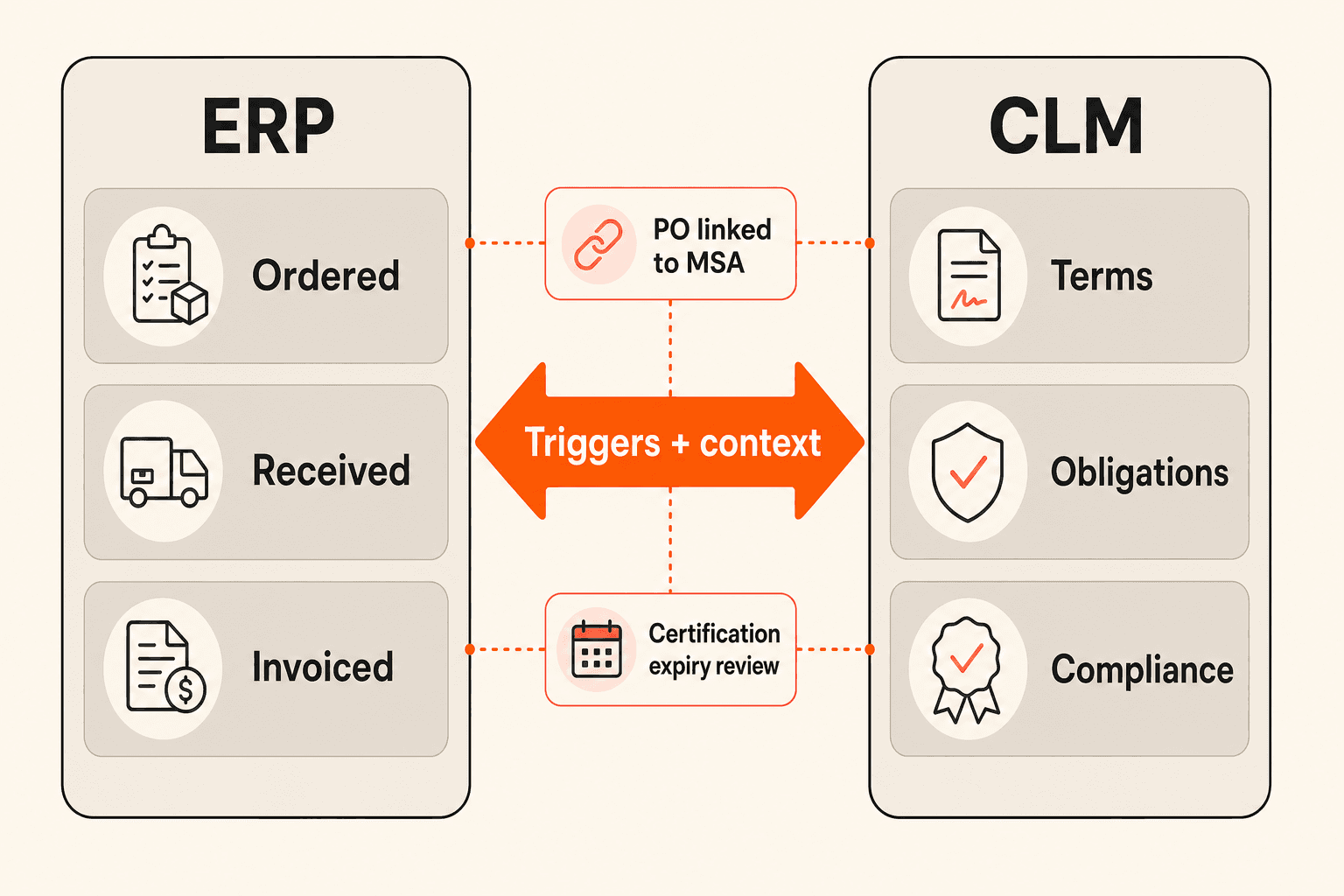
Manufacturing organizations typically run ERP systems for PO processing, inventory, and supplier master data — strong on transactions, light on contract-specific capabilities like clause libraries, redlining, and compliance reporting. ERP manages transactional reality; the contract system manages the legal framework governing it.
Capability | ERP system | Contract management system |
|---|---|---|
Purchase order processing | Yes | No |
Supplier master data | Yes | No |
Clause libraries and redlining | No | Yes |
Risk-based approval routing | No | Yes |
Obligation and compliance tracking | No | Yes |
Audit trail of contract changes | No | Yes |
Renewal and deadline alerts | No | Yes |
Integration lets contract terms inform transactions and transaction data inform contract review: a certification expiring helps you identify agreements worth reviewing, a PO links back to its parent contract, and an approaching renewal date alerts procurement before auto-renewal locks in unfavorable terms.
Key features for manufacturing contract management
Manufacturing contract management software should provide centralized storage, automated workflows, and reliable search without heavy customization.
Contract clauses management standardizes supplier terms, quality requirements, and compliance language through pre-defined and custom clause libraries. Contract reporting tracks expiring contracts, renewals, and compliance deadlines, with saved reports for recurring needs like quarterly certification reviews.
Contract intake management replaces email-based requests with structured forms that route procurement, operations, and quality requests to the right workflow. Field management extracts structured data — supplier name, contract value, expiration date, renewal terms — with custom fields for manufacturing-specific data.
Post-signature value realization
Most manufacturers invest heavily negotiating supplier agreements but lose value through poor post-execution management: discounts go unapplied, quality requirements go unenforced, favorable terms go unused, because nobody tracks them after signature.
That leakage isn’t malicious — it’s the natural result of contracts filed away with no systematic way to track obligations. The contract becomes a document of record rather than a tool teams actually use.
Effective contract management closes that gap: alerts trigger when obligations come due, and reports compare performance against commitments.
Ready to centralize your manufacturing contract management? See how Concord handles supplier agreements, quality addenda, and POs.
Note: This content addresses legal and regulatory compliance topics for informational purposes. It is not legal advice. Verify specific compliance requirements with legal counsel familiar with your industry and jurisdiction.
Managing supplier agreements, quality addenda, and purchase orders across email and shared drives creates version chaos manufacturing teams know too well. Manufacturing contract management software centralizes these documents, automates approval routing, and tracks deadlines that manual spreadsheets can’t reliably handle.
Supplier relationships generate families of related documents that must stay aligned: a master agreement, a quality addendum, statements of work, and purchase orders issued against them. As separate files with no hierarchical link, version control breaks down.
In short: Manufacturing contract management software centralizes, routes, and tracks supplier agreements — master agreements, quality addenda, SOWs, and POs — so approvals, deadlines, and audit records stay accurate as those documents change.
Key takeaways
Manufacturing supplier contracts form interconnected families — MSAs, quality addenda, SOWs, and POs — that must stay aligned as terms change.
Manual tracking in email and spreadsheets creates approval bottlenecks, scattered storage, and compliance gaps that surface during audits.
ERP and contract management systems are complementary: ERP handles transactions, contract management handles the legal framework governing them.
What makes manufacturing contract management different
Manufacturing supplier relationships create contract families, not isolated agreements. A tier-one automotive supplier might have a master agreement covering payment terms and liability, a quality addendum specifying ISO 9001 requirements, multiple SOWs, and hundreds of POs issued against those frameworks.
Changes to parent documents affect child agreements: when legal renegotiates the liability cap in a master agreement, that touches every active SOW and future PO. Teams managing these relationships in shared drives describe the same pattern — quality updates an addendum, but procurement keeps issuing POs against outdated terms until an audit surfaces it.
Manufacturing contract management software supports these hierarchical relationships, surfaces related agreements from any point in the family, and helps teams identify which child agreements may need review when a parent document changes.
The hidden costs of manual supplier contract processes
Teams running supplier contracts through email and spreadsheets describe compounding inefficiency: every contract type gets the same manual handling — printing, signing, scanning, filing, updating trackers — so a $5,000 PO for packaging consumes nearly as much effort as a $500,000 master agreement.
Approval bottlenecks emerge from multi-department coordination. Contracts need input from legal, quality, procurement, and operations, but teams lack visibility into where delays occur, so requests sit idle while stakeholders assume someone else is reviewing.
Scattered storage makes retrieval nearly impossible during audits or disputes — agreements live across inboxes, laptops, SharePoint, and ERP systems, and some disappear when employees leave. Compliance tracking goes stale the same way, leaving gaps in the record.
Managing contract families: MSAs, quality agreements, and POs
Manufacturing contract management software treats supplier agreements as connected families, not separate files. The master agreement sits at the top; quality agreements branch from it; SOWs define deliverables; POs trigger transactions governed by the parent agreements.
This hierarchy matters day to day. Opening a PO should show which master agreement governs it and which quality requirements apply, and updating the MSA should make affected SOWs and POs easy to identify.
Centralized document and agreement management eliminates the scattered file problem: all supplier contracts live in one searchable repository, filterable by supplier, contract type, status, or expiration window.
Approval workflows that match manufacturing risk profiles
Manufacturing approval complexity scales with contract risk, not dollar value alone — a $5,000 PO for safety-critical components may warrant more scrutiny than a $50,000 PO for commodity packaging. Routing needs to reflect contract type, supplier criticality, and regulatory requirements.
Teams describe frustration with both over- and under-engineered approval chains: routing everything through legal creates bottlenecks, while letting high-risk agreements execute without quality or compliance input creates exposure. The fix is conditional workflow logic.
Effective approval management lets you define chains matching your real risk model — routine POs to approved suppliers follow a fast path, while new suppliers or quality-critical specs route through legal, quality, and compliance review regardless of value. Visibility into stalled contracts lets you escalate before it’s a problem.
Compliance tracking and audit readiness
Compliance obligations live in contract language but must become structured, trackable data to be actionable — a quality agreement’s ISO 9001 requirement with 60 days’ notice before lapse is only useful if it’s tracked as a deadline with alerts, not left to memory.
Contract deadline management tracks insurance expirations, certification renewals, audit schedules, and auto-renewal windows, with alerts before critical dates arrive. Version history showing who changed what and who approved it gives you a producible audit record.
Integration with ERP and procurement systems
Manufacturing organizations typically run ERP systems for PO processing, inventory, and supplier master data — strong on transactions, light on contract-specific capabilities like clause libraries, redlining, and compliance reporting. ERP manages transactional reality; the contract system manages the legal framework governing it.
Capability | ERP system | Contract management system |
|---|---|---|
Purchase order processing | Yes | No |
Supplier master data | Yes | No |
Clause libraries and redlining | No | Yes |
Risk-based approval routing | No | Yes |
Obligation and compliance tracking | No | Yes |
Audit trail of contract changes | No | Yes |
Renewal and deadline alerts | No | Yes |
Integration lets contract terms inform transactions and transaction data inform contract review: a certification expiring helps you identify agreements worth reviewing, a PO links back to its parent contract, and an approaching renewal date alerts procurement before auto-renewal locks in unfavorable terms.
Key features for manufacturing contract management
Manufacturing contract management software should provide centralized storage, automated workflows, and reliable search without heavy customization.
Contract clauses management standardizes supplier terms, quality requirements, and compliance language through pre-defined and custom clause libraries. Contract reporting tracks expiring contracts, renewals, and compliance deadlines, with saved reports for recurring needs like quarterly certification reviews.
Contract intake management replaces email-based requests with structured forms that route procurement, operations, and quality requests to the right workflow. Field management extracts structured data — supplier name, contract value, expiration date, renewal terms — with custom fields for manufacturing-specific data.
Post-signature value realization
Most manufacturers invest heavily negotiating supplier agreements but lose value through poor post-execution management: discounts go unapplied, quality requirements go unenforced, favorable terms go unused, because nobody tracks them after signature.
That leakage isn’t malicious — it’s the natural result of contracts filed away with no systematic way to track obligations. The contract becomes a document of record rather than a tool teams actually use.
Effective contract management closes that gap: alerts trigger when obligations come due, and reports compare performance against commitments.
Ready to centralize your manufacturing contract management? See how Concord handles supplier agreements, quality addenda, and POs.
Note: This content addresses legal and regulatory compliance topics for informational purposes. It is not legal advice. Verify specific compliance requirements with legal counsel familiar with your industry and jurisdiction.
Need to know
Frequently Asked Questions

Take the "management" out
of contract management.
Customer Support
Legal
Compare
Resources
Customer Support
Company
Legal
Compare
Resources
Customer Support
Company
Legal
Compare
© 2025 Concord. All rights reserved.