Contract Clause Library: Build a Reusable Playbook
Contract Clause Library: Build a Reusable Playbook
Contract Clause Library: Build a Reusable Playbook
Contract Clause Library: Build a Reusable Playbook
contract clause library

Key takeaways
A contract clause library is a centralized, team-owned collection of preferred and fallback contract language.
The library starts empty by design. Its value comes from standardizing your own clauses, not from a vendor-supplied pack.
Fallback tiers give reviewers pre-approved alternatives, so nobody improvises when a counterparty pushes back.
Organizing clauses by contract type turns the library into a checklist that AI review can enforce automatically.
Every contract your team negotiates reuses a finite set of provisions: liability, indemnification, term and renewal, governing law, payment, termination. Without a central home for that language, it lives in people’s heads, scattered template copies, or old signed agreements. A contract clause library fixes this by making your preferred language explicit, reusable, and ready to insert at the moment you negotiate.
This guide walks through what a clause library is, why it beats maintaining a pile of near-duplicate templates, and how to build one that connects to automated first-pass review against your standards.
What is a contract clause library?
A contract clause library is a centralized collection of reusable contract clauses your team owns and maintains. Each entry has a title, a short description, and the clause content itself, so anyone can find and insert vetted language without rewriting it from scratch.
One point surprises many teams evaluating this: the library is a blank slate, not a vendor-supplied set of pre-vetted clauses. The value comes from the discipline of standardizing your own language. The library is simply the container that holds it and keeps it consistent.
That distinction matters. Your clauses reflect your risk tolerance, your jurisdiction, and your negotiating position. No off-the-shelf pack replaces the work of deciding what “our standard” actually means.
“It comes empty, and then you put in whatever language you want.”
Mastering the Contract Lifecycle webinar
Transcript: “The Clause Library we do have. If you’re on the Enterprise plan, you do have access to a Clause Library. This is something that you’ll build. It comes empty, and then you put in whatever language you want. This is where you can add the language that you prefer, and then you can simply insert that while you’re drafting or negotiating.”
Why a clause library beats scattered templates
Teams running negotiation through email and multiple template copies commonly describe version confusion as a top frustration. Someone edits a clause in one file, another person works from an older copy, and no one is certain which language is current.
Without a single source of truth, three predictable problems show up:
Inconsistency. Different reviewers use different wording for the same provision.
Slowness. People draft preferred language from scratch each time, under deadline pressure.
Risk. No one can point to the definitive version of your standard.
A centralized library solves all three at once. It also cuts down on template sprawl. Teams often end up maintaining dozens of near-identical templates because a single clause varies by counterparty. When you can swap language within a document instead of cloning an entire template, that sprawl shrinks.
Template library | Clause library | |
|---|---|---|
What it holds | Whole documents | Individual provisions |
What it solves | Starting from a blank page | Version confusion and inconsistent language |
How you use it | Clone a document, then edit | Insert or swap vetted language inside any document |
There is a quieter benefit too. Teams frequently rely on one long-tenured reviewer who “knows the clauses,” and leaders worry about what happens when that person leaves. A codified library turns tacit knowledge into a reusable system that newer team members can lean on.
Step 1: Inventory your recurring clauses
Start by listing the provisions that appear in nearly every contract you touch. For most teams that includes liability caps, indemnification, term and renewal, termination for convenience, governing law, confidentiality, and payment terms.
Pull three to five recently negotiated agreements per contract type and note how each provision was worded. You will likely see variation across documents that should be identical. That variation is exactly what the library will resolve.
Keep this first pass simple. You are building an inventory, not writing final language yet.
Step 2: Define your standard (preferred) language
For each recurring clause, decide on the single version you would open with in an ideal negotiation. This is your preferred, or default, clause.
Write it once, get it reviewed, and save it in the library with a clear title and a short description of when to use it. Concord’s clause management lets you create, view, edit, and organize these entries in one place, so the preferred version is always the one people reach for.
Resist the urge to hedge your standard language toward what you expect a counterparty to accept. That compromise belongs in your fallback tiers, which come next.
Step 3: Build fallback tiers for negotiation
Negotiation is a sequence of concessions. A single standard clause assumes the other side accepts it, which often does not happen. Fallback provisions let you decide in advance what you will accept when pushed.
Set a default clause plus ranked alternatives: option A, option B, option C. Each tier represents a position you have already approved, so reviewers are not improvising when a counterparty pushes back. The clause selector pattern makes this practical, letting you drop in a pre-approved alternative during the negotiation itself.
Here is how a liability cap might be tiered:
Tier | Liability cap language |
|---|---|
Default | Capped at fees paid in the prior 12 months |
Fallback A | Capped at fees paid in the prior 24 months |
Fallback B | Capped at two times annual fees, with carve-outs for confidentiality breaches |
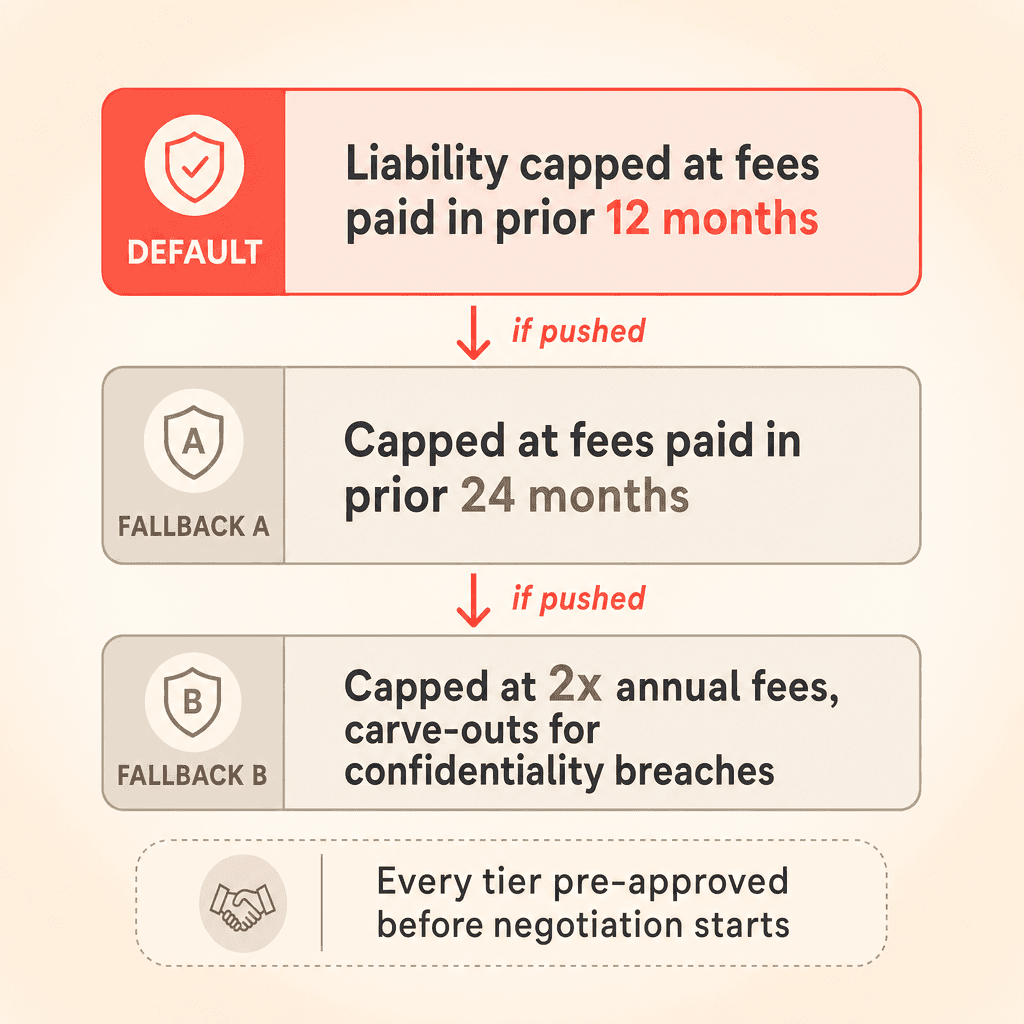
This structure is the difference between a static reference and a genuine contract playbook. Subcontractors and teams that mostly receive third-party paper feel this most. Instead of drafting a counter from scratch on each redline, they respond quickly with vetted fallback language.
See how pre-approved fallback clauses work during a live negotiation. Request a demo.
Step 4: Organize by contract type
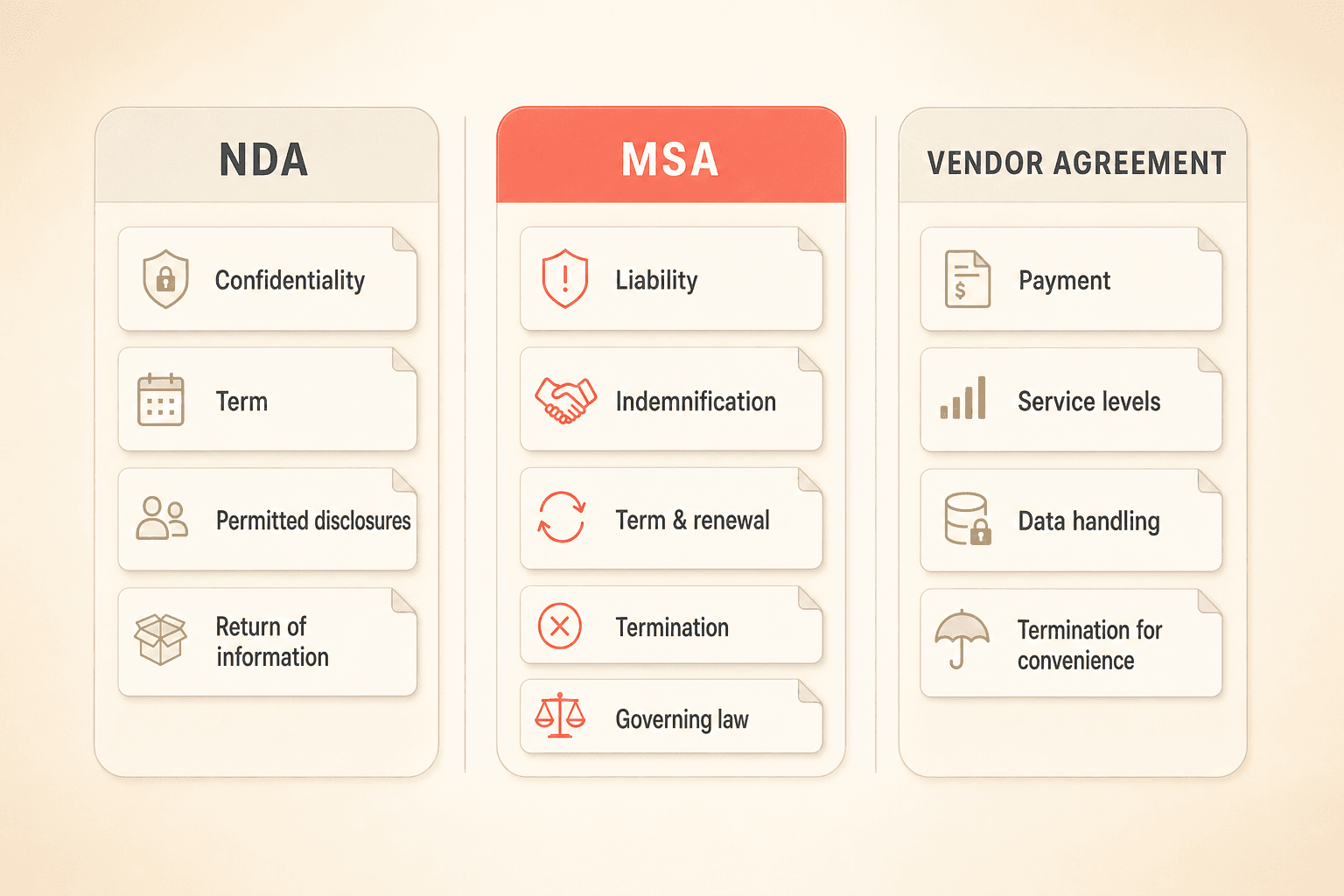
Not every clause applies to every agreement. An NDA needs different provisions than an MSA or a vendor agreement, so group your standards accordingly.
Teams that manually review incoming contracts against long clause checklists, sometimes dozens of required clauses per type, describe this as slow and error-prone. Organizing your library by contract type mirrors how review actually happens and makes gaps obvious.
A simple structure works well:
NDA: confidentiality, term, permitted disclosures, return of information.
MSA: liability, indemnification, term and renewal, termination, governing law.
Vendor agreement: payment, service levels, data handling, termination for convenience.
Once your standards are grouped this way, you have a checklist that doubles as the basis for automated review.
Step 5: Connect your library to AI playbook enforcement
A clause library defines what good looks like. That definition is what makes automated review possible, because there has to be a standard to check an incoming document against.
A recurring request across conversations is the ability to flag deviations automatically rather than checking clause by clause. Think liability caps above a threshold, indemnification pointing the wrong direction, unwanted auto-renewals, or a missing termination-for-convenience right. AI-assisted contract review can do a first-pass redline that surfaces where a document departs from your standards and suggests your preferred language.
Transcript: “Agents are not just about custom data extraction. AI is very good at reviewing documents against a playbook. What you’re going to be able to do with Concord Horizon is to basically define a playbook. Let’s say all my NDAs in my company must have these specific clauses. Every time someone uploads an NDA, the agent will be running and will be able to flag any document that has discrepancies with your policy.”
The two capabilities complement each other. The library codifies your standards, and playbook review applies them across every incoming contract. The logical progression looks like this:
Codify preferred and fallback clauses in your library.
Organize those standards by contract type.
Let a first-pass review flag deviations from them.
Route flagged deviations through approval.
That last step pairs naturally with clause standards. When someone edits a specific clause or a field value crosses a threshold, approval workflows can route it automatically to the right reviewer. The library defines the preferred language, and the workflow governs what happens when it changes.

Governance: keeping the library current
A clause library is only as useful as its accuracy. Assign an owner, usually someone in legal ops or a senior contract manager, who is responsible for keeping entries current.
Review the library on a set cadence, and update or retire clauses when your position shifts, a regulation changes, or a fallback tier stops holding up in negotiation. Concord supports editing, updating, and deleting clauses, with confirmation prompts on deletion so you do not lose language by accident.
Treat additions with the same care as your original standards. New clauses should be reviewed and approved before they join the library, so the “standard” always means something.
Bring your standards into one place
A clause library turns scattered language into a system your whole team can rely on, and it gives automated review something concrete to check against. See how Concord helps you build, organize, and enforce your clause standards. Request a demo to get started.
Key takeaways
A contract clause library is a centralized, team-owned collection of preferred and fallback contract language.
The library starts empty by design. Its value comes from standardizing your own clauses, not from a vendor-supplied pack.
Fallback tiers give reviewers pre-approved alternatives, so nobody improvises when a counterparty pushes back.
Organizing clauses by contract type turns the library into a checklist that AI review can enforce automatically.
Every contract your team negotiates reuses a finite set of provisions: liability, indemnification, term and renewal, governing law, payment, termination. Without a central home for that language, it lives in people’s heads, scattered template copies, or old signed agreements. A contract clause library fixes this by making your preferred language explicit, reusable, and ready to insert at the moment you negotiate.
This guide walks through what a clause library is, why it beats maintaining a pile of near-duplicate templates, and how to build one that connects to automated first-pass review against your standards.
What is a contract clause library?
A contract clause library is a centralized collection of reusable contract clauses your team owns and maintains. Each entry has a title, a short description, and the clause content itself, so anyone can find and insert vetted language without rewriting it from scratch.
One point surprises many teams evaluating this: the library is a blank slate, not a vendor-supplied set of pre-vetted clauses. The value comes from the discipline of standardizing your own language. The library is simply the container that holds it and keeps it consistent.
That distinction matters. Your clauses reflect your risk tolerance, your jurisdiction, and your negotiating position. No off-the-shelf pack replaces the work of deciding what “our standard” actually means.
“It comes empty, and then you put in whatever language you want.”
Mastering the Contract Lifecycle webinar
Transcript: “The Clause Library we do have. If you’re on the Enterprise plan, you do have access to a Clause Library. This is something that you’ll build. It comes empty, and then you put in whatever language you want. This is where you can add the language that you prefer, and then you can simply insert that while you’re drafting or negotiating.”
Why a clause library beats scattered templates
Teams running negotiation through email and multiple template copies commonly describe version confusion as a top frustration. Someone edits a clause in one file, another person works from an older copy, and no one is certain which language is current.
Without a single source of truth, three predictable problems show up:
Inconsistency. Different reviewers use different wording for the same provision.
Slowness. People draft preferred language from scratch each time, under deadline pressure.
Risk. No one can point to the definitive version of your standard.
A centralized library solves all three at once. It also cuts down on template sprawl. Teams often end up maintaining dozens of near-identical templates because a single clause varies by counterparty. When you can swap language within a document instead of cloning an entire template, that sprawl shrinks.
Template library | Clause library | |
|---|---|---|
What it holds | Whole documents | Individual provisions |
What it solves | Starting from a blank page | Version confusion and inconsistent language |
How you use it | Clone a document, then edit | Insert or swap vetted language inside any document |
There is a quieter benefit too. Teams frequently rely on one long-tenured reviewer who “knows the clauses,” and leaders worry about what happens when that person leaves. A codified library turns tacit knowledge into a reusable system that newer team members can lean on.
Step 1: Inventory your recurring clauses
Start by listing the provisions that appear in nearly every contract you touch. For most teams that includes liability caps, indemnification, term and renewal, termination for convenience, governing law, confidentiality, and payment terms.
Pull three to five recently negotiated agreements per contract type and note how each provision was worded. You will likely see variation across documents that should be identical. That variation is exactly what the library will resolve.
Keep this first pass simple. You are building an inventory, not writing final language yet.
Step 2: Define your standard (preferred) language
For each recurring clause, decide on the single version you would open with in an ideal negotiation. This is your preferred, or default, clause.
Write it once, get it reviewed, and save it in the library with a clear title and a short description of when to use it. Concord’s clause management lets you create, view, edit, and organize these entries in one place, so the preferred version is always the one people reach for.
Resist the urge to hedge your standard language toward what you expect a counterparty to accept. That compromise belongs in your fallback tiers, which come next.
Step 3: Build fallback tiers for negotiation
Negotiation is a sequence of concessions. A single standard clause assumes the other side accepts it, which often does not happen. Fallback provisions let you decide in advance what you will accept when pushed.
Set a default clause plus ranked alternatives: option A, option B, option C. Each tier represents a position you have already approved, so reviewers are not improvising when a counterparty pushes back. The clause selector pattern makes this practical, letting you drop in a pre-approved alternative during the negotiation itself.
Here is how a liability cap might be tiered:
Tier | Liability cap language |
|---|---|
Default | Capped at fees paid in the prior 12 months |
Fallback A | Capped at fees paid in the prior 24 months |
Fallback B | Capped at two times annual fees, with carve-outs for confidentiality breaches |
This structure is the difference between a static reference and a genuine contract playbook. Subcontractors and teams that mostly receive third-party paper feel this most. Instead of drafting a counter from scratch on each redline, they respond quickly with vetted fallback language.
See how pre-approved fallback clauses work during a live negotiation. Request a demo.
Step 4: Organize by contract type
Not every clause applies to every agreement. An NDA needs different provisions than an MSA or a vendor agreement, so group your standards accordingly.
Teams that manually review incoming contracts against long clause checklists, sometimes dozens of required clauses per type, describe this as slow and error-prone. Organizing your library by contract type mirrors how review actually happens and makes gaps obvious.
A simple structure works well:
NDA: confidentiality, term, permitted disclosures, return of information.
MSA: liability, indemnification, term and renewal, termination, governing law.
Vendor agreement: payment, service levels, data handling, termination for convenience.
Once your standards are grouped this way, you have a checklist that doubles as the basis for automated review.
Step 5: Connect your library to AI playbook enforcement
A clause library defines what good looks like. That definition is what makes automated review possible, because there has to be a standard to check an incoming document against.
A recurring request across conversations is the ability to flag deviations automatically rather than checking clause by clause. Think liability caps above a threshold, indemnification pointing the wrong direction, unwanted auto-renewals, or a missing termination-for-convenience right. AI-assisted contract review can do a first-pass redline that surfaces where a document departs from your standards and suggests your preferred language.
Transcript: “Agents are not just about custom data extraction. AI is very good at reviewing documents against a playbook. What you’re going to be able to do with Concord Horizon is to basically define a playbook. Let’s say all my NDAs in my company must have these specific clauses. Every time someone uploads an NDA, the agent will be running and will be able to flag any document that has discrepancies with your policy.”
The two capabilities complement each other. The library codifies your standards, and playbook review applies them across every incoming contract. The logical progression looks like this:
Codify preferred and fallback clauses in your library.
Organize those standards by contract type.
Let a first-pass review flag deviations from them.
Route flagged deviations through approval.
That last step pairs naturally with clause standards. When someone edits a specific clause or a field value crosses a threshold, approval workflows can route it automatically to the right reviewer. The library defines the preferred language, and the workflow governs what happens when it changes.
Governance: keeping the library current
A clause library is only as useful as its accuracy. Assign an owner, usually someone in legal ops or a senior contract manager, who is responsible for keeping entries current.
Review the library on a set cadence, and update or retire clauses when your position shifts, a regulation changes, or a fallback tier stops holding up in negotiation. Concord supports editing, updating, and deleting clauses, with confirmation prompts on deletion so you do not lose language by accident.
Treat additions with the same care as your original standards. New clauses should be reviewed and approved before they join the library, so the “standard” always means something.
Bring your standards into one place
A clause library turns scattered language into a system your whole team can rely on, and it gives automated review something concrete to check against. See how Concord helps you build, organize, and enforce your clause standards. Request a demo to get started.
Need to know
Frequently Asked Questions

Take the "management" out
of contract management.
Customer Support
Legal
Compare
Resources
Customer Support
Company
Legal
Compare
Resources
Customer Support
Company
Legal
Compare
© 2025 Concord. All rights reserved.