The True Cost of Manual Contract Management
The True Cost of Manual Contract Management
The True Cost of Manual Contract Management
The True Cost of Manual Contract Management
cost of manual contract management

Key takeaways
Manual contract management drains money four ways: lost time, compliance risk, leaked revenue, and a process that breaks as you grow.
The largest time cost is invisible. It shows up as slow cycle times and a team that always feels behind, never as a budget line.
Email-based redlining causes version-control failures that become real liability during audits and due diligence.
Missed auto-renewal windows and slow approvals leak revenue directly, on both the buy side and the sell side.
A purpose-built platform recovers these costs with centralized intake, AI extraction, real-time dashboards, and automated approvals.
Your contract process is costing more than you think. The cost of manual contract management rarely appears as a line item on any budget, yet it quietly drains time, creates compliance exposure, and leaks revenue across every department that touches an agreement. If your team manages contracts through email, spreadsheets, and shared drives, these hidden costs compound with every deal, every renewal, and every new hire.
The challenge is that these costs are distributed. Legal spends extra hours chasing redlines. Procurement misses a renewal window. Sales waits three days for an approval that should take three hours. No single person sees the full picture, so the problem persists, growing silently alongside the organization.
This post breaks down where those costs hide and what they actually look like in practice.
The four hidden costs of manual contract processes
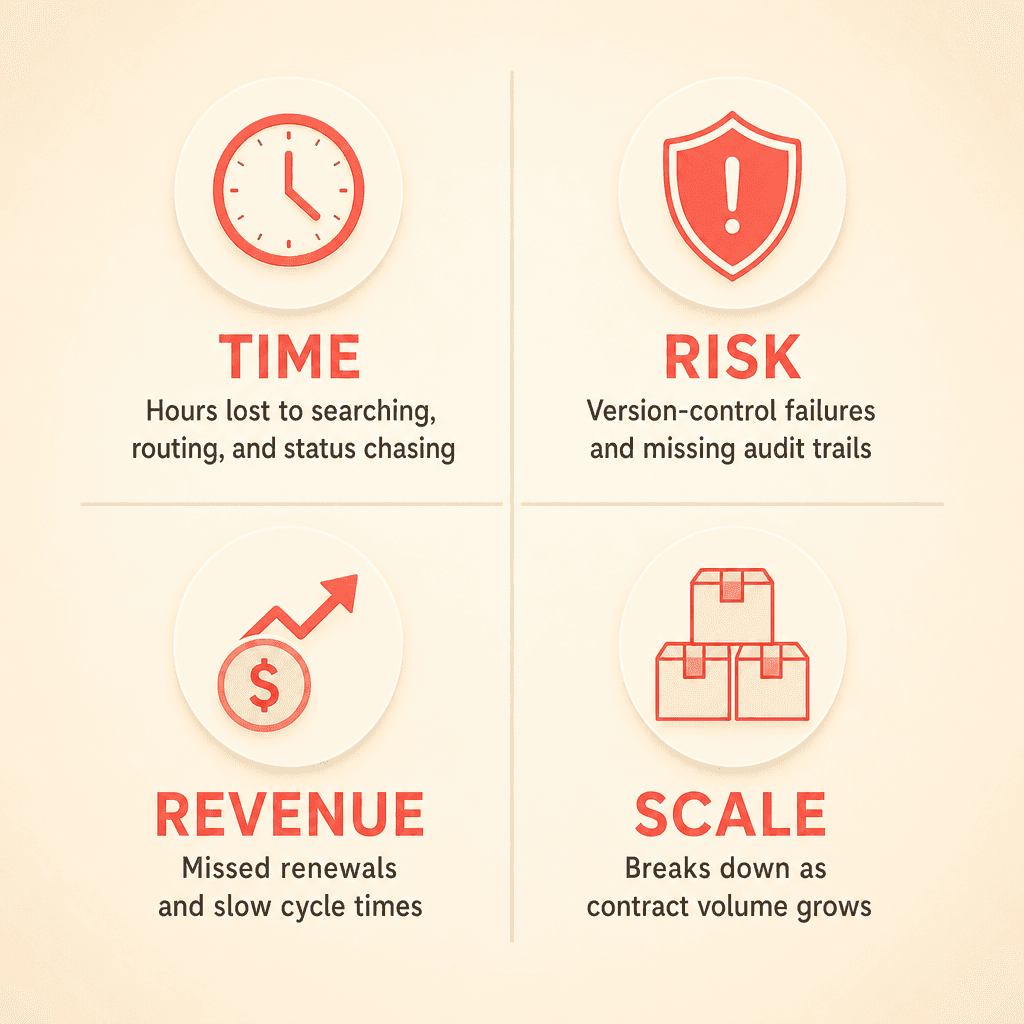
Before going deeper, here is a summary of the primary cost categories:
Time costs: Hours lost to searching, versioning, routing, and answering status inquiries across departments.
Risk costs: Compliance exposure from version-control failures, missing audit trails, and untracked obligations.
Revenue costs: Missed renewals, slow deal cycles, and weakened negotiating position that directly affect the bottom line.
Scale costs: Manual processes that work at low volume break down as organizations grow, creating compounding failures.
Time: the invisible tax on every team
The most widespread cost of manual contract management is time, and it hides in plain sight. Every manual task in a contract workflow takes only minutes on its own: searching a shared drive for the right template, cross-referencing a spreadsheet to check a renewal date, forwarding a redline to the correct approver, responding to a “where does this stand?” message from a stakeholder. Individually, these tasks feel trivial. In aggregate, they consume a staggering number of hours.
Legal and operations leaders frequently describe spending a significant portion of their week on contract administration rather than substantive work. Status inquiries alone can eat hours. When five people across different departments each spend even two to three hours per week on contract-related administrative overhead, the cumulative salary-equivalent cost over a year is substantial.
The worst part is that this time cost is invisible to leadership. It never appears on a report. It shows up only as slower throughput, longer cycle times, and a vague sense that the team is always behind. You can explore how centralized visibility replaces these manual check-ins in Concord’s contract analytics guide.
Where the hours go
Consider the typical lifecycle of a single contract under a manual process:
Intake: A business unit submits a request via email or Slack. Legal may not see it for hours or days. Duplicate requests sometimes arrive through different channels.
Drafting: Someone searches a shared drive for the “latest” template, hoping the version saved there is actually current.
Negotiation: Redlines go back and forth as email attachments. Three people may have three different “latest versions” open simultaneously.
Approval: The draft gets forwarded to an approver, who may sit on it without anyone knowing. Follow-up emails get sent. Days pass.
Signature: The final version gets routed for signature, but someone has to manually confirm it matches the last agreed-upon redline.
Each handoff introduces delay and error potential. Multiply this by dozens or hundreds of contracts per quarter, and the time cost becomes one of the largest untracked expenses in the organization.
Risk: version-control failures as compliance liability
When contracts are negotiated through email attachments, no single source of truth exists. Every participant holds a local copy on their machine, and it becomes structurally impossible to guarantee that the signed version matches the last agreed-upon redline.
Legal operations leaders frequently describe discovering, after execution, that a signed contract contained terms that should have been revised during negotiation. The root cause is almost always version confusion during an email-based redline process. Someone sent the wrong attachment. An approver reviewed an outdated draft. A clause that was supposed to be deleted survived into the final version.
In regulated industries, or during due diligence for a transaction, the inability to produce a clean audit trail of negotiation and approval is more than inconvenient. It can trigger regulatory findings, deal delays, or material misrepresentations. The cost of a single compliance failure often exceeds what a contract management system costs annually.
The audit readiness problem
Teams managing contracts manually commonly describe scrambling when an audit or compliance review is triggered. The process looks something like this: pull contracts from multiple shared drives, reconstruct approval histories from email chains, cross-reference spreadsheets to confirm obligation tracking, and hope nothing was missed. This reactive approach to compliance is both stressful and unreliable.
A central repository with automated text extraction and AI-powered summaries makes audit preparation a routine task rather than a crisis.
Revenue: the money you lose without noticing
The revenue impact of manual contract processes shows up in two primary ways: missed renewals and slow cycle times.
Missed renewals are direct revenue leakage
Contracts with auto-renewal clauses must be managed ahead of the deadline. If you miss the opt-out window on a vendor contract, you are locked into terms for another cycle, whether those terms are favorable or not. On the sell side, failing to initiate a renewal conversation in time means lost upsell opportunities or, worse, customer churn.
Organizations relying on spreadsheet-based renewal tracking commonly describe discovering missed windows only after the auto-renewal has already triggered. A spreadsheet can store a renewal date, but it cannot alert the right person at the right time, escalate when an alert goes unacknowledged, or trigger a workflow to initiate the renewal process. The gap between “data stored” and “action taken” is where revenue leaks.
Slow cycle times cost more than you measure
Every day a contract sits waiting for review, approval, or signature is a day that revenue goes unrecognized, a vendor relationship stays informal, or a new hire cannot start. Contract cycle time is a direct input to deal velocity. Manual processes, with their sequential handoffs and email-based routing, maximize cycle time by default.
Sales and business development teams frequently identify contract turnaround as a friction point in closing deals. The delays are often attributed to “legal being slow,” but the real cause is typically the structural inefficiency of the process itself. No single person is slow. The process, with its lack of visibility and manual routing, is slow by design.
Automated workflow and approval routing removes these structural bottlenecks by replacing email forwarding chains with configured approval paths that track and escalate automatically.
The compounding effect: manual processes do not scale
A manual contract process that works for 50 contracts per year breaks at 500 and becomes unmanageable at 5,000. The failure mode is not gradual degradation. It is sudden collapse when volume exceeds the capacity of the people and spreadsheets holding the system together.
Teams that describe their contract process as “working fine” often qualify that statement with caveats: “as long as nothing falls through the cracks” or “as long as Sarah stays.” This single-point-of-failure dependency is a structural risk that compounds with growth.
When contracts live in individual email inboxes or personal folders, employee departures create immediate knowledge gaps. New team members have no way to understand the history or context of existing agreements. Institutional knowledge walks out the door with every resignation, and rebuilding it is expensive if it is possible at all.
Organizations growing through new product lines, geographic expansion, or acquisitions face an even steeper challenge. Each new entity or business unit adds contract volume, and a manual process that was already stretched thin simply cannot absorb the increase without additional headcount or increased error rates.
What modern contract management looks like
Dimension | Manual process | Modern platform |
|---|---|---|
Intake | Email and Slack requests, easily lost or duplicated | Centralized intake form legal can triage and track |
Templates | Hunt for the latest version on a shared drive | Always-current templates in one library |
Negotiation | Redlines as email attachments, with several “latest” versions | A single source of truth with tracked versions |
Approvals | Forwarded by email, stalls with no visibility | Automated routing that tracks and escalates |
Renewals | Tracked in a spreadsheet that cannot alert anyone | Proactive alerts before the opt-out window |
Audit trail | Reconstructed from email chains under pressure | A complete history ready for audit on demand |
Scaling | Breaks as volume grows and needs more headcount | Bulk operations absorb volume without new hires |
The costs described above are not inevitable. They are the predictable result of a process that relies on tools never designed for contract management. Email is a communication tool. Spreadsheets are calculation tools. Shared drives are storage tools. None of them can manage a contract lifecycle.
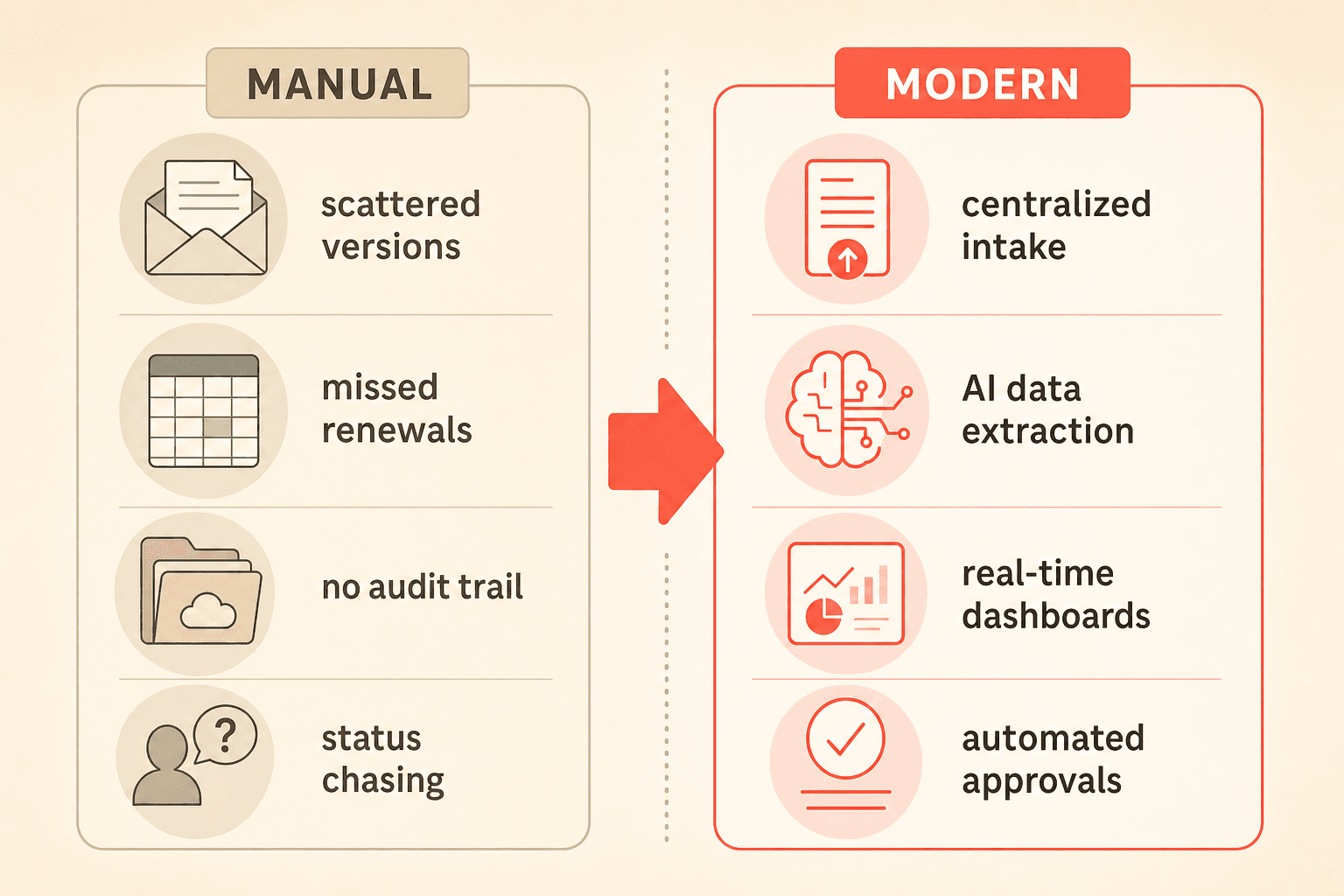
A purpose-built approach to contract management addresses these costs directly:
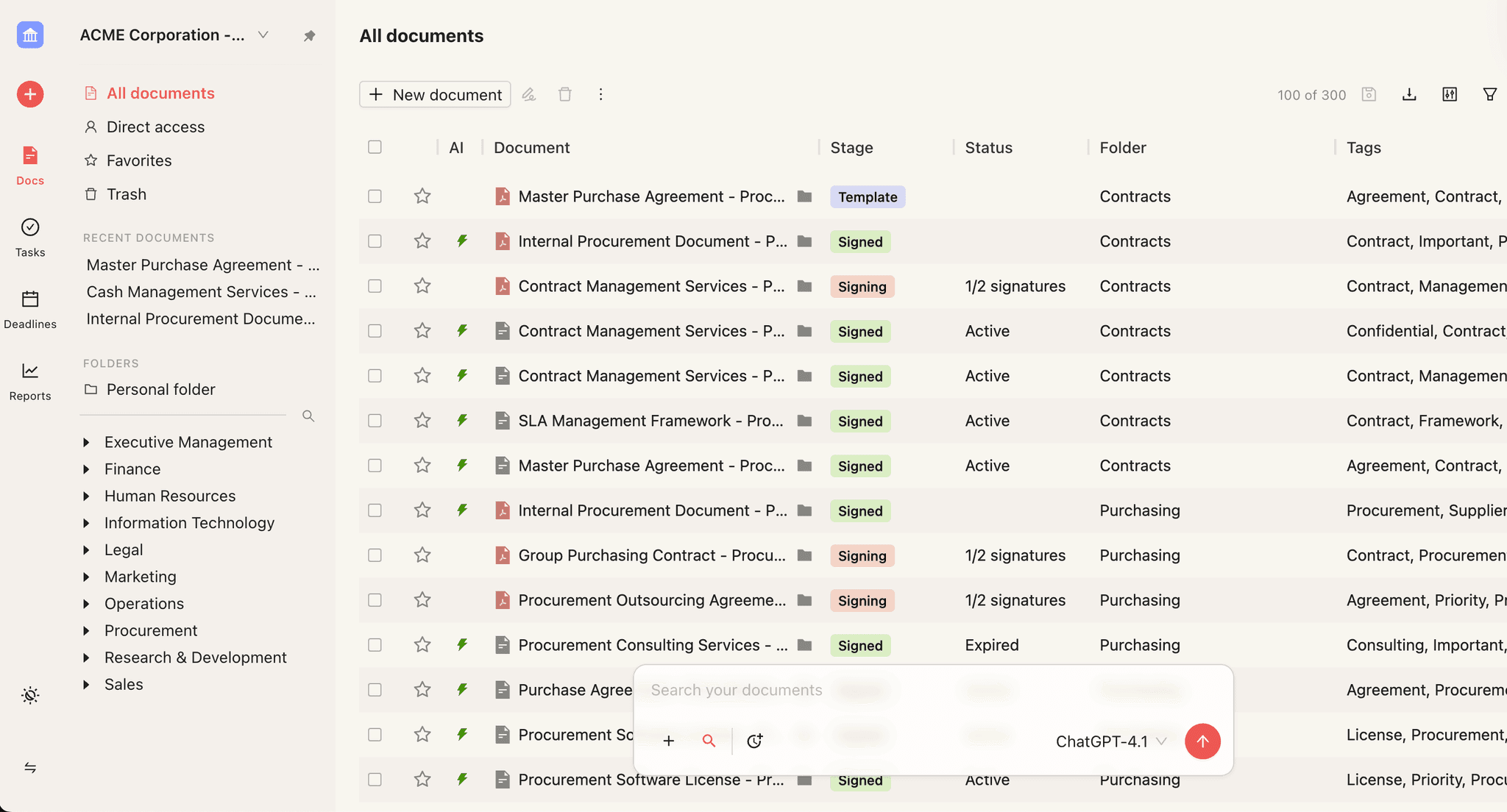
Centralized intake gives business units a structured way to submit requests that legal can triage, prioritize, and track, eliminating lost and duplicated requests. Learn more about contract intake management.
AI-powered data extraction automatically pulls key terms, dates, parties, and obligations from uploaded documents, replacing hours of manual review.
Real-time dashboards replace status inquiries with self-serve visibility, showing document statuses, lifecycle metrics, and trends filterable by date, tag, or team.
Automated approval workflows route contracts to the right reviewers based on configurable rules, track completion, and escalate when approvals stall.
Bulk operations allow growing teams to analyze and manage large contract volumes without proportional headcount increases.
The goal is not to add technology for its own sake. The goal is to reclaim the time, reduce the risk, and recover the revenue that manual processes quietly consume.
If you are ready to understand what your manual contract process is actually costing your team, request a Concord demo and see how centralized contract management replaces the hidden costs with measurable results.
Key takeaways
Manual contract management drains money four ways: lost time, compliance risk, leaked revenue, and a process that breaks as you grow.
The largest time cost is invisible. It shows up as slow cycle times and a team that always feels behind, never as a budget line.
Email-based redlining causes version-control failures that become real liability during audits and due diligence.
Missed auto-renewal windows and slow approvals leak revenue directly, on both the buy side and the sell side.
A purpose-built platform recovers these costs with centralized intake, AI extraction, real-time dashboards, and automated approvals.
Your contract process is costing more than you think. The cost of manual contract management rarely appears as a line item on any budget, yet it quietly drains time, creates compliance exposure, and leaks revenue across every department that touches an agreement. If your team manages contracts through email, spreadsheets, and shared drives, these hidden costs compound with every deal, every renewal, and every new hire.
The challenge is that these costs are distributed. Legal spends extra hours chasing redlines. Procurement misses a renewal window. Sales waits three days for an approval that should take three hours. No single person sees the full picture, so the problem persists, growing silently alongside the organization.
This post breaks down where those costs hide and what they actually look like in practice.
The four hidden costs of manual contract processes
Before going deeper, here is a summary of the primary cost categories:
Time costs: Hours lost to searching, versioning, routing, and answering status inquiries across departments.
Risk costs: Compliance exposure from version-control failures, missing audit trails, and untracked obligations.
Revenue costs: Missed renewals, slow deal cycles, and weakened negotiating position that directly affect the bottom line.
Scale costs: Manual processes that work at low volume break down as organizations grow, creating compounding failures.
Time: the invisible tax on every team
The most widespread cost of manual contract management is time, and it hides in plain sight. Every manual task in a contract workflow takes only minutes on its own: searching a shared drive for the right template, cross-referencing a spreadsheet to check a renewal date, forwarding a redline to the correct approver, responding to a “where does this stand?” message from a stakeholder. Individually, these tasks feel trivial. In aggregate, they consume a staggering number of hours.
Legal and operations leaders frequently describe spending a significant portion of their week on contract administration rather than substantive work. Status inquiries alone can eat hours. When five people across different departments each spend even two to three hours per week on contract-related administrative overhead, the cumulative salary-equivalent cost over a year is substantial.
The worst part is that this time cost is invisible to leadership. It never appears on a report. It shows up only as slower throughput, longer cycle times, and a vague sense that the team is always behind. You can explore how centralized visibility replaces these manual check-ins in Concord’s contract analytics guide.
Where the hours go
Consider the typical lifecycle of a single contract under a manual process:
Intake: A business unit submits a request via email or Slack. Legal may not see it for hours or days. Duplicate requests sometimes arrive through different channels.
Drafting: Someone searches a shared drive for the “latest” template, hoping the version saved there is actually current.
Negotiation: Redlines go back and forth as email attachments. Three people may have three different “latest versions” open simultaneously.
Approval: The draft gets forwarded to an approver, who may sit on it without anyone knowing. Follow-up emails get sent. Days pass.
Signature: The final version gets routed for signature, but someone has to manually confirm it matches the last agreed-upon redline.
Each handoff introduces delay and error potential. Multiply this by dozens or hundreds of contracts per quarter, and the time cost becomes one of the largest untracked expenses in the organization.
Risk: version-control failures as compliance liability
When contracts are negotiated through email attachments, no single source of truth exists. Every participant holds a local copy on their machine, and it becomes structurally impossible to guarantee that the signed version matches the last agreed-upon redline.
Legal operations leaders frequently describe discovering, after execution, that a signed contract contained terms that should have been revised during negotiation. The root cause is almost always version confusion during an email-based redline process. Someone sent the wrong attachment. An approver reviewed an outdated draft. A clause that was supposed to be deleted survived into the final version.
In regulated industries, or during due diligence for a transaction, the inability to produce a clean audit trail of negotiation and approval is more than inconvenient. It can trigger regulatory findings, deal delays, or material misrepresentations. The cost of a single compliance failure often exceeds what a contract management system costs annually.
The audit readiness problem
Teams managing contracts manually commonly describe scrambling when an audit or compliance review is triggered. The process looks something like this: pull contracts from multiple shared drives, reconstruct approval histories from email chains, cross-reference spreadsheets to confirm obligation tracking, and hope nothing was missed. This reactive approach to compliance is both stressful and unreliable.
A central repository with automated text extraction and AI-powered summaries makes audit preparation a routine task rather than a crisis.
Revenue: the money you lose without noticing
The revenue impact of manual contract processes shows up in two primary ways: missed renewals and slow cycle times.
Missed renewals are direct revenue leakage
Contracts with auto-renewal clauses must be managed ahead of the deadline. If you miss the opt-out window on a vendor contract, you are locked into terms for another cycle, whether those terms are favorable or not. On the sell side, failing to initiate a renewal conversation in time means lost upsell opportunities or, worse, customer churn.
Organizations relying on spreadsheet-based renewal tracking commonly describe discovering missed windows only after the auto-renewal has already triggered. A spreadsheet can store a renewal date, but it cannot alert the right person at the right time, escalate when an alert goes unacknowledged, or trigger a workflow to initiate the renewal process. The gap between “data stored” and “action taken” is where revenue leaks.
Slow cycle times cost more than you measure
Every day a contract sits waiting for review, approval, or signature is a day that revenue goes unrecognized, a vendor relationship stays informal, or a new hire cannot start. Contract cycle time is a direct input to deal velocity. Manual processes, with their sequential handoffs and email-based routing, maximize cycle time by default.
Sales and business development teams frequently identify contract turnaround as a friction point in closing deals. The delays are often attributed to “legal being slow,” but the real cause is typically the structural inefficiency of the process itself. No single person is slow. The process, with its lack of visibility and manual routing, is slow by design.
Automated workflow and approval routing removes these structural bottlenecks by replacing email forwarding chains with configured approval paths that track and escalate automatically.
The compounding effect: manual processes do not scale
A manual contract process that works for 50 contracts per year breaks at 500 and becomes unmanageable at 5,000. The failure mode is not gradual degradation. It is sudden collapse when volume exceeds the capacity of the people and spreadsheets holding the system together.
Teams that describe their contract process as “working fine” often qualify that statement with caveats: “as long as nothing falls through the cracks” or “as long as Sarah stays.” This single-point-of-failure dependency is a structural risk that compounds with growth.
When contracts live in individual email inboxes or personal folders, employee departures create immediate knowledge gaps. New team members have no way to understand the history or context of existing agreements. Institutional knowledge walks out the door with every resignation, and rebuilding it is expensive if it is possible at all.
Organizations growing through new product lines, geographic expansion, or acquisitions face an even steeper challenge. Each new entity or business unit adds contract volume, and a manual process that was already stretched thin simply cannot absorb the increase without additional headcount or increased error rates.
What modern contract management looks like
Dimension | Manual process | Modern platform |
|---|---|---|
Intake | Email and Slack requests, easily lost or duplicated | Centralized intake form legal can triage and track |
Templates | Hunt for the latest version on a shared drive | Always-current templates in one library |
Negotiation | Redlines as email attachments, with several “latest” versions | A single source of truth with tracked versions |
Approvals | Forwarded by email, stalls with no visibility | Automated routing that tracks and escalates |
Renewals | Tracked in a spreadsheet that cannot alert anyone | Proactive alerts before the opt-out window |
Audit trail | Reconstructed from email chains under pressure | A complete history ready for audit on demand |
Scaling | Breaks as volume grows and needs more headcount | Bulk operations absorb volume without new hires |
The costs described above are not inevitable. They are the predictable result of a process that relies on tools never designed for contract management. Email is a communication tool. Spreadsheets are calculation tools. Shared drives are storage tools. None of them can manage a contract lifecycle.
A purpose-built approach to contract management addresses these costs directly:
Centralized intake gives business units a structured way to submit requests that legal can triage, prioritize, and track, eliminating lost and duplicated requests. Learn more about contract intake management.
AI-powered data extraction automatically pulls key terms, dates, parties, and obligations from uploaded documents, replacing hours of manual review.
Real-time dashboards replace status inquiries with self-serve visibility, showing document statuses, lifecycle metrics, and trends filterable by date, tag, or team.
Automated approval workflows route contracts to the right reviewers based on configurable rules, track completion, and escalate when approvals stall.
Bulk operations allow growing teams to analyze and manage large contract volumes without proportional headcount increases.
The goal is not to add technology for its own sake. The goal is to reclaim the time, reduce the risk, and recover the revenue that manual processes quietly consume.
If you are ready to understand what your manual contract process is actually costing your team, request a Concord demo and see how centralized contract management replaces the hidden costs with measurable results.
Need to know
Frequently Asked Questions

Take the "management" out
of contract management.
Customer Support
Legal
Compare
Resources
Customer Support
Company
Legal
Compare
Resources
Customer Support
Company
Legal
Compare
© 2025 Concord. All rights reserved.