MCP Server Contract Management: Connect Your CLM to Any LLM
MCP Server Contract Management: Connect Your CLM to Any LLM
MCP Server Contract Management: Connect Your CLM to Any LLM
MCP Server Contract Management: Connect Your CLM to Any LLM

Key takeaways
Concord is the first CLM to ship a native MCP (Model Context Protocol) server — an open standard that connects your live contract data to any LLM.
MCP works with Claude, ChatGPT, Gemini, Copilot, and custom models, so you avoid both proprietary AI lock-in and brittle custom API builds.
Because contract data is structured — clauses, dates, obligations — MCP lets an AI assistant give contextually accurate answers instead of keyword-matched guesses.
Your data stays in Concord: the MCP server respects your existing permissions and audit trails, so nothing is exported into a third-party AI tool.
High-value workflows include renewal tracking, clause-variation analysis, obligation extraction, pre-negotiation briefings, and custom dashboards.
Your contract repository holds answers to hundreds of critical questions. Which vendors have auto-renewal clauses? What are your net payment terms across EMEA suppliers? How many agreements expire before the end of Q3? The problem is that extracting those answers typically requires filtered searches, spreadsheet exports, and hours of manual document review. MCP server contract management changes that equation entirely.
This guide explains what MCP is, why it matters for contract management, and how the integration works in practice.
What is MCP and why should contract teams care?
Model Context Protocol, or MCP, is an open standard that allows applications to expose their data to large language models in a structured, secure way. Think of it as a universal adapter between your software and any AI assistant.
Before MCP, connecting a CLM to an LLM meant one of two things: the CLM vendor built a proprietary AI feature (locked to their chosen model), or your engineering team built a custom API integration (expensive and brittle). MCP eliminates both of those compromises. It creates a standardized way for an AI assistant to read your contract data, understand its structure, and respond to natural-language queries grounded in real information.
For contract teams, this is significant because your data is uniquely structured. Contracts contain nested clauses, conditional obligations, date-dependent triggers, and relationship hierarchies that flat-text search handles poorly. MCP preserves that structure when exposing data to an LLM, which means the AI can give you contextually accurate answers rather than keyword-matched guesses.
From the webinar — what MCP is: The idea behind it: it’s basically a USB for AI — a way to plug different systems together. Before MCP, we had lots of different connectors, proprietary protocols, and siloed data. Now there’s one standard way to connect the different LLMs and AI tools, and the other tools and apps you already use — Slack, Gmail, HubSpot, Concord. It’s just a way to connect all of these different things and share data between them.
Why LLM-agnosticism matters for MCP integration CLM
Organizations are not settling on a single AI assistant. Legal teams may prefer Claude for its strength in document analysis. Sales teams may already use Copilot because it lives inside their Microsoft stack. Procurement might want to build a custom workflow on an open-source model. Different departments, different compliance requirements, different tools.
A CLM that only connects to one AI provider forces every team into a lowest-common-denominator choice. That creates friction, slows adoption, and ties your contract data strategy to a single vendor’s AI roadmap.
By shipping an MCP server, Concord removes the LLM selection from the CLM purchasing decision entirely. Your contract data becomes a stable foundation that any MCP-compatible AI assistant can query. The model you use today can differ from the model you use next quarter, and your contract data layer remains constant.
This LLM-agnostic approach is particularly important given how quickly the AI tool market shifts. Locking into one model today could mean re-platforming tomorrow. MCP prevents that scenario.
How Concord’s MCP server works
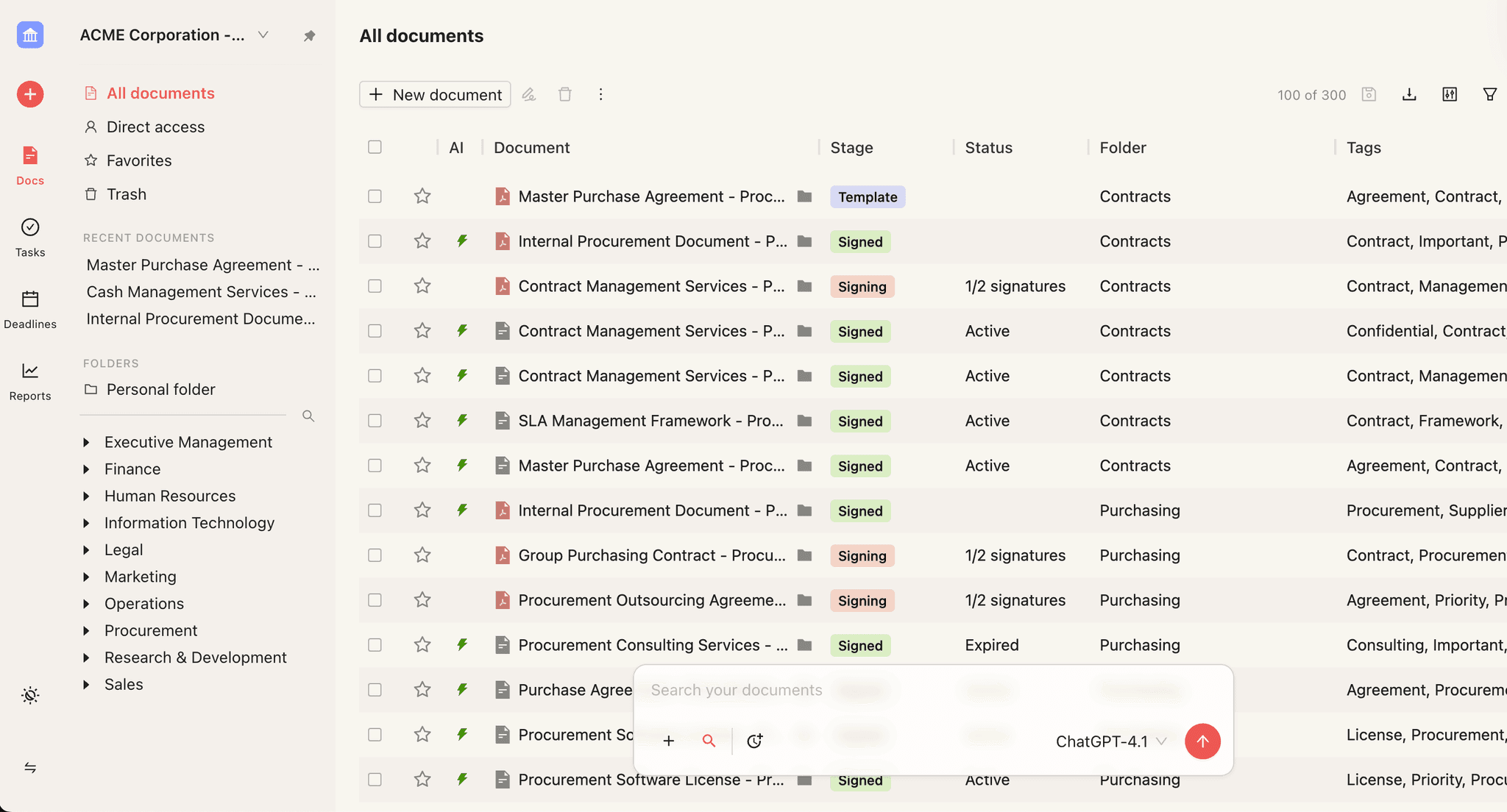
Concord’s MCP AI Integration Setup enables you to connect your Concord instance with AI assistants like Claude and ChatGPT through the Model Context Protocol. Once configured, the AI assistant can access and work with your Concord data, meaning your contracts become queryable by conversation rather than by manual search alone.
Here is what that looks like in practice:
Structured data exposure. Concord stores contract data in structured JSON formats that maintain relationships and hierarchy. This is not flat text. When an LLM queries your contracts through MCP, it receives organized data, including metadata, clause content, party information, dates, and obligation details, in a format it can reason about accurately.
Clause-level depth. Your clause libraries become AI-queryable through MCP. That means you can ask an AI assistant to find every contract that uses outdated indemnification language, compare limitation of liability clauses across your vendor portfolio, or identify non-standard termination provisions. The assistant pulls answers from your organized clause data rather than scanning raw document text.
Search infrastructure. Concord already indexes contract data for fast retrieval through its search connector. MCP extends that indexed searchability to external AI assistants, so the speed and accuracy you experience inside Concord translates to your AI-powered workflows.
Integration-first architecture. MCP is part of a broader pattern. Concord connects to the tools teams already use, including HubSpot, Slack, and Salesforce, through its integration management layer. The MCP server adds LLMs to that connected stack, treating AI assistants as another category of tool your contract data can power.
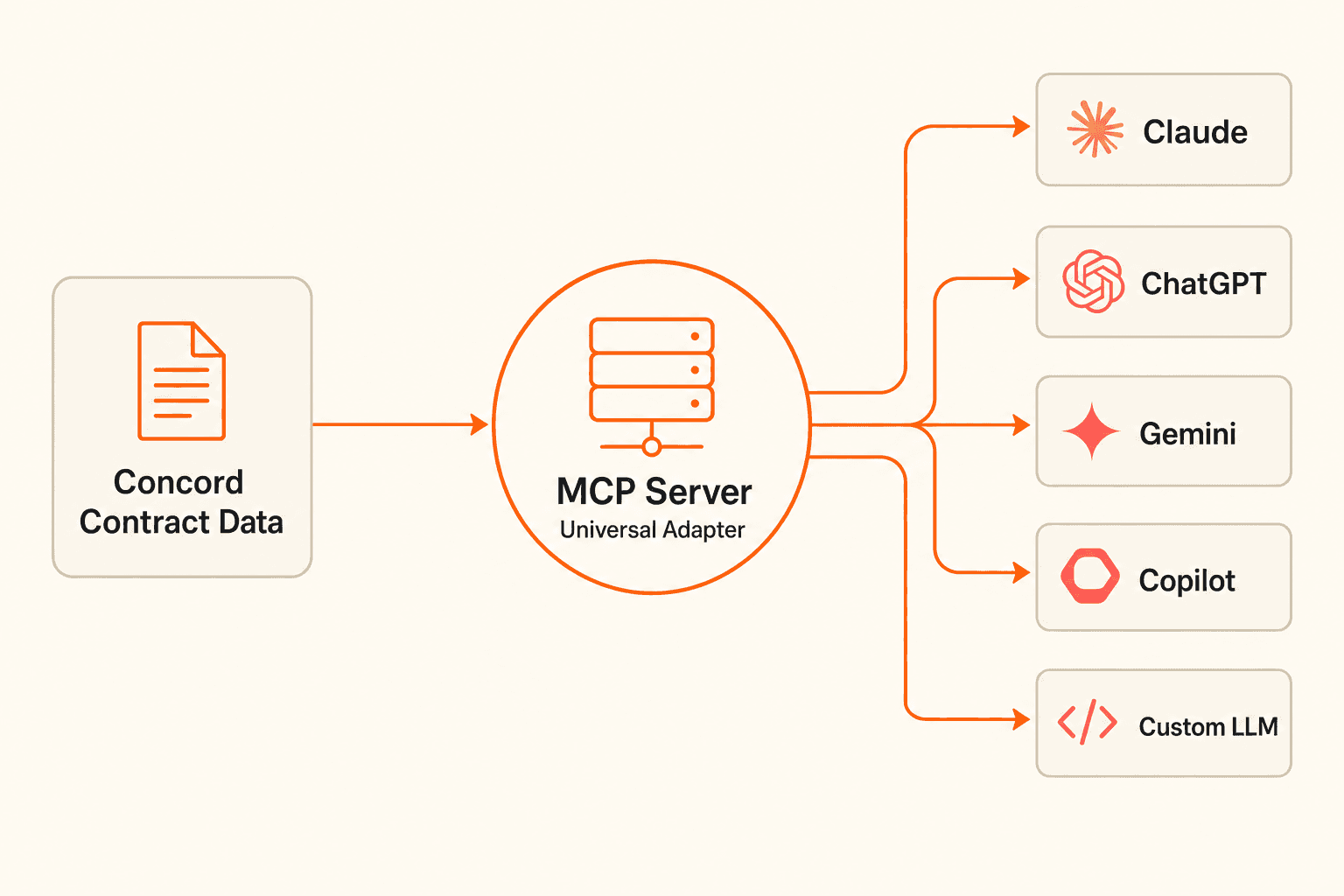
Five use cases for connecting your CLM to an LLM
The highest-value application of MCP in contract management is conversational querying. Here are five specific workflows that become possible when your CLM data is accessible to any AI assistant.
1. Portfolio-wide renewal tracking
Instead of running a filtered report and manually reviewing results, ask your AI assistant: “Which contracts have auto-renewal clauses and are coming up for renewal in the next 90 days?” The assistant queries your live Concord data through MCP and returns a structured answer with contract names, counterparties, renewal dates, and notice periods.
From the webinar — a live renewal query: I’m going to ask it which contracts are renewing next year and give me a table with the amounts and links to the contracts. To do that it has to go through the whole database, find the contracts, build the table, and link them together. We’re giving the LLM the ability to search through both your contracts in the repository and their content, to pull the key information it needs — in this case the renewal dates. It runs through all the contracts and renewal dates, and then building out the table — that’s all Claude.
2. Clause variation analysis
Legal teams spend significant time comparing clause language across agreements. With MCP, you can ask: “Show me all the variations of our indemnification clause across active vendor agreements.” The assistant pulls clause-level data from your clause management library and presents a comparison, highlighting deviations from your standard language.
3. Obligation extraction for compliance
Compliance reviews often require identifying specific obligations buried across dozens or hundreds of contracts. A natural-language query like “What are our data deletion obligations across all agreements with European counterparties?” replaces what would otherwise be days of manual review.
4. Pre-negotiation intelligence
Before entering a renewal negotiation, ask your AI assistant to summarize the full relationship: contract history, current terms, any amendments, payment terms, and SLA commitments. The assistant synthesizes data from your CLM into a briefing document in seconds.
5. Custom workflow integration
Technical teams can connect Concord’s MCP server to custom-built tools. A procurement team might build an internal dashboard that uses an open-source LLM to monitor contract spend thresholds. An engineering team might build an automated alert system that queries contract data for upcoming deliverable deadlines. MCP makes both possible without custom API work.
See it on your own contracts. Request a demo and watch an AI assistant answer live questions against your Concord data through MCP.
MCP-native vs. proprietary AI add-ons: why the integration model matters
Teams evaluating CLM platforms frequently describe a gap between the AI features vendors promise and what actually works in their environment. Proprietary AI add-ons require you to adopt the vendor’s AI stack. Custom API integrations require engineering resources most legal and contract teams do not have.
MCP-native (Concord) | Proprietary AI add-on | Custom API integration | |
|---|---|---|---|
Choose your own LLM | Any MCP-compatible model | Locked to the vendor’s model | Possible, but you build it |
Engineering effort | None — set up by ops or legal | None | High — ongoing build and upkeep |
Vendor lock-in | None | High | Tied to your own codebase |
Adapts to new AI tools | Automatically, as tools adopt MCP | Requires re-platforming | Requires re-building |
MCP sits in a different category. It is an open protocol specifically designed to let applications expose data to LLMs in a standardized way. Because it is a standard rather than a proprietary feature, it is not controlled by any single AI vendor.
Concord’s decision to ship an MCP server means you get LLM connectivity without custom development, vendor lock-in, or data exports. Your CLM transforms from a static document repository into an AI-queryable intelligence layer, and you choose which AI tools sit on top of it.
No other major CLM platform currently ships a native MCP server. This matters not because being first is inherently valuable, but because it reflects a design philosophy: your contract data should be accessible to whatever tools you choose, not locked behind a vendor’s proprietary AI module.
Key takeaways
Concord is the first CLM to ship a native MCP (Model Context Protocol) server — an open standard that connects your live contract data to any LLM.
MCP works with Claude, ChatGPT, Gemini, Copilot, and custom models, so you avoid both proprietary AI lock-in and brittle custom API builds.
Because contract data is structured — clauses, dates, obligations — MCP lets an AI assistant give contextually accurate answers instead of keyword-matched guesses.
Your data stays in Concord: the MCP server respects your existing permissions and audit trails, so nothing is exported into a third-party AI tool.
High-value workflows include renewal tracking, clause-variation analysis, obligation extraction, pre-negotiation briefings, and custom dashboards.
Your contract repository holds answers to hundreds of critical questions. Which vendors have auto-renewal clauses? What are your net payment terms across EMEA suppliers? How many agreements expire before the end of Q3? The problem is that extracting those answers typically requires filtered searches, spreadsheet exports, and hours of manual document review. MCP server contract management changes that equation entirely.
This guide explains what MCP is, why it matters for contract management, and how the integration works in practice.
What is MCP and why should contract teams care?
Model Context Protocol, or MCP, is an open standard that allows applications to expose their data to large language models in a structured, secure way. Think of it as a universal adapter between your software and any AI assistant.
Before MCP, connecting a CLM to an LLM meant one of two things: the CLM vendor built a proprietary AI feature (locked to their chosen model), or your engineering team built a custom API integration (expensive and brittle). MCP eliminates both of those compromises. It creates a standardized way for an AI assistant to read your contract data, understand its structure, and respond to natural-language queries grounded in real information.
For contract teams, this is significant because your data is uniquely structured. Contracts contain nested clauses, conditional obligations, date-dependent triggers, and relationship hierarchies that flat-text search handles poorly. MCP preserves that structure when exposing data to an LLM, which means the AI can give you contextually accurate answers rather than keyword-matched guesses.
From the webinar — what MCP is: The idea behind it: it’s basically a USB for AI — a way to plug different systems together. Before MCP, we had lots of different connectors, proprietary protocols, and siloed data. Now there’s one standard way to connect the different LLMs and AI tools, and the other tools and apps you already use — Slack, Gmail, HubSpot, Concord. It’s just a way to connect all of these different things and share data between them.
Why LLM-agnosticism matters for MCP integration CLM
Organizations are not settling on a single AI assistant. Legal teams may prefer Claude for its strength in document analysis. Sales teams may already use Copilot because it lives inside their Microsoft stack. Procurement might want to build a custom workflow on an open-source model. Different departments, different compliance requirements, different tools.
A CLM that only connects to one AI provider forces every team into a lowest-common-denominator choice. That creates friction, slows adoption, and ties your contract data strategy to a single vendor’s AI roadmap.
By shipping an MCP server, Concord removes the LLM selection from the CLM purchasing decision entirely. Your contract data becomes a stable foundation that any MCP-compatible AI assistant can query. The model you use today can differ from the model you use next quarter, and your contract data layer remains constant.
This LLM-agnostic approach is particularly important given how quickly the AI tool market shifts. Locking into one model today could mean re-platforming tomorrow. MCP prevents that scenario.
How Concord’s MCP server works
Concord’s MCP AI Integration Setup enables you to connect your Concord instance with AI assistants like Claude and ChatGPT through the Model Context Protocol. Once configured, the AI assistant can access and work with your Concord data, meaning your contracts become queryable by conversation rather than by manual search alone.
Here is what that looks like in practice:
Structured data exposure. Concord stores contract data in structured JSON formats that maintain relationships and hierarchy. This is not flat text. When an LLM queries your contracts through MCP, it receives organized data, including metadata, clause content, party information, dates, and obligation details, in a format it can reason about accurately.
Clause-level depth. Your clause libraries become AI-queryable through MCP. That means you can ask an AI assistant to find every contract that uses outdated indemnification language, compare limitation of liability clauses across your vendor portfolio, or identify non-standard termination provisions. The assistant pulls answers from your organized clause data rather than scanning raw document text.
Search infrastructure. Concord already indexes contract data for fast retrieval through its search connector. MCP extends that indexed searchability to external AI assistants, so the speed and accuracy you experience inside Concord translates to your AI-powered workflows.
Integration-first architecture. MCP is part of a broader pattern. Concord connects to the tools teams already use, including HubSpot, Slack, and Salesforce, through its integration management layer. The MCP server adds LLMs to that connected stack, treating AI assistants as another category of tool your contract data can power.
Five use cases for connecting your CLM to an LLM
The highest-value application of MCP in contract management is conversational querying. Here are five specific workflows that become possible when your CLM data is accessible to any AI assistant.
1. Portfolio-wide renewal tracking
Instead of running a filtered report and manually reviewing results, ask your AI assistant: “Which contracts have auto-renewal clauses and are coming up for renewal in the next 90 days?” The assistant queries your live Concord data through MCP and returns a structured answer with contract names, counterparties, renewal dates, and notice periods.
From the webinar — a live renewal query: I’m going to ask it which contracts are renewing next year and give me a table with the amounts and links to the contracts. To do that it has to go through the whole database, find the contracts, build the table, and link them together. We’re giving the LLM the ability to search through both your contracts in the repository and their content, to pull the key information it needs — in this case the renewal dates. It runs through all the contracts and renewal dates, and then building out the table — that’s all Claude.
2. Clause variation analysis
Legal teams spend significant time comparing clause language across agreements. With MCP, you can ask: “Show me all the variations of our indemnification clause across active vendor agreements.” The assistant pulls clause-level data from your clause management library and presents a comparison, highlighting deviations from your standard language.
3. Obligation extraction for compliance
Compliance reviews often require identifying specific obligations buried across dozens or hundreds of contracts. A natural-language query like “What are our data deletion obligations across all agreements with European counterparties?” replaces what would otherwise be days of manual review.
4. Pre-negotiation intelligence
Before entering a renewal negotiation, ask your AI assistant to summarize the full relationship: contract history, current terms, any amendments, payment terms, and SLA commitments. The assistant synthesizes data from your CLM into a briefing document in seconds.
5. Custom workflow integration
Technical teams can connect Concord’s MCP server to custom-built tools. A procurement team might build an internal dashboard that uses an open-source LLM to monitor contract spend thresholds. An engineering team might build an automated alert system that queries contract data for upcoming deliverable deadlines. MCP makes both possible without custom API work.
See it on your own contracts. Request a demo and watch an AI assistant answer live questions against your Concord data through MCP.
MCP-native vs. proprietary AI add-ons: why the integration model matters
Teams evaluating CLM platforms frequently describe a gap between the AI features vendors promise and what actually works in their environment. Proprietary AI add-ons require you to adopt the vendor’s AI stack. Custom API integrations require engineering resources most legal and contract teams do not have.
MCP-native (Concord) | Proprietary AI add-on | Custom API integration | |
|---|---|---|---|
Choose your own LLM | Any MCP-compatible model | Locked to the vendor’s model | Possible, but you build it |
Engineering effort | None — set up by ops or legal | None | High — ongoing build and upkeep |
Vendor lock-in | None | High | Tied to your own codebase |
Adapts to new AI tools | Automatically, as tools adopt MCP | Requires re-platforming | Requires re-building |
MCP sits in a different category. It is an open protocol specifically designed to let applications expose data to LLMs in a standardized way. Because it is a standard rather than a proprietary feature, it is not controlled by any single AI vendor.
Concord’s decision to ship an MCP server means you get LLM connectivity without custom development, vendor lock-in, or data exports. Your CLM transforms from a static document repository into an AI-queryable intelligence layer, and you choose which AI tools sit on top of it.
No other major CLM platform currently ships a native MCP server. This matters not because being first is inherently valuable, but because it reflects a design philosophy: your contract data should be accessible to whatever tools you choose, not locked behind a vendor’s proprietary AI module.
Need to know
Frequently Asked Questions

Take the "management" out
of contract management.
Customer Support
Legal
Compare
Resources
Customer Support
Company
Legal
Compare
Resources
Customer Support
Company
Legal
Compare
© 2025 Concord. All rights reserved.