Contract Document Linking: How AI Connects MSAs and SOWs
Contract Document Linking: How AI Connects MSAs and SOWs
Contract Document Linking: How AI Connects MSAs and SOWs
Contract Document Linking: How AI Connects MSAs and SOWs
contract document linking, contract families, MSA and SOW management, contract amendment tracking, parent-child contract relationships, AI contract management

Every contract in your repository either stands alone or belongs to a family. A master services agreement (MSA) spawns statements of work (SOWs), amendments, order forms, and certificates of insurance, and each one only makes sense in context.
Contract document linking creates that context: the recorded connection between each child document and its parent. In most repositories, someone has to create every link by hand, on every document, every time. That model holds at low volume and breaks everywhere else.
Key takeaways
Contract document linking records the connection between each child document (SOW, amendment, order form, certificate of insurance) and its parent MSA. The family, not any single file, is the legally current state of a relationship.
Manual linking is a permanent tax: every supplemental document needs a hand-built link, and siblings stay invisible to each other even on disciplined teams.
Required fields backfire. Under deadline, users pick whatever clears the form, trading missing links for wrong ones.
Documents carry evidence of their own relationships. AI extraction reads parties, dates, and amendment references, then proposes the parent so your team confirms links instead of constructing them.
Review is always cheaper than construction.
What is a contract family?
A contract family is the full set of documents that governs a single commercial relationship. The MSA sets the standing terms: liability, indemnity, payment, governing law. SOWs scope individual projects under those terms.
Amendments change the terms over time, and supporting records attach along the way. The family, not any single file, is the legally current state of your relationship with a customer or vendor. Ask “what are our terms with this vendor right now” and the only honest answer comes from reading the master plus every amendment stacked on top of it.
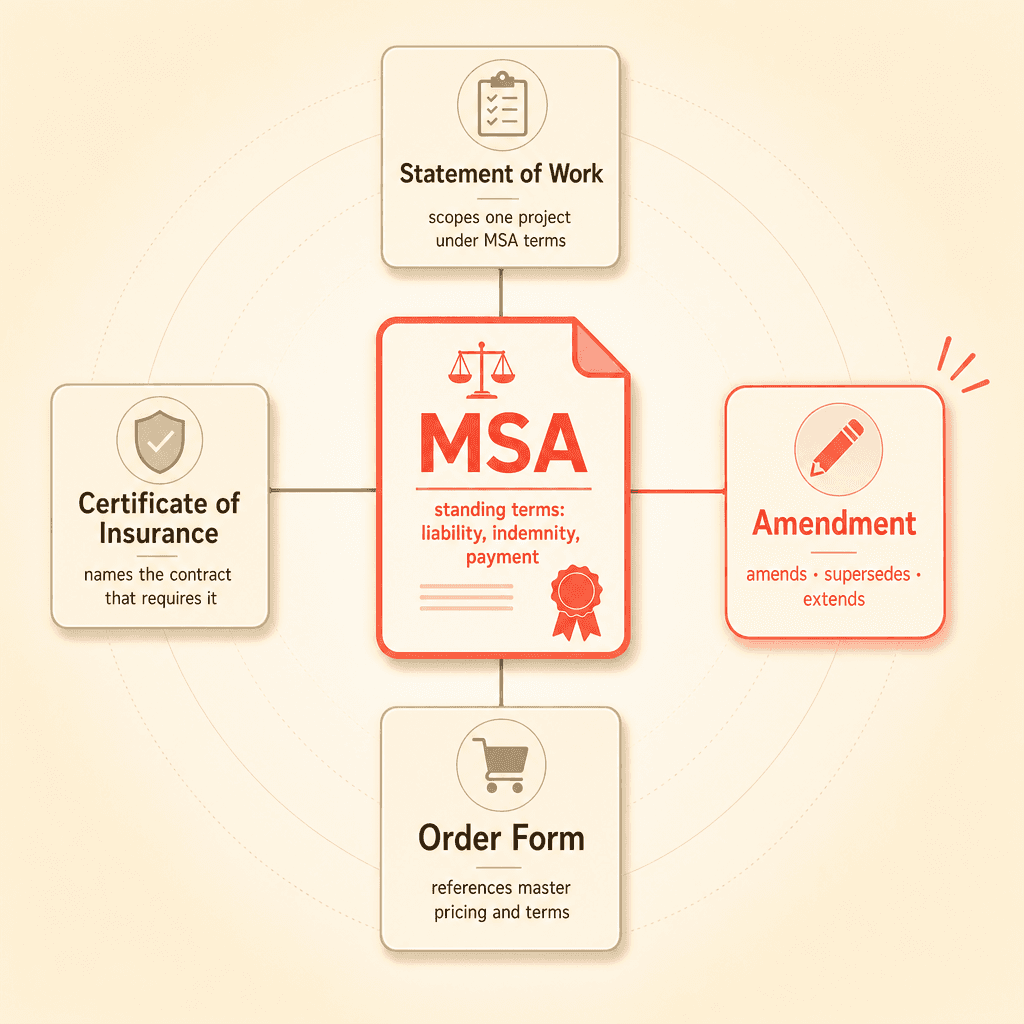
A system that stores documents as isolated records forces you to rebuild that family from memory, every time.
The hidden cost of manual contract document linking
Manual contract document linking becomes a permanent tax on your team as soon as volume grows.
Manual linking sounds cheap: one click at upload. Multiply that click across hundreds or thousands of supplemental documents and the bill never stops coming.
Teams running contract intake at volume commonly describe the same wound. An order form or SOW gets uploaded with no link to its parent MSA, and every later reviewer has to ask what the document even belongs to. Retroactive cleanup means tracing who uploaded a file and which master it belongs to, long after that context has decayed.
The tree structure of manual links makes partial visibility the default, even for disciplined teams. Link a new amendment to an MSA and its sibling amendments stay invisible to one another; each relationship has to be built on the parent individually. A master carrying eight amendments is not eight extra documents; it is an accumulating chain of manual acts that repeats with every new SOW.
Ambiguity raises the cost further. A vendor with two contracts signed the same day, or a master with a long amendment history, forces the uploader to pick the right parent under time pressure. Manual linking leans on naming conventions and search discipline, and both degrade as your repository grows.
Procurement and vendor management teams feel a version of this too. Every certificate of insurance arrives as a separate document with its own expiration dates, and each one must be tied back to the right parent by hand.
Why required fields backfire
Making the link field mandatory trades missing links for wrong ones.
The instinctive fix is policy: make the link field mandatory at upload. Teams that have tried this report the same outcome. Users under deadline find ways around required fields, picking placeholder parents or whatever value clears the form.
Wrong links are harder to detect and harder to fix than missing ones. Policing compliance fails where automation works, because a required field asks humans to perform an optional-feeling step perfectly, forever.
The better question is the one legal ops leaders keep asking: can the system recognize the relationship on its own, so nobody has to already know it?
How AI detects parent-child relationships
Documents carry evidence of their own relationships. An amendment does not just change terms; it names the agreement it amends, often down to the execution date and the defined term for each party. SOWs recite the master they sit under, and certificates of insurance name both the insured party and the contract that requires them.
Those are the same signals AI already reads well. Concord’s AI contract data extraction identifies parties, dates, and key terms at upload, and Bulk AI Data Extraction applies the same reading across an entire existing repository. Custom extraction prompts let you target the exact reference language your templates use.
Relationship detection builds on that foundation. Match the parties, titles, dates, and amendment references in a new document against the agreements already on file, then propose the parent. The shift in effort is the point: your team stops constructing links and starts confirming them.
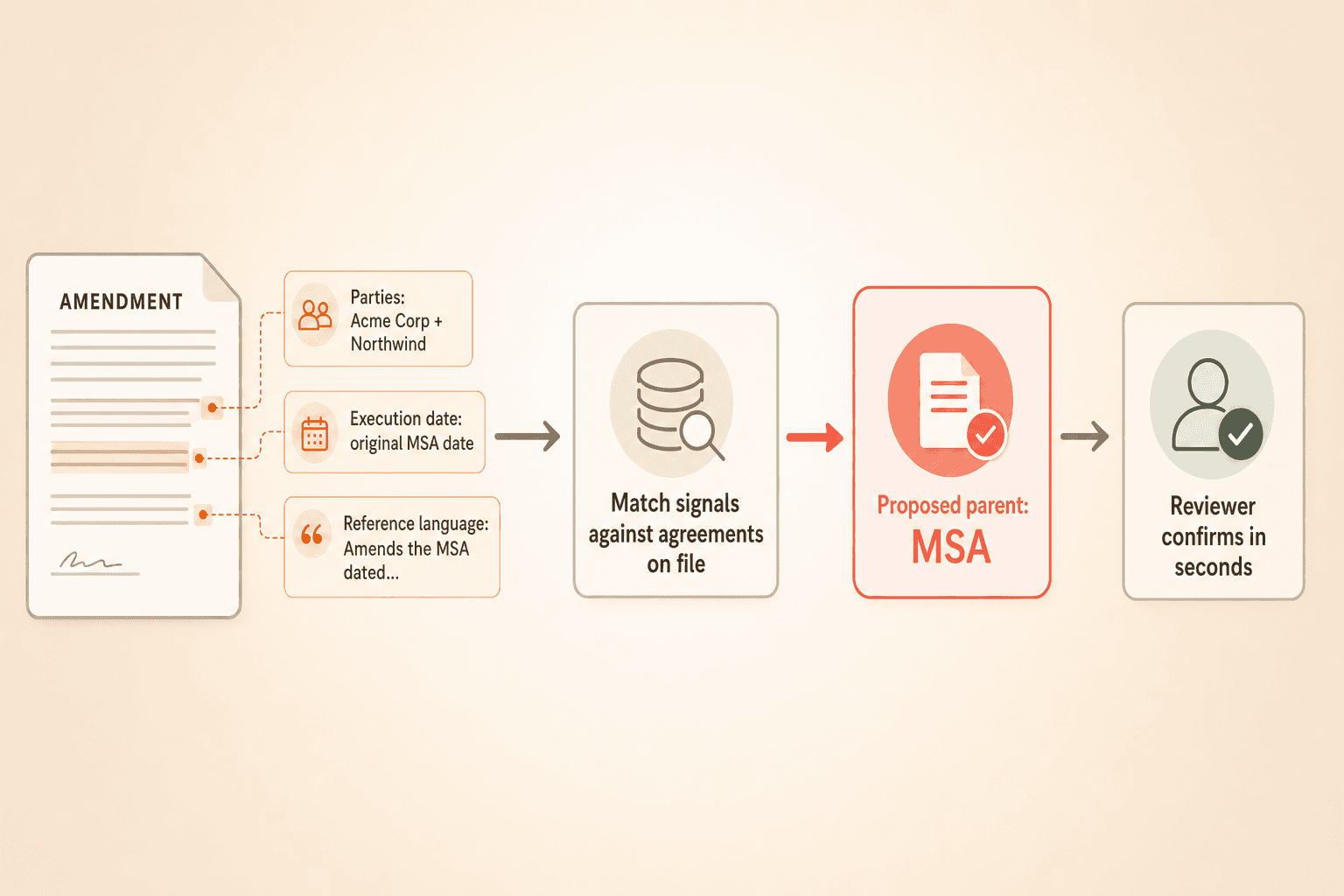
A reviewer approving a suggested parent spends seconds. The same link built by hand costs search time, cross-checks, and guesswork, especially when a counterparty has two masters signed the same day and the system has to surface candidates for a human to pick between. Review is always cheaper than construction.
Review is always cheaper than construction.
| Manual linking | AI-assisted detection |
|---|---|---|
Who creates the link | The uploader, by hand, every time | The system proposes; a person confirms |
Cost per document | Search time, cross-checks, guesswork | Seconds to review a suggestion |
Legacy backlog | Retroactive cleanup by tracing uploaders | Bulk extraction reads the existing repository |
Typical error mode | Missing links, or wrong parents under deadline | Occasional wrong suggestion, caught in review |
Sibling visibility | Invisible unless cross-linked by hand | The whole family on one screen |
See how Concord’s AI extraction reads the relationships already inside your contracts. Book a demo.
From tree to web: seeing the whole contract family
Visibility is the difference between a tree and a web. In a tree, every child hangs off the parent and siblings never see each other. Open amendment four and you learn nothing about amendments one through three unless someone cross-linked them by hand, which almost nobody does.
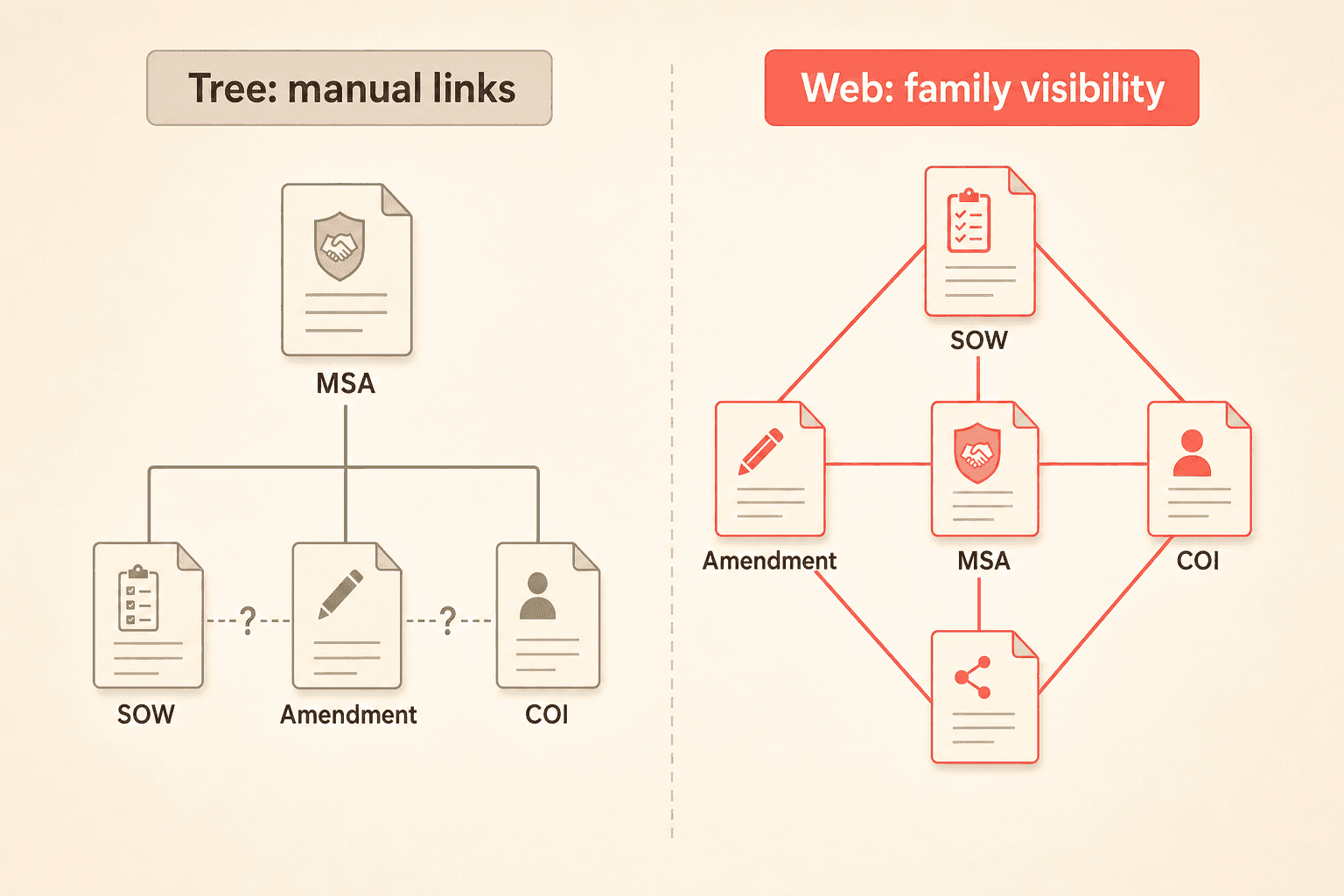
Family-level visibility means every document knows its relatives. Open the MSA and see each SOW, amendment, and certificate attached to it, with the contract hierarchy intact. Open any amendment and its siblings appear next to the master it modifies, the full web of parent-child contract relationships on one screen.
The legally current state of a relationship stops being a mental reconstruction and becomes a screen you can trust. That is what organizing a contract repository is actually for.
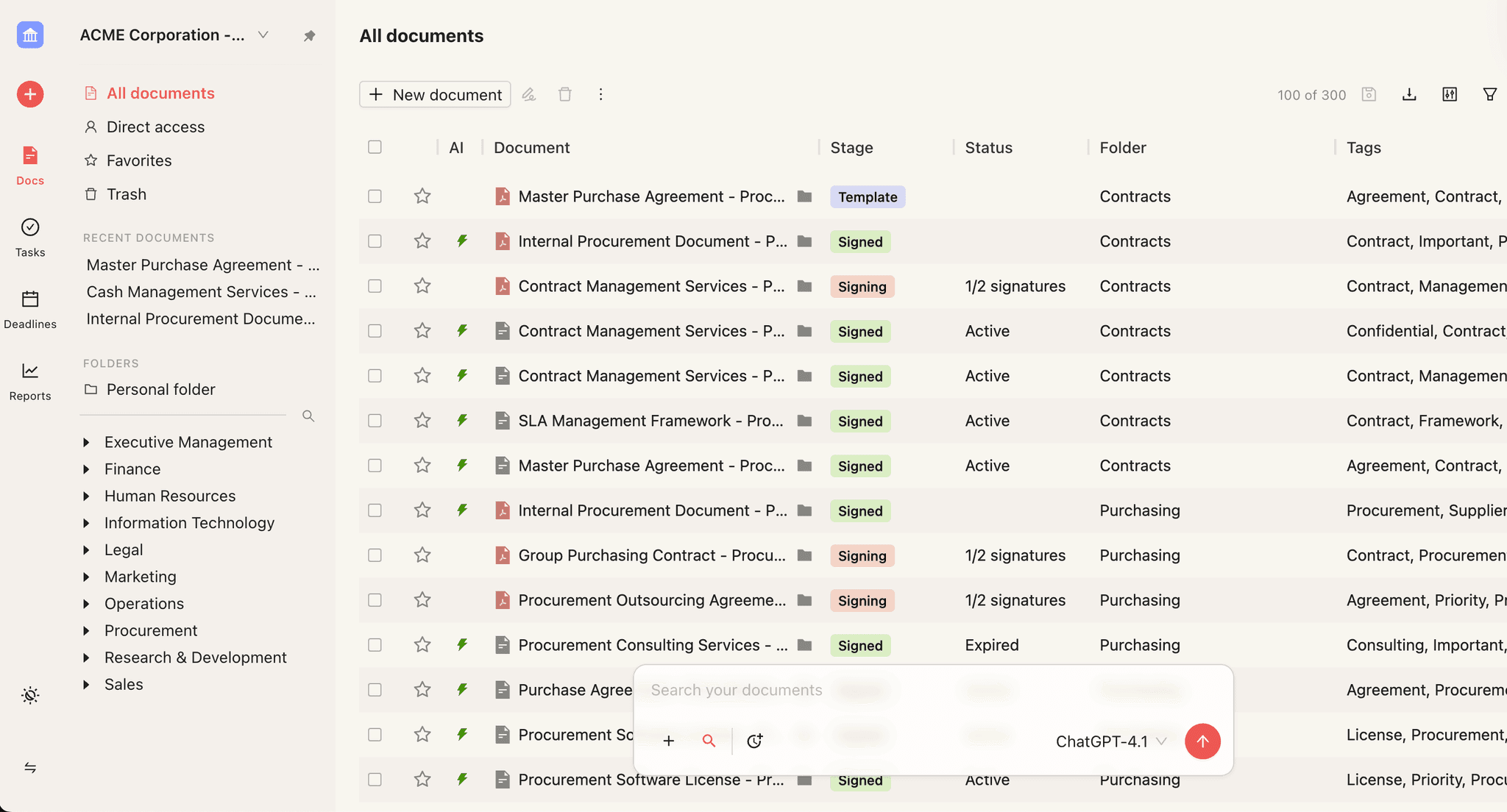
Transcript: “We do have the contract linking or document linking. Doesn’t have to be a contract. So this is where you can come in and basically link together whatever you want. So I can link to, I can amend, I can say if it’s a framework agreement, supersedes, extends. So if I have a contract signed today, six months from now, there’s an amendment to that agreement. This is an easy way for me to be able to go into any one of those contracts and see the relationship between them.”
What family visibility makes possible
Contract document linking is not clerical housekeeping. It is the data model for everything downstream in AI contract management.
Renewal and obligation tracking only work when the system knows which documents belong together; an amendment that quietly extends a term changes your renewal date whether or not anyone flags it. Reporting only means something when families count as families instead of loose files.
Vendor reviews stop requiring a folder-by-folder audit, and contract amendment tracking becomes a read, not a hunt.
Teams also want gap awareness: a flag when a counterparty’s family looks incomplete, such as an MSA and SOW on file with no NDA. Today that check runs on manual workarounds and custom fields, exactly the kind of maintenance that belongs in software rather than in someone’s memory. Extracted relationship data paired with workflow automation points the way: proposed links routed into review queues, owners notified when families change.
The bottom line
MSA and SOW management lives or dies on the family view. Manual contract document linking cannot keep up with the volume of amendments, order forms, and certificates your repository absorbs, and required fields only trade one failure for another. The durable fix is reading the relationships already written into your documents.
See how Concord’s AI reads and organizes your contracts. Book a demo.
Every contract in your repository either stands alone or belongs to a family. A master services agreement (MSA) spawns statements of work (SOWs), amendments, order forms, and certificates of insurance, and each one only makes sense in context.
Contract document linking creates that context: the recorded connection between each child document and its parent. In most repositories, someone has to create every link by hand, on every document, every time. That model holds at low volume and breaks everywhere else.
Key takeaways
Contract document linking records the connection between each child document (SOW, amendment, order form, certificate of insurance) and its parent MSA. The family, not any single file, is the legally current state of a relationship.
Manual linking is a permanent tax: every supplemental document needs a hand-built link, and siblings stay invisible to each other even on disciplined teams.
Required fields backfire. Under deadline, users pick whatever clears the form, trading missing links for wrong ones.
Documents carry evidence of their own relationships. AI extraction reads parties, dates, and amendment references, then proposes the parent so your team confirms links instead of constructing them.
Review is always cheaper than construction.
What is a contract family?
A contract family is the full set of documents that governs a single commercial relationship. The MSA sets the standing terms: liability, indemnity, payment, governing law. SOWs scope individual projects under those terms.
Amendments change the terms over time, and supporting records attach along the way. The family, not any single file, is the legally current state of your relationship with a customer or vendor. Ask “what are our terms with this vendor right now” and the only honest answer comes from reading the master plus every amendment stacked on top of it.
A system that stores documents as isolated records forces you to rebuild that family from memory, every time.
The hidden cost of manual contract document linking
Manual contract document linking becomes a permanent tax on your team as soon as volume grows.
Manual linking sounds cheap: one click at upload. Multiply that click across hundreds or thousands of supplemental documents and the bill never stops coming.
Teams running contract intake at volume commonly describe the same wound. An order form or SOW gets uploaded with no link to its parent MSA, and every later reviewer has to ask what the document even belongs to. Retroactive cleanup means tracing who uploaded a file and which master it belongs to, long after that context has decayed.
The tree structure of manual links makes partial visibility the default, even for disciplined teams. Link a new amendment to an MSA and its sibling amendments stay invisible to one another; each relationship has to be built on the parent individually. A master carrying eight amendments is not eight extra documents; it is an accumulating chain of manual acts that repeats with every new SOW.
Ambiguity raises the cost further. A vendor with two contracts signed the same day, or a master with a long amendment history, forces the uploader to pick the right parent under time pressure. Manual linking leans on naming conventions and search discipline, and both degrade as your repository grows.
Procurement and vendor management teams feel a version of this too. Every certificate of insurance arrives as a separate document with its own expiration dates, and each one must be tied back to the right parent by hand.
Why required fields backfire
Making the link field mandatory trades missing links for wrong ones.
The instinctive fix is policy: make the link field mandatory at upload. Teams that have tried this report the same outcome. Users under deadline find ways around required fields, picking placeholder parents or whatever value clears the form.
Wrong links are harder to detect and harder to fix than missing ones. Policing compliance fails where automation works, because a required field asks humans to perform an optional-feeling step perfectly, forever.
The better question is the one legal ops leaders keep asking: can the system recognize the relationship on its own, so nobody has to already know it?
How AI detects parent-child relationships
Documents carry evidence of their own relationships. An amendment does not just change terms; it names the agreement it amends, often down to the execution date and the defined term for each party. SOWs recite the master they sit under, and certificates of insurance name both the insured party and the contract that requires them.
Those are the same signals AI already reads well. Concord’s AI contract data extraction identifies parties, dates, and key terms at upload, and Bulk AI Data Extraction applies the same reading across an entire existing repository. Custom extraction prompts let you target the exact reference language your templates use.
Relationship detection builds on that foundation. Match the parties, titles, dates, and amendment references in a new document against the agreements already on file, then propose the parent. The shift in effort is the point: your team stops constructing links and starts confirming them.
A reviewer approving a suggested parent spends seconds. The same link built by hand costs search time, cross-checks, and guesswork, especially when a counterparty has two masters signed the same day and the system has to surface candidates for a human to pick between. Review is always cheaper than construction.
Review is always cheaper than construction.
| Manual linking | AI-assisted detection |
|---|---|---|
Who creates the link | The uploader, by hand, every time | The system proposes; a person confirms |
Cost per document | Search time, cross-checks, guesswork | Seconds to review a suggestion |
Legacy backlog | Retroactive cleanup by tracing uploaders | Bulk extraction reads the existing repository |
Typical error mode | Missing links, or wrong parents under deadline | Occasional wrong suggestion, caught in review |
Sibling visibility | Invisible unless cross-linked by hand | The whole family on one screen |
See how Concord’s AI extraction reads the relationships already inside your contracts. Book a demo.
From tree to web: seeing the whole contract family
Visibility is the difference between a tree and a web. In a tree, every child hangs off the parent and siblings never see each other. Open amendment four and you learn nothing about amendments one through three unless someone cross-linked them by hand, which almost nobody does.
Family-level visibility means every document knows its relatives. Open the MSA and see each SOW, amendment, and certificate attached to it, with the contract hierarchy intact. Open any amendment and its siblings appear next to the master it modifies, the full web of parent-child contract relationships on one screen.
The legally current state of a relationship stops being a mental reconstruction and becomes a screen you can trust. That is what organizing a contract repository is actually for.
Transcript: “We do have the contract linking or document linking. Doesn’t have to be a contract. So this is where you can come in and basically link together whatever you want. So I can link to, I can amend, I can say if it’s a framework agreement, supersedes, extends. So if I have a contract signed today, six months from now, there’s an amendment to that agreement. This is an easy way for me to be able to go into any one of those contracts and see the relationship between them.”
What family visibility makes possible
Contract document linking is not clerical housekeeping. It is the data model for everything downstream in AI contract management.
Renewal and obligation tracking only work when the system knows which documents belong together; an amendment that quietly extends a term changes your renewal date whether or not anyone flags it. Reporting only means something when families count as families instead of loose files.
Vendor reviews stop requiring a folder-by-folder audit, and contract amendment tracking becomes a read, not a hunt.
Teams also want gap awareness: a flag when a counterparty’s family looks incomplete, such as an MSA and SOW on file with no NDA. Today that check runs on manual workarounds and custom fields, exactly the kind of maintenance that belongs in software rather than in someone’s memory. Extracted relationship data paired with workflow automation points the way: proposed links routed into review queues, owners notified when families change.
The bottom line
MSA and SOW management lives or dies on the family view. Manual contract document linking cannot keep up with the volume of amendments, order forms, and certificates your repository absorbs, and required fields only trade one failure for another. The durable fix is reading the relationships already written into your documents.
See how Concord’s AI reads and organizes your contracts. Book a demo.
Need to know
Frequently Asked Questions

Take the "management" out
of contract management.
Customer Support
Legal
Compare
Resources
Customer Support
Company
Legal
Compare
Resources
Customer Support
Company
Legal
Compare
© 2025 Concord. All rights reserved.