AI contract data extraction: custom fields and metadata
AI contract data extraction: custom fields and metadata
AI contract data extraction: custom fields and metadata
AI contract data extraction: custom fields and metadata
contract management
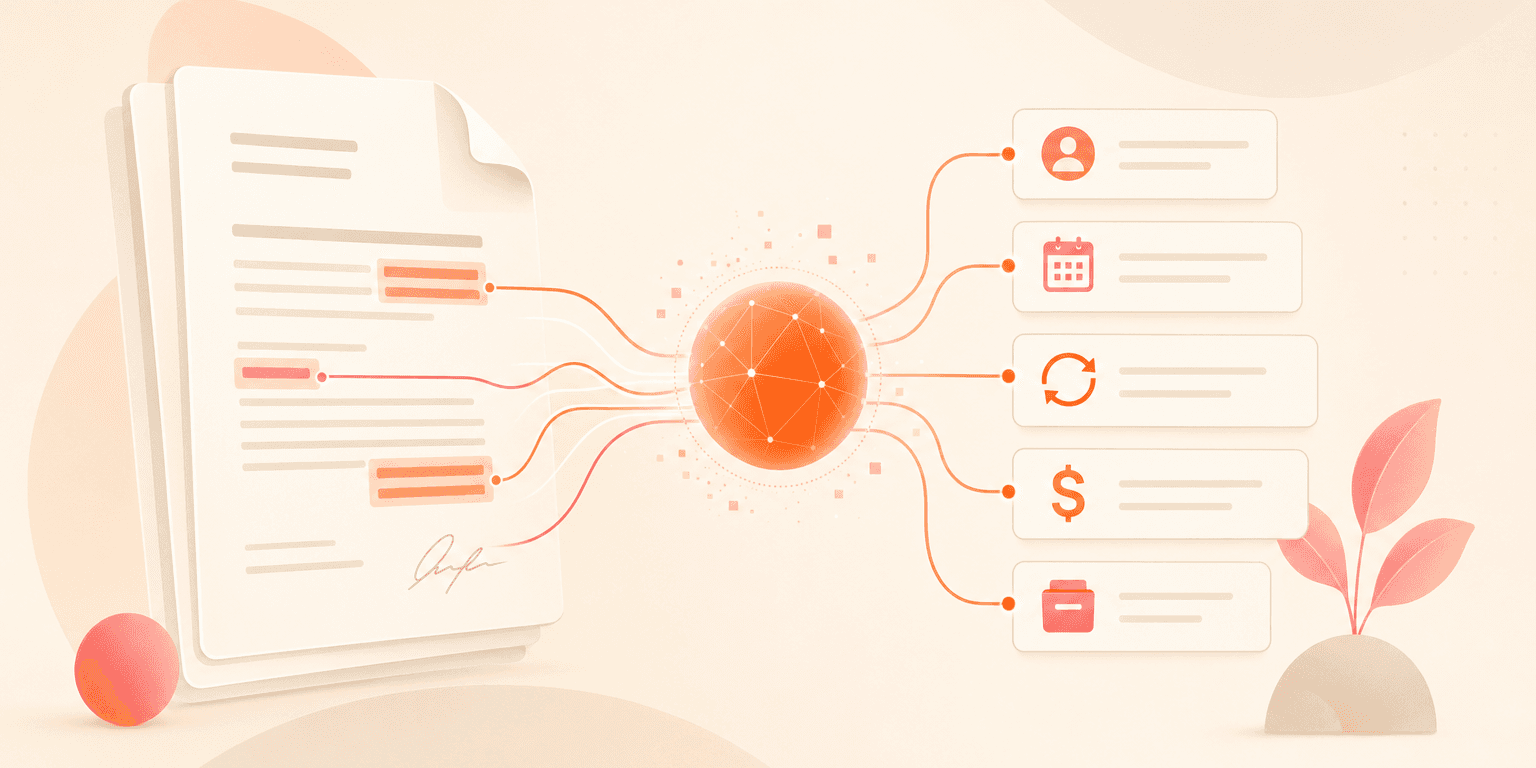
Your contract repository is only as useful as the data attached to each document. When parties, dates, renewal terms, and financial amounts are missing or inconsistent, reports break, renewals sneak up, and teams fall back to opening PDFs one by one. For legal and procurement groups managing hundreds or thousands of agreements, manual data entry has been the default answer, and it has been slow, inconsistent, and expensive.
AI contract data extraction removes that bottleneck. Instead of asking a paralegal to read each contract and type fields into a spreadsheet, your CLM platform reads the document, identifies the key data points, and writes them into structured fields you can search, filter, and report on. According to our research, prospects consistently rank contract visibility and metadata completeness as top priorities when replacing legacy CLM tools.
Why contract metadata is the bottleneck in CLM
Most teams inherit repositories that were never fully populated. Older systems required users to type counterparty names, effective dates, and renewal windows by hand, and teams gave up somewhere between import and implementation. The result is a searchable folder structure, not a searchable database.
The fix is not more paralegal hours. The fix is a contract repository where every document arrives with its metadata already extracted, normalized, and ready for reporting.
Teams that want a faster way to understand document contents at a glance can also benefit from AI contract summary software, which condenses key terms into concise overviews without manual review.
Teams looking to modernize their legal operations can explore a broader overview of AI for legal contracts and what it enables across the contract lifecycle.
How AI contract data extraction works
Before AI can populate any field, the document has to be readable. Concord's extraction pipeline starts with optical character recognition (OCR) that converts scanned PDFs, images, and third-party exports into machine-readable text. From there, the AI identifies contract-relevant patterns: party names near signature blocks, dates near words like "effective" or "termination," monetary amounts near fee schedules, and clause references throughout the document body.
The model then writes those values into structured property fields attached to the contract. Because the data lives as structured properties rather than free text, you can filter on it, report on it, trigger workflows from it, and export it to other systems.
Standard fields extracted automatically
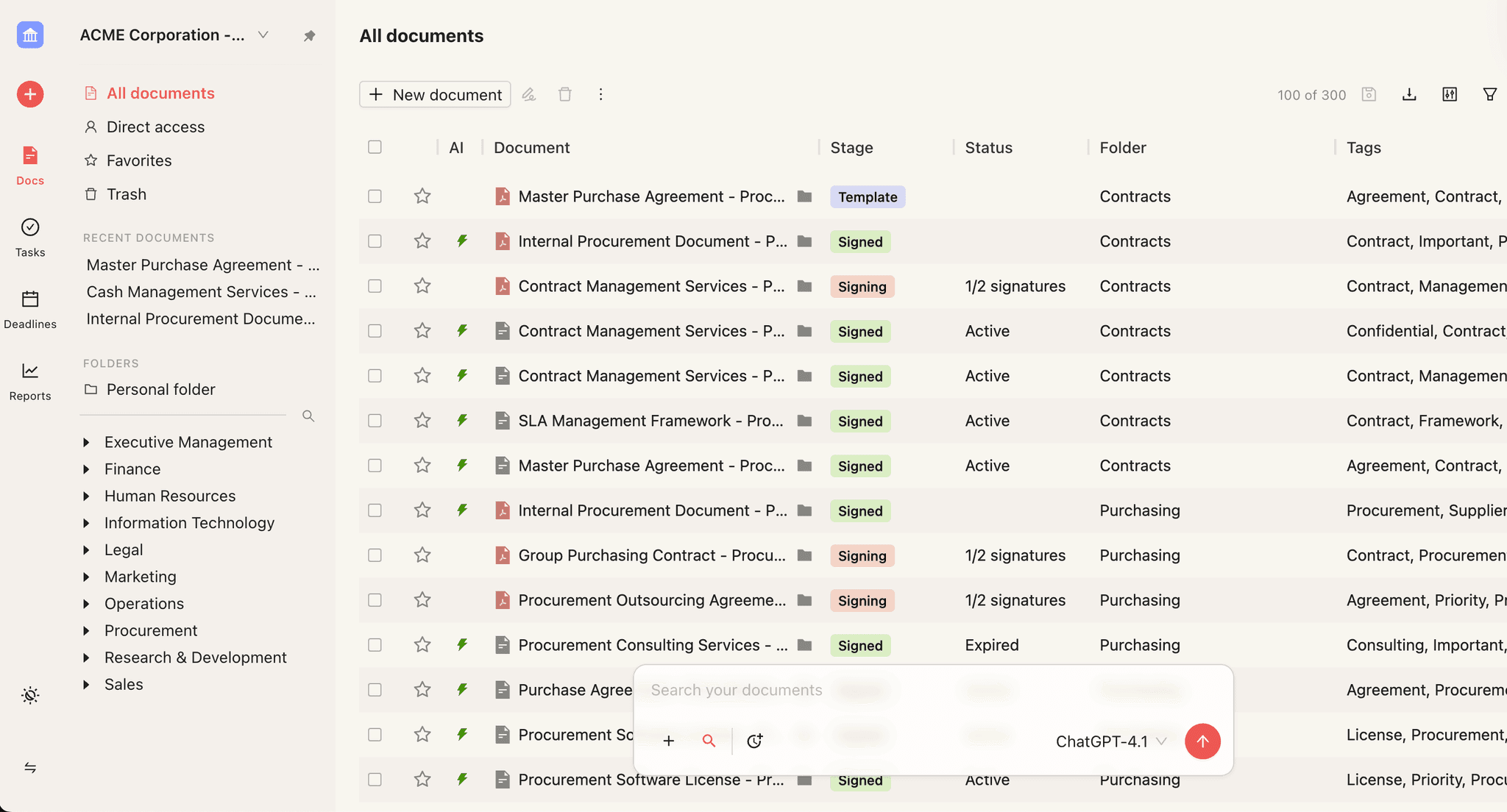
When you upload a contract into Concord, AI Contract Property Extraction captures seven categories of standard metadata without any manual setup:
Agreement category (procurement, sales, HR, real estate)
Document type (NDA, MSA, employment agreement, lease, statement of work)
Parties (counterparty name and your signing entity)
Description and subject matter
Lifecycle dates (signature, effective date, duration, renewal, termination notice)
Financial terms (total contract value, recurring amounts, payment terms)
Key clauses and references
These fields populate automatically on every contract you ingest, whether it is a brand-new agreement drafted in Concord or a scanned copy of a five-year-old MSA pulled from a shared drive. That coverage matters because most portfolios carry a long tail of historical documents where manual data entry was never completed.
Custom AI Property Extraction: fields you define by contract type
Standard metadata covers the questions every team asks. Real contract portfolios require more than that. A procurement lead tracking a SaaS vendor agreement cares about price-escalation caps and data processing addendum references. An HR leader managing employment contracts cares about notice periods, non-compete duration, and equity vesting schedules. A real estate manager reviewing leases cares about rent escalation clauses and option-to-renew windows.
Concord's Custom AI Property Extraction lets you define those fields yourself, by contract type, using natural-language prompts. You tell the AI what to look for ("extract the limitation of liability cap as a dollar amount"), specify the data type (text, number, date, currency, dropdown), and apply it only to the contract types where it matters. The AI then populates that field on every matching document, both new uploads and existing contracts in your repository.
Because extraction is conditional on contract type, NDAs do not get cluttered with lease-specific fields, and MSAs do not lose relevant fields because the template was built for something generic. You can define unlimited custom properties, which matters for teams managing master agreements, amendments, and umbrella contracts that each carry different data points.
Retroactive extraction on historical contracts
Teams migrating from legacy CLMs, shared drives, or spreadsheets often ask the same question: can the AI process existing contracts, not just new ones? Yes. Concord's Bulk AI Data Extraction runs extraction across many contracts at once, with real-time progress monitoring and downloadable results. During implementation, you can point it at your historical repository and let it populate standard and custom fields across thousands of documents in a single pass.
You can also preview results before committing them. AI Contract Preview Extraction shows what the model found for each field so your team can review, correct, and approve before the data is written to the record. For high-stakes fields like indemnity caps or auto-renewal dates, that review step keeps humans in the loop where it counts.
From extraction to reporting and obligation tracking
Structured metadata is only useful when it feeds something downstream. Once fields are populated, they power four capabilities inside Concord:
Search and filtering. Find every contract with a termination-for-convenience clause, or every agreement expiring in the next 90 days, in seconds.
Reports and dashboards. Roll up total contract value by counterparty, renewal exposure by quarter, or indemnity caps by contract type through reporting and analytics.
Automated workflows. AI-Powered Workflow Builder uses extracted fields to trigger renewal notices, approval routings, or obligation reminders automatically.
Exports and integrations. Smart Fields Export pushes structured data into spreadsheets, BI tools, or downstream systems like ERP and CRM.
That chain, from OCR to extraction to reporting to automation, is what turns a contract repository into an actual data source.
What to consider when evaluating AI extraction accuracy
Accuracy claims in the CLM market vary widely, and the right question is not "what is your accuracy percentage" but "under what conditions." Here is what matters:
OCR fidelity on messy documents. Clean, native PDFs extract well across most tools. Scanned copies, faxed amendments, and handwritten addenda are where accuracy diverges. Ask vendors how they handle low-quality scans and variable formats.
Coverage across contract types. A tool that handles NDAs well but struggles on multi-schedule MSAs is not ready for a real portfolio. Test extraction on your own mix of documents, not a vendor-supplied sample.
Review and correction workflow. No AI hits 100 percent accuracy on every field. The practical question is how quickly a human can spot and fix errors. Preview modes, inline edits, and audit trails matter as much as raw model performance.
Custom field flexibility. Can you add new extraction fields without vendor engineering work? Can you change them later? When extraction is hard-coded, your repository freezes the day it ships.
According to our research, sophisticated prospects expect the AI to do the heavy lifting while flagging complex contracts for human review, particularly those with many embedded dates or layered financial schedules.
FAQ
What is AI contract data extraction?
AI contract data extraction is the automated process of reading a contract document and pulling key data points (parties, dates, financial terms, clauses) into structured fields you can search, filter, and report on. It replaces the manual data entry that legal and procurement teams have traditionally done by hand and makes metadata available across every document in your repository.
Can AI extract custom fields specific to our contract types?
Yes. Concord's Custom AI Property Extraction lets you define your own fields using natural-language prompts and apply them by contract type. You can set up different extraction rules for NDAs, MSAs, leases, or employment agreements, with no cap on the number of custom properties you configure.
Does AI extraction work on historical contracts, not just new ones?
Yes. Bulk AI Data Extraction processes existing contracts in your repository so you can migrate from legacy systems or spreadsheets without redoing manual data entry. During implementation, the AI can populate standard and custom fields across thousands of documents in a single run, with real-time progress monitoring.
How accurate is Concord's AI extraction?
Concord's AI achieves high accuracy on standard lifecycle date and party extraction across typical contract formats. For complex contracts with many embedded dates or financial schedules, manual review is recommended, and the preview and approval workflow makes that review quick and auditable.
See AI contract data extraction on your own contracts
If your team still retypes contract metadata into spreadsheets, you are paying for that work twice: once in labor, and again in the missed renewals and reporting gaps that follow. AI contract data extraction captures standard fields from every document automatically, and Custom AI Property Extraction lets you define the contract-specific data that matters to your team.
Book a Concord demo to see how AI contract data extraction and custom fields work on your contract types.
Your contract repository is only as useful as the data attached to each document. When parties, dates, renewal terms, and financial amounts are missing or inconsistent, reports break, renewals sneak up, and teams fall back to opening PDFs one by one. For legal and procurement groups managing hundreds or thousands of agreements, manual data entry has been the default answer, and it has been slow, inconsistent, and expensive.
AI contract data extraction removes that bottleneck. Instead of asking a paralegal to read each contract and type fields into a spreadsheet, your CLM platform reads the document, identifies the key data points, and writes them into structured fields you can search, filter, and report on. According to our research, prospects consistently rank contract visibility and metadata completeness as top priorities when replacing legacy CLM tools.
Why contract metadata is the bottleneck in CLM
Most teams inherit repositories that were never fully populated. Older systems required users to type counterparty names, effective dates, and renewal windows by hand, and teams gave up somewhere between import and implementation. The result is a searchable folder structure, not a searchable database.
The fix is not more paralegal hours. The fix is a contract repository where every document arrives with its metadata already extracted, normalized, and ready for reporting.
Teams that want a faster way to understand document contents at a glance can also benefit from AI contract summary software, which condenses key terms into concise overviews without manual review.
Teams looking to modernize their legal operations can explore a broader overview of AI for legal contracts and what it enables across the contract lifecycle.
How AI contract data extraction works
Before AI can populate any field, the document has to be readable. Concord's extraction pipeline starts with optical character recognition (OCR) that converts scanned PDFs, images, and third-party exports into machine-readable text. From there, the AI identifies contract-relevant patterns: party names near signature blocks, dates near words like "effective" or "termination," monetary amounts near fee schedules, and clause references throughout the document body.
The model then writes those values into structured property fields attached to the contract. Because the data lives as structured properties rather than free text, you can filter on it, report on it, trigger workflows from it, and export it to other systems.
Standard fields extracted automatically
When you upload a contract into Concord, AI Contract Property Extraction captures seven categories of standard metadata without any manual setup:
Agreement category (procurement, sales, HR, real estate)
Document type (NDA, MSA, employment agreement, lease, statement of work)
Parties (counterparty name and your signing entity)
Description and subject matter
Lifecycle dates (signature, effective date, duration, renewal, termination notice)
Financial terms (total contract value, recurring amounts, payment terms)
Key clauses and references
These fields populate automatically on every contract you ingest, whether it is a brand-new agreement drafted in Concord or a scanned copy of a five-year-old MSA pulled from a shared drive. That coverage matters because most portfolios carry a long tail of historical documents where manual data entry was never completed.
Custom AI Property Extraction: fields you define by contract type
Standard metadata covers the questions every team asks. Real contract portfolios require more than that. A procurement lead tracking a SaaS vendor agreement cares about price-escalation caps and data processing addendum references. An HR leader managing employment contracts cares about notice periods, non-compete duration, and equity vesting schedules. A real estate manager reviewing leases cares about rent escalation clauses and option-to-renew windows.
Concord's Custom AI Property Extraction lets you define those fields yourself, by contract type, using natural-language prompts. You tell the AI what to look for ("extract the limitation of liability cap as a dollar amount"), specify the data type (text, number, date, currency, dropdown), and apply it only to the contract types where it matters. The AI then populates that field on every matching document, both new uploads and existing contracts in your repository.
Because extraction is conditional on contract type, NDAs do not get cluttered with lease-specific fields, and MSAs do not lose relevant fields because the template was built for something generic. You can define unlimited custom properties, which matters for teams managing master agreements, amendments, and umbrella contracts that each carry different data points.
Retroactive extraction on historical contracts
Teams migrating from legacy CLMs, shared drives, or spreadsheets often ask the same question: can the AI process existing contracts, not just new ones? Yes. Concord's Bulk AI Data Extraction runs extraction across many contracts at once, with real-time progress monitoring and downloadable results. During implementation, you can point it at your historical repository and let it populate standard and custom fields across thousands of documents in a single pass.
You can also preview results before committing them. AI Contract Preview Extraction shows what the model found for each field so your team can review, correct, and approve before the data is written to the record. For high-stakes fields like indemnity caps or auto-renewal dates, that review step keeps humans in the loop where it counts.
From extraction to reporting and obligation tracking
Structured metadata is only useful when it feeds something downstream. Once fields are populated, they power four capabilities inside Concord:
Search and filtering. Find every contract with a termination-for-convenience clause, or every agreement expiring in the next 90 days, in seconds.
Reports and dashboards. Roll up total contract value by counterparty, renewal exposure by quarter, or indemnity caps by contract type through reporting and analytics.
Automated workflows. AI-Powered Workflow Builder uses extracted fields to trigger renewal notices, approval routings, or obligation reminders automatically.
Exports and integrations. Smart Fields Export pushes structured data into spreadsheets, BI tools, or downstream systems like ERP and CRM.
That chain, from OCR to extraction to reporting to automation, is what turns a contract repository into an actual data source.
What to consider when evaluating AI extraction accuracy
Accuracy claims in the CLM market vary widely, and the right question is not "what is your accuracy percentage" but "under what conditions." Here is what matters:
OCR fidelity on messy documents. Clean, native PDFs extract well across most tools. Scanned copies, faxed amendments, and handwritten addenda are where accuracy diverges. Ask vendors how they handle low-quality scans and variable formats.
Coverage across contract types. A tool that handles NDAs well but struggles on multi-schedule MSAs is not ready for a real portfolio. Test extraction on your own mix of documents, not a vendor-supplied sample.
Review and correction workflow. No AI hits 100 percent accuracy on every field. The practical question is how quickly a human can spot and fix errors. Preview modes, inline edits, and audit trails matter as much as raw model performance.
Custom field flexibility. Can you add new extraction fields without vendor engineering work? Can you change them later? When extraction is hard-coded, your repository freezes the day it ships.
According to our research, sophisticated prospects expect the AI to do the heavy lifting while flagging complex contracts for human review, particularly those with many embedded dates or layered financial schedules.
FAQ
What is AI contract data extraction?
AI contract data extraction is the automated process of reading a contract document and pulling key data points (parties, dates, financial terms, clauses) into structured fields you can search, filter, and report on. It replaces the manual data entry that legal and procurement teams have traditionally done by hand and makes metadata available across every document in your repository.
Can AI extract custom fields specific to our contract types?
Yes. Concord's Custom AI Property Extraction lets you define your own fields using natural-language prompts and apply them by contract type. You can set up different extraction rules for NDAs, MSAs, leases, or employment agreements, with no cap on the number of custom properties you configure.
Does AI extraction work on historical contracts, not just new ones?
Yes. Bulk AI Data Extraction processes existing contracts in your repository so you can migrate from legacy systems or spreadsheets without redoing manual data entry. During implementation, the AI can populate standard and custom fields across thousands of documents in a single run, with real-time progress monitoring.
How accurate is Concord's AI extraction?
Concord's AI achieves high accuracy on standard lifecycle date and party extraction across typical contract formats. For complex contracts with many embedded dates or financial schedules, manual review is recommended, and the preview and approval workflow makes that review quick and auditable.
See AI contract data extraction on your own contracts
If your team still retypes contract metadata into spreadsheets, you are paying for that work twice: once in labor, and again in the missed renewals and reporting gaps that follow. AI contract data extraction captures standard fields from every document automatically, and Custom AI Property Extraction lets you define the contract-specific data that matters to your team.
Book a Concord demo to see how AI contract data extraction and custom fields work on your contract types.

Take the "management" out
of contract management.
Customer Support
Legal
Compare
Resources
Customer Support
Company
Legal
Compare
Resources
Customer Support
Company
Legal
Compare
© 2025 Concord. All rights reserved.