What is boilerplate language in contracts? Meaning and examples
What is boilerplate language in contracts? Meaning and examples
What is boilerplate language in contracts? Meaning and examples
What is boilerplate language in contracts? Meaning and examples
contract management

If you have ever reviewed a contract, you have likely encountered boilerplate language, even if you did not recognize it by that name. These are the standardized clauses that appear at the end of nearly every agreement, covering topics like governing law, severability, and force majeure. While they may look routine, boilerplate provisions carry real legal weight and deserve careful attention from anyone who drafts, reviews, or signs contracts.
This guide breaks down what boilerplate means in a legal context, walks through the most common boilerplate clauses with plain-language examples, and explains how to manage this critical contract language effectively.
What does "boilerplate" mean in legal contracts?
The term "boilerplate" originally referred to the steel plates used in steam boilers, and later to the pre-set text plates used by newspapers and printing presses. In legal practice, it describes standardized contract language that is reused across multiple agreements with little or no modification.
Boilerplate clauses typically address procedural and structural aspects of the contract relationship rather than the core commercial deal.
Understanding the broader contract structure starts with recognizing foundational contract types, so review our guide to unilateral vs bilateral contracts.
They govern what happens when something goes wrong, how disputes are handled, which laws apply, and how the agreement can be changed.
Why boilerplate clauses matter
It is tempting to skim past boilerplate sections and focus on the "real" terms of a deal, like pricing, deliverables, and timelines. That approach creates risk. Boilerplate clauses determine how your contract functions under stress, and courts enforce them.
They allocate risk. Clauses like indemnification, limitation of liability, and force majeure determine who bears financial exposure when things go sideways. A single poorly worded indemnification clause can expose your organization to uncapped liability.
They control dispute outcomes. Governing law and dispute resolution clauses dictate where and how conflicts are resolved. Signing a contract governed by the laws of an unfavorable jurisdiction can put you at a significant disadvantage before any argument begins.
They affect enforceability. Severability and entire agreement clauses protect the contract itself. Without a severability clause, one invalid provision could jeopardize the entire agreement.
Nine common boilerplate clauses with examples
Below are nine of the most frequently used boilerplate provisions. Each includes a plain-language explanation and an illustrative example. Note: these examples are for educational purposes only and do not constitute legal advice.
1\. Governing law
This clause specifies which jurisdiction's laws will interpret the contract.
_Example: "This Agreement shall be governed by and construed in accordance with the laws of the State of Delaware, without regard to its conflict of laws principles."_
2\. Dispute resolution
This clause establishes how disagreements will be handled, whether through litigation, arbitration, or mediation.
_Example: "Any dispute arising out of this Agreement shall be resolved by binding arbitration administered by the American Arbitration Association in accordance with its Commercial Arbitration Rules."_
3\. Severability
If a court finds one clause unenforceable, a severability provision keeps the rest of the contract intact.
_Example: "If any provision of this Agreement is held to be invalid or unenforceable, the remaining provisions shall continue in full force and effect."_
4\. Entire agreement (integration clause)
This clause confirms that the written contract represents the full agreement between the parties, superseding prior discussions or promises.
_Example: "This Agreement constitutes the entire agreement between the parties and supersedes all prior negotiations, representations, and agreements, whether written or oral."_
5\. Force majeure
Force majeure clauses excuse performance when extraordinary events, such as natural disasters, pandemics, or government actions, make fulfillment impossible or impractical.
_Example: "Neither party shall be liable for any failure to perform its obligations where such failure results from circumstances beyond the reasonable control of that party, including but not limited to acts of God, war, pandemic, or government regulation."_
6\. Assignment
This clause controls whether a party can transfer its rights or obligations under the contract to a third party.
_Example: "Neither party may assign this Agreement or any rights or obligations hereunder without the prior written consent of the other party, except in connection with a merger or acquisition."_
7\. Notices
The notices clause specifies how formal communications between the parties must be delivered to be legally effective.
_Example: "All notices required under this Agreement shall be in writing and delivered by certified mail, return receipt requested, or by nationally recognized overnight courier to the addresses set forth on the signature page."_
8\. Indemnification
Indemnification clauses require one party to compensate the other for certain losses, damages, or claims.
_Example: "Vendor shall indemnify, defend, and hold harmless Client from and against any third-party claims arising out of Vendor's breach of this Agreement or Vendor's negligence or willful misconduct."_
9\. Limitation of liability
This clause caps the amount of damages a party can recover under the contract.
_Example: "In no event shall either party's total aggregate liability under this Agreement exceed the total fees paid by Client in the twelve-month period preceding the claim."_
For a deeper look at how these clauses fit within the broader contract structure, see Concord's guide to contract clauses.
Risks of poorly managed boilerplate language
Because boilerplate appears in so many contracts, errors compound quickly. That gap creates several tangible risks.
Copy-and-paste errors. When team members pull standard language from old contracts rather than a controlled library, outdated terms, incorrect party references, and conflicting provisions slip in. Teams managing high volumes of repetitive agreements, such as independent contractor agreements across multiple jurisdictions, are especially vulnerable to these inconsistencies.
Language drift over time. Without a single source of truth, different team members may use slightly different versions of the same clause. Over months and years, your "standard" indemnification language may exist in five or six variants across your active contracts, each carrying different risk profiles.
Non-legal stakeholders making risky edits. Controllers, project coordinators, IT analysts, and other business users often participate in contract review. Without clear guidance on which clauses are negotiable and which are not, these users may accept changes to boilerplate language without understanding the legal implications.
Compliance exposure. In regulated industries, boilerplate clauses often contain compliance-critical language. Inconsistent boilerplate across your contract portfolio makes it harder to demonstrate uniform compliance practices.
For more on managing contract risk, see Concord's guide to contract lifecycle management.
How to standardize and manage boilerplate clauses
Addressing boilerplate risk requires a systematic approach that gives your legal team control while allowing business users to draft and execute contracts efficiently. Here is what that looks like in practice.
Build a centralized clause library
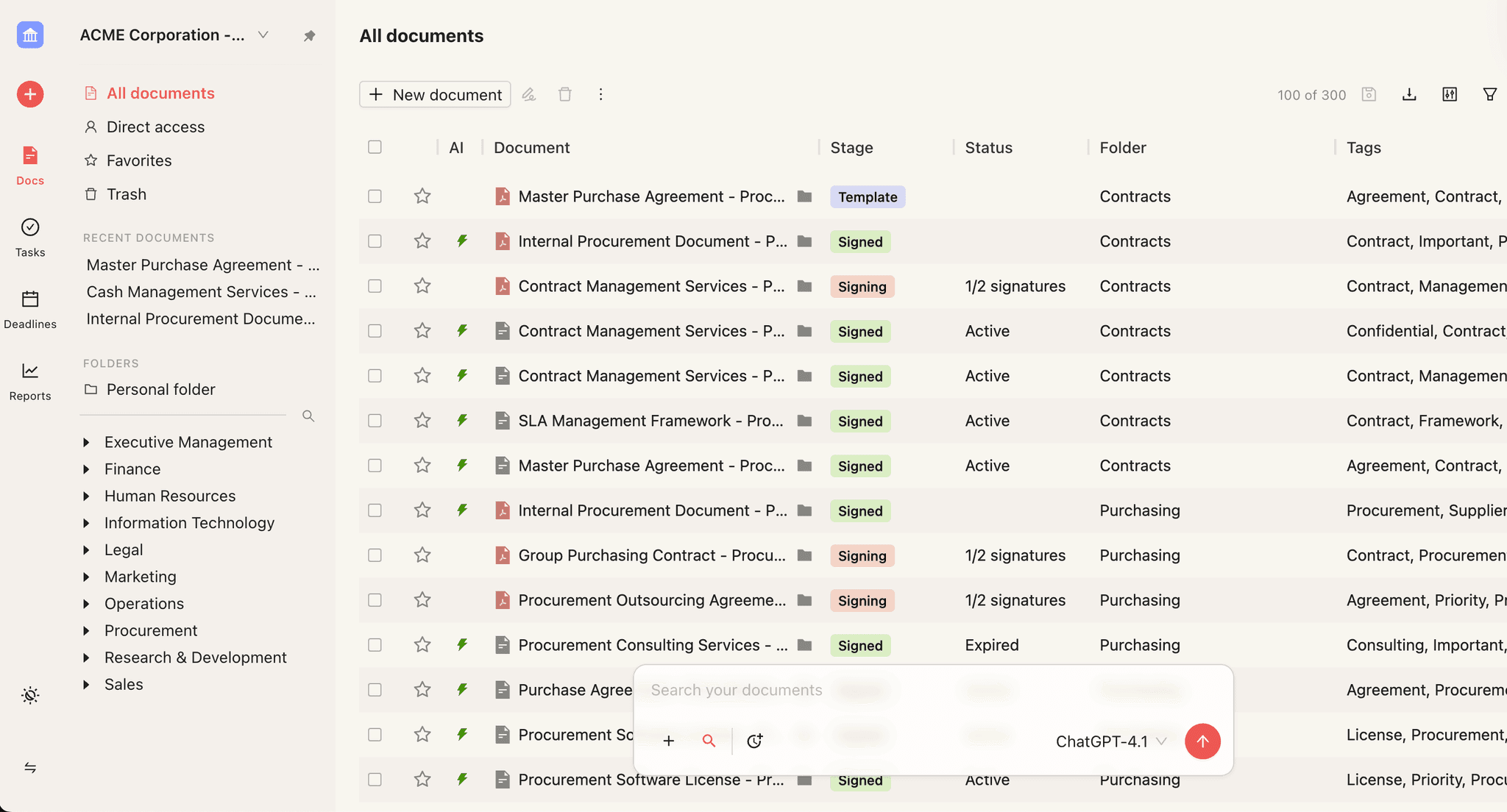
Your organization's boilerplate language should live in a single, controlled location, not scattered across Word documents, email threads, and old contract files. Concord's clause management feature lets your legal team maintain a library of pre-approved language organized by clause type, jurisdiction, and use case. When drafters need a governing law clause for a California-based agreement, they select it from the library rather than hunting through past contracts.
Separate what stays the same from what changes
Well-designed contract templates distinguish between fixed boilerplate sections and variable deal-specific fields like party names, dates, and financial terms. Concord's unified contract template fields create this separation explicitly, so boilerplate language remains consistent while your team customizes only the fields that should change. Learn more in Concord's guide to contract templates.
Set up governance for boilerplate deviations
Boilerplate is not "set and forget." When a counterparty redlines your limitation of liability clause or changes your governing law provision, someone qualified needs to review that change. Concord's conditional contract logic and business rules engine can trigger approval workflows automatically when specific boilerplate sections are modified. If a liability cap is changed beyond a pre-defined threshold, the system routes the contract to the appropriate reviewer before it moves forward.
Educate your broader team
Non-legal stakeholders involved in contract review need to understand what boilerplate clauses do and why they matter. Creating a simple internal reference guide, or using Concord's sample agreement feature to show new users what a well-structured contract looks like, reduces the likelihood of uninformed edits to critical provisions.
Use AI review to catch deviations in third-party paper
Your own contracts may have clean boilerplate, but what about agreements drafted by vendors, customers, or partners? AI-assisted review tools can compare incoming third-party contracts against your preferred standards, flagging where their boilerplate language deviates from your position on indemnification, termination notice, confidentiality, and other critical clauses.
Frequently asked questions
Can boilerplate clauses be negotiated? Yes. Despite the name "standard," boilerplate clauses are negotiable. In practice, parties frequently negotiate indemnification, limitation of liability, governing law, and dispute resolution clauses. The key is knowing which clauses your organization considers non-negotiable versus those where you have flexibility. A clause library with tiered language (preferred, acceptable, and fallback positions) helps your team negotiate efficiently.
What happens if a contract does not include standard boilerplate provisions? Omitting boilerplate clauses does not necessarily invalidate a contract, but it creates ambiguity. Without a governing law clause, courts will apply conflict-of-laws rules to determine which jurisdiction's law applies, and the result may not favor you. Without a severability clause, one unenforceable provision could potentially void the entire agreement. Including comprehensive boilerplate protects both parties by addressing scenarios the core deal terms do not cover.
How often should you update your boilerplate language? Review your standard clause language at least annually, or whenever significant legal, regulatory, or business changes occur. New data privacy laws, shifts in case law, or changes to your corporate structure can all render existing boilerplate inadequate. A centralized clause library makes updates straightforward: change the clause once, and every future contract pulls the current version.
Take control of your contract language
Boilerplate clauses form the structural foundation of every agreement your organization signs. Managing them well reduces legal risk, speeds up contract cycles, and keeps your team aligned. Concord's clause library, template management, and conditional logic features give you the tools to standardize, govern, and deploy your boilerplate language with confidence.
Ready to see how it works? Request a demo of Concord and explore the clause library and template capabilities for yourself.
If you have ever reviewed a contract, you have likely encountered boilerplate language, even if you did not recognize it by that name. These are the standardized clauses that appear at the end of nearly every agreement, covering topics like governing law, severability, and force majeure. While they may look routine, boilerplate provisions carry real legal weight and deserve careful attention from anyone who drafts, reviews, or signs contracts.
This guide breaks down what boilerplate means in a legal context, walks through the most common boilerplate clauses with plain-language examples, and explains how to manage this critical contract language effectively.
What does "boilerplate" mean in legal contracts?
The term "boilerplate" originally referred to the steel plates used in steam boilers, and later to the pre-set text plates used by newspapers and printing presses. In legal practice, it describes standardized contract language that is reused across multiple agreements with little or no modification.
Boilerplate clauses typically address procedural and structural aspects of the contract relationship rather than the core commercial deal.
Understanding the broader contract structure starts with recognizing foundational contract types, so review our guide to unilateral vs bilateral contracts.
They govern what happens when something goes wrong, how disputes are handled, which laws apply, and how the agreement can be changed.
Why boilerplate clauses matter
It is tempting to skim past boilerplate sections and focus on the "real" terms of a deal, like pricing, deliverables, and timelines. That approach creates risk. Boilerplate clauses determine how your contract functions under stress, and courts enforce them.
They allocate risk. Clauses like indemnification, limitation of liability, and force majeure determine who bears financial exposure when things go sideways. A single poorly worded indemnification clause can expose your organization to uncapped liability.
They control dispute outcomes. Governing law and dispute resolution clauses dictate where and how conflicts are resolved. Signing a contract governed by the laws of an unfavorable jurisdiction can put you at a significant disadvantage before any argument begins.
They affect enforceability. Severability and entire agreement clauses protect the contract itself. Without a severability clause, one invalid provision could jeopardize the entire agreement.
Nine common boilerplate clauses with examples
Below are nine of the most frequently used boilerplate provisions. Each includes a plain-language explanation and an illustrative example. Note: these examples are for educational purposes only and do not constitute legal advice.
1\. Governing law
This clause specifies which jurisdiction's laws will interpret the contract.
_Example: "This Agreement shall be governed by and construed in accordance with the laws of the State of Delaware, without regard to its conflict of laws principles."_
2\. Dispute resolution
This clause establishes how disagreements will be handled, whether through litigation, arbitration, or mediation.
_Example: "Any dispute arising out of this Agreement shall be resolved by binding arbitration administered by the American Arbitration Association in accordance with its Commercial Arbitration Rules."_
3\. Severability
If a court finds one clause unenforceable, a severability provision keeps the rest of the contract intact.
_Example: "If any provision of this Agreement is held to be invalid or unenforceable, the remaining provisions shall continue in full force and effect."_
4\. Entire agreement (integration clause)
This clause confirms that the written contract represents the full agreement between the parties, superseding prior discussions or promises.
_Example: "This Agreement constitutes the entire agreement between the parties and supersedes all prior negotiations, representations, and agreements, whether written or oral."_
5\. Force majeure
Force majeure clauses excuse performance when extraordinary events, such as natural disasters, pandemics, or government actions, make fulfillment impossible or impractical.
_Example: "Neither party shall be liable for any failure to perform its obligations where such failure results from circumstances beyond the reasonable control of that party, including but not limited to acts of God, war, pandemic, or government regulation."_
6\. Assignment
This clause controls whether a party can transfer its rights or obligations under the contract to a third party.
_Example: "Neither party may assign this Agreement or any rights or obligations hereunder without the prior written consent of the other party, except in connection with a merger or acquisition."_
7\. Notices
The notices clause specifies how formal communications between the parties must be delivered to be legally effective.
_Example: "All notices required under this Agreement shall be in writing and delivered by certified mail, return receipt requested, or by nationally recognized overnight courier to the addresses set forth on the signature page."_
8\. Indemnification
Indemnification clauses require one party to compensate the other for certain losses, damages, or claims.
_Example: "Vendor shall indemnify, defend, and hold harmless Client from and against any third-party claims arising out of Vendor's breach of this Agreement or Vendor's negligence or willful misconduct."_
9\. Limitation of liability
This clause caps the amount of damages a party can recover under the contract.
_Example: "In no event shall either party's total aggregate liability under this Agreement exceed the total fees paid by Client in the twelve-month period preceding the claim."_
For a deeper look at how these clauses fit within the broader contract structure, see Concord's guide to contract clauses.
Risks of poorly managed boilerplate language
Because boilerplate appears in so many contracts, errors compound quickly. That gap creates several tangible risks.
Copy-and-paste errors. When team members pull standard language from old contracts rather than a controlled library, outdated terms, incorrect party references, and conflicting provisions slip in. Teams managing high volumes of repetitive agreements, such as independent contractor agreements across multiple jurisdictions, are especially vulnerable to these inconsistencies.
Language drift over time. Without a single source of truth, different team members may use slightly different versions of the same clause. Over months and years, your "standard" indemnification language may exist in five or six variants across your active contracts, each carrying different risk profiles.
Non-legal stakeholders making risky edits. Controllers, project coordinators, IT analysts, and other business users often participate in contract review. Without clear guidance on which clauses are negotiable and which are not, these users may accept changes to boilerplate language without understanding the legal implications.
Compliance exposure. In regulated industries, boilerplate clauses often contain compliance-critical language. Inconsistent boilerplate across your contract portfolio makes it harder to demonstrate uniform compliance practices.
For more on managing contract risk, see Concord's guide to contract lifecycle management.
How to standardize and manage boilerplate clauses
Addressing boilerplate risk requires a systematic approach that gives your legal team control while allowing business users to draft and execute contracts efficiently. Here is what that looks like in practice.
Build a centralized clause library
Your organization's boilerplate language should live in a single, controlled location, not scattered across Word documents, email threads, and old contract files. Concord's clause management feature lets your legal team maintain a library of pre-approved language organized by clause type, jurisdiction, and use case. When drafters need a governing law clause for a California-based agreement, they select it from the library rather than hunting through past contracts.
Separate what stays the same from what changes
Well-designed contract templates distinguish between fixed boilerplate sections and variable deal-specific fields like party names, dates, and financial terms. Concord's unified contract template fields create this separation explicitly, so boilerplate language remains consistent while your team customizes only the fields that should change. Learn more in Concord's guide to contract templates.
Set up governance for boilerplate deviations
Boilerplate is not "set and forget." When a counterparty redlines your limitation of liability clause or changes your governing law provision, someone qualified needs to review that change. Concord's conditional contract logic and business rules engine can trigger approval workflows automatically when specific boilerplate sections are modified. If a liability cap is changed beyond a pre-defined threshold, the system routes the contract to the appropriate reviewer before it moves forward.
Educate your broader team
Non-legal stakeholders involved in contract review need to understand what boilerplate clauses do and why they matter. Creating a simple internal reference guide, or using Concord's sample agreement feature to show new users what a well-structured contract looks like, reduces the likelihood of uninformed edits to critical provisions.
Use AI review to catch deviations in third-party paper
Your own contracts may have clean boilerplate, but what about agreements drafted by vendors, customers, or partners? AI-assisted review tools can compare incoming third-party contracts against your preferred standards, flagging where their boilerplate language deviates from your position on indemnification, termination notice, confidentiality, and other critical clauses.
Frequently asked questions
Can boilerplate clauses be negotiated? Yes. Despite the name "standard," boilerplate clauses are negotiable. In practice, parties frequently negotiate indemnification, limitation of liability, governing law, and dispute resolution clauses. The key is knowing which clauses your organization considers non-negotiable versus those where you have flexibility. A clause library with tiered language (preferred, acceptable, and fallback positions) helps your team negotiate efficiently.
What happens if a contract does not include standard boilerplate provisions? Omitting boilerplate clauses does not necessarily invalidate a contract, but it creates ambiguity. Without a governing law clause, courts will apply conflict-of-laws rules to determine which jurisdiction's law applies, and the result may not favor you. Without a severability clause, one unenforceable provision could potentially void the entire agreement. Including comprehensive boilerplate protects both parties by addressing scenarios the core deal terms do not cover.
How often should you update your boilerplate language? Review your standard clause language at least annually, or whenever significant legal, regulatory, or business changes occur. New data privacy laws, shifts in case law, or changes to your corporate structure can all render existing boilerplate inadequate. A centralized clause library makes updates straightforward: change the clause once, and every future contract pulls the current version.
Take control of your contract language
Boilerplate clauses form the structural foundation of every agreement your organization signs. Managing them well reduces legal risk, speeds up contract cycles, and keeps your team aligned. Concord's clause library, template management, and conditional logic features give you the tools to standardize, govern, and deploy your boilerplate language with confidence.
Ready to see how it works? Request a demo of Concord and explore the clause library and template capabilities for yourself.

Take the "management" out
of contract management.
Customer Support
Legal
Compare
Resources
Customer Support
Company
Legal
Compare
Resources
Customer Support
Company
Legal
Compare
© 2025 Concord. All rights reserved.