How to reduce contract admin burden on senior legal staff
How to reduce contract admin burden on senior legal staff
How to reduce contract admin burden on senior legal staff
How to reduce contract admin burden on senior legal staff
contract management

Every General Counsel knows the feeling: you went to law school to advise on strategy, manage risk, and protect your organization. Instead, you spend hours routing contract requests, pulling dates from PDFs, and chasing approvals across departments. If you want to reduce the admin burden that contracts create, you need to address the specific tasks that consume your time, not just adopt another tool.
In-house legal professionals consistently report spending a significant share of their time on administrative and process-driven tasks rather than substantive legal work. That ratio becomes unsustainable as contract volumes grow. Organizations across industries are seeing contract volumes per legal full-time employee climb year over year with no corresponding increase in headcount.
The math is simple: more contracts, same staff, same manual processes. Something has to give.
Teams looking to close that gap often start by exploring purpose-built legal operations software designed to automate the tasks consuming senior attorney time.
Why senior legal staff are drowning in contract admin
Your days likely include a predictable set of low-value tasks. Contract requests arrive through email, Slack, and hallway conversations with no consistent format or priority signal. You manually open each contract to pull key data, including parties, expiration dates, termination notice windows, and financial terms, then enter that information into spreadsheets.
Cross-departmental bottlenecks compound the problem. When sales, procurement, HR, and compliance all need to weigh in on a single agreement, senior legal becomes the traffic controller. You lack visibility into where delays occur, which means you field status-check emails instead of focusing on the substance of the deal.
Then there is the deadline problem. Mid-market organizations frequently report missing critical contract deadlines due to manual tracking methods. Missed 60-day termination notices or lapsed insurance certificates lock you into unfavorable terms and create avoidable costs. The root cause is almost always the same: no centralized system surfacing what needs attention and when.
The three capabilities that reclaim strategic time
Based on patterns across legal teams of all sizes, three specific capabilities address the bulk of admin drain: structured intake, AI-powered data extraction, and delegated approvals with tiered permissions. Here is how each one works in practice.
Structured intake forms
Without a formalized intake process, every contract request requires you to manually triage, categorize, and route it. That triage work compounds as volume grows, turning you into a dispatcher rather than a counselor.
Concord's contract intake management feature replaces ad hoc requests with customizable forms. Business users submit requests through structured fields: contract type (NDA, MSA, SOW), urgency level, counterparty name, and relevant deal details. Requests are automatically routed to the appropriate legal team member based on the rules you set.
The intake form can also link directly to pre-approved templates, generating a first draft the moment a request comes in. You move from receiving a vague email ("Hey, can you draft something for this vendor?") to receiving a complete, categorized request in a managed queue.
AI-powered data extraction
Manual data abstraction is one of the most time-intensive tasks in contract administration. You open a PDF, scan for the effective date, hunt for the termination notice period, locate the total value, and type it all into a spreadsheet. Multiply that by hundreds of contracts and you have a full-time job that adds zero strategic value.
Concord's AI extraction automatically identifies and pulls key data points upon upload: agreement category, document type, parties, signing and effective dates, duration, renewal terms, early termination notice periods, and total agreement value. It works on Word documents, native PDFs, and scanned images through OCR processing.
Legal teams using AI-powered extraction typically see contract review and abstraction time drop dramatically. Custom properties let you track additional fields specific to your organization, such as risk level, contract owner, or insurance requirements. During implementation, bulk upload with batch extraction processes your entire existing portfolio, so you are not starting from scratch.
You can learn more about how centralized contract data changes day-to-day legal work in this guide to contract management for legal teams.
Delegated approvals and tiered permissions
Many senior legal leaders face a binary problem: either too many people have access to contracts (creating risk), or the GC must personally handle every interaction (creating bottlenecks). The answer is not fewer users. It is the right access for each user.
Concord's folder-based permission structure and role-based access controls let you create a tiered model. Junior attorneys or paralegals can handle routine contract interactions. Business users can submit requests and view contracts in read-only mode. Senior legal retains edit, approve, and sign authority on high-value or high-risk agreements.
Hierarchical folder structures with per-folder access controls mean you can separate sensitive contracts (executive employment agreements, M&A documents) from general access. Team-based and group-based permissions make it straightforward to adjust as your organization changes. Legal departments that implement tiered access models consistently report a measurable decrease in senior attorney time spent on routine approvals.
What changes when admin burden drops
The return on removing admin tasks is not abstract. It shows up in concrete ways across your week.
Deadline compliance improves. Concord's contract deadline management sends automated weekly emails every Monday with all upcoming deadlines. A calendar view, filterable by deadline type and contract category, syncs with Outlook and Google Calendar. You can configure notification windows at 30, 60, or 90 days out. Custom deadlines for items like certificate of insurance expiry dates mean nothing falls through the cracks.
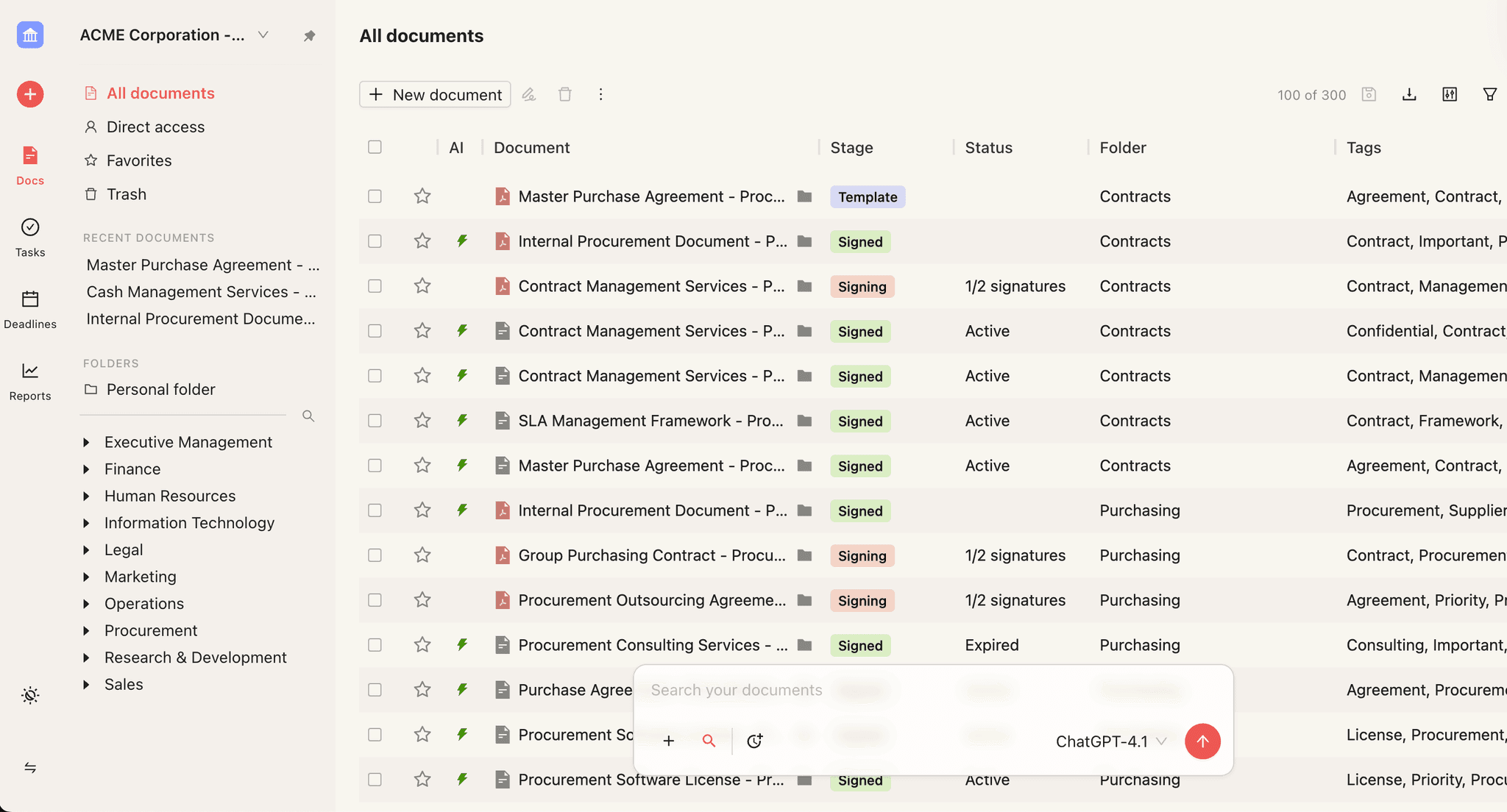
Retrieval becomes instant. Instead of searching across SharePoint, Google Drive, Outlook folders, and local drives, you have a centralized inbox-style view of all active contracts. Customizable columns, archive functionality, and metadata filtering let you answer the question "What is our current situation with this counterparty?" in seconds rather than hours.
Negotiation cycles shorten. The redundant steps legal teams describe, downloading, editing, re-uploading, deleting old versions, resending, disappear inside a platform built for contract collaboration. Version control and in-platform editing replace the six-step manual process for every clause change.
How to get started
Reducing admin burden is not an all-or-nothing project. Start with the area causing the most pain:
Audit your intake process. Track how contract requests reach you for one week. Count the channels (email, Slack, verbal, ad hoc uploads) and the time you spend triaging. This gives you a baseline.
Identify your extraction backlog. How many existing contracts sit in scattered folders without extracted metadata? Bulk upload with batch AI extraction can process that backlog during initial setup.
Map your permission needs. List who needs to submit, view, edit, and approve contracts. A tiered model becomes obvious once you see it on paper.
A purpose-built CLM platform handles these three areas far more effectively than stitching together email, shared drives, and spreadsheets. The goal is not to add technology for its own sake. It is to give you back the hours you need for the work that actually requires your expertise.
Frequently asked questions
Q: How long does it take to migrate an existing contract portfolio into a CLM platform?
Migration timelines depend on portfolio size, but Concord's bulk upload feature processes zip folders of documents, and batch AI extraction pulls key data points across all uploaded files automatically. Most legal teams complete initial migration and extraction within days rather than weeks.
Q: Can business users submit contract requests without having access to the full contract repository?
Yes. Concord's role-based permissions allow you to give business users access only to the intake form submission process and read-only views of relevant contracts. Senior legal retains full control over editing, approval, and signing authority.
Q: Does AI extraction work on older scanned contracts?
Concord's OCR processing handles scanned documents and image-based PDFs, extracting the same data points as native digital files. This means your legacy paper contracts, once scanned, can be indexed and tracked alongside newer agreements.
Ready to reclaim the strategic hours your role demands? Request a demo of Concord and see how intake forms, AI extraction, and tiered permissions work with your existing contract portfolio.
Every General Counsel knows the feeling: you went to law school to advise on strategy, manage risk, and protect your organization. Instead, you spend hours routing contract requests, pulling dates from PDFs, and chasing approvals across departments. If you want to reduce the admin burden that contracts create, you need to address the specific tasks that consume your time, not just adopt another tool.
In-house legal professionals consistently report spending a significant share of their time on administrative and process-driven tasks rather than substantive legal work. That ratio becomes unsustainable as contract volumes grow. Organizations across industries are seeing contract volumes per legal full-time employee climb year over year with no corresponding increase in headcount.
The math is simple: more contracts, same staff, same manual processes. Something has to give.
Teams looking to close that gap often start by exploring purpose-built legal operations software designed to automate the tasks consuming senior attorney time.
Why senior legal staff are drowning in contract admin
Your days likely include a predictable set of low-value tasks. Contract requests arrive through email, Slack, and hallway conversations with no consistent format or priority signal. You manually open each contract to pull key data, including parties, expiration dates, termination notice windows, and financial terms, then enter that information into spreadsheets.
Cross-departmental bottlenecks compound the problem. When sales, procurement, HR, and compliance all need to weigh in on a single agreement, senior legal becomes the traffic controller. You lack visibility into where delays occur, which means you field status-check emails instead of focusing on the substance of the deal.
Then there is the deadline problem. Mid-market organizations frequently report missing critical contract deadlines due to manual tracking methods. Missed 60-day termination notices or lapsed insurance certificates lock you into unfavorable terms and create avoidable costs. The root cause is almost always the same: no centralized system surfacing what needs attention and when.
The three capabilities that reclaim strategic time
Based on patterns across legal teams of all sizes, three specific capabilities address the bulk of admin drain: structured intake, AI-powered data extraction, and delegated approvals with tiered permissions. Here is how each one works in practice.
Structured intake forms
Without a formalized intake process, every contract request requires you to manually triage, categorize, and route it. That triage work compounds as volume grows, turning you into a dispatcher rather than a counselor.
Concord's contract intake management feature replaces ad hoc requests with customizable forms. Business users submit requests through structured fields: contract type (NDA, MSA, SOW), urgency level, counterparty name, and relevant deal details. Requests are automatically routed to the appropriate legal team member based on the rules you set.
The intake form can also link directly to pre-approved templates, generating a first draft the moment a request comes in. You move from receiving a vague email ("Hey, can you draft something for this vendor?") to receiving a complete, categorized request in a managed queue.
AI-powered data extraction
Manual data abstraction is one of the most time-intensive tasks in contract administration. You open a PDF, scan for the effective date, hunt for the termination notice period, locate the total value, and type it all into a spreadsheet. Multiply that by hundreds of contracts and you have a full-time job that adds zero strategic value.
Concord's AI extraction automatically identifies and pulls key data points upon upload: agreement category, document type, parties, signing and effective dates, duration, renewal terms, early termination notice periods, and total agreement value. It works on Word documents, native PDFs, and scanned images through OCR processing.
Legal teams using AI-powered extraction typically see contract review and abstraction time drop dramatically. Custom properties let you track additional fields specific to your organization, such as risk level, contract owner, or insurance requirements. During implementation, bulk upload with batch extraction processes your entire existing portfolio, so you are not starting from scratch.
You can learn more about how centralized contract data changes day-to-day legal work in this guide to contract management for legal teams.
Delegated approvals and tiered permissions
Many senior legal leaders face a binary problem: either too many people have access to contracts (creating risk), or the GC must personally handle every interaction (creating bottlenecks). The answer is not fewer users. It is the right access for each user.
Concord's folder-based permission structure and role-based access controls let you create a tiered model. Junior attorneys or paralegals can handle routine contract interactions. Business users can submit requests and view contracts in read-only mode. Senior legal retains edit, approve, and sign authority on high-value or high-risk agreements.
Hierarchical folder structures with per-folder access controls mean you can separate sensitive contracts (executive employment agreements, M&A documents) from general access. Team-based and group-based permissions make it straightforward to adjust as your organization changes. Legal departments that implement tiered access models consistently report a measurable decrease in senior attorney time spent on routine approvals.
What changes when admin burden drops
The return on removing admin tasks is not abstract. It shows up in concrete ways across your week.
Deadline compliance improves. Concord's contract deadline management sends automated weekly emails every Monday with all upcoming deadlines. A calendar view, filterable by deadline type and contract category, syncs with Outlook and Google Calendar. You can configure notification windows at 30, 60, or 90 days out. Custom deadlines for items like certificate of insurance expiry dates mean nothing falls through the cracks.
Retrieval becomes instant. Instead of searching across SharePoint, Google Drive, Outlook folders, and local drives, you have a centralized inbox-style view of all active contracts. Customizable columns, archive functionality, and metadata filtering let you answer the question "What is our current situation with this counterparty?" in seconds rather than hours.
Negotiation cycles shorten. The redundant steps legal teams describe, downloading, editing, re-uploading, deleting old versions, resending, disappear inside a platform built for contract collaboration. Version control and in-platform editing replace the six-step manual process for every clause change.
How to get started
Reducing admin burden is not an all-or-nothing project. Start with the area causing the most pain:
Audit your intake process. Track how contract requests reach you for one week. Count the channels (email, Slack, verbal, ad hoc uploads) and the time you spend triaging. This gives you a baseline.
Identify your extraction backlog. How many existing contracts sit in scattered folders without extracted metadata? Bulk upload with batch AI extraction can process that backlog during initial setup.
Map your permission needs. List who needs to submit, view, edit, and approve contracts. A tiered model becomes obvious once you see it on paper.
A purpose-built CLM platform handles these three areas far more effectively than stitching together email, shared drives, and spreadsheets. The goal is not to add technology for its own sake. It is to give you back the hours you need for the work that actually requires your expertise.
Frequently asked questions
Q: How long does it take to migrate an existing contract portfolio into a CLM platform?
Migration timelines depend on portfolio size, but Concord's bulk upload feature processes zip folders of documents, and batch AI extraction pulls key data points across all uploaded files automatically. Most legal teams complete initial migration and extraction within days rather than weeks.
Q: Can business users submit contract requests without having access to the full contract repository?
Yes. Concord's role-based permissions allow you to give business users access only to the intake form submission process and read-only views of relevant contracts. Senior legal retains full control over editing, approval, and signing authority.
Q: Does AI extraction work on older scanned contracts?
Concord's OCR processing handles scanned documents and image-based PDFs, extracting the same data points as native digital files. This means your legacy paper contracts, once scanned, can be indexed and tracked alongside newer agreements.
Ready to reclaim the strategic hours your role demands? Request a demo of Concord and see how intake forms, AI extraction, and tiered permissions work with your existing contract portfolio.

Take the "management" out
of contract management.
Customer Support
Legal
Compare
Resources
Customer Support
Company
Legal
Compare
Resources
Customer Support
Company
Legal
Compare
© 2025 Concord. All rights reserved.