Contract management integrations CRM: your evaluation checklist
Contract management integrations CRM: your evaluation checklist
Contract management integrations CRM: your evaluation checklist
Contract management integrations CRM: your evaluation checklist
contract management

Choosing a contract lifecycle management platform is about more than templates and e-signatures. The real test is whether your CLM connects to the systems you already rely on every day. Contract management integrations CRM, ERP, and HRIS connections can determine whether your new platform becomes a single source of truth or just another silo.
This checklist gives you a practical framework for evaluating integration capabilities across three core system categories: CRM, ERP, and HRIS. You will find specific questions to ask vendors, realistic expectations for each integration type, and guidance on when native connectors, middleware, or custom APIs are the right fit.
Why integrations are the make-or-break factor in CLM selection
Contracts end up buried as file attachments in CRM records, scattered across SharePoint folders, trapped in email inboxes, or hidden inside ERP modules. Searching across those locations is difficult. Extracting clause data is nearly impossible. Tracking deadlines is a manual exercise that depends on someone remembering to check.
A CLM platform only replaces that fragmentation if it connects to the tools your teams actually use. Integration capability is not a "nice to have" checkbox. It is the factor that determines whether your CLM becomes the system of record for contracts or simply adds one more place to look.
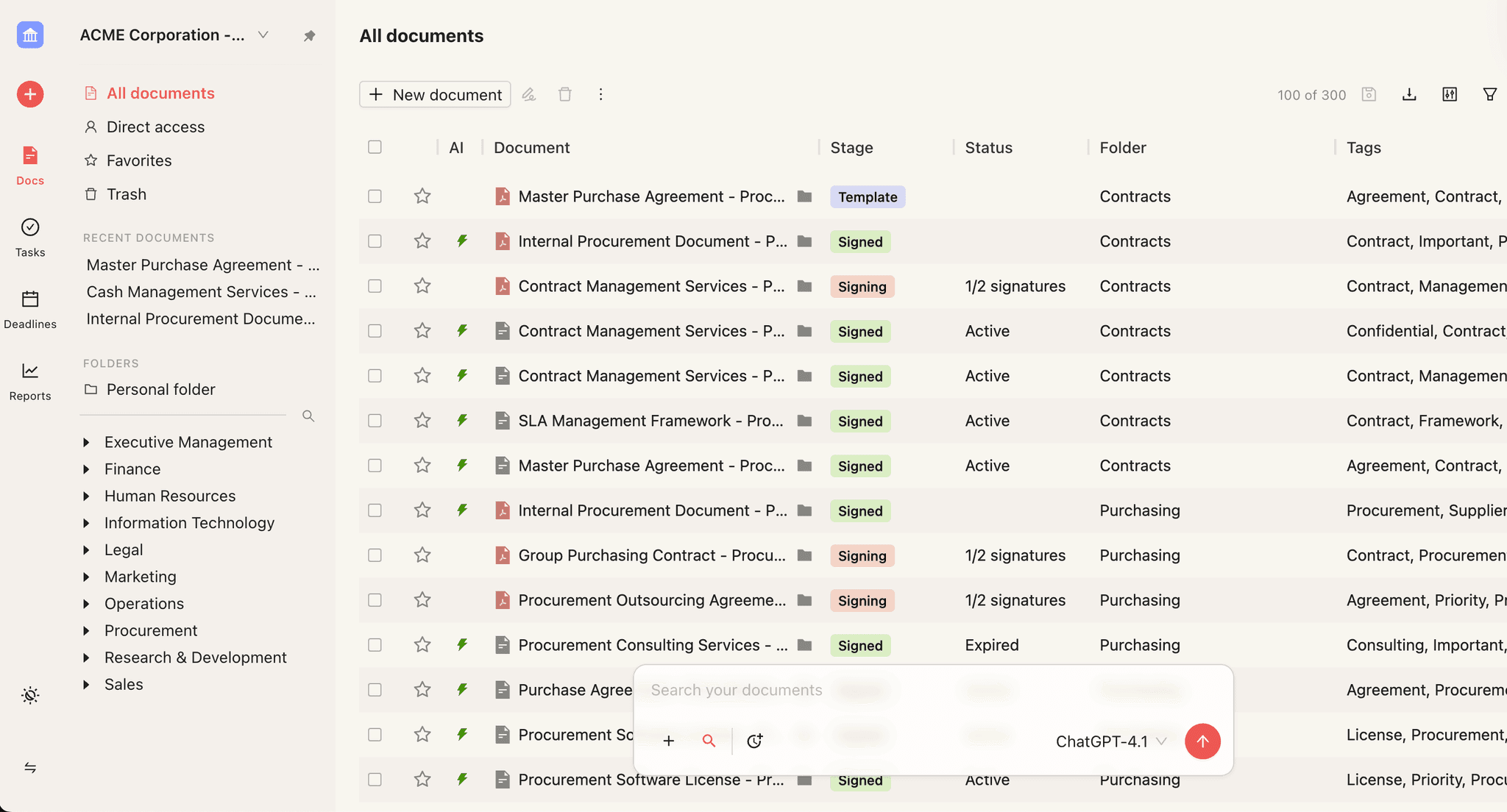
To understand the full scope of what modern platforms offer, explore how purpose-built contract management software centralizes contracts across your entire organization.
Before you evaluate any vendor's integration list, define what you need the integration to do. Prefilling contract templates with deal data is a different requirement than syncing signature status back to a CRM. Triggering approval workflows based on contract value thresholds is different from pushing renewal dates to a finance system. Specificity matters more than a long list of logos on a vendor's website.
CRM integration checklist: Salesforce, HubSpot, and beyond
Your CRM is likely where deals originate, which makes it the most natural starting point for contract management integrations CRM buyers need to evaluate.
Here is what to evaluate:
Document generation from CRM data. Can the CLM pull party names, deal values, contract terms, and other fields directly from a CRM record to prefill a contract template? This eliminates manual re-entry and reduces errors. With Concord's Salesforce integration, you can generate a contract directly from a deal record without copying data between systems. The same functionality exists for HubSpot, a platform many buyers incorrectly assume is unsupported by CLM vendors.
Bidirectional status syncing. When a contract is sent, viewed, or signed, does that status flow back to the CRM automatically? Concord's integration event system pushes milestone updates (signing, execution, expiration) back to your CRM so sales teams see real-time contract status without leaving their primary workspace.
HubSpot-specific workflow. If you use HubSpot, confirm that the CLM offers a direct integration, not just a workaround. With Concord, a user clicks a button within HubSpot, prefills data into a Concord template, sends the contract for review and signature, and the signed status updates automatically in HubSpot.
Checklist items for CRM integration:
Can you generate contracts from CRM records with prefilled data?
Does signature status sync back to CRM deal records automatically?
Is the integration native, or does it require middleware?
Which CRM platforms have native support (Salesforce, HubSpot, others)?
Can you trigger internal approval workflows based on CRM deal data?
ERP integration checklist: setting realistic expectations
ERP integration is where buyer expectations and vendor capabilities most often diverge. Most CLM vendors do not offer native connectors for Oracle, SAP, or Microsoft Dynamics.
That does not mean ERP integration is impossible. It means you should plan for a different path.
Middleware as the practical bridge. Concord supports Zapier integration, which connects to thousands of applications including many ERP platforms. Zapier can handle common use cases: pushing executed contract metadata to an ERP, triggering a procurement workflow when a vendor agreement is signed, or syncing renewal dates to a finance calendar.
Open API and webhooks for custom connections. If your ERP requires a deeper connection than middleware can provide, look for a CLM with a documented open API. Concord offers API and webhook access, allowing your IT team or an integration partner to build custom connections tailored to your specific ERP configuration.
Checklist items for ERP integration:
Does the CLM offer a native connector for your specific ERP platform?
If not, does the CLM support middleware (Zapier, MuleSoft, or similar)?
Is there an open API with documentation sufficient for your IT team?
What contract data can be pushed to the ERP (metadata, financial terms, deadlines)?
What is the expected implementation timeline and cost for a custom ERP integration?
HRIS integration checklist: employment agreements and onboarding
HRIS integration is a less common starting point for CLM buyers, but it matters if your organization generates a high volume of employment agreements, onboarding documents, or contractor agreements.
HRIS connections are typically handled through middleware or API rather than native connectors. The primary use cases are generating offer letters and employment agreements prefilled with employee data, routing those documents through approval workflows, and storing signed agreements with full lifecycle tracking.
Checklist items for HRIS integration:
Can the CLM generate employment agreements from HRIS employee data?
Does the middleware or API support your specific HRIS platform?
Can signed employment documents sync back to the employee record?
Does the CLM support department-specific approval routing for HR contracts?
Concord's contract intake management feature is particularly relevant here. Structured intake forms allow HR teams to submit contract requests with all necessary details and attachments, replacing email-based request processes that lead to lost documents and version confusion.
Middleware and API checklist: filling the gaps
No CLM platform offers native integrations for every system. The question is how well a vendor supports the connections that fall outside their native list.
Zapier for accessible automation. Zapier connects Concord to thousands of applications without requiring custom code. Common use cases include sending Slack notifications when contracts hit specific milestones, syncing signed contract data to project management tools, and creating records in systems that lack native CLM connectors.
API and webhooks for full control. For organizations with development resources, an open API provides the flexibility to build exactly the integration you need. Webhooks allow external systems to receive real-time notifications when contract events occur.
Checklist items for middleware and API:
Does the CLM offer Zapier integration (or equivalent middleware)?
Is the API well documented, with clear rate limits and authentication requirements?
Are webhooks available for real-time event notifications?
What level of technical expertise is required to build custom integrations?
Is integration support available from the vendor during implementation?
Questions to ask every CLM vendor about integrations
Before you sign a contract with a CLM vendor, ask these questions directly:
Which integrations are native, which require middleware, and which require custom API development?
What does each integration actually do? (A logo on a webpage does not tell you the scope.)
What plan tier includes integration access?
How long does a typical integration take to configure?
What happens to contract data when an integration fails or disconnects?
Can the CLM serve as the system of record even if an integration is not available for a specific platform?
That last question matters most. Your CLM should function as the authoritative source for all contract data, with integrations feeding information in and pushing updates out. Concord's agreement lifecycle management capabilities provide full tracking from creation to execution, regardless of how a contract enters the system. Documents uploaded from a CRM export, an ERP download, or an email attachment all receive AI-powered data extraction and tagging automatically.
Frequently asked questions
Q: Do I need native integrations for every system my organization uses? A: Not necessarily. Native integrations are ideal for high-frequency connections like CRM-to-CLM document generation. For less frequent or more specialized connections, middleware like Zapier or custom API development can be equally effective at a lower implementation cost.
Q: What if my CRM is not Salesforce or HubSpot? A: Concord supports Zapier integration, which connects to thousands of applications including many CRM platforms beyond Salesforce and HubSpot. For CRMs that require a deeper connection, Concord's open API and webhook capabilities provide a path for custom integration.
Q: How do I prioritize which integrations to implement first? A: Start with the integration that eliminates your highest-volume manual process. For most organizations, that means CRM integration for document generation and signature syncing. ERP and HRIS integrations can follow once your core CLM workflows are established.
Ready to see how Concord connects to the tools your teams already use? Request a demo to walk through integration capabilities for your specific tech stack.
Choosing a contract lifecycle management platform is about more than templates and e-signatures. The real test is whether your CLM connects to the systems you already rely on every day. Contract management integrations CRM, ERP, and HRIS connections can determine whether your new platform becomes a single source of truth or just another silo.
This checklist gives you a practical framework for evaluating integration capabilities across three core system categories: CRM, ERP, and HRIS. You will find specific questions to ask vendors, realistic expectations for each integration type, and guidance on when native connectors, middleware, or custom APIs are the right fit.
Why integrations are the make-or-break factor in CLM selection
Contracts end up buried as file attachments in CRM records, scattered across SharePoint folders, trapped in email inboxes, or hidden inside ERP modules. Searching across those locations is difficult. Extracting clause data is nearly impossible. Tracking deadlines is a manual exercise that depends on someone remembering to check.
A CLM platform only replaces that fragmentation if it connects to the tools your teams actually use. Integration capability is not a "nice to have" checkbox. It is the factor that determines whether your CLM becomes the system of record for contracts or simply adds one more place to look.
To understand the full scope of what modern platforms offer, explore how purpose-built contract management software centralizes contracts across your entire organization.
Before you evaluate any vendor's integration list, define what you need the integration to do. Prefilling contract templates with deal data is a different requirement than syncing signature status back to a CRM. Triggering approval workflows based on contract value thresholds is different from pushing renewal dates to a finance system. Specificity matters more than a long list of logos on a vendor's website.
CRM integration checklist: Salesforce, HubSpot, and beyond
Your CRM is likely where deals originate, which makes it the most natural starting point for contract management integrations CRM buyers need to evaluate.
Here is what to evaluate:
Document generation from CRM data. Can the CLM pull party names, deal values, contract terms, and other fields directly from a CRM record to prefill a contract template? This eliminates manual re-entry and reduces errors. With Concord's Salesforce integration, you can generate a contract directly from a deal record without copying data between systems. The same functionality exists for HubSpot, a platform many buyers incorrectly assume is unsupported by CLM vendors.
Bidirectional status syncing. When a contract is sent, viewed, or signed, does that status flow back to the CRM automatically? Concord's integration event system pushes milestone updates (signing, execution, expiration) back to your CRM so sales teams see real-time contract status without leaving their primary workspace.
HubSpot-specific workflow. If you use HubSpot, confirm that the CLM offers a direct integration, not just a workaround. With Concord, a user clicks a button within HubSpot, prefills data into a Concord template, sends the contract for review and signature, and the signed status updates automatically in HubSpot.
Checklist items for CRM integration:
Can you generate contracts from CRM records with prefilled data?
Does signature status sync back to CRM deal records automatically?
Is the integration native, or does it require middleware?
Which CRM platforms have native support (Salesforce, HubSpot, others)?
Can you trigger internal approval workflows based on CRM deal data?
ERP integration checklist: setting realistic expectations
ERP integration is where buyer expectations and vendor capabilities most often diverge. Most CLM vendors do not offer native connectors for Oracle, SAP, or Microsoft Dynamics.
That does not mean ERP integration is impossible. It means you should plan for a different path.
Middleware as the practical bridge. Concord supports Zapier integration, which connects to thousands of applications including many ERP platforms. Zapier can handle common use cases: pushing executed contract metadata to an ERP, triggering a procurement workflow when a vendor agreement is signed, or syncing renewal dates to a finance calendar.
Open API and webhooks for custom connections. If your ERP requires a deeper connection than middleware can provide, look for a CLM with a documented open API. Concord offers API and webhook access, allowing your IT team or an integration partner to build custom connections tailored to your specific ERP configuration.
Checklist items for ERP integration:
Does the CLM offer a native connector for your specific ERP platform?
If not, does the CLM support middleware (Zapier, MuleSoft, or similar)?
Is there an open API with documentation sufficient for your IT team?
What contract data can be pushed to the ERP (metadata, financial terms, deadlines)?
What is the expected implementation timeline and cost for a custom ERP integration?
HRIS integration checklist: employment agreements and onboarding
HRIS integration is a less common starting point for CLM buyers, but it matters if your organization generates a high volume of employment agreements, onboarding documents, or contractor agreements.
HRIS connections are typically handled through middleware or API rather than native connectors. The primary use cases are generating offer letters and employment agreements prefilled with employee data, routing those documents through approval workflows, and storing signed agreements with full lifecycle tracking.
Checklist items for HRIS integration:
Can the CLM generate employment agreements from HRIS employee data?
Does the middleware or API support your specific HRIS platform?
Can signed employment documents sync back to the employee record?
Does the CLM support department-specific approval routing for HR contracts?
Concord's contract intake management feature is particularly relevant here. Structured intake forms allow HR teams to submit contract requests with all necessary details and attachments, replacing email-based request processes that lead to lost documents and version confusion.
Middleware and API checklist: filling the gaps
No CLM platform offers native integrations for every system. The question is how well a vendor supports the connections that fall outside their native list.
Zapier for accessible automation. Zapier connects Concord to thousands of applications without requiring custom code. Common use cases include sending Slack notifications when contracts hit specific milestones, syncing signed contract data to project management tools, and creating records in systems that lack native CLM connectors.
API and webhooks for full control. For organizations with development resources, an open API provides the flexibility to build exactly the integration you need. Webhooks allow external systems to receive real-time notifications when contract events occur.
Checklist items for middleware and API:
Does the CLM offer Zapier integration (or equivalent middleware)?
Is the API well documented, with clear rate limits and authentication requirements?
Are webhooks available for real-time event notifications?
What level of technical expertise is required to build custom integrations?
Is integration support available from the vendor during implementation?
Questions to ask every CLM vendor about integrations
Before you sign a contract with a CLM vendor, ask these questions directly:
Which integrations are native, which require middleware, and which require custom API development?
What does each integration actually do? (A logo on a webpage does not tell you the scope.)
What plan tier includes integration access?
How long does a typical integration take to configure?
What happens to contract data when an integration fails or disconnects?
Can the CLM serve as the system of record even if an integration is not available for a specific platform?
That last question matters most. Your CLM should function as the authoritative source for all contract data, with integrations feeding information in and pushing updates out. Concord's agreement lifecycle management capabilities provide full tracking from creation to execution, regardless of how a contract enters the system. Documents uploaded from a CRM export, an ERP download, or an email attachment all receive AI-powered data extraction and tagging automatically.
Frequently asked questions
Q: Do I need native integrations for every system my organization uses? A: Not necessarily. Native integrations are ideal for high-frequency connections like CRM-to-CLM document generation. For less frequent or more specialized connections, middleware like Zapier or custom API development can be equally effective at a lower implementation cost.
Q: What if my CRM is not Salesforce or HubSpot? A: Concord supports Zapier integration, which connects to thousands of applications including many CRM platforms beyond Salesforce and HubSpot. For CRMs that require a deeper connection, Concord's open API and webhook capabilities provide a path for custom integration.
Q: How do I prioritize which integrations to implement first? A: Start with the integration that eliminates your highest-volume manual process. For most organizations, that means CRM integration for document generation and signature syncing. ERP and HRIS integrations can follow once your core CLM workflows are established.
Ready to see how Concord connects to the tools your teams already use? Request a demo to walk through integration capabilities for your specific tech stack.

Take the "management" out
of contract management.
Customer Support
Legal
Compare
Resources
Customer Support
Company
Legal
Compare
Resources
Customer Support
Company
Legal
Compare
© 2025 Concord. All rights reserved.