Severability Clause: Meaning, Examples, and Why It Matters
Severability Clause: Meaning, Examples, and Why It Matters
Severability Clause: Meaning, Examples, and Why It Matters
Severability Clause: Meaning, Examples, and Why It Matters
severability clause, severability clause example, savings clause contract, blue pencil rule, severable contract vs severability clause, contract clause library, boilerplate clauses, partial invalidity contract

A severability clause is one of the shortest provisions in most commercial agreements. It is also one of the easiest to skip during review. It tells a court that if one term is invalid, the rest of the contract should still stand.
That sounds simple, but the clause does less than many people assume. The version in your signed contracts may also differ from the one your legal team approved. This guide explains what a severability clause means, how courts treat it, what common drafting looks like, and why clause governance matters when you manage agreements at volume.
Important: This article is educational and is not legal advice. Severability, blue-pencil, and reformation rules vary by jurisdiction and contract type. Verify the drafting and enforceability of any severability language with qualified legal counsel in your governing jurisdiction.
Key takeaways
A severability clause asks a court to keep the rest of a contract in force when one term fails, but courts treat it as evidence of intent, not a guarantee.
No severability language can revive a term that mandatory law or public policy prohibits, such as a noncompete barred by statute.
Whether a court may strike an invalid term or rewrite it depends on the governing jurisdiction, so confirm any reformation language with counsel.
At scale, the bigger risk is silent drift: modified or missing severability language that no one can find across your contracts.
What is a severability clause?
A severability clause, sometimes called a savings or separability clause, states that if a court finds a provision invalid, void, or unenforceable, the remaining provisions continue in force. It usually sits among the boilerplate clauses near the end of an agreement, alongside governing law, notices, and entire agreement language.
The clause records intent. It tells a future judge or arbitrator that the parties did not want the whole deal to collapse because one piece failed.
Severability is evidence, not a guarantee
The most common misunderstanding is that a severability clause guarantees the rest of the contract survives. It does not. As the Legal Information Institute explains, courts look at the contract’s text, structure, purpose, and the parties’ intent, and the clause is relevant evidence that is not necessarily conclusive.
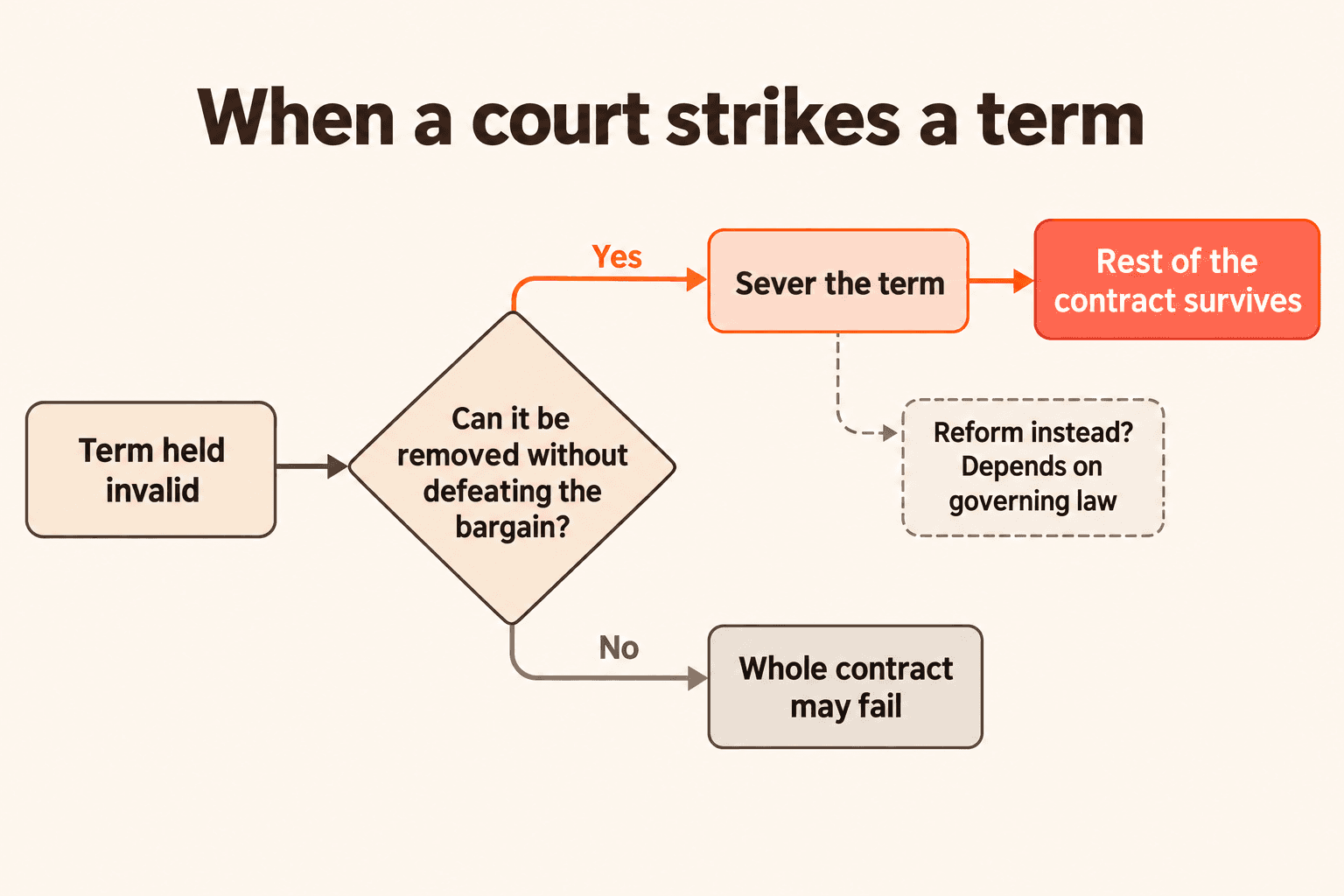
In practice, a court asks whether the invalid term can be removed without defeating the bargain. If the struck provision was central to the deal, or if removing it leaves no workable consideration, the court may refuse to enforce the remainder anyway.
Think of the clause as a strong signal rather than a switch. It improves the chances that independent obligations, such as confidentiality or payment terms, will hold up when a problem appears elsewhere.
It cannot cure illegality
No drafting overrides mandatory law or public policy. A severability clause cannot make a prohibited term enforceable.
Restrictive covenants show this clearly. California Business and Professions Code § 16600 broadly voids contractual restraints on engaging in a lawful profession, trade, or business, subject to statutory exceptions. A severability clause will not revive an employee noncompete that the statute prohibits, though it may help preserve the rest of the employment agreement once the noncompete falls away.
Severing versus reforming
Two different remedies often get blended together in drafting:
Severing (blue-penciling) means deleting the offending language and leaving the workable text in place.
Reforming means a court narrows, rewrites, or supplements an overbroad term so it becomes enforceable.
Jurisdictions differ on which of these a court may do. Some courts will strike offending words but refuse to rewrite them, and some will reject an entire restrictive covenant rather than trim it. A clause instructing a court to “reform the provision to the maximum extent permitted” may ask for more than governing law allows, so confirm with counsel what your chosen jurisdiction permits.
Partial and as-applied invalidity
Well-drafted clauses cover more than a provision that is invalid on its face. They also address a provision that is invalid only as applied to a particular person, circumstance, or jurisdiction.
This distinction matters for contracts that operate across state lines. A limitation that holds up in one state may fail in another, and as-applied language lets the provision keep working where it is lawful. Federal regulations use the same structure: 13 C.F.R. § 120.4 separates a provision invalid in particular applications from one invalid in all circumstances.
Severability clause examples
Here are three common approaches. Treat them as illustrations of structure, not approved language for your agreements.
Standard version
“If any provision of this Agreement, or its application to any person or circumstance, is held invalid or unenforceable, that provision or application will be severed to the minimum extent necessary, and the remaining provisions will remain in full force and effect.”
This version combines partial invalidity, as-applied invalidity, and minimum necessary severance.
Conservative version
“The parties intend that any invalid or unenforceable provision be enforced to the fullest extent permitted by law and, if necessary, severed without affecting the remainder.”
This one states intent without promising that a court will rewrite anything.
Reformation version
“If any provision is found unenforceable, the court may modify it to the minimum extent necessary to make it enforceable.”
This version asks for judicial modification. Some jurisdictions accept that request and others do not.
Severable contract vs. severability clause vs. survival
Three related terms often get confused:
Term | What it does | Example |
|---|---|---|
Severability clause | Tells a court to keep the rest of the contract in force after one provision is ruled invalid | A court strikes an overbroad noncompete, and the confidentiality and payment terms may still apply |
Severable contract | Divides the deal into independent parts, such as separate deliverables with separate payments | One deliverable fails, and the other deliverables and their payments can still stand |
Survival clause | Keeps named obligations in effect after the contract ends | Confidentiality obligations continue after termination |
When reviewers mix these up, errors follow. A reviewer might assume the survival clause protects confidentiality after a court strikes a different term, when that is the severability clause’s job.
Why a severability clause matters at scale
At scale, the risk is rarely a missing severability clause. It is a quietly modified one that no one can find.
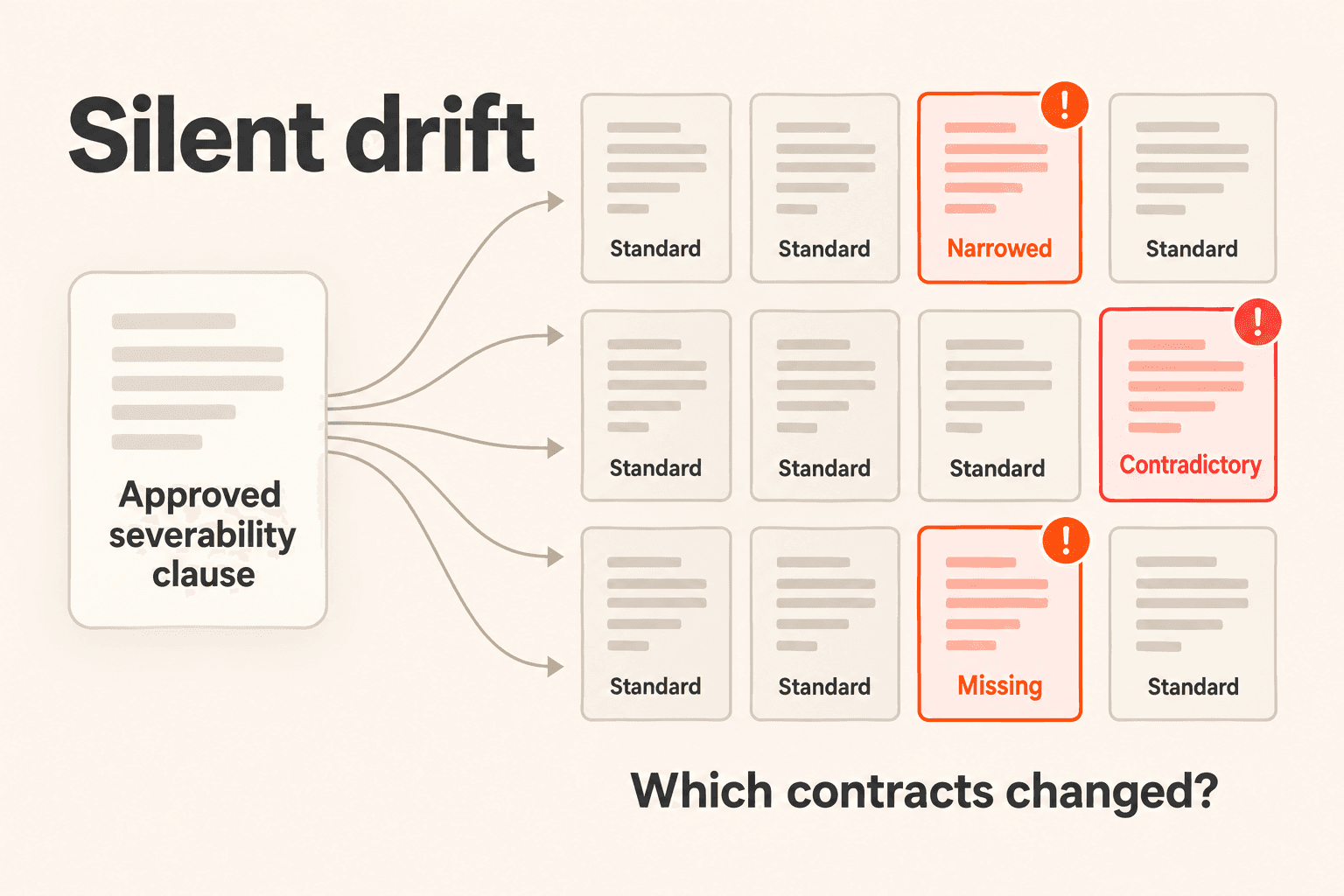
In a single negotiated deal, an attentive lawyer can spot a modified severability clause. Across thousands of agreements, manual review cannot reliably catch every change. At that volume, the odds that at least one contract carries a narrowed, contradictory, or missing clause become very high.
The risk is silent drift
A missing clause is easy to notice. A modified one is not.
Consider the edits that slip through redlines. “Shall be severed” becomes “this Agreement shall terminate,” a new carve-out ties severability to an unrelated section, or a counterparty’s paper swaps your minimum-severance language for a broad reformation instruction.
Each change looks minor on its own, yet each alters how a dispute would play out. Legal ops leaders frequently describe being unable to answer a basic question: which contracts have non-standard severability language? When agreements live in shared drives and email, the honest answer is often that no one knows.
Dependencies hide in other clauses
A severability clause does not operate alone. Reviewers often check it in isolation and miss how it interacts with limitation of liability, indemnity, governing law, integration, order of precedence, and arbitration provisions.
Suppose your order-of-precedence clause says an exhibit controls, and the exhibit contains its own “all or nothing” invalidity language. You now have two conflicting instructions. That conflict creates the kind of interpretive fight severability language is supposed to prevent.
Negotiated deviations are hard to find later
Teams commonly describe accepting a modified savings clause through an email redline, then losing track of it. Months later, at renewal, audit, or dispute, no one can easily surface which agreements carry the deviation or who approved it.
How to govern severability language
A few practical steps reduce drift risk:
Keep one approved version, plus fallbacks. Store the standard clause and any pre-approved alternates in a central clause library so drafters pull from the same source.
Record who approved changes. Every edit to standard language should have an owner and a history.
Link clauses to templates. When the standard changes, you should know which contract templates use it.
Review related provisions together. Check severability against governing law, integration, amendment, and order-of-precedence language in the same pass.
Flag negotiated deviations. Capture changes in a system of record, not only in email threads.
How Concord helps you control boilerplate
Concord treats clause language as a governed asset rather than text buried inside documents.
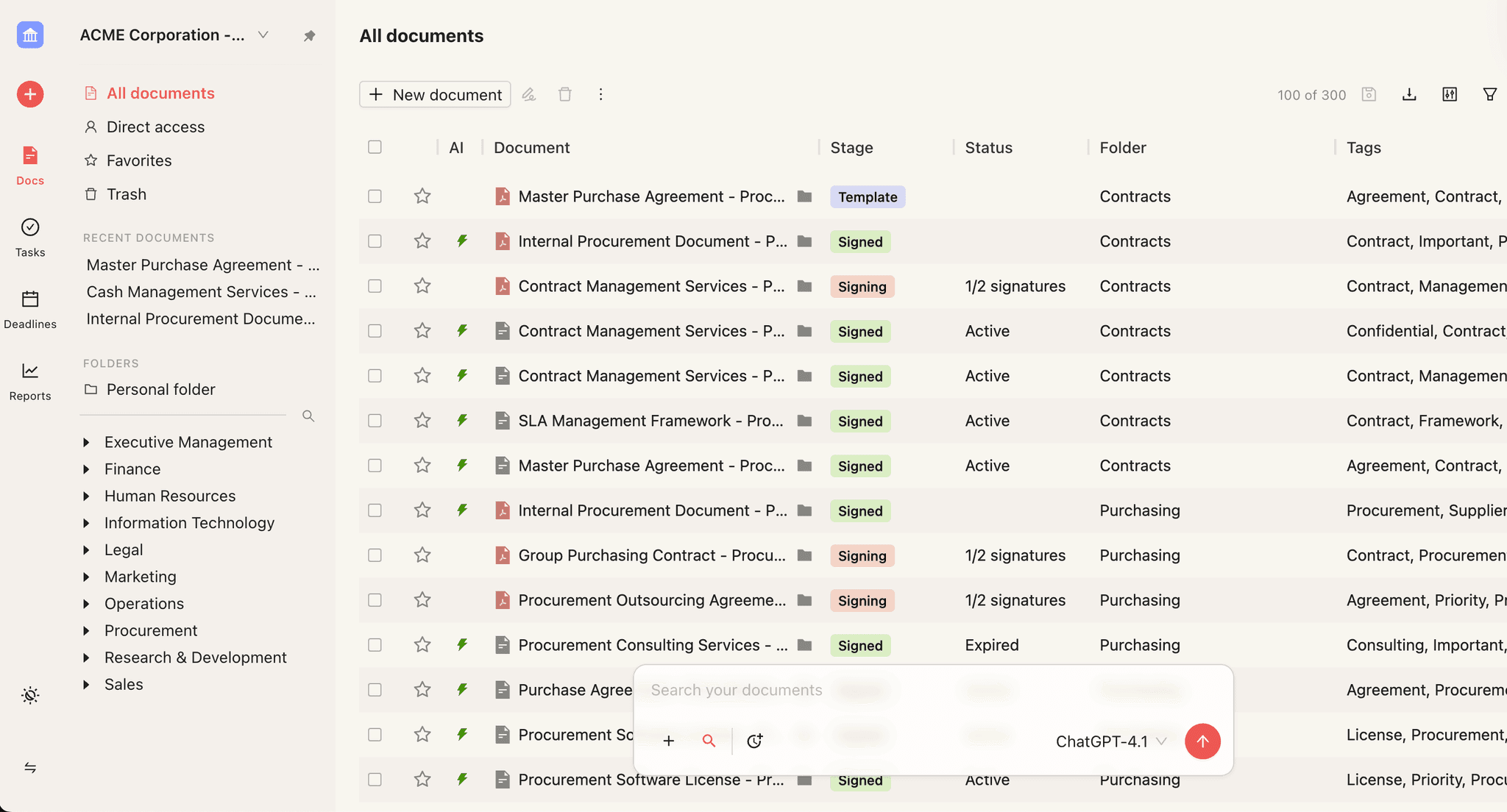
With Clause Library Management, you can centralize approved severability language, including standard and fallback versions with titles, descriptions, and content. Clause Management lets your team create, view, edit, and organize clauses across the organization, so drafters work from current language.
Contract Clauses Management connects clauses to templates and documents, linking your severability provision to the agreements that use it. When someone edits a clause that existing templates rely on, Clause Update Confirmation alerts them to the impact before the change spreads.
Clause Deletion includes confirmation dialogs, so outdated or non-standard variants get removed on purpose rather than by accident. Clause Title Display and Clause Content Display help reviewers scan list views, find severability clauses quickly, and read full text without opening each document.
Keep your boilerplate under control
Your severability clause only helps if the version in each agreement is the one you meant to use. Book a demo to see how Concord’s clause library keeps approved language consistent across every template and contract.
A severability clause is one of the shortest provisions in most commercial agreements. It is also one of the easiest to skip during review. It tells a court that if one term is invalid, the rest of the contract should still stand.
That sounds simple, but the clause does less than many people assume. The version in your signed contracts may also differ from the one your legal team approved. This guide explains what a severability clause means, how courts treat it, what common drafting looks like, and why clause governance matters when you manage agreements at volume.
Important: This article is educational and is not legal advice. Severability, blue-pencil, and reformation rules vary by jurisdiction and contract type. Verify the drafting and enforceability of any severability language with qualified legal counsel in your governing jurisdiction.
Key takeaways
A severability clause asks a court to keep the rest of a contract in force when one term fails, but courts treat it as evidence of intent, not a guarantee.
No severability language can revive a term that mandatory law or public policy prohibits, such as a noncompete barred by statute.
Whether a court may strike an invalid term or rewrite it depends on the governing jurisdiction, so confirm any reformation language with counsel.
At scale, the bigger risk is silent drift: modified or missing severability language that no one can find across your contracts.
What is a severability clause?
A severability clause, sometimes called a savings or separability clause, states that if a court finds a provision invalid, void, or unenforceable, the remaining provisions continue in force. It usually sits among the boilerplate clauses near the end of an agreement, alongside governing law, notices, and entire agreement language.
The clause records intent. It tells a future judge or arbitrator that the parties did not want the whole deal to collapse because one piece failed.
Severability is evidence, not a guarantee
The most common misunderstanding is that a severability clause guarantees the rest of the contract survives. It does not. As the Legal Information Institute explains, courts look at the contract’s text, structure, purpose, and the parties’ intent, and the clause is relevant evidence that is not necessarily conclusive.
In practice, a court asks whether the invalid term can be removed without defeating the bargain. If the struck provision was central to the deal, or if removing it leaves no workable consideration, the court may refuse to enforce the remainder anyway.
Think of the clause as a strong signal rather than a switch. It improves the chances that independent obligations, such as confidentiality or payment terms, will hold up when a problem appears elsewhere.
It cannot cure illegality
No drafting overrides mandatory law or public policy. A severability clause cannot make a prohibited term enforceable.
Restrictive covenants show this clearly. California Business and Professions Code § 16600 broadly voids contractual restraints on engaging in a lawful profession, trade, or business, subject to statutory exceptions. A severability clause will not revive an employee noncompete that the statute prohibits, though it may help preserve the rest of the employment agreement once the noncompete falls away.
Severing versus reforming
Two different remedies often get blended together in drafting:
Severing (blue-penciling) means deleting the offending language and leaving the workable text in place.
Reforming means a court narrows, rewrites, or supplements an overbroad term so it becomes enforceable.
Jurisdictions differ on which of these a court may do. Some courts will strike offending words but refuse to rewrite them, and some will reject an entire restrictive covenant rather than trim it. A clause instructing a court to “reform the provision to the maximum extent permitted” may ask for more than governing law allows, so confirm with counsel what your chosen jurisdiction permits.
Partial and as-applied invalidity
Well-drafted clauses cover more than a provision that is invalid on its face. They also address a provision that is invalid only as applied to a particular person, circumstance, or jurisdiction.
This distinction matters for contracts that operate across state lines. A limitation that holds up in one state may fail in another, and as-applied language lets the provision keep working where it is lawful. Federal regulations use the same structure: 13 C.F.R. § 120.4 separates a provision invalid in particular applications from one invalid in all circumstances.
Severability clause examples
Here are three common approaches. Treat them as illustrations of structure, not approved language for your agreements.
Standard version
“If any provision of this Agreement, or its application to any person or circumstance, is held invalid or unenforceable, that provision or application will be severed to the minimum extent necessary, and the remaining provisions will remain in full force and effect.”
This version combines partial invalidity, as-applied invalidity, and minimum necessary severance.
Conservative version
“The parties intend that any invalid or unenforceable provision be enforced to the fullest extent permitted by law and, if necessary, severed without affecting the remainder.”
This one states intent without promising that a court will rewrite anything.
Reformation version
“If any provision is found unenforceable, the court may modify it to the minimum extent necessary to make it enforceable.”
This version asks for judicial modification. Some jurisdictions accept that request and others do not.
Severable contract vs. severability clause vs. survival
Three related terms often get confused:
Term | What it does | Example |
|---|---|---|
Severability clause | Tells a court to keep the rest of the contract in force after one provision is ruled invalid | A court strikes an overbroad noncompete, and the confidentiality and payment terms may still apply |
Severable contract | Divides the deal into independent parts, such as separate deliverables with separate payments | One deliverable fails, and the other deliverables and their payments can still stand |
Survival clause | Keeps named obligations in effect after the contract ends | Confidentiality obligations continue after termination |
When reviewers mix these up, errors follow. A reviewer might assume the survival clause protects confidentiality after a court strikes a different term, when that is the severability clause’s job.
Why a severability clause matters at scale
At scale, the risk is rarely a missing severability clause. It is a quietly modified one that no one can find.
In a single negotiated deal, an attentive lawyer can spot a modified severability clause. Across thousands of agreements, manual review cannot reliably catch every change. At that volume, the odds that at least one contract carries a narrowed, contradictory, or missing clause become very high.
The risk is silent drift
A missing clause is easy to notice. A modified one is not.
Consider the edits that slip through redlines. “Shall be severed” becomes “this Agreement shall terminate,” a new carve-out ties severability to an unrelated section, or a counterparty’s paper swaps your minimum-severance language for a broad reformation instruction.
Each change looks minor on its own, yet each alters how a dispute would play out. Legal ops leaders frequently describe being unable to answer a basic question: which contracts have non-standard severability language? When agreements live in shared drives and email, the honest answer is often that no one knows.
Dependencies hide in other clauses
A severability clause does not operate alone. Reviewers often check it in isolation and miss how it interacts with limitation of liability, indemnity, governing law, integration, order of precedence, and arbitration provisions.
Suppose your order-of-precedence clause says an exhibit controls, and the exhibit contains its own “all or nothing” invalidity language. You now have two conflicting instructions. That conflict creates the kind of interpretive fight severability language is supposed to prevent.
Negotiated deviations are hard to find later
Teams commonly describe accepting a modified savings clause through an email redline, then losing track of it. Months later, at renewal, audit, or dispute, no one can easily surface which agreements carry the deviation or who approved it.
How to govern severability language
A few practical steps reduce drift risk:
Keep one approved version, plus fallbacks. Store the standard clause and any pre-approved alternates in a central clause library so drafters pull from the same source.
Record who approved changes. Every edit to standard language should have an owner and a history.
Link clauses to templates. When the standard changes, you should know which contract templates use it.
Review related provisions together. Check severability against governing law, integration, amendment, and order-of-precedence language in the same pass.
Flag negotiated deviations. Capture changes in a system of record, not only in email threads.
How Concord helps you control boilerplate
Concord treats clause language as a governed asset rather than text buried inside documents.
With Clause Library Management, you can centralize approved severability language, including standard and fallback versions with titles, descriptions, and content. Clause Management lets your team create, view, edit, and organize clauses across the organization, so drafters work from current language.
Contract Clauses Management connects clauses to templates and documents, linking your severability provision to the agreements that use it. When someone edits a clause that existing templates rely on, Clause Update Confirmation alerts them to the impact before the change spreads.
Clause Deletion includes confirmation dialogs, so outdated or non-standard variants get removed on purpose rather than by accident. Clause Title Display and Clause Content Display help reviewers scan list views, find severability clauses quickly, and read full text without opening each document.
Keep your boilerplate under control
Your severability clause only helps if the version in each agreement is the one you meant to use. Book a demo to see how Concord’s clause library keeps approved language consistent across every template and contract.
Need to know
Frequently Asked Questions

Take the "management" out
of contract management.
Customer Support
Legal
Compare
Resources
Customer Support
Company
Legal
Compare
Resources
Customer Support
Company
Legal
Compare
© 2025 Concord. All rights reserved.