How to use contract templates at scale: governance for high-volume teams
How to use contract templates at scale: governance for high-volume teams
How to use contract templates at scale: governance for high-volume teams
How to use contract templates at scale: governance for high-volume teams
contract management

Key takeaways
Templates only reduce inconsistency when someone governs them. Past roughly 25 to 50 users, an ungoverned library becomes the source of the inconsistency it was meant to remove.
Centralize every template under a single owner and let only administrators edit the master, so no department spins up its own copy.
Segment access with folder-based permissions first. Every other governance control depends on people seeing only the templates their function needs.
Set version control and approval routing at the template level, not per contract, so one update or one rule protects every agreement the template produces.
For multiple legal entities, separate by subsidiary rather than just segmenting folders, keeping each entity's compliance rules and contracts isolated.
Your organization adopted contract templates to bring consistency to every agreement going out the door. The same language, the same clauses, the same structure, every time. But somewhere between 5-50 users, the template library itself became a source of confusion. Different departments created their own versions. Someone edited a "master" template without telling anyone. Old versions sat alongside current ones in a shared drive, and nobody could say which was authoritative.
This is the central paradox of scaling contract templates without governance: the tool meant to eliminate inconsistency becomes the very thing producing it.
If your team processes hundreds or thousands of contracts per year across multiple departments, you need more than templates. You need a governance framework that keeps those templates accurate, accessible, and controlled as usage grows.
Template proliferation is the first sign of a governance gap
Contract templates work beautifully when one person or a small team owns them. The problems start when adoption spreads across HR, sales, procurement, legal, and account management without a plan for who controls what.
Legal ops leaders frequently describe situations where 300 or more partner contracts exist across shared drives with no clear version history and no way to tell which template version produced which agreement. Teams managing 10 or more people working from the same set of templates report a persistent fear of copy-paste errors, especially when drafters manually recreate contracts from prior versions rather than pulling from a controlled source.
One common workaround is requiring a redline comparison to the original template before any agreement goes out. That practice signals a real problem: the system itself doesn't prevent errors, so humans have to catch them manually. That works at low volume. It collapses at scale.
What governance looks like here: Centralize all templates in a single system with clear ownership. Every template should have a designated owner responsible for updates, and only administrators should be able to modify the master version. Concord's unified template fields allow you to maintain a single controlled template that auto-populates the correct data every time a contract is generated, reducing the temptation for users to create ad hoc copies.
Access control is not optional at scale
When 25 or more people across departments all generate contracts from templates, uncontrolled access creates real risk. An HR user accidentally sends a sales agreement. A junior team member modifies a template they shouldn't touch. A departing employee downloads the entire contract library.
IT leaders and operations managers consistently ask about segmenting template access by department, project, or client. The request is always some version of the same question: "Can you make it so sales only sees sales contracts and HR only sees employment agreements?"
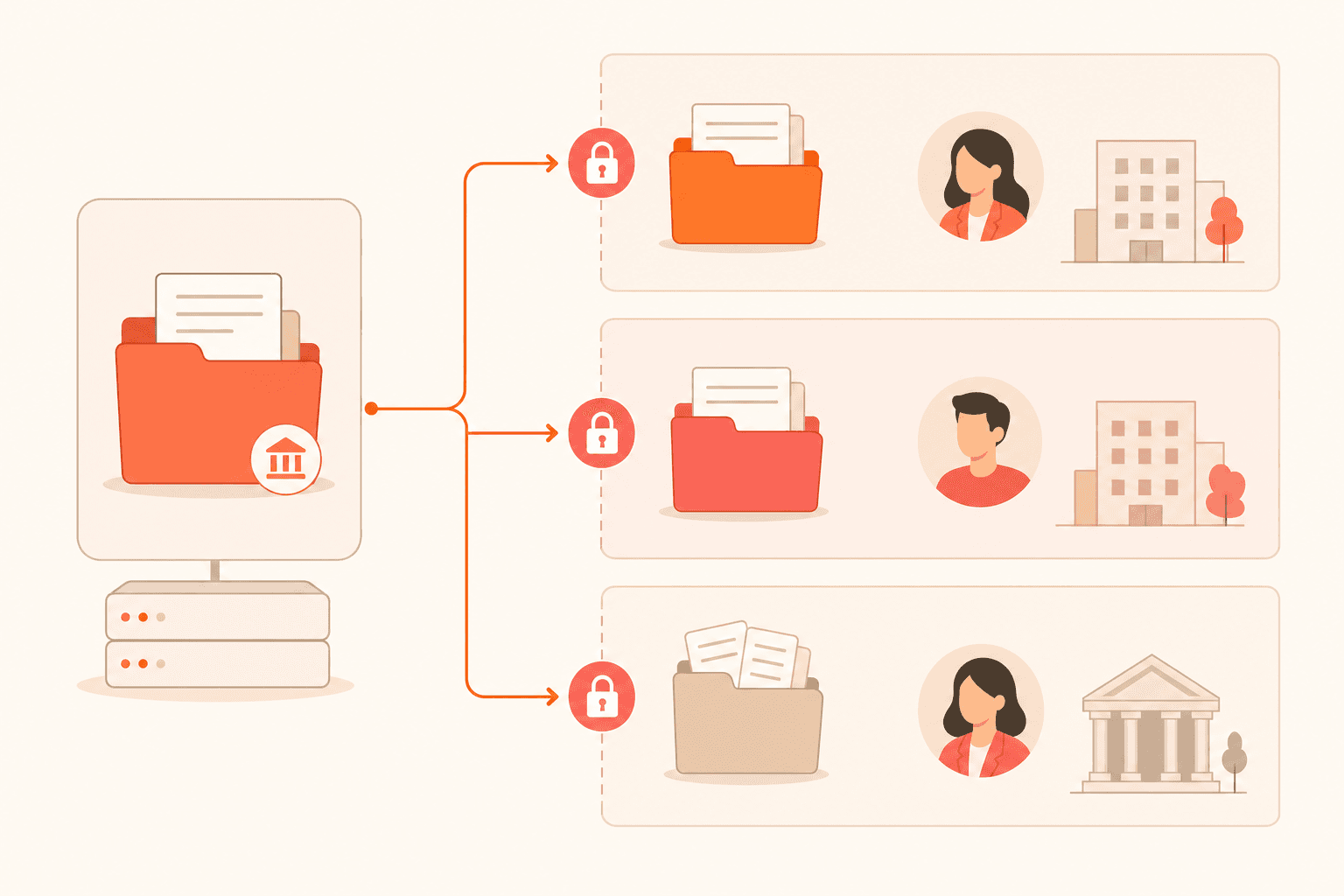
What governance looks like here: Folder-based permissions segment access at the organizational level. Teams only see the templates and contracts relevant to their function. Concord's team management capabilities let you assign access by role and department, so scaling template usage across the organization doesn't mean losing control over who sees and edits what. This is the first governance layer, and without it, every other governance practice is undermined.
Version control must live at the template level
Every contract generated from a template inherits whatever that template contains at the moment of generation. If the template was outdated, every contract it produces carries that error forward.
At 10 contracts per month, someone might catch it. At 100 contracts per month, dozens of agreements could go out with incorrect terms before anyone notices. The risk compounds because the contracts themselves might look perfectly formatted. Nothing about them screams "wrong version." The error is invisible until someone reads the fine print.
What governance looks like here: Version control needs to extend to the template itself, not just the contracts it produces. Teams should be able to see the full edit history of a template, know who changed what and when, and revert if necessary. The audit trail at the template level is what prevents a single bad edit from cascading into dozens or hundreds of flawed agreements.
Approval workflows belong inside the template, not on top of it
Manually assigning approvers to each individual contract is a governance approach that works at low volume and breaks at high volume. Operations leaders frequently ask whether approval workflows can be set at the template level so every contract generated from that template automatically inherits the correct routing.
That question reveals hard-won experience. Teams that have tried per-document approval setup at scale report that it introduces human error and delays. Someone forgets to add the right approver. A contract bypasses legal review because the person generating it didn't know it needed one. A high-value agreement gets the same lightweight approval as a standard services contract.
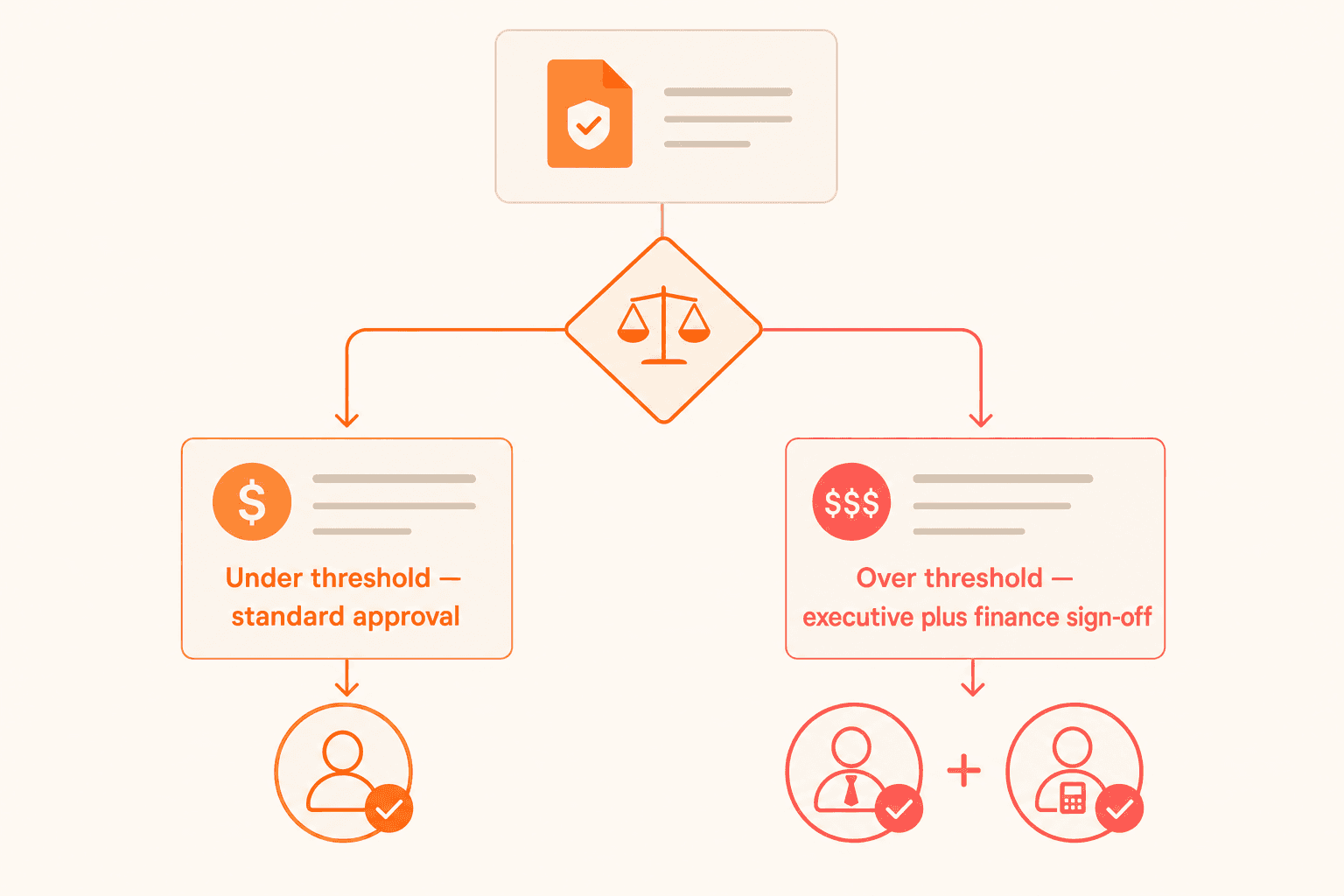
What governance looks like here: Embed approval workflows directly into the template using Concord's contract workflow management. Conditional logic routes approvals based on contract value, type, or other field-level data. A contract over a certain dollar threshold automatically triggers additional sign-off. A specific contract type automatically routes through legal review. Governance becomes structural rather than dependent on individual memory.
Intake forms are governance mechanisms, not just convenience features
When template usage scales across an organization, "who can kick off a contract?" becomes a governance question. Without a formal intake process, anyone with access can generate a contract from a template, even if they lack the context or authority to do so.
Structured intake forms formalize the request process. The requester fills out the form, which populates the correct template, assigns the right approver, and routes the document into the proper workflow. This creates an auditable trail from request to execution and prevents ad hoc contract generation that bypasses your governance structure.
Multi-entity organizations need separation, not just segmentation
Organizations that operate across multiple legal entities face a governance challenge that goes beyond folder permissions. Each entity may have different compliance requirements, different template standards, and different approval authorities.
Commingling contracts across entities in a single shared environment creates legal and regulatory risk. Database-level separation by subsidiary keeps each entity's contracts, templates, and workflows isolated while still manageable from a central administrative view. If your organization spans multiple subsidiaries or divisions, this is a governance requirement, not a nice-to-have.
Building your template governance framework
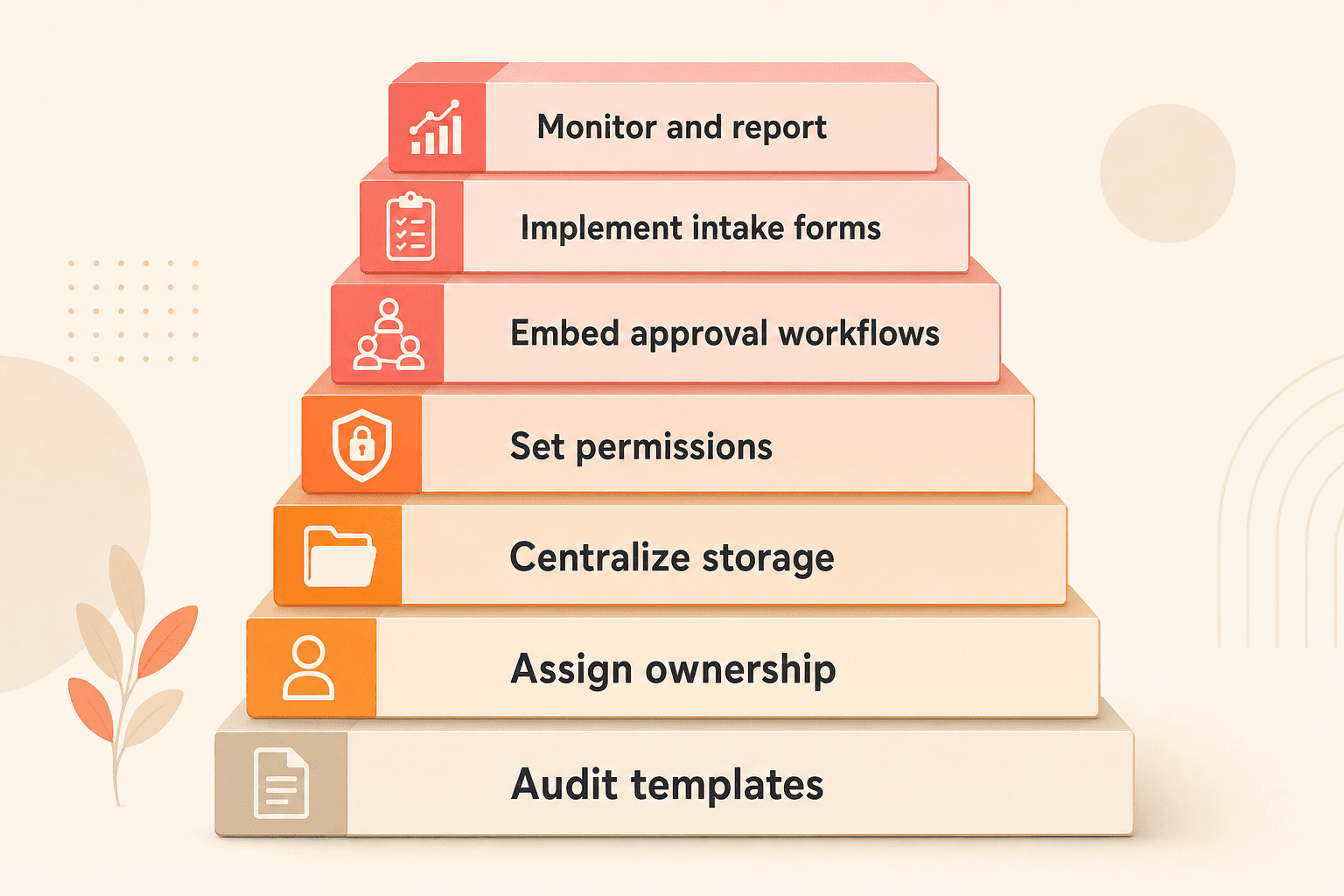
Here is a practical checklist for teams ready to put governance around their template usage:
Audit your current templates. Identify every template in use across every department. Flag duplicates, outdated versions, and templates that exist only in someone's email or personal drive.
Assign ownership. Every template gets a single owner responsible for its accuracy and currency. No orphan templates.
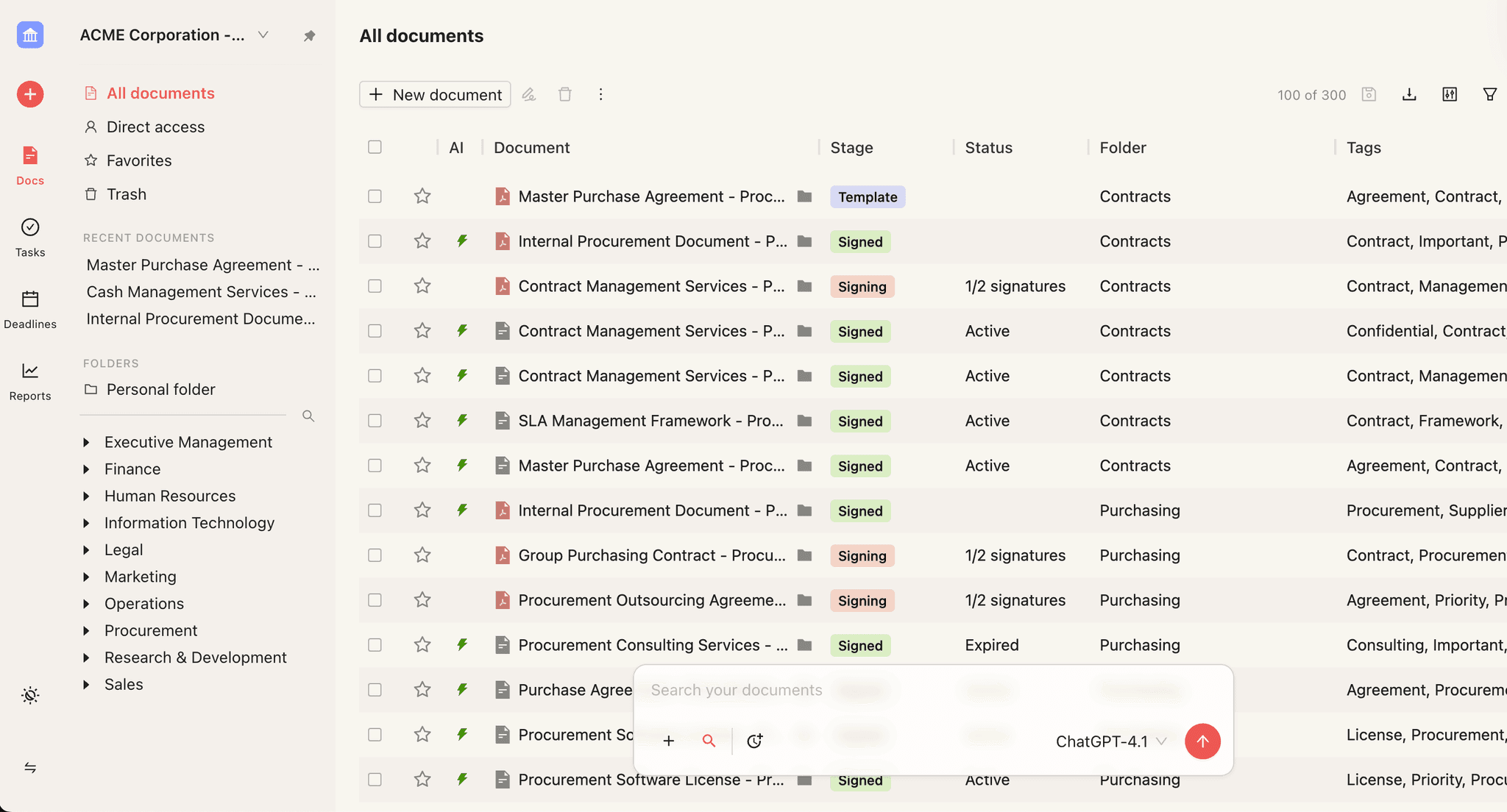
Centralize storage. Move all templates into a single, controlled repository. Concord's document management supports bulk upload and tagging to bring scattered contracts into one governed location.
Set permissions. Configure folder-based and role-based access so each department sees only what it needs.
Embed approval workflows. Set conditional approval chains at the template level so governance is automatic, not manual.
Implement intake forms. Formalize the contract request process to control who can initiate contracts and capture the right data upfront.
Monitor and report. Use contract reporting and analytics to track template usage, identify bottlenecks, and spot governance gaps before they become problems.
Governance layer | What breaks without it | Concord capability |
|---|---|---|
Centralized ownership | Duplicate templates proliferate and no one can name the authoritative version | Unified template fields with a single designated owner |
Access control | Wrong contracts get sent and users edit templates they should not touch | Folder-based permissions and team management |
Version control | One bad edit cascades into every contract the template produces | Template-level edit history and audit trail |
Approval workflows | Approvers get missed and high-value agreements skip legal review | Conditional approval workflows set at the template level |
Intake forms | Anyone with access generates contracts with no record of who or why | Structured intake forms that route each request |
Multi-entity separation | Contracts commingle across legal entities and create compliance risk | Subsidiary-level separation with central administrative visibility |
Key takeaways
Templates only reduce inconsistency when someone governs them. Past roughly 25 to 50 users, an ungoverned library becomes the source of the inconsistency it was meant to remove.
Centralize every template under a single owner and let only administrators edit the master, so no department spins up its own copy.
Segment access with folder-based permissions first. Every other governance control depends on people seeing only the templates their function needs.
Set version control and approval routing at the template level, not per contract, so one update or one rule protects every agreement the template produces.
For multiple legal entities, separate by subsidiary rather than just segmenting folders, keeping each entity's compliance rules and contracts isolated.
Your organization adopted contract templates to bring consistency to every agreement going out the door. The same language, the same clauses, the same structure, every time. But somewhere between 5-50 users, the template library itself became a source of confusion. Different departments created their own versions. Someone edited a "master" template without telling anyone. Old versions sat alongside current ones in a shared drive, and nobody could say which was authoritative.
This is the central paradox of scaling contract templates without governance: the tool meant to eliminate inconsistency becomes the very thing producing it.
If your team processes hundreds or thousands of contracts per year across multiple departments, you need more than templates. You need a governance framework that keeps those templates accurate, accessible, and controlled as usage grows.
Template proliferation is the first sign of a governance gap
Contract templates work beautifully when one person or a small team owns them. The problems start when adoption spreads across HR, sales, procurement, legal, and account management without a plan for who controls what.
Legal ops leaders frequently describe situations where 300 or more partner contracts exist across shared drives with no clear version history and no way to tell which template version produced which agreement. Teams managing 10 or more people working from the same set of templates report a persistent fear of copy-paste errors, especially when drafters manually recreate contracts from prior versions rather than pulling from a controlled source.
One common workaround is requiring a redline comparison to the original template before any agreement goes out. That practice signals a real problem: the system itself doesn't prevent errors, so humans have to catch them manually. That works at low volume. It collapses at scale.
What governance looks like here: Centralize all templates in a single system with clear ownership. Every template should have a designated owner responsible for updates, and only administrators should be able to modify the master version. Concord's unified template fields allow you to maintain a single controlled template that auto-populates the correct data every time a contract is generated, reducing the temptation for users to create ad hoc copies.
Access control is not optional at scale
When 25 or more people across departments all generate contracts from templates, uncontrolled access creates real risk. An HR user accidentally sends a sales agreement. A junior team member modifies a template they shouldn't touch. A departing employee downloads the entire contract library.
IT leaders and operations managers consistently ask about segmenting template access by department, project, or client. The request is always some version of the same question: "Can you make it so sales only sees sales contracts and HR only sees employment agreements?"
What governance looks like here: Folder-based permissions segment access at the organizational level. Teams only see the templates and contracts relevant to their function. Concord's team management capabilities let you assign access by role and department, so scaling template usage across the organization doesn't mean losing control over who sees and edits what. This is the first governance layer, and without it, every other governance practice is undermined.
Version control must live at the template level
Every contract generated from a template inherits whatever that template contains at the moment of generation. If the template was outdated, every contract it produces carries that error forward.
At 10 contracts per month, someone might catch it. At 100 contracts per month, dozens of agreements could go out with incorrect terms before anyone notices. The risk compounds because the contracts themselves might look perfectly formatted. Nothing about them screams "wrong version." The error is invisible until someone reads the fine print.
What governance looks like here: Version control needs to extend to the template itself, not just the contracts it produces. Teams should be able to see the full edit history of a template, know who changed what and when, and revert if necessary. The audit trail at the template level is what prevents a single bad edit from cascading into dozens or hundreds of flawed agreements.
Approval workflows belong inside the template, not on top of it
Manually assigning approvers to each individual contract is a governance approach that works at low volume and breaks at high volume. Operations leaders frequently ask whether approval workflows can be set at the template level so every contract generated from that template automatically inherits the correct routing.
That question reveals hard-won experience. Teams that have tried per-document approval setup at scale report that it introduces human error and delays. Someone forgets to add the right approver. A contract bypasses legal review because the person generating it didn't know it needed one. A high-value agreement gets the same lightweight approval as a standard services contract.
What governance looks like here: Embed approval workflows directly into the template using Concord's contract workflow management. Conditional logic routes approvals based on contract value, type, or other field-level data. A contract over a certain dollar threshold automatically triggers additional sign-off. A specific contract type automatically routes through legal review. Governance becomes structural rather than dependent on individual memory.
Intake forms are governance mechanisms, not just convenience features
When template usage scales across an organization, "who can kick off a contract?" becomes a governance question. Without a formal intake process, anyone with access can generate a contract from a template, even if they lack the context or authority to do so.
Structured intake forms formalize the request process. The requester fills out the form, which populates the correct template, assigns the right approver, and routes the document into the proper workflow. This creates an auditable trail from request to execution and prevents ad hoc contract generation that bypasses your governance structure.
Multi-entity organizations need separation, not just segmentation
Organizations that operate across multiple legal entities face a governance challenge that goes beyond folder permissions. Each entity may have different compliance requirements, different template standards, and different approval authorities.
Commingling contracts across entities in a single shared environment creates legal and regulatory risk. Database-level separation by subsidiary keeps each entity's contracts, templates, and workflows isolated while still manageable from a central administrative view. If your organization spans multiple subsidiaries or divisions, this is a governance requirement, not a nice-to-have.
Building your template governance framework
Here is a practical checklist for teams ready to put governance around their template usage:
Audit your current templates. Identify every template in use across every department. Flag duplicates, outdated versions, and templates that exist only in someone's email or personal drive.
Assign ownership. Every template gets a single owner responsible for its accuracy and currency. No orphan templates.
Centralize storage. Move all templates into a single, controlled repository. Concord's document management supports bulk upload and tagging to bring scattered contracts into one governed location.
Set permissions. Configure folder-based and role-based access so each department sees only what it needs.
Embed approval workflows. Set conditional approval chains at the template level so governance is automatic, not manual.
Implement intake forms. Formalize the contract request process to control who can initiate contracts and capture the right data upfront.
Monitor and report. Use contract reporting and analytics to track template usage, identify bottlenecks, and spot governance gaps before they become problems.
Governance layer | What breaks without it | Concord capability |
|---|---|---|
Centralized ownership | Duplicate templates proliferate and no one can name the authoritative version | Unified template fields with a single designated owner |
Access control | Wrong contracts get sent and users edit templates they should not touch | Folder-based permissions and team management |
Version control | One bad edit cascades into every contract the template produces | Template-level edit history and audit trail |
Approval workflows | Approvers get missed and high-value agreements skip legal review | Conditional approval workflows set at the template level |
Intake forms | Anyone with access generates contracts with no record of who or why | Structured intake forms that route each request |
Multi-entity separation | Contracts commingle across legal entities and create compliance risk | Subsidiary-level separation with central administrative visibility |
Need to know
Frequently Asked Questions

Take the "management" out
of contract management.
Customer Support
Legal
Compare
Resources
Customer Support
Company
Legal
Compare
Resources
Customer Support
Company
Legal
Compare
© 2025 Concord. All rights reserved.