Letter of intent vs contract: when is an LOI binding?
Letter of intent vs contract: when is an LOI binding?
Letter of intent vs contract: when is an LOI binding?
Letter of intent vs contract: when is an LOI binding?
contract management

Few document labels create more false comfort than “letter of intent.” Deal teams sign LOIs assuming they are harmless preludes to the real agreement, then discover in a dispute that a court reads the same pages very differently. Your team needs to know where the letter of intent vs contract line actually sits, and when an LOI crosses it.
The short answer: an LOI can be fully binding, partially binding, or non-binding, and the title at the top of the page controls none of it. Courts weigh the operative language, the completeness of the agreed terms, and the conduct of the parties.
One note before you go further: this article is general legal education, not legal advice. Enforceability depends on specific facts and governing law, so talk to qualified counsel about any particular LOI before you sign or rely on it.
Key takeaways
An LOI can be fully binding, partially binding, or non-binding. Courts focus on the operative language, completeness of terms, and parties’ conduct rather than the document title.
A non-binding transaction can still contain enforceable duties, especially confidentiality, exclusivity, cost allocation, and governing-law provisions.
A duty to negotiate in good faith may bind the parties even when neither side has committed to closing the transaction.
Structured intake, provision extraction, legal routing, deadline tracking, and negotiation records help prevent avoidable LOI breaches.
What is the difference between a letter of intent and a contract?
A contract records enforceable promises the parties intend to perform. A letter of intent records a proposed deal before the definitive agreement, but its legal effect depends on its language. An LOI may bind the entire transaction, only duties such as confidentiality or exclusivity, or neither.
Letter of intent vs contract: the label tells you almost nothing
Contract law across common-law jurisdictions asks one core question: did the parties objectively intend to be bound? Courts answer it by reading what you wrote, checking which terms you agreed on, and reviewing how you acted afterward. The document’s title is, at most, a weak signal.
A document titled “Letter of Intent” that settles every material term, including price, subject matter, quantity, and duration, and uses promissory language like “Seller shall sell” and “Buyer agrees to purchase,” presents the same objective evidence of a contract as a document titled “Agreement.” A boilerplate “non-binding” legend helps your argument, but it cannot override operative text that contradicts it. Substance beats labels.
The takeaway is uncomfortable but simple: someone on your team has to read the operative provisions before signature. If your intake process files every LOI as non-binding by default, you are guessing about enforceability without looking at the evidence a court would weigh.
The three categories courts use to classify an LOI

Judges in commercial centers like New York and Delaware generally sort preliminary agreements into three buckets:
Type I preliminary agreement. A fully binding contract on all essential terms. The formal document that follows is a formality, and either side can sue to enforce the deal itself.
Type II preliminary agreement. No obligation to close, but a binding duty to negotiate in good faith toward a definitive contract. Bad-faith abandonment can still create liability.
Agreement to agree. An expression of intent to keep negotiating, with no present intent to be bound. Neither side owes anything beyond what specific carve-out provisions say.
LOI category | What is binding | Practical consequence |
|---|---|---|
Fully binding preliminary agreement | The essential transaction terms | Either party may seek to enforce the deal |
Binding duty to negotiate | The negotiation process, not necessarily the final transaction | A bad-faith walk-away may create liability |
Non-binding agreement to agree | Only expressly binding carve-outs | Either side may generally exit, subject to confidentiality or exclusivity duties |
Which bucket your LOI lands in depends on express binding or non-binding wording, whether all material terms are settled, whether either side has started performing, and whether deals of this type are usually papered formally. Other states skip the Type I and Type II vocabulary and ask a simpler question about definiteness of terms. Because the same document can be enforceable in one state and unenforceable in another, the governing-law clause deserves real attention rather than a copy-paste from your last deal.
The binding carve-outs hiding inside “non-binding” LOIs

Specific provisions can be enforceable even when the proposed transaction itself remains non-binding. Courts routinely hold that specific provisions inside an otherwise non-binding LOI are independently enforceable when drafted in definite terms. The usual suspects are confidentiality, exclusivity or no-shop clauses, cost allocation, and governing law. You can sign an LOI genuinely believing the deal is non-binding while taking on enforceable duties about how you negotiate, who else you may talk to, and how you handle shared information.
Confidentiality terms are a common example: they often survive the collapse of the deal itself, exposing you to claims long after talks end. Survival language misleads business readers in both directions, with some assuming everything survives and others assuming nothing does.
The Delaware Supreme Court’s decision in ev3, Inc. v. Lesh shows how sharply courts draw this line. The court held that language allowing an LOI to “survive” into a later merger agreement did not convert clearly non-binding LOI provisions into binding ones. Only provisions expressly designated as binding, such as exclusivity and confidentiality, survived as enforceable promises.
Exclusivity and good faith: where LOI disputes actually start
Exclusivity breaches rank among the most common LOI disputes, and the most avoidable. A no-shop clause creates a defined obligation: for a stated period, one or both parties agree not to negotiate with anyone else. A party that solicits competing bids or signs with a third party inside that window hands the other side a clean breach claim, even if the underlying transaction was never binding.
Why does this keep happening? Deal teams often do not realize the no-shop clause is binding, or the exclusivity window drifts as talks extend and nobody tracks the end date. The obligation exists on paper but in no one’s calendar.
Good-faith negotiation duties are the second trap. Courts in Delaware, New York, and Illinois recognize preliminary agreements that bind you to negotiate in good faith toward a definitive contract, even with no duty to close. Deliberate conduct inconsistent with that duty, such as abandoning the agreed framework the moment a better offer appears, can support damages.
Federal courts apply the same logic to term sheets. In Givaudan SA v. Conagen Inc. (2d Cir. 2025), the Second Circuit treated a detailed term sheet as a binding preliminary agreement to negotiate in good faith even though the parties never reached a final exclusivity agreement, while noting that the plaintiff still had to prove recoverable damages. The lesson: non-binding does not mean consequence-free.
Why LOI risk is really a tracking problem
Many preventable LOI failures begin with misclassification and missed obligations, not uncertainty about the legal doctrine. The legal doctrine here is well developed. The failure mode inside companies is simpler: people sign LOIs without reading them closely, file them without flagging binding provisions, and lose sight of the obligations those provisions create. A confidentiality duty outlives a dead deal with no one aware it exists, an exclusivity window expires unnoticed, or a good-faith duty gets breached because the deal lead never knew it was agreed to.
When pre-contract work runs through email and spreadsheets, LOIs and term sheets can sit outside the main contract repository, leaving their obligations disconnected from deadline tracking. Inconsistent intake can also cause a document labeled “LOI” to be treated as non-binding by default even when it contains binding carve-outs.
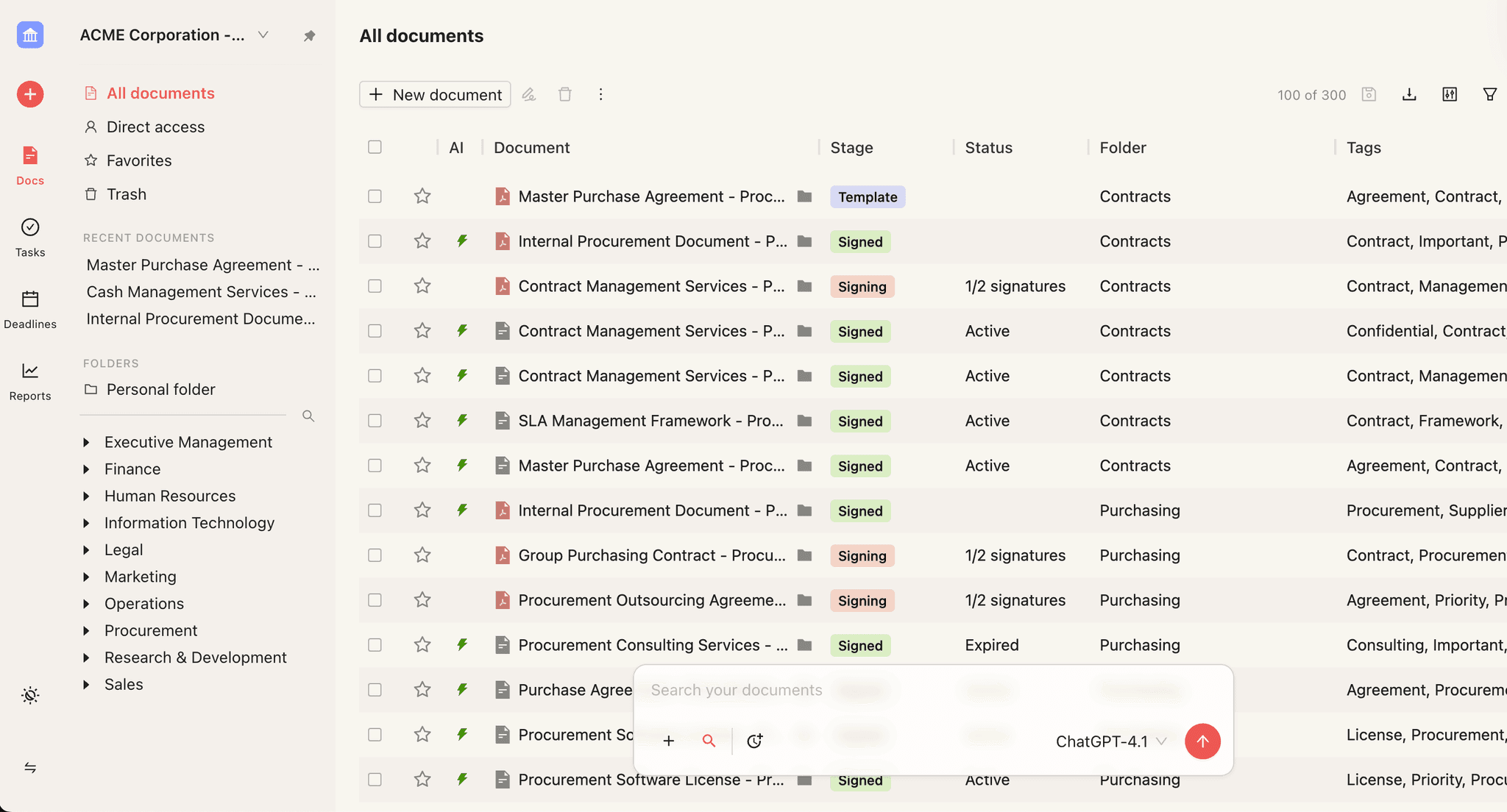
More legal knowledge alone does not fix this. You need the same infrastructure you use across contract management: structured intake, obligation extraction, deadline alerts, approval routing, and a searchable contract repository that surfaces live obligations across every document type, not just signed contracts.
How to manage LOIs like the obligations they create
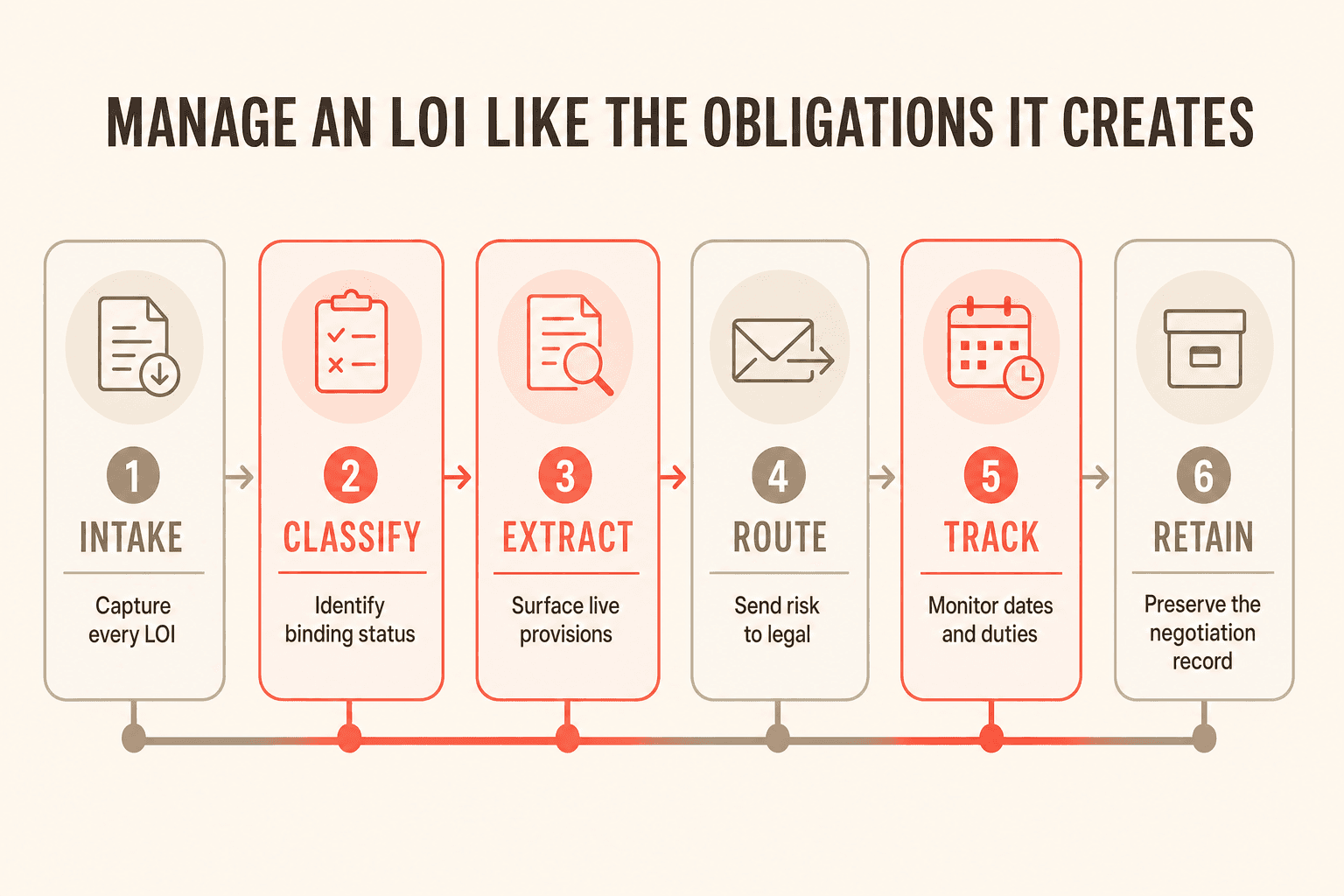
Six habits close most of the gap.
Classify every LOI at intake. Structured contract intake workflows prompt for document type, binding status, and key obligation categories before a document enters your system. That single step prevents the default-to-non-binding mistake.
Extract binding provisions automatically. AI-powered extraction flags exclusivity periods, confidentiality terms, governing-law clauses, and cost-sharing provisions at upload. You get the key metadata without manual review of every page.
Track exclusivity windows like renewal dates. A no-shop period with an end date is exactly the kind of obligation automated deadline alerts are built to catch. Teams that track LOI exclusivity the same way they track renewals rarely breach it by accident.
Draft from a vetted clause library. A centralized clause library gives deal teams pre-approved non-binding legends, binding carve-out language, exclusivity clauses, and governing-law provisions reviewed by counsel. That beats ad hoc language copied from a prior deal governed by different law.
Route approvals based on binding status. An LOI with binding exclusivity warrants legal review before signature; a purely non-binding expression of interest may not. Conditional approval workflows enforce that distinction in practice, and field-level controls can reserve provisions like exclusivity period and governing law so only counsel can modify them.
Keep negotiations in one tracked workspace. Structured collaboration, rather than scattered email threads, creates a clean record of versions, redlines, and communications. If a dispute ever turns on whether you negotiated in good faith, that record matters.
The bottom line
An LOI is never just a formality. Courts enforce LOIs based on what the provisions say, how complete the terms are, and how the parties behave, and the binding carve-outs inside a non-binding document create live obligations from the moment you sign. The teams that avoid LOI disputes read the operative language, classify documents correctly at intake, and track exclusivity and confidentiality obligations with the same rigor they apply to executed contracts.
One final reminder: nothing in this article is legal advice. The enforceability of any specific LOI depends on its language and governing law, so consult qualified legal counsel before signing, exiting, or seeking to enforce one.
Want one place to track every obligation across LOIs, term sheets, and executed agreements? Book a Concord demo to see structured intake, AI extraction, and deadline alerts in action.
Few document labels create more false comfort than “letter of intent.” Deal teams sign LOIs assuming they are harmless preludes to the real agreement, then discover in a dispute that a court reads the same pages very differently. Your team needs to know where the letter of intent vs contract line actually sits, and when an LOI crosses it.
The short answer: an LOI can be fully binding, partially binding, or non-binding, and the title at the top of the page controls none of it. Courts weigh the operative language, the completeness of the agreed terms, and the conduct of the parties.
One note before you go further: this article is general legal education, not legal advice. Enforceability depends on specific facts and governing law, so talk to qualified counsel about any particular LOI before you sign or rely on it.
Key takeaways
An LOI can be fully binding, partially binding, or non-binding. Courts focus on the operative language, completeness of terms, and parties’ conduct rather than the document title.
A non-binding transaction can still contain enforceable duties, especially confidentiality, exclusivity, cost allocation, and governing-law provisions.
A duty to negotiate in good faith may bind the parties even when neither side has committed to closing the transaction.
Structured intake, provision extraction, legal routing, deadline tracking, and negotiation records help prevent avoidable LOI breaches.
What is the difference between a letter of intent and a contract?
A contract records enforceable promises the parties intend to perform. A letter of intent records a proposed deal before the definitive agreement, but its legal effect depends on its language. An LOI may bind the entire transaction, only duties such as confidentiality or exclusivity, or neither.
Letter of intent vs contract: the label tells you almost nothing
Contract law across common-law jurisdictions asks one core question: did the parties objectively intend to be bound? Courts answer it by reading what you wrote, checking which terms you agreed on, and reviewing how you acted afterward. The document’s title is, at most, a weak signal.
A document titled “Letter of Intent” that settles every material term, including price, subject matter, quantity, and duration, and uses promissory language like “Seller shall sell” and “Buyer agrees to purchase,” presents the same objective evidence of a contract as a document titled “Agreement.” A boilerplate “non-binding” legend helps your argument, but it cannot override operative text that contradicts it. Substance beats labels.
The takeaway is uncomfortable but simple: someone on your team has to read the operative provisions before signature. If your intake process files every LOI as non-binding by default, you are guessing about enforceability without looking at the evidence a court would weigh.
The three categories courts use to classify an LOI
Judges in commercial centers like New York and Delaware generally sort preliminary agreements into three buckets:
Type I preliminary agreement. A fully binding contract on all essential terms. The formal document that follows is a formality, and either side can sue to enforce the deal itself.
Type II preliminary agreement. No obligation to close, but a binding duty to negotiate in good faith toward a definitive contract. Bad-faith abandonment can still create liability.
Agreement to agree. An expression of intent to keep negotiating, with no present intent to be bound. Neither side owes anything beyond what specific carve-out provisions say.
LOI category | What is binding | Practical consequence |
|---|---|---|
Fully binding preliminary agreement | The essential transaction terms | Either party may seek to enforce the deal |
Binding duty to negotiate | The negotiation process, not necessarily the final transaction | A bad-faith walk-away may create liability |
Non-binding agreement to agree | Only expressly binding carve-outs | Either side may generally exit, subject to confidentiality or exclusivity duties |
Which bucket your LOI lands in depends on express binding or non-binding wording, whether all material terms are settled, whether either side has started performing, and whether deals of this type are usually papered formally. Other states skip the Type I and Type II vocabulary and ask a simpler question about definiteness of terms. Because the same document can be enforceable in one state and unenforceable in another, the governing-law clause deserves real attention rather than a copy-paste from your last deal.
The binding carve-outs hiding inside “non-binding” LOIs
Specific provisions can be enforceable even when the proposed transaction itself remains non-binding. Courts routinely hold that specific provisions inside an otherwise non-binding LOI are independently enforceable when drafted in definite terms. The usual suspects are confidentiality, exclusivity or no-shop clauses, cost allocation, and governing law. You can sign an LOI genuinely believing the deal is non-binding while taking on enforceable duties about how you negotiate, who else you may talk to, and how you handle shared information.
Confidentiality terms are a common example: they often survive the collapse of the deal itself, exposing you to claims long after talks end. Survival language misleads business readers in both directions, with some assuming everything survives and others assuming nothing does.
The Delaware Supreme Court’s decision in ev3, Inc. v. Lesh shows how sharply courts draw this line. The court held that language allowing an LOI to “survive” into a later merger agreement did not convert clearly non-binding LOI provisions into binding ones. Only provisions expressly designated as binding, such as exclusivity and confidentiality, survived as enforceable promises.
Exclusivity and good faith: where LOI disputes actually start
Exclusivity breaches rank among the most common LOI disputes, and the most avoidable. A no-shop clause creates a defined obligation: for a stated period, one or both parties agree not to negotiate with anyone else. A party that solicits competing bids or signs with a third party inside that window hands the other side a clean breach claim, even if the underlying transaction was never binding.
Why does this keep happening? Deal teams often do not realize the no-shop clause is binding, or the exclusivity window drifts as talks extend and nobody tracks the end date. The obligation exists on paper but in no one’s calendar.
Good-faith negotiation duties are the second trap. Courts in Delaware, New York, and Illinois recognize preliminary agreements that bind you to negotiate in good faith toward a definitive contract, even with no duty to close. Deliberate conduct inconsistent with that duty, such as abandoning the agreed framework the moment a better offer appears, can support damages.
Federal courts apply the same logic to term sheets. In Givaudan SA v. Conagen Inc. (2d Cir. 2025), the Second Circuit treated a detailed term sheet as a binding preliminary agreement to negotiate in good faith even though the parties never reached a final exclusivity agreement, while noting that the plaintiff still had to prove recoverable damages. The lesson: non-binding does not mean consequence-free.
Why LOI risk is really a tracking problem
Many preventable LOI failures begin with misclassification and missed obligations, not uncertainty about the legal doctrine. The legal doctrine here is well developed. The failure mode inside companies is simpler: people sign LOIs without reading them closely, file them without flagging binding provisions, and lose sight of the obligations those provisions create. A confidentiality duty outlives a dead deal with no one aware it exists, an exclusivity window expires unnoticed, or a good-faith duty gets breached because the deal lead never knew it was agreed to.
When pre-contract work runs through email and spreadsheets, LOIs and term sheets can sit outside the main contract repository, leaving their obligations disconnected from deadline tracking. Inconsistent intake can also cause a document labeled “LOI” to be treated as non-binding by default even when it contains binding carve-outs.
More legal knowledge alone does not fix this. You need the same infrastructure you use across contract management: structured intake, obligation extraction, deadline alerts, approval routing, and a searchable contract repository that surfaces live obligations across every document type, not just signed contracts.
How to manage LOIs like the obligations they create
Six habits close most of the gap.
Classify every LOI at intake. Structured contract intake workflows prompt for document type, binding status, and key obligation categories before a document enters your system. That single step prevents the default-to-non-binding mistake.
Extract binding provisions automatically. AI-powered extraction flags exclusivity periods, confidentiality terms, governing-law clauses, and cost-sharing provisions at upload. You get the key metadata without manual review of every page.
Track exclusivity windows like renewal dates. A no-shop period with an end date is exactly the kind of obligation automated deadline alerts are built to catch. Teams that track LOI exclusivity the same way they track renewals rarely breach it by accident.
Draft from a vetted clause library. A centralized clause library gives deal teams pre-approved non-binding legends, binding carve-out language, exclusivity clauses, and governing-law provisions reviewed by counsel. That beats ad hoc language copied from a prior deal governed by different law.
Route approvals based on binding status. An LOI with binding exclusivity warrants legal review before signature; a purely non-binding expression of interest may not. Conditional approval workflows enforce that distinction in practice, and field-level controls can reserve provisions like exclusivity period and governing law so only counsel can modify them.
Keep negotiations in one tracked workspace. Structured collaboration, rather than scattered email threads, creates a clean record of versions, redlines, and communications. If a dispute ever turns on whether you negotiated in good faith, that record matters.
The bottom line
An LOI is never just a formality. Courts enforce LOIs based on what the provisions say, how complete the terms are, and how the parties behave, and the binding carve-outs inside a non-binding document create live obligations from the moment you sign. The teams that avoid LOI disputes read the operative language, classify documents correctly at intake, and track exclusivity and confidentiality obligations with the same rigor they apply to executed contracts.
One final reminder: nothing in this article is legal advice. The enforceability of any specific LOI depends on its language and governing law, so consult qualified legal counsel before signing, exiting, or seeking to enforce one.
Want one place to track every obligation across LOIs, term sheets, and executed agreements? Book a Concord demo to see structured intake, AI extraction, and deadline alerts in action.
Need to know
Frequently Asked Questions

Take the "management" out
of contract management.
Customer Support
Legal
Compare
Resources
Customer Support
Company
Legal
Compare
Resources
Customer Support
Company
Legal
Compare
© 2025 Concord. All rights reserved.