Addendum vs. Amendment: When to Use Each
Addendum vs. Amendment: When to Use Each
Addendum vs. Amendment: When to Use Each
Addendum vs. Amendment: When to Use Each
addendum vs amendment, contract amendment, contract addendum, contract modification, document linking, contract lifecycle management

The addendum vs amendment question shows up in nearly every contract team, usually at an inconvenient moment. A signed document arrives, and you have to decide what it actually does. Does it change the original agreement, or does it add to it?
The two terms get used interchangeably, but they describe different actions. An amendment changes or replaces terms that already exist in a contract. An addendum attaches new, supplemental terms without altering the original language.
This article is for informational purposes only and does not constitute legal advice. Enforceability of any contract modification depends on jurisdiction-specific statutes, case law, and the terms of your contract. Consult qualified legal counsel before executing an amendment or addendum.
Key takeaways
An amendment changes existing contract terms, while an addendum adds supplemental terms without replacing the original language.
The document’s function matters more than its label, but consistent naming makes contract records easier to organize and trust.
Execution requirements depend on the contract, governing law, and type of transaction, so qualified counsel should confirm the required formalities.
After signature, link every modification to its master agreement and update the dates, obligations, and alerts affected by the new terms.
Addendum vs. amendment: the definitional difference
An amendment is a modification of existing terms. It strikes, replaces, or alters language that was part of the original bargain. The legal question it raises: does the original agreement permit modification, and if so, under what formalities?
An addendum is an addition of supplemental terms. It attaches new provisions, schedules, or exhibits without necessarily changing the original text. The legal question here: are the supplemental terms integrated with the original agreement, and does the contract’s modification clause control how they attach?
The label matters less than the function. Courts generally do not invalidate a document because the parties called it an addendum when it operated as an amendment, or the reverse. What carries legal weight is substance: whether the document modifies existing terms or adds new ones.
The practical risk of sloppy labeling shows up in your repository. Inconsistently labeled files are harder to organize, link, and track, and that problem compounds with every new counterparty.
Question | Amendment | Addendum |
|---|---|---|
Primary function | Changes an existing term | Adds supplemental terms |
Effect on original text | Replaces, strikes, or revises language | Leaves original language intact |
Common uses | Price, scope, term, renewal date | Schedule, exhibit, service level, definitions |
Drafting cue | State exactly what is replaced | State how the attachment joins the agreement |
Records treatment | Link to the master and track changed terms | Link to the master and identify the added material |
Why the same document can face different legal rules
The governing law, transaction type, and original contract determine which formalities a modification must satisfy.
Under common law, which covers most services and general commercial contracts, a modification typically requires new consideration. Each party must give something of legal value for the change to hold.
Contracts for the sale of goods follow a different rule. Under UCC § 2-209, no new consideration is required for a modification to be binding. That asymmetry means a services agreement and a goods agreement with identical amendment language can face very different enforceability outcomes.
Writing requirements add another layer. UCC § 2-209 ties modifications to the Statute of Frauds: if the contract as modified falls within the statute, the amendment must be in a signed writing. Many jurisdictions apply the same logic to material modifications of contracts subject to a Statute of Frauds, such as long-term agreements.
Many contracts also contain a no oral modification clause, a provision requiring all changes in a signed writing. Several states give such clauses statutory force. Courts sometimes treat a failed oral modification as a waiver rather than an amendment, and waivers carry their own rules.
State statutes and case law diverge on these points. Treat any claim about what counts as a valid amendment as jurisdiction-dependent, and confirm specifics with counsel.
How to decide between an amendment and an addendum
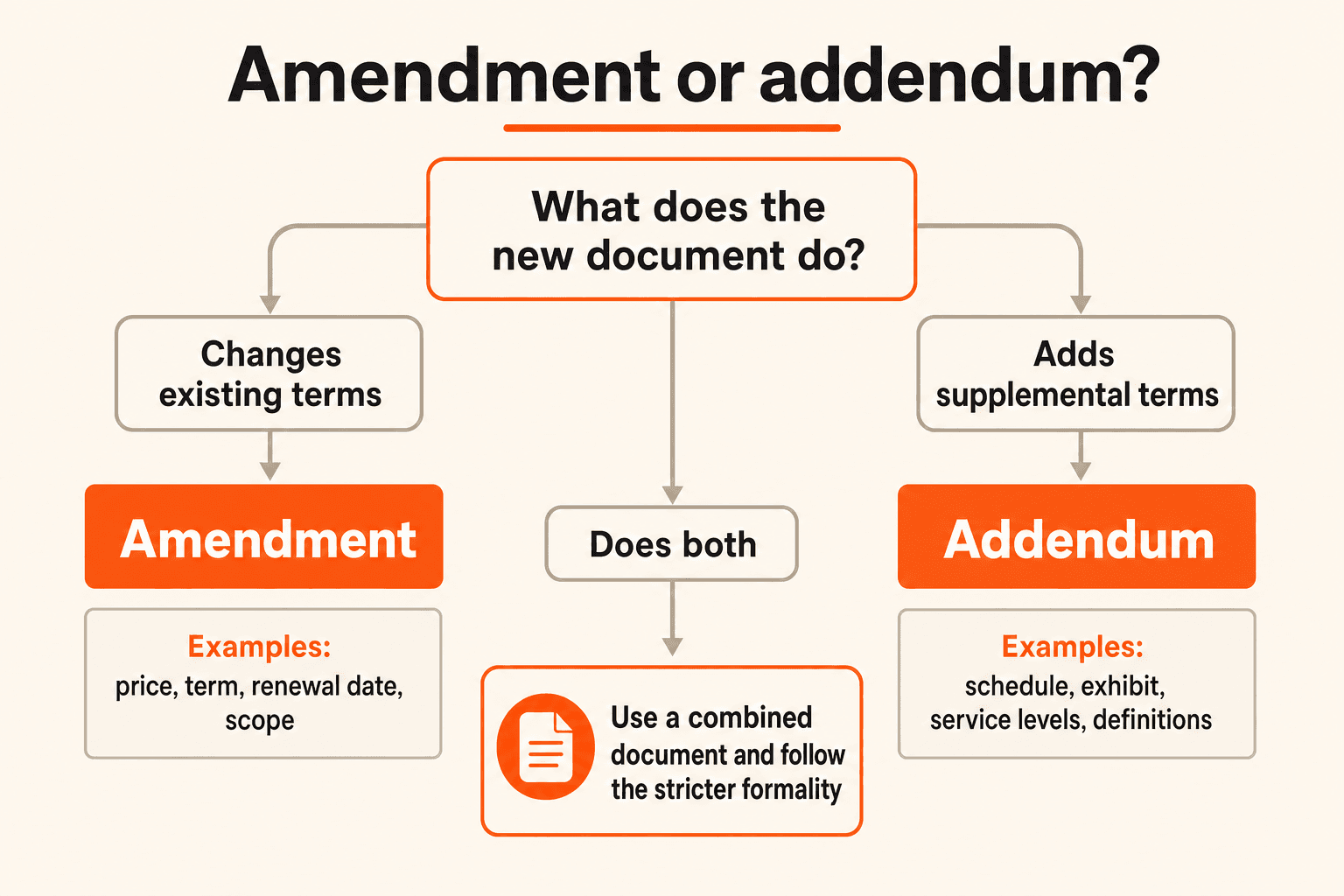
To decide when to use an addendum versus an amendment, ask one question: are you changing what was already agreed, or adding something new? Changing a price, a term length, a renewal date, or a scope calls for an amendment. The amendment replaces the old provision with the new one.
Adding a schedule, a new exhibit, supplemental service levels, or an expanded definitions section calls for an addendum. The original text stays intact, and the addendum builds on it. The contract amendment vs addendum decision rarely requires more analysis than that.
Check the contract’s own modification clause before drafting either document. Many agreements dictate the required form, and knowing how to amend a contract correctly often starts in the fine print of the original. A single document can also do both, in which case drafters often title it “amendment and addendum” and let the substance of each section determine how it functions.
The records risk behind unlinked modifications
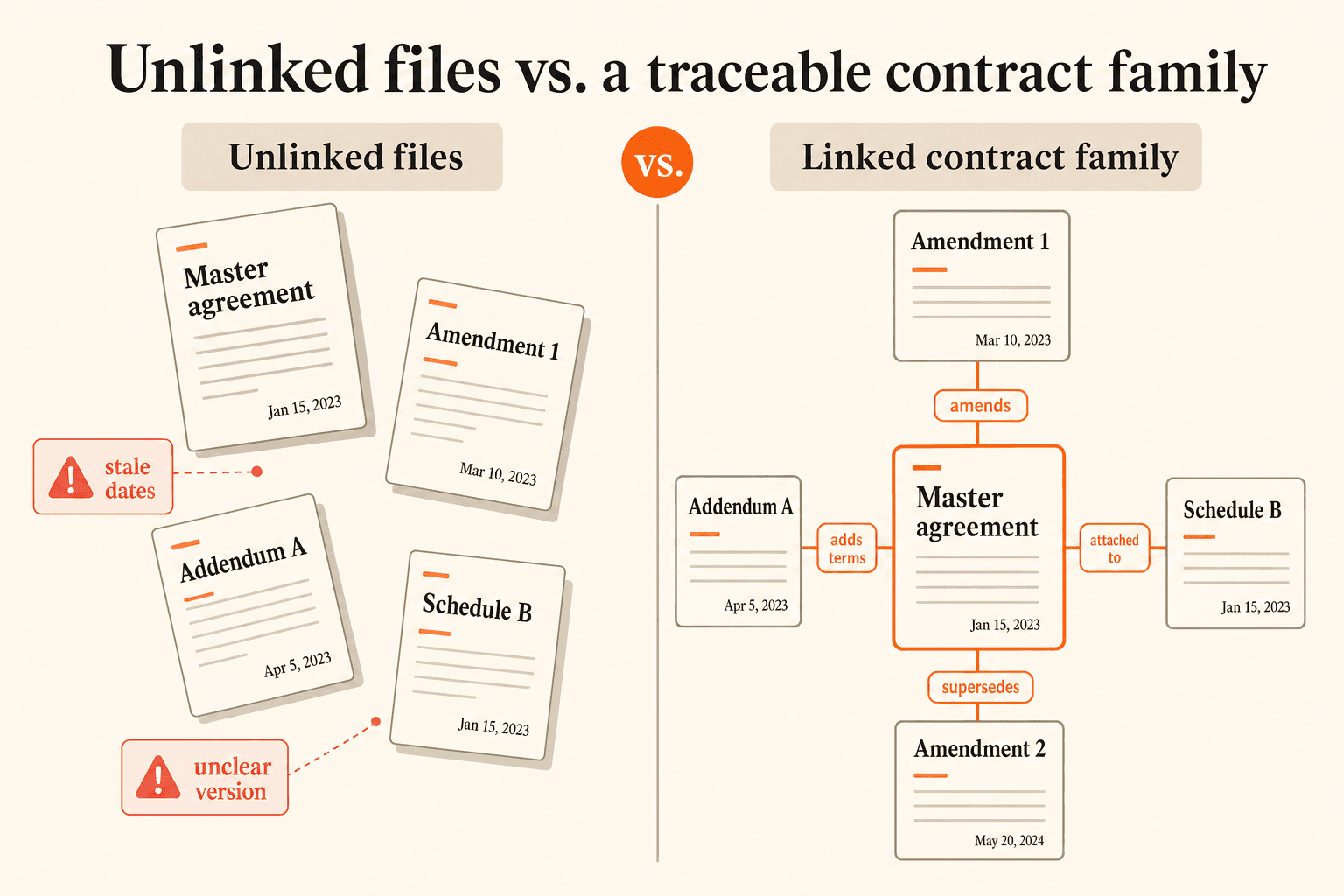
An unlinked modification can leave renewal dates, obligations, and reports tied to terms that are no longer current.
A legal risk becomes a records risk the moment a signed amendment disappears into a folder. Teams keep running renewal alerts, obligation tracking, and reporting off the original terms, unaware that a modification changed the effective date, pricing, or scope.
Teams handling contract modifications at volume commonly describe the linking step as the most tedious part of the workflow, especially when onboarding legacy documents in bulk. A master agreement with 20 addendums means 20 manual link operations before the record is trustworthy.
Bulk uploads create a second hazard: mis-linking. When one counterparty has both standalone contracts and modified versions, files without disciplined naming conventions are easy to attach to the wrong parent. Contract numbers, dates, and party identifiers in file names are the procedural fix, validated by a second person before the record goes live.
The signature moment carries its own risk. Legal ops leaders frequently point out that signers receive amendments without ever seeing the master contract. Linked contract documents give the signer a direct path from the amendment record to the parent agreement, which removes hesitation and speeds execution.
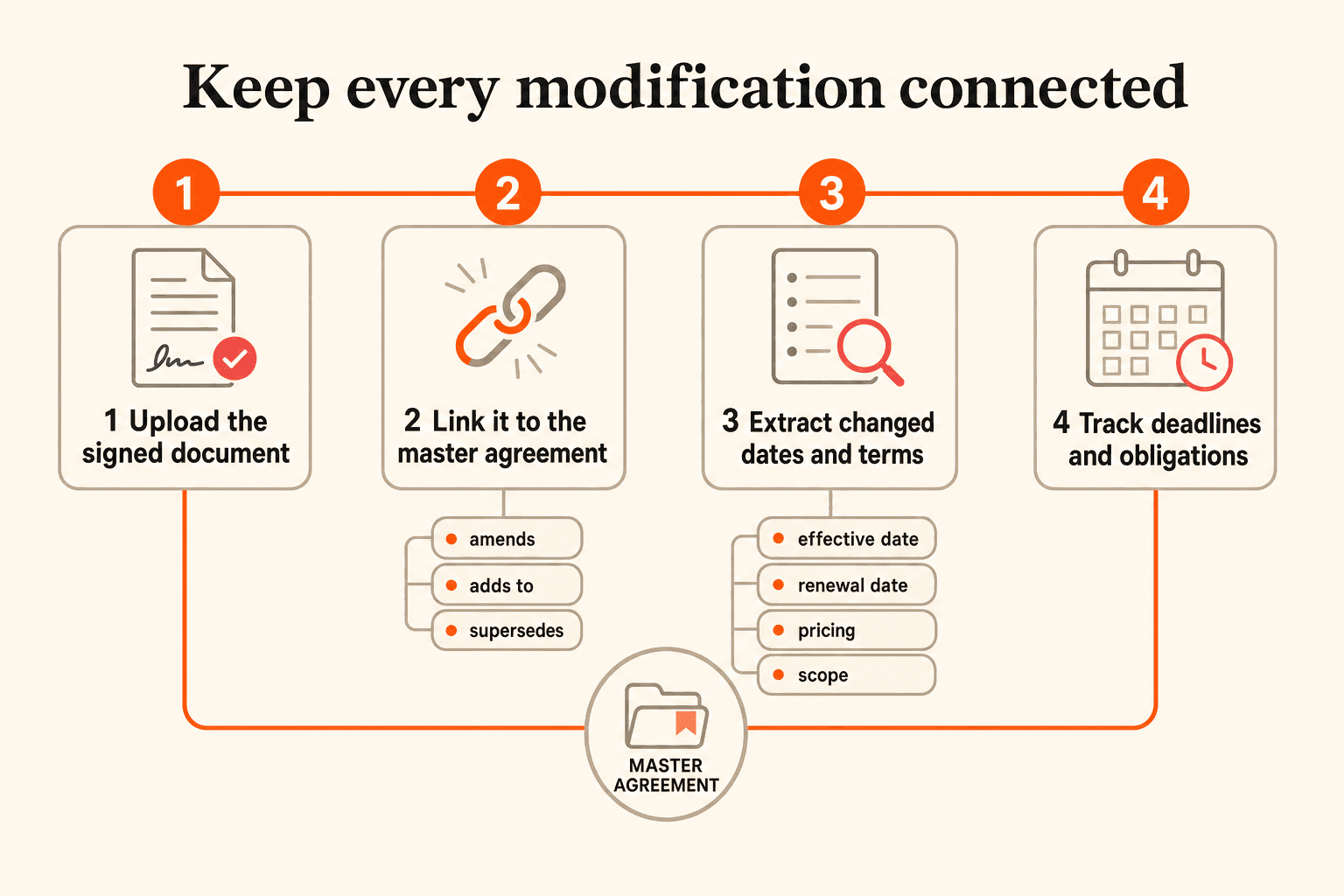
Teams shopping for contract software regularly ask whether the system should treat amendments differently from addendums. The answer is one workflow for both: upload, link, validate, track.
How to keep every amendment connected to its master agreement
Document linking connects amendments and addendums to their parent agreement with bidirectional relationship labels such as “amends,” “amended by,” “extends,” and “supersedes.” The full hierarchy appears in the summary panel, so you can see every child document from the master record and work back the other way. The document linking guide shows the mechanics.
Custom properties let you enforce naming conventions at the field level. Define fields for contract number, parent document name, and amendment sequence, then require them at upload. Sorting, searching, and linking become reliable instead of hopeful.
AI extraction pulls lifecycle properties out of every uploaded document, including amendments and addendums: signed dates, effective dates, durations, renewal terms, and termination notice windows. Each linked document gets its data independently extracted, so the amendment that moved your renewal date actually updates the tracked date. The AI extraction guide walks through the setup.
Deadline alerts then run on amended terms rather than stale originals. Weekly automated emails fire from lifecycle events on each document, including linked amendments that changed end dates or notice periods. The deadline alerts guide covers configuration.
A clause library keeps amendment language standardized, and clause update confirmation prompts reviewers when template-derived language changes. Folders preserve access controls across linked documents, so a user can see that two records are related without gaining access to a restricted parent document. The contract lifecycle management guide connects all of these pieces.
See how Concord keeps amendments, addendums, and master agreements connected, with changed dates and obligations tracked on each document. Request a demo
The bottom line
The addendum vs amendment distinction is easy to blur and expensive to ignore. Amendments change terms, addendums add them, and jurisdiction-specific rules decide which formalities apply. After signature, every modification needs to be linked, dated, and tracked so your team always knows which version is in force.
One more reminder: this content is informational only and does not constitute legal advice. Consult qualified counsel before executing any contract modification.
The addendum vs amendment question shows up in nearly every contract team, usually at an inconvenient moment. A signed document arrives, and you have to decide what it actually does. Does it change the original agreement, or does it add to it?
The two terms get used interchangeably, but they describe different actions. An amendment changes or replaces terms that already exist in a contract. An addendum attaches new, supplemental terms without altering the original language.
This article is for informational purposes only and does not constitute legal advice. Enforceability of any contract modification depends on jurisdiction-specific statutes, case law, and the terms of your contract. Consult qualified legal counsel before executing an amendment or addendum.
Key takeaways
An amendment changes existing contract terms, while an addendum adds supplemental terms without replacing the original language.
The document’s function matters more than its label, but consistent naming makes contract records easier to organize and trust.
Execution requirements depend on the contract, governing law, and type of transaction, so qualified counsel should confirm the required formalities.
After signature, link every modification to its master agreement and update the dates, obligations, and alerts affected by the new terms.
Addendum vs. amendment: the definitional difference
An amendment is a modification of existing terms. It strikes, replaces, or alters language that was part of the original bargain. The legal question it raises: does the original agreement permit modification, and if so, under what formalities?
An addendum is an addition of supplemental terms. It attaches new provisions, schedules, or exhibits without necessarily changing the original text. The legal question here: are the supplemental terms integrated with the original agreement, and does the contract’s modification clause control how they attach?
The label matters less than the function. Courts generally do not invalidate a document because the parties called it an addendum when it operated as an amendment, or the reverse. What carries legal weight is substance: whether the document modifies existing terms or adds new ones.
The practical risk of sloppy labeling shows up in your repository. Inconsistently labeled files are harder to organize, link, and track, and that problem compounds with every new counterparty.
Question | Amendment | Addendum |
|---|---|---|
Primary function | Changes an existing term | Adds supplemental terms |
Effect on original text | Replaces, strikes, or revises language | Leaves original language intact |
Common uses | Price, scope, term, renewal date | Schedule, exhibit, service level, definitions |
Drafting cue | State exactly what is replaced | State how the attachment joins the agreement |
Records treatment | Link to the master and track changed terms | Link to the master and identify the added material |
Why the same document can face different legal rules
The governing law, transaction type, and original contract determine which formalities a modification must satisfy.
Under common law, which covers most services and general commercial contracts, a modification typically requires new consideration. Each party must give something of legal value for the change to hold.
Contracts for the sale of goods follow a different rule. Under UCC § 2-209, no new consideration is required for a modification to be binding. That asymmetry means a services agreement and a goods agreement with identical amendment language can face very different enforceability outcomes.
Writing requirements add another layer. UCC § 2-209 ties modifications to the Statute of Frauds: if the contract as modified falls within the statute, the amendment must be in a signed writing. Many jurisdictions apply the same logic to material modifications of contracts subject to a Statute of Frauds, such as long-term agreements.
Many contracts also contain a no oral modification clause, a provision requiring all changes in a signed writing. Several states give such clauses statutory force. Courts sometimes treat a failed oral modification as a waiver rather than an amendment, and waivers carry their own rules.
State statutes and case law diverge on these points. Treat any claim about what counts as a valid amendment as jurisdiction-dependent, and confirm specifics with counsel.
How to decide between an amendment and an addendum
To decide when to use an addendum versus an amendment, ask one question: are you changing what was already agreed, or adding something new? Changing a price, a term length, a renewal date, or a scope calls for an amendment. The amendment replaces the old provision with the new one.
Adding a schedule, a new exhibit, supplemental service levels, or an expanded definitions section calls for an addendum. The original text stays intact, and the addendum builds on it. The contract amendment vs addendum decision rarely requires more analysis than that.
Check the contract’s own modification clause before drafting either document. Many agreements dictate the required form, and knowing how to amend a contract correctly often starts in the fine print of the original. A single document can also do both, in which case drafters often title it “amendment and addendum” and let the substance of each section determine how it functions.
The records risk behind unlinked modifications
An unlinked modification can leave renewal dates, obligations, and reports tied to terms that are no longer current.
A legal risk becomes a records risk the moment a signed amendment disappears into a folder. Teams keep running renewal alerts, obligation tracking, and reporting off the original terms, unaware that a modification changed the effective date, pricing, or scope.
Teams handling contract modifications at volume commonly describe the linking step as the most tedious part of the workflow, especially when onboarding legacy documents in bulk. A master agreement with 20 addendums means 20 manual link operations before the record is trustworthy.
Bulk uploads create a second hazard: mis-linking. When one counterparty has both standalone contracts and modified versions, files without disciplined naming conventions are easy to attach to the wrong parent. Contract numbers, dates, and party identifiers in file names are the procedural fix, validated by a second person before the record goes live.
The signature moment carries its own risk. Legal ops leaders frequently point out that signers receive amendments without ever seeing the master contract. Linked contract documents give the signer a direct path from the amendment record to the parent agreement, which removes hesitation and speeds execution.
Teams shopping for contract software regularly ask whether the system should treat amendments differently from addendums. The answer is one workflow for both: upload, link, validate, track.
How to keep every amendment connected to its master agreement
Document linking connects amendments and addendums to their parent agreement with bidirectional relationship labels such as “amends,” “amended by,” “extends,” and “supersedes.” The full hierarchy appears in the summary panel, so you can see every child document from the master record and work back the other way. The document linking guide shows the mechanics.
Custom properties let you enforce naming conventions at the field level. Define fields for contract number, parent document name, and amendment sequence, then require them at upload. Sorting, searching, and linking become reliable instead of hopeful.
AI extraction pulls lifecycle properties out of every uploaded document, including amendments and addendums: signed dates, effective dates, durations, renewal terms, and termination notice windows. Each linked document gets its data independently extracted, so the amendment that moved your renewal date actually updates the tracked date. The AI extraction guide walks through the setup.
Deadline alerts then run on amended terms rather than stale originals. Weekly automated emails fire from lifecycle events on each document, including linked amendments that changed end dates or notice periods. The deadline alerts guide covers configuration.
A clause library keeps amendment language standardized, and clause update confirmation prompts reviewers when template-derived language changes. Folders preserve access controls across linked documents, so a user can see that two records are related without gaining access to a restricted parent document. The contract lifecycle management guide connects all of these pieces.
See how Concord keeps amendments, addendums, and master agreements connected, with changed dates and obligations tracked on each document. Request a demo
The bottom line
The addendum vs amendment distinction is easy to blur and expensive to ignore. Amendments change terms, addendums add them, and jurisdiction-specific rules decide which formalities apply. After signature, every modification needs to be linked, dated, and tracked so your team always knows which version is in force.
One more reminder: this content is informational only and does not constitute legal advice. Consult qualified counsel before executing any contract modification.
Need to know
Frequently Asked Questions

Take the "management" out
of contract management.
Customer Support
Legal
Compare
Resources
Customer Support
Company
Legal
Compare
Resources
Customer Support
Company
Legal
Compare
© 2025 Concord. All rights reserved.