Express contracts: definition, examples, and digital execution
Express contracts: definition, examples, and digital execution
Express contracts: definition, examples, and digital execution
Express contracts: definition, examples, and digital execution
contract management

Key takeaways
An express contract states every term explicitly, in writing or speech, so neither party is left guessing about what was promised.
Four elements make it binding: offer, acceptance, consideration, and mutual assent.
Express contracts differ from implied contracts, which courts infer from conduct rather than from stated terms.
Written express contracts are far easier to prove and enforce than oral ones, and some agreements must be in writing under the Statute of Frauds.
Digital execution keeps an express contract fast and enforceable from draft to signature: built-in e-signature, standardized templates, conditional logic, and centralized AI storage.
An express contract is an agreement in which all terms and conditions are explicitly stated by the parties involved, whether in writing or verbally. Unlike agreements formed through conduct or circumstance, an express contract leaves no ambiguity about what each party has promised. For legal ops managers, procurement leads, sales teams, and contract administrators, understanding how express contracts work, and how to execute them digitally, is foundational to building faster, more enforceable contract workflows.
What is an express contract?
An express contract exists when the parties clearly articulate and agree to specific terms. The agreement can take written or oral form, though written express contracts are far more common in professional settings because they provide a clear record of what was promised.
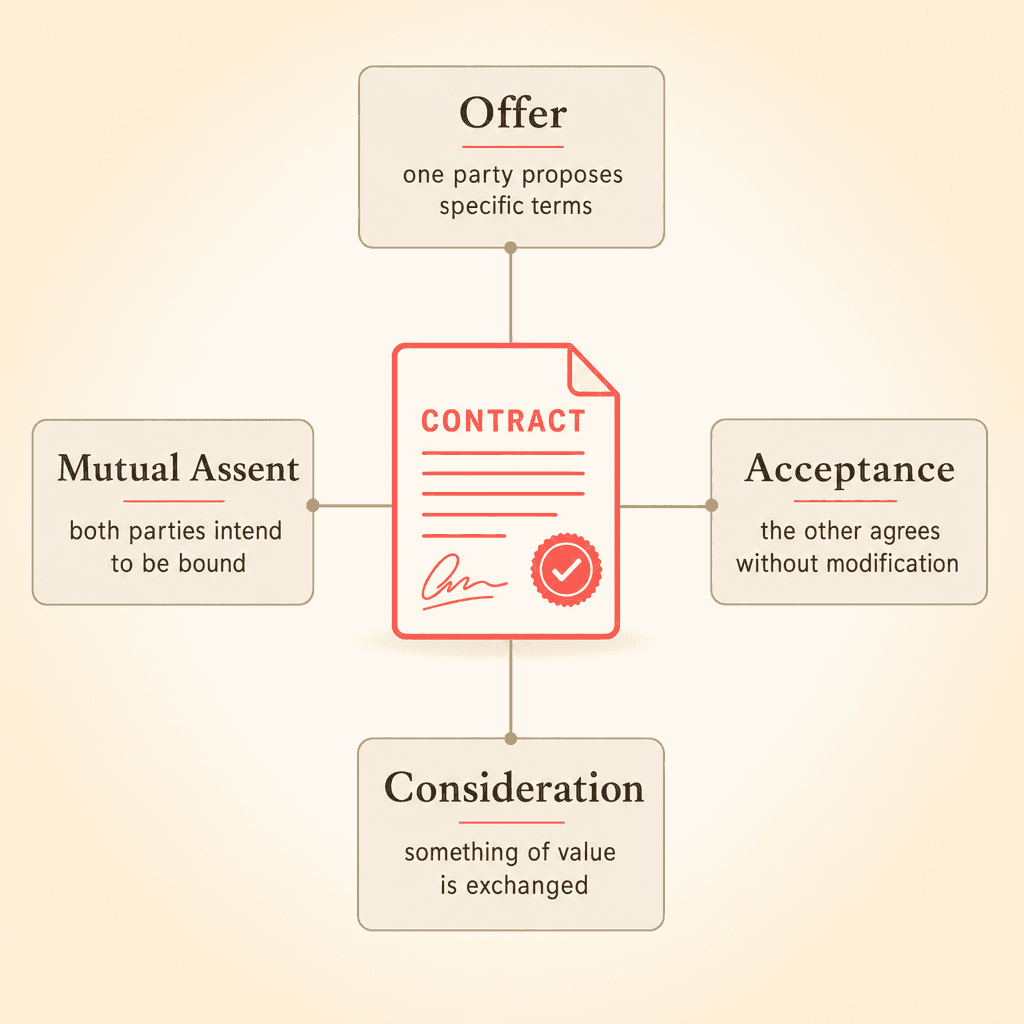
Every express contract contains four core elements:
Offer: One party proposes specific terms (a scope of work, a price, a timeline).
Acceptance: The other party agrees to those terms without material modification.
Consideration: Something of value is exchanged, such as payment for a service or product.
Mutual assent: Both parties intend to be bound by the agreement.
The word “express” simply means the terms are stated outright rather than inferred from behavior. A signed vendor agreement with listed deliverables and payment dates is an express contract. A handshake deal where both parties verbally agree on price and delivery is also technically an express contract, though proving its terms later becomes far more difficult.
Note: Enforceability requirements for express contracts vary by jurisdiction and contract type. Certain agreements (real estate transactions, contracts above specific value thresholds) may require written form under statutes such as the Statute of Frauds. Consult legal counsel for guidance specific to your situation.
Express contract vs. implied contract
The distinction between express and implied contracts comes up frequently in legal discussions, and the difference is straightforward.
Express contract | Implied contract | |
|---|---|---|
How terms are communicated | Stated explicitly (written or oral) | Inferred from conduct, circumstances, or course of dealing |
Clarity of obligations | Each party’s duties are spelled out | Obligations are assumed based on behavior |
Evidence | The contract document (or recorded verbal agreement) serves as primary evidence | Courts examine the parties’ actions and reasonable expectations |
Common examples | Employment agreements, vendor contracts, NDAs, purchase orders | Returning to the same contractor who always charges the same rate without a new written agreement each time |
An implied contract forms when a reasonable person would conclude, based on the parties’ behavior, that an agreement exists. An express contract removes that inference entirely by putting everything in plain language. For teams managing contract risk, the express approach is almost always preferable because it creates a clear, reviewable record. You can learn more about different agreement structures in Concord’s guide to types of contracts.
Express contract examples in practice
Express contracts appear across virtually every function and industry. Here are common examples your teams likely encounter:
Employment offer letter. The employer states the role, compensation, start date, benefits, and at-will status. The candidate signs to accept. Every material term is explicit.
SaaS subscription order form. A software vendor specifies the subscription tier, number of seats, annual fee, payment schedule, auto-renewal terms, and service-level commitments. The buyer countersigns.
Construction subcontractor agreement. A general contractor engages a subcontractor with defined scope, materials specifications, completion milestones, payment terms, and insurance requirements.
Non-disclosure agreement (NDA). Two parties define what constitutes confidential information, the duration of the obligation, permitted disclosures, and remedies for breach.
Master service agreement (MSA) with statement of work (SOW). The MSA sets general terms (liability, IP ownership, dispute resolution), while each SOW specifies project scope, fees, and timelines.
In each case, the hallmark is the same: the parties have written down exactly what they are agreeing to. You can explore how to structure these agreements using Concord’s guide to contract templates.
Sample express contract language
Below are illustrative clause examples showing how express contract terms are typically drafted. These samples are for educational purposes only and do not constitute legal advice.
Recitals (preamble):
“This Agreement is entered into as of [Date] by and between [Party A], a [State] corporation with its principal place of business at [Address], and [Party B], an individual/entity located at [Address], for the purpose of [brief description of the engagement].”
Payment terms:
“Party A shall pay Party B the sum of [Amount] within thirty (30) calendar days of receipt of a valid invoice. Late payments shall accrue interest at a rate of 1.5 percent per month.”
Termination clause:
“Either party may terminate this Agreement for convenience upon sixty (60) days’ written notice to the other party. Upon termination, Party A shall pay Party B for all services rendered through the effective date of termination.”
Signature block:
“IN WITNESS WHEREOF, the parties have executed this Agreement as of the date first written above.”
[Signature line, printed name, title, date for each party]
Each of these sections makes the contract’s terms unambiguous. When these clauses live inside a template with dynamic fields (dropdowns for payment terms, auto-populated party details, required signature fields), every new agreement starts from a vetted baseline. Concord’s guide to contract fields explains how to configure these dynamic elements.
Why digital execution matters for express contracts
A clearly stated agreement is only as strong as its execution process. Legal ops leaders frequently report that the gap between “terms are finalized” and “contract is signed” is where speed and enforceability break down.
The cost of manual execution
Teams managing contracts through email chains, shared drives, and disconnected signature tools face compounding problems:
Version confusion. Multiple drafts circulate simultaneously, and unsigned versions get mistaken for final agreements.
Signature delays. Organizations relying on physical mail or disjointed e-signature tools routinely see execution timelines stretch into weeks, even when terms are fully agreed upon.
Missing audit trails. Without a system that tracks every edit, comment, approval, and signature event, even a well-drafted express contract becomes difficult to enforce. Proving what was agreed to, and when, requires a complete record.
Retrieval failures. Contracts scattered across individual desktops and email attachments create a practical enforceability problem. If you cannot locate the executed copy quickly, the clarity of your express contract offers limited protection.
Organizations processing hundreds of contracts per month report that these manual workflows create compounding delays and compliance risks that grow with each new agreement.
See how Concord turns finalized terms into a signed, stored, and searchable express contract in minutes. Request a demo to run it against your own agreements.
How digital tools close the gap
Modern contract platforms address each of these failure points directly:
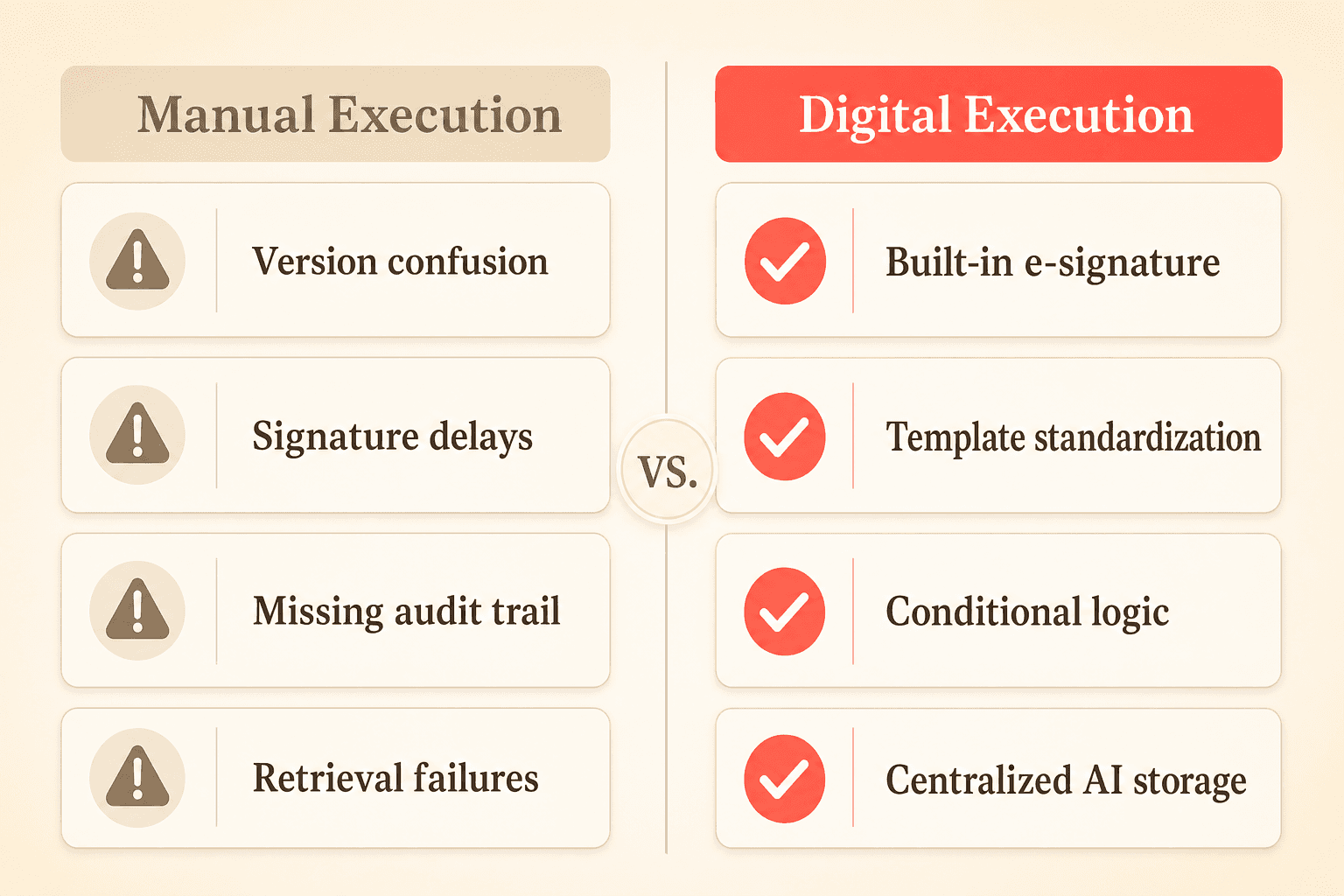
Built-in e-signature allows express contracts to be signed the moment terms are finalized. Signers can type, draw, or upload a signature image without leaving the platform. When signatures are included at no additional per-envelope cost and with no document limits, the financial friction of “one more signature” disappears entirely.
From the webinar: You can also do signing order, so if you want the other side to sign first before you sign, you can set up that signing order. We do have auto-request signature, which I always recommend having on. What that means is, as soon as one person signs it, it automatically sends the request to the next person who is set up as the signer. One place where that really comes in handy is when you have executives who need to sign all your documents at the end, but you do not want them invited to the document until the other party signs it. So you add them as a signer, you do not invite them yet, and you set up auto-request signature. That way, as soon as the other person signs, they get the request to come in and sign it.
Template standardization pairs naturally with express contracts. Pre-approved language blocks, clause libraries, and dynamic fields that auto-populate party details and financial terms prevent two common failures: vague language that blurs an express contract into something closer to an implied agreement, and non-standard terms that legal never reviewed.
Conditional logic keeps contracts express while handling complexity. If an order value exceeds a threshold, a different payment term or additional approval step auto-populates. The terms remain explicitly stated; the system simply selects the correct ones.
From the webinar: We’re going to set an approval. We have our standard, company-wide approval options here, but if I click on custom and add a step, I can go into this conditional step. So I can come in and say, if contract value is greater than or equal to 10,000, then I want approval from the executive team and the finance team. I can also choose whether I want all of them to approve, or just one person from each team. In this case I’ll say anyone. I could also add another step, so once they’ve approved it because it’s over this amount, it goes to someone else. We’ve just created a conditional workflow based on the amount of the contract.
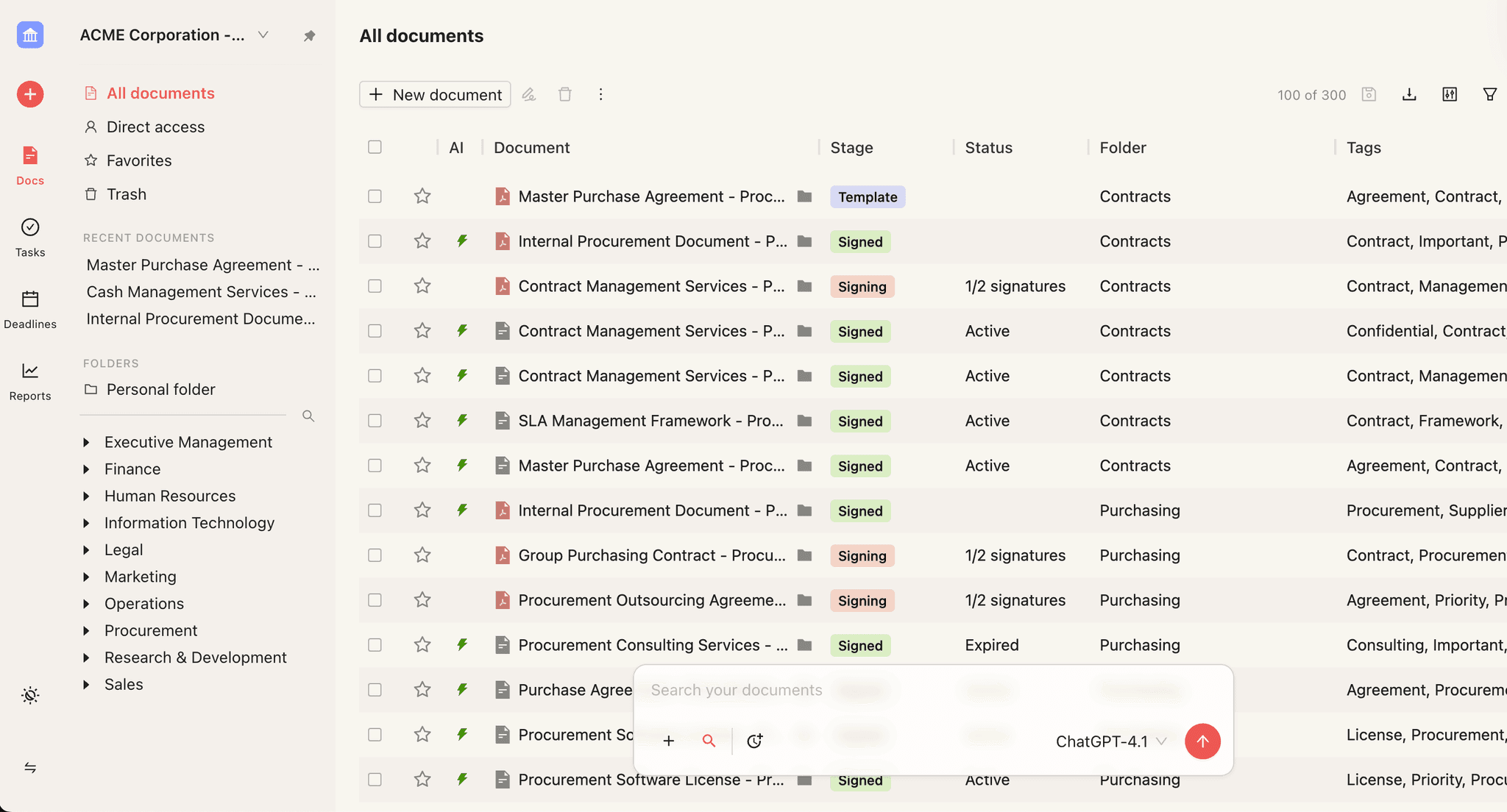
Centralized storage with AI-powered extraction means every executed express contract is indexed, searchable, and retrievable. Text extraction pulls parties, dates, financial terms, and lifecycle details from uploaded documents (PDF, Word, or HTML), so even legacy agreements become part of your single source of truth.
Automated deadline tracking handles the post-signature lifecycle. Express contracts with auto-renewal windows, early termination deadlines, or milestone-based obligations require active management. Automated alerts prevent the entirely avoidable cost of missing a renewal deadline on an agreement you intended to renegotiate.
A note on oral express contracts
Oral express contracts remain technically enforceable in many jurisdictions below certain value thresholds. But when digital tools make it possible to draft, negotiate, and sign a written agreement in minutes, the practical justification for relying on oral agreements nearly vanishes. A written express contract created from a template, signed electronically, and stored with a full audit trail will always be easier to enforce than a verbal promise.
Take the next step with your express contracts
If your team is drafting express contracts in word processors, negotiating through email, and chasing signatures across disconnected tools, every agreement carries more risk and takes longer than it should. Concord brings drafting, negotiation, e-signature, and post-signature management into a single platform, so your express contracts move from draft to execution in minutes rather than weeks. Request a demo to see how it works with your agreements.
This article is for informational purposes only and does not constitute legal advice. Consult a qualified attorney for guidance on specific contract law questions.
Key takeaways
An express contract states every term explicitly, in writing or speech, so neither party is left guessing about what was promised.
Four elements make it binding: offer, acceptance, consideration, and mutual assent.
Express contracts differ from implied contracts, which courts infer from conduct rather than from stated terms.
Written express contracts are far easier to prove and enforce than oral ones, and some agreements must be in writing under the Statute of Frauds.
Digital execution keeps an express contract fast and enforceable from draft to signature: built-in e-signature, standardized templates, conditional logic, and centralized AI storage.
An express contract is an agreement in which all terms and conditions are explicitly stated by the parties involved, whether in writing or verbally. Unlike agreements formed through conduct or circumstance, an express contract leaves no ambiguity about what each party has promised. For legal ops managers, procurement leads, sales teams, and contract administrators, understanding how express contracts work, and how to execute them digitally, is foundational to building faster, more enforceable contract workflows.
What is an express contract?
An express contract exists when the parties clearly articulate and agree to specific terms. The agreement can take written or oral form, though written express contracts are far more common in professional settings because they provide a clear record of what was promised.
Every express contract contains four core elements:
Offer: One party proposes specific terms (a scope of work, a price, a timeline).
Acceptance: The other party agrees to those terms without material modification.
Consideration: Something of value is exchanged, such as payment for a service or product.
Mutual assent: Both parties intend to be bound by the agreement.
The word “express” simply means the terms are stated outright rather than inferred from behavior. A signed vendor agreement with listed deliverables and payment dates is an express contract. A handshake deal where both parties verbally agree on price and delivery is also technically an express contract, though proving its terms later becomes far more difficult.
Note: Enforceability requirements for express contracts vary by jurisdiction and contract type. Certain agreements (real estate transactions, contracts above specific value thresholds) may require written form under statutes such as the Statute of Frauds. Consult legal counsel for guidance specific to your situation.
Express contract vs. implied contract
The distinction between express and implied contracts comes up frequently in legal discussions, and the difference is straightforward.
Express contract | Implied contract | |
|---|---|---|
How terms are communicated | Stated explicitly (written or oral) | Inferred from conduct, circumstances, or course of dealing |
Clarity of obligations | Each party’s duties are spelled out | Obligations are assumed based on behavior |
Evidence | The contract document (or recorded verbal agreement) serves as primary evidence | Courts examine the parties’ actions and reasonable expectations |
Common examples | Employment agreements, vendor contracts, NDAs, purchase orders | Returning to the same contractor who always charges the same rate without a new written agreement each time |
An implied contract forms when a reasonable person would conclude, based on the parties’ behavior, that an agreement exists. An express contract removes that inference entirely by putting everything in plain language. For teams managing contract risk, the express approach is almost always preferable because it creates a clear, reviewable record. You can learn more about different agreement structures in Concord’s guide to types of contracts.
Express contract examples in practice
Express contracts appear across virtually every function and industry. Here are common examples your teams likely encounter:
Employment offer letter. The employer states the role, compensation, start date, benefits, and at-will status. The candidate signs to accept. Every material term is explicit.
SaaS subscription order form. A software vendor specifies the subscription tier, number of seats, annual fee, payment schedule, auto-renewal terms, and service-level commitments. The buyer countersigns.
Construction subcontractor agreement. A general contractor engages a subcontractor with defined scope, materials specifications, completion milestones, payment terms, and insurance requirements.
Non-disclosure agreement (NDA). Two parties define what constitutes confidential information, the duration of the obligation, permitted disclosures, and remedies for breach.
Master service agreement (MSA) with statement of work (SOW). The MSA sets general terms (liability, IP ownership, dispute resolution), while each SOW specifies project scope, fees, and timelines.
In each case, the hallmark is the same: the parties have written down exactly what they are agreeing to. You can explore how to structure these agreements using Concord’s guide to contract templates.
Sample express contract language
Below are illustrative clause examples showing how express contract terms are typically drafted. These samples are for educational purposes only and do not constitute legal advice.
Recitals (preamble):
“This Agreement is entered into as of [Date] by and between [Party A], a [State] corporation with its principal place of business at [Address], and [Party B], an individual/entity located at [Address], for the purpose of [brief description of the engagement].”
Payment terms:
“Party A shall pay Party B the sum of [Amount] within thirty (30) calendar days of receipt of a valid invoice. Late payments shall accrue interest at a rate of 1.5 percent per month.”
Termination clause:
“Either party may terminate this Agreement for convenience upon sixty (60) days’ written notice to the other party. Upon termination, Party A shall pay Party B for all services rendered through the effective date of termination.”
Signature block:
“IN WITNESS WHEREOF, the parties have executed this Agreement as of the date first written above.”
[Signature line, printed name, title, date for each party]
Each of these sections makes the contract’s terms unambiguous. When these clauses live inside a template with dynamic fields (dropdowns for payment terms, auto-populated party details, required signature fields), every new agreement starts from a vetted baseline. Concord’s guide to contract fields explains how to configure these dynamic elements.
Why digital execution matters for express contracts
A clearly stated agreement is only as strong as its execution process. Legal ops leaders frequently report that the gap between “terms are finalized” and “contract is signed” is where speed and enforceability break down.
The cost of manual execution
Teams managing contracts through email chains, shared drives, and disconnected signature tools face compounding problems:
Version confusion. Multiple drafts circulate simultaneously, and unsigned versions get mistaken for final agreements.
Signature delays. Organizations relying on physical mail or disjointed e-signature tools routinely see execution timelines stretch into weeks, even when terms are fully agreed upon.
Missing audit trails. Without a system that tracks every edit, comment, approval, and signature event, even a well-drafted express contract becomes difficult to enforce. Proving what was agreed to, and when, requires a complete record.
Retrieval failures. Contracts scattered across individual desktops and email attachments create a practical enforceability problem. If you cannot locate the executed copy quickly, the clarity of your express contract offers limited protection.
Organizations processing hundreds of contracts per month report that these manual workflows create compounding delays and compliance risks that grow with each new agreement.
See how Concord turns finalized terms into a signed, stored, and searchable express contract in minutes. Request a demo to run it against your own agreements.
How digital tools close the gap
Modern contract platforms address each of these failure points directly:
Built-in e-signature allows express contracts to be signed the moment terms are finalized. Signers can type, draw, or upload a signature image without leaving the platform. When signatures are included at no additional per-envelope cost and with no document limits, the financial friction of “one more signature” disappears entirely.
From the webinar: You can also do signing order, so if you want the other side to sign first before you sign, you can set up that signing order. We do have auto-request signature, which I always recommend having on. What that means is, as soon as one person signs it, it automatically sends the request to the next person who is set up as the signer. One place where that really comes in handy is when you have executives who need to sign all your documents at the end, but you do not want them invited to the document until the other party signs it. So you add them as a signer, you do not invite them yet, and you set up auto-request signature. That way, as soon as the other person signs, they get the request to come in and sign it.
Template standardization pairs naturally with express contracts. Pre-approved language blocks, clause libraries, and dynamic fields that auto-populate party details and financial terms prevent two common failures: vague language that blurs an express contract into something closer to an implied agreement, and non-standard terms that legal never reviewed.
Conditional logic keeps contracts express while handling complexity. If an order value exceeds a threshold, a different payment term or additional approval step auto-populates. The terms remain explicitly stated; the system simply selects the correct ones.
From the webinar: We’re going to set an approval. We have our standard, company-wide approval options here, but if I click on custom and add a step, I can go into this conditional step. So I can come in and say, if contract value is greater than or equal to 10,000, then I want approval from the executive team and the finance team. I can also choose whether I want all of them to approve, or just one person from each team. In this case I’ll say anyone. I could also add another step, so once they’ve approved it because it’s over this amount, it goes to someone else. We’ve just created a conditional workflow based on the amount of the contract.
Centralized storage with AI-powered extraction means every executed express contract is indexed, searchable, and retrievable. Text extraction pulls parties, dates, financial terms, and lifecycle details from uploaded documents (PDF, Word, or HTML), so even legacy agreements become part of your single source of truth.
Automated deadline tracking handles the post-signature lifecycle. Express contracts with auto-renewal windows, early termination deadlines, or milestone-based obligations require active management. Automated alerts prevent the entirely avoidable cost of missing a renewal deadline on an agreement you intended to renegotiate.
A note on oral express contracts
Oral express contracts remain technically enforceable in many jurisdictions below certain value thresholds. But when digital tools make it possible to draft, negotiate, and sign a written agreement in minutes, the practical justification for relying on oral agreements nearly vanishes. A written express contract created from a template, signed electronically, and stored with a full audit trail will always be easier to enforce than a verbal promise.
Take the next step with your express contracts
If your team is drafting express contracts in word processors, negotiating through email, and chasing signatures across disconnected tools, every agreement carries more risk and takes longer than it should. Concord brings drafting, negotiation, e-signature, and post-signature management into a single platform, so your express contracts move from draft to execution in minutes rather than weeks. Request a demo to see how it works with your agreements.
This article is for informational purposes only and does not constitute legal advice. Consult a qualified attorney for guidance on specific contract law questions.
Need to know
Frequently Asked Questions

Take the "management" out
of contract management.
Customer Support
Legal
Compare
Resources
Customer Support
Company
Legal
Compare
Resources
Customer Support
Company
Legal
Compare
© 2025 Concord. All rights reserved.