What is a perform contract? Executed vs executory explained
What is a perform contract? Executed vs executory explained
What is a perform contract? Executed vs executory explained
What is a perform contract? Executed vs executory explained
contract management

Key takeaways
Contract performance means each party carrying out the duties it agreed to. A contract is performed once every party has met its obligations.
An executed contract has two meanings: signed and binding, or fully performed with nothing left to do. Confusing the two creates reporting and compliance gaps across teams.
An executory contract still has outstanding obligations. Most agreements stay executory for the majority of their lifespan.
Many contracts are partially performed, holding executed and executory obligations at the same time, so your tracking system has to account for both.
What is contract performance?
Contract performance is each party carrying out the duties spelled out in an agreement, such as delivering goods, providing services, or making payments. A contract is fully performed once every party has satisfied its obligations. Until then, some duties remain outstanding.
When you hear the phrase “perform contracts,” you might picture the moment pen meets paper. But contract performance refers to something far more consequential: the fulfillment of obligations that each party agreed to when signing. Understanding how contracts are performed, and knowing the difference between executed and executory contracts, is foundational to managing your agreements with confidence. Without this knowledge, teams risk missed deadlines, accidental auto-renewals, and compliance gaps that carry real financial weight.
This article breaks down what it means to perform a contract, clarifies the commonly confused distinction between executed and executory agreements, and explains why tracking contract performance status matters for every team that manages binding obligations.
What does it mean to perform a contract?
Contract performance refers to each party carrying out the duties and obligations spelled out in the agreement. When you perform a contract, you are doing what you promised to do: delivering goods, rendering services, making payments, or fulfilling any other commitments defined in the contract’s terms.
Contract performance meaning varies slightly depending on context, but the core idea remains the same. A contract is considered performed when all parties have satisfied their respective obligations. Until that point, some or all duties remain outstanding.
Types of contract performance generally fall into three categories:
Complete performance: All obligations have been fulfilled by all parties. The contract is done.
Substantial performance: A party has fulfilled the material terms of the agreement, even if minor details remain incomplete. Courts often treat this as sufficient to discharge the contract.
Partial performance: Some obligations have been met, but significant duties remain. The contract is still active.
These categories matter because they determine what rights and responsibilities each party still holds. A partially performed contract requires different attention than one that has been fully completed. For a closer look at how contracts move through stages, visit Concord’s guide to contract lifecycle management.
What is an executed contract?
The term “executed contract” is one of the most misunderstood phrases in contract management. It carries two distinct meanings, and confusing them creates real problems across teams.
Meaning 1: Signed. In everyday usage, “executed” often means that all parties have signed the agreement. You might hear someone say, “The contract has been executed,” meaning signatures are in place and the agreement is now binding.
Meaning 2: Fully performed. In contract law, an executed contract refers to an agreement where all obligations have been completely fulfilled by every party. Nothing remains to be done. The contract has been performed in its entirety.
This dual meaning creates frequent miscommunication between legal, procurement, and finance teams. A procurement manager might report that a vendor contract is “fully executed,” meaning signed, while a legal team member interprets the same phrase as meaning all deliverables have been received and all payments made. The gap between these interpretations can lead to compliance oversights, premature file closures, or inaccurate reporting.
For the purposes of this article, a fully executed contract means one where every obligation has been satisfied by all parties.
What is an executory contract?
An executory contract is the opposite of a fully executed one. In an executory contract, one or more parties still have outstanding obligations to fulfill. The agreement is active, binding, and requires ongoing attention.
Most contracts spend the majority of their lifespan in an executory state. Consider a two-year software subscription agreement. From the moment it is signed until the final month of service is delivered and the last payment is made, the contract remains executory. Both the vendor (who must provide ongoing access to the software) and the buyer (who must continue making payments) have unfulfilled obligations.
The executory contract definition is straightforward, but its implications are significant. Every executory contract represents a set of commitments your organization must actively monitor. Deadlines, renewal windows, notice periods, compliance certifications: all of these are markers of executory obligations that require tracking.
To learn more about managing renewals and deadlines, check out Concord’s guide to contract renewals.
Executed vs executory contracts: key differences
The performed contract vs executory contract distinction is not just academic. It shapes how your team should handle each agreement day to day. Here is a side-by-side comparison:
Executed contract | Executory contract | |
|---|---|---|
Obligation status | All obligations fulfilled by all parties | One or more obligations remain outstanding |
Management need | Archival and reference access | Active monitoring, deadline tracking, workflow management |
Risk profile | Low (residual obligations like warranties may still apply) | Higher (missed obligations carry financial and legal consequences) |
Examples | A completed one-time purchase where goods were delivered and payment was made | An ongoing lease, subscription agreement, or service contract with future payment or delivery dates |
Team action required | Store for audit and reference purposes | Track deadlines, monitor compliance, manage renewals |
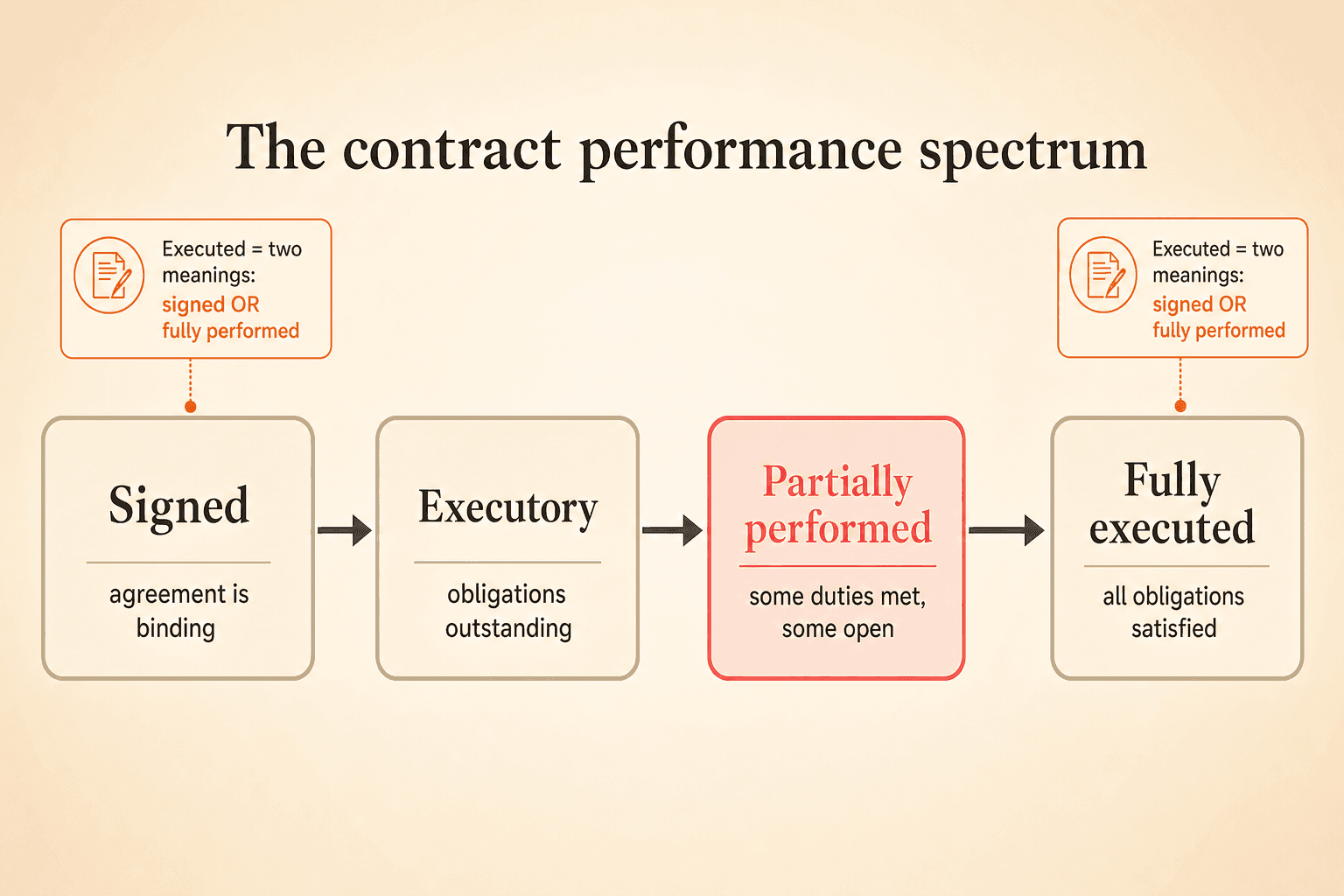
One important nuance: a contract does not flip from executory to executed in a single moment. Many agreements exist in a partially performed state. A vendor may have delivered three of four shipments, while the buyer has paid for two. Both parties hold both executed and executory obligations within the same agreement. Your tracking system needs to account for this complexity.
Why contract performance status matters for your team
Knowing whether a contract is executed, executory, or partially performed is not a theoretical exercise. It directly determines what your team needs to do next.
Missed deadlines stem from unclear performance tracking. Contract administrators commonly report that auto-renewals and missed notice periods happen because nobody is actively monitoring which obligations remain outstanding. If you do not know which contracts are still executory, you cannot act on them in time.
High contract volume amplifies the problem. Organizations managing hundreds or thousands of active agreements describe the difficulty of knowing, at any given moment, which contracts are fully performed, which are partially performed, and which are still entirely executory. At that scale, mental tracking and spreadsheet-based systems break down.
Reporting on contract status is manual and error-prone without the right tools. Legal ops leaders frequently note that assembling a picture of where contracts stand requires significant manual effort when done outside a dedicated platform. Pulling together data on which agreements are active, nearing expiration, or carrying outstanding obligations becomes a recurring time drain.
For more on how reporting supports contract management, visit Concord’s guide to contract reporting and analytics.
From a Concord customer webinar. Watch the clip
I have mine configured to warn me at the 60 day mark in some cases and the 90 day mark in others. The first time something pops onto the report, that is my trigger to go look at the contract: do I have the right number of seats, the right terms, are we planning on renewing this vendor? The non-renewal notifications matter too, because you want to make any changes in time. I have been burned before where a 60 day notice period sneaks up on you and you realize 30 days out that you need a change, and the vendor says you have already renewed. This gives me early enough warning. Every Monday morning it hits my inbox and makes sure I see contracts that need attention before it becomes a problem.
The hidden risks in “fully performed” contracts
Even contracts you consider fully executed may carry lingering obligations. Post-termination covenants, indemnification clauses, warranty periods, and confidentiality provisions can extend obligations well beyond the primary performance period.
A contract for a construction project might be “complete” in that the building is finished and the final payment is made. But the warranty clause may impose a two-year obligation on the contractor to remedy defects. That clause keeps a portion of the contract executory long after the project wraps up.
Organizations that cannot quickly identify these residual obligations carry hidden risk. Assuming a contract is fully performed when post-termination duties still exist can result in lapsed compliance, unaddressed warranty claims, or exposure to liability.
How contract management software tracks performance
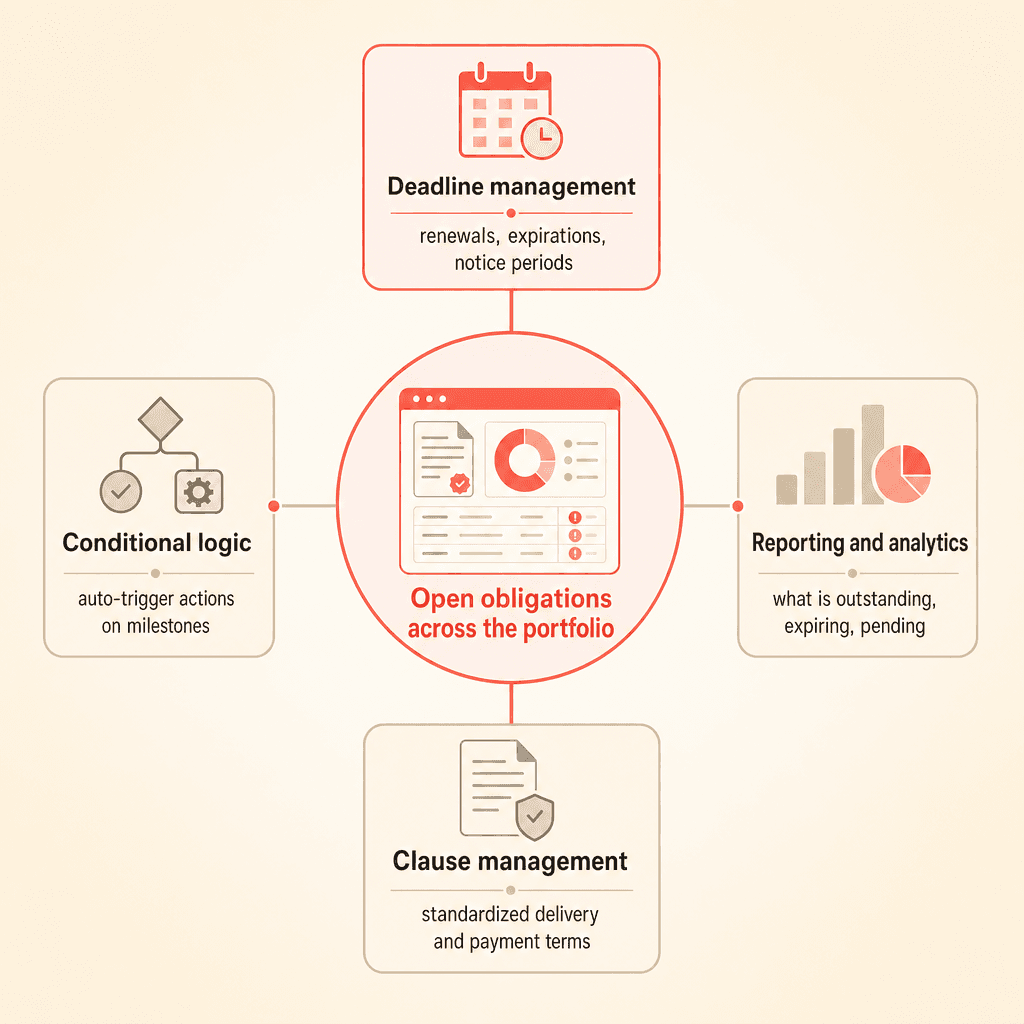
When your team manages a handful of agreements, it is possible to track performance status manually. At scale, this becomes unsustainable. A contract management platform gives your team the ability to monitor every open obligation across your entire portfolio.
Deadline management is the most direct connection between executory contracts and day-to-day tracking. A platform like Concord monitors renewals, expirations, and notice periods in both list and calendar views. Every executory contract with a time-bound obligation becomes visible, sortable, and actionable.
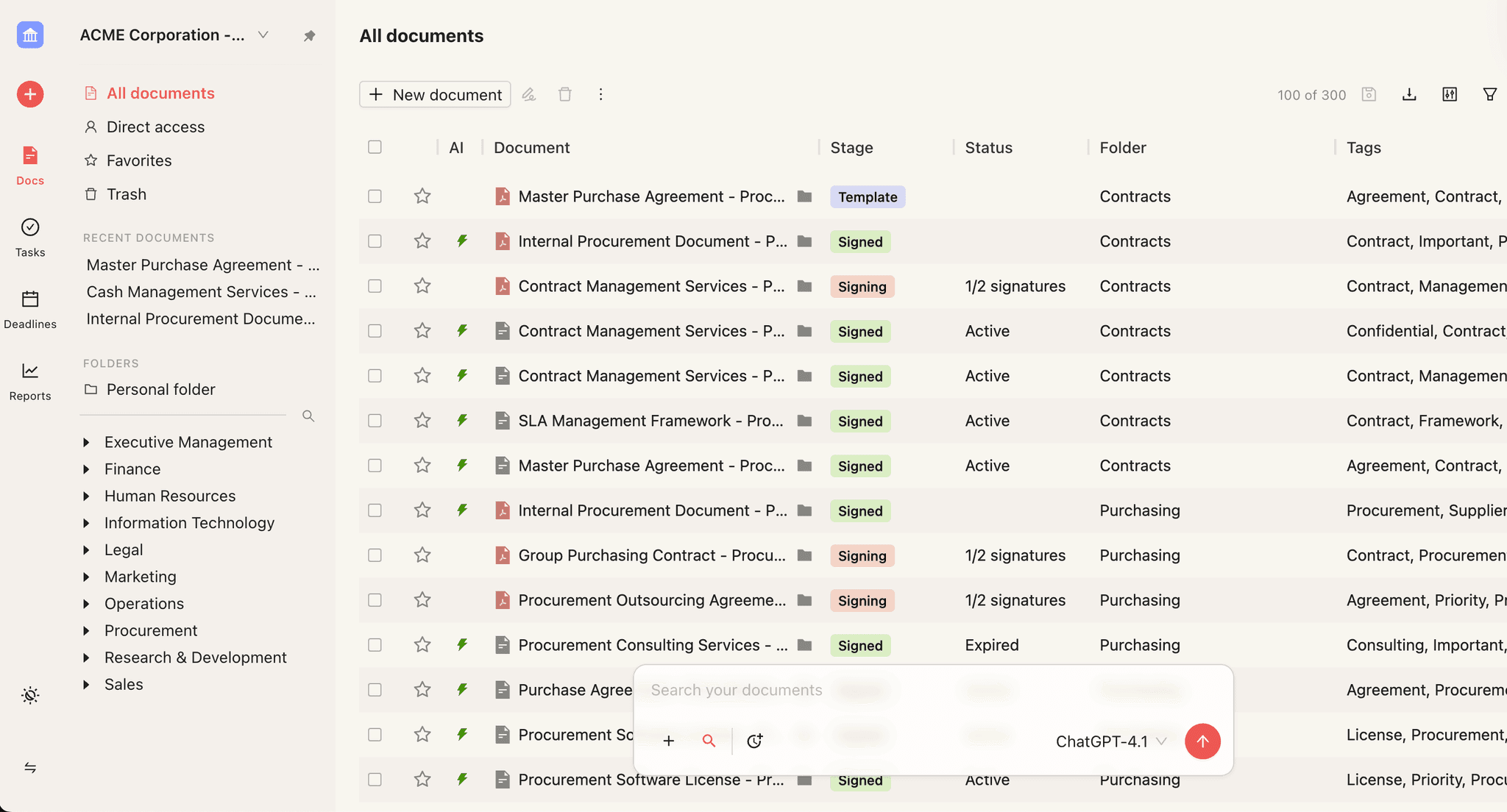
Reporting and analytics allow your team to answer portfolio-level questions: How many contracts are expiring this quarter? Which agreements have pending signatures? What obligations remain open? Custom reports and filters let you build views organized by performance status, so you always know what is outstanding.
Clause management supports standardization of performance-related language. Delivery terms, payment schedules, and termination provisions define what “performance” means in each agreement. A clause library helps your team apply consistent, well-drafted terms that make performance tracking clearer from the start.
Conditional logic within contracts can automate performance-related actions. When specific conditions are met, such as a delivery confirmation triggering a payment milestone, workflows move forward without manual intervention.
From a Concord customer webinar. Watch the clip
I am going to store and track something that was previously uploaded. Previously I would type in the title and all the lifecycle dates by hand. Lifecycle dates are really important for me. That is one of the biggest things I use Concord for: how do I know when this contract comes up for renewal, and when one of those 60 day non-renewal notifications is going to sneak up on you? The nice thing about the AI feature is it does a lot of the work for me. I uploaded the document without typing anything, and the summary already picked up the parties, a short description, the sign date, effective date, end date, and tacit renewal. That saved me maybe 60 seconds, but added up over how many contracts you do, that is quite a lot.
See every open obligation across your portfolio in one place. Request a demo and watch Concord track executory deadlines, renewals, and clauses for you.
This article is for informational purposes only and does not constitute legal advice. Consult a qualified attorney for guidance on specific contract law questions.
Key takeaways
Contract performance means each party carrying out the duties it agreed to. A contract is performed once every party has met its obligations.
An executed contract has two meanings: signed and binding, or fully performed with nothing left to do. Confusing the two creates reporting and compliance gaps across teams.
An executory contract still has outstanding obligations. Most agreements stay executory for the majority of their lifespan.
Many contracts are partially performed, holding executed and executory obligations at the same time, so your tracking system has to account for both.
What is contract performance?
Contract performance is each party carrying out the duties spelled out in an agreement, such as delivering goods, providing services, or making payments. A contract is fully performed once every party has satisfied its obligations. Until then, some duties remain outstanding.
When you hear the phrase “perform contracts,” you might picture the moment pen meets paper. But contract performance refers to something far more consequential: the fulfillment of obligations that each party agreed to when signing. Understanding how contracts are performed, and knowing the difference between executed and executory contracts, is foundational to managing your agreements with confidence. Without this knowledge, teams risk missed deadlines, accidental auto-renewals, and compliance gaps that carry real financial weight.
This article breaks down what it means to perform a contract, clarifies the commonly confused distinction between executed and executory agreements, and explains why tracking contract performance status matters for every team that manages binding obligations.
What does it mean to perform a contract?
Contract performance refers to each party carrying out the duties and obligations spelled out in the agreement. When you perform a contract, you are doing what you promised to do: delivering goods, rendering services, making payments, or fulfilling any other commitments defined in the contract’s terms.
Contract performance meaning varies slightly depending on context, but the core idea remains the same. A contract is considered performed when all parties have satisfied their respective obligations. Until that point, some or all duties remain outstanding.
Types of contract performance generally fall into three categories:
Complete performance: All obligations have been fulfilled by all parties. The contract is done.
Substantial performance: A party has fulfilled the material terms of the agreement, even if minor details remain incomplete. Courts often treat this as sufficient to discharge the contract.
Partial performance: Some obligations have been met, but significant duties remain. The contract is still active.
These categories matter because they determine what rights and responsibilities each party still holds. A partially performed contract requires different attention than one that has been fully completed. For a closer look at how contracts move through stages, visit Concord’s guide to contract lifecycle management.
What is an executed contract?
The term “executed contract” is one of the most misunderstood phrases in contract management. It carries two distinct meanings, and confusing them creates real problems across teams.
Meaning 1: Signed. In everyday usage, “executed” often means that all parties have signed the agreement. You might hear someone say, “The contract has been executed,” meaning signatures are in place and the agreement is now binding.
Meaning 2: Fully performed. In contract law, an executed contract refers to an agreement where all obligations have been completely fulfilled by every party. Nothing remains to be done. The contract has been performed in its entirety.
This dual meaning creates frequent miscommunication between legal, procurement, and finance teams. A procurement manager might report that a vendor contract is “fully executed,” meaning signed, while a legal team member interprets the same phrase as meaning all deliverables have been received and all payments made. The gap between these interpretations can lead to compliance oversights, premature file closures, or inaccurate reporting.
For the purposes of this article, a fully executed contract means one where every obligation has been satisfied by all parties.
What is an executory contract?
An executory contract is the opposite of a fully executed one. In an executory contract, one or more parties still have outstanding obligations to fulfill. The agreement is active, binding, and requires ongoing attention.
Most contracts spend the majority of their lifespan in an executory state. Consider a two-year software subscription agreement. From the moment it is signed until the final month of service is delivered and the last payment is made, the contract remains executory. Both the vendor (who must provide ongoing access to the software) and the buyer (who must continue making payments) have unfulfilled obligations.
The executory contract definition is straightforward, but its implications are significant. Every executory contract represents a set of commitments your organization must actively monitor. Deadlines, renewal windows, notice periods, compliance certifications: all of these are markers of executory obligations that require tracking.
To learn more about managing renewals and deadlines, check out Concord’s guide to contract renewals.
Executed vs executory contracts: key differences
The performed contract vs executory contract distinction is not just academic. It shapes how your team should handle each agreement day to day. Here is a side-by-side comparison:
Executed contract | Executory contract | |
|---|---|---|
Obligation status | All obligations fulfilled by all parties | One or more obligations remain outstanding |
Management need | Archival and reference access | Active monitoring, deadline tracking, workflow management |
Risk profile | Low (residual obligations like warranties may still apply) | Higher (missed obligations carry financial and legal consequences) |
Examples | A completed one-time purchase where goods were delivered and payment was made | An ongoing lease, subscription agreement, or service contract with future payment or delivery dates |
Team action required | Store for audit and reference purposes | Track deadlines, monitor compliance, manage renewals |
One important nuance: a contract does not flip from executory to executed in a single moment. Many agreements exist in a partially performed state. A vendor may have delivered three of four shipments, while the buyer has paid for two. Both parties hold both executed and executory obligations within the same agreement. Your tracking system needs to account for this complexity.
Why contract performance status matters for your team
Knowing whether a contract is executed, executory, or partially performed is not a theoretical exercise. It directly determines what your team needs to do next.
Missed deadlines stem from unclear performance tracking. Contract administrators commonly report that auto-renewals and missed notice periods happen because nobody is actively monitoring which obligations remain outstanding. If you do not know which contracts are still executory, you cannot act on them in time.
High contract volume amplifies the problem. Organizations managing hundreds or thousands of active agreements describe the difficulty of knowing, at any given moment, which contracts are fully performed, which are partially performed, and which are still entirely executory. At that scale, mental tracking and spreadsheet-based systems break down.
Reporting on contract status is manual and error-prone without the right tools. Legal ops leaders frequently note that assembling a picture of where contracts stand requires significant manual effort when done outside a dedicated platform. Pulling together data on which agreements are active, nearing expiration, or carrying outstanding obligations becomes a recurring time drain.
For more on how reporting supports contract management, visit Concord’s guide to contract reporting and analytics.
From a Concord customer webinar. Watch the clip
I have mine configured to warn me at the 60 day mark in some cases and the 90 day mark in others. The first time something pops onto the report, that is my trigger to go look at the contract: do I have the right number of seats, the right terms, are we planning on renewing this vendor? The non-renewal notifications matter too, because you want to make any changes in time. I have been burned before where a 60 day notice period sneaks up on you and you realize 30 days out that you need a change, and the vendor says you have already renewed. This gives me early enough warning. Every Monday morning it hits my inbox and makes sure I see contracts that need attention before it becomes a problem.
The hidden risks in “fully performed” contracts
Even contracts you consider fully executed may carry lingering obligations. Post-termination covenants, indemnification clauses, warranty periods, and confidentiality provisions can extend obligations well beyond the primary performance period.
A contract for a construction project might be “complete” in that the building is finished and the final payment is made. But the warranty clause may impose a two-year obligation on the contractor to remedy defects. That clause keeps a portion of the contract executory long after the project wraps up.
Organizations that cannot quickly identify these residual obligations carry hidden risk. Assuming a contract is fully performed when post-termination duties still exist can result in lapsed compliance, unaddressed warranty claims, or exposure to liability.
How contract management software tracks performance
When your team manages a handful of agreements, it is possible to track performance status manually. At scale, this becomes unsustainable. A contract management platform gives your team the ability to monitor every open obligation across your entire portfolio.
Deadline management is the most direct connection between executory contracts and day-to-day tracking. A platform like Concord monitors renewals, expirations, and notice periods in both list and calendar views. Every executory contract with a time-bound obligation becomes visible, sortable, and actionable.
Reporting and analytics allow your team to answer portfolio-level questions: How many contracts are expiring this quarter? Which agreements have pending signatures? What obligations remain open? Custom reports and filters let you build views organized by performance status, so you always know what is outstanding.
Clause management supports standardization of performance-related language. Delivery terms, payment schedules, and termination provisions define what “performance” means in each agreement. A clause library helps your team apply consistent, well-drafted terms that make performance tracking clearer from the start.
Conditional logic within contracts can automate performance-related actions. When specific conditions are met, such as a delivery confirmation triggering a payment milestone, workflows move forward without manual intervention.
From a Concord customer webinar. Watch the clip
I am going to store and track something that was previously uploaded. Previously I would type in the title and all the lifecycle dates by hand. Lifecycle dates are really important for me. That is one of the biggest things I use Concord for: how do I know when this contract comes up for renewal, and when one of those 60 day non-renewal notifications is going to sneak up on you? The nice thing about the AI feature is it does a lot of the work for me. I uploaded the document without typing anything, and the summary already picked up the parties, a short description, the sign date, effective date, end date, and tacit renewal. That saved me maybe 60 seconds, but added up over how many contracts you do, that is quite a lot.
See every open obligation across your portfolio in one place. Request a demo and watch Concord track executory deadlines, renewals, and clauses for you.
This article is for informational purposes only and does not constitute legal advice. Consult a qualified attorney for guidance on specific contract law questions.
Need to know
Frequently Asked Questions

Take the "management" out
of contract management.
Customer Support
Legal
Compare
Resources
Customer Support
Company
Legal
Compare
Resources
Customer Support
Company
Legal
Compare
© 2025 Concord. All rights reserved.