Build a Delegation of Authority Matrix for Contracts
Build a Delegation of Authority Matrix for Contracts
Build a Delegation of Authority Matrix for Contracts
Build a Delegation of Authority Matrix for Contracts

Build a Delegation of Authority Matrix for Contracts
Your delegation of authority matrix probably lives in a spreadsheet. It lists dollar thresholds, contract types, and the names of people allowed to sign. In practice, most contracts never touch it.
That gap between the documented matrix and actual approval behavior is where risk concentrates. Contracts get signed by people without the authority to sign them. High-exposure terms slip through without review while routine NDAs consume legal time they don’t warrant.
You can close that gap with two moves: design a matrix that accounts for value, contract type, and risk, then map it to automated conditional approvals so it governs in practice. One note before you start: this article is not legal advice, so verify specific delegation requirements and internal-control obligations with your counsel.
Key takeaways
A matrix sorted only by dollar amount misclassifies risk every day. Contract type and risk triggers, like auto-renewal or uncapped liability, should escalate a contract regardless of its value.
Route approvals to a role, such as the VP of the requesting department, not a named person. Named approvers go stale the moment someone changes jobs.
A documented matrix is only half of an approval control. It governs in practice only when automated conditional routing enforces it.
What is a delegation of authority matrix?
A delegation of authority matrix maps contract characteristics such as value, type, and risk level to the roles authorized to approve and sign them. It sets thresholds, escalation paths, and consent rules so every approval follows a documented rule instead of ad hoc judgment.
What belongs in a delegation of authority matrix
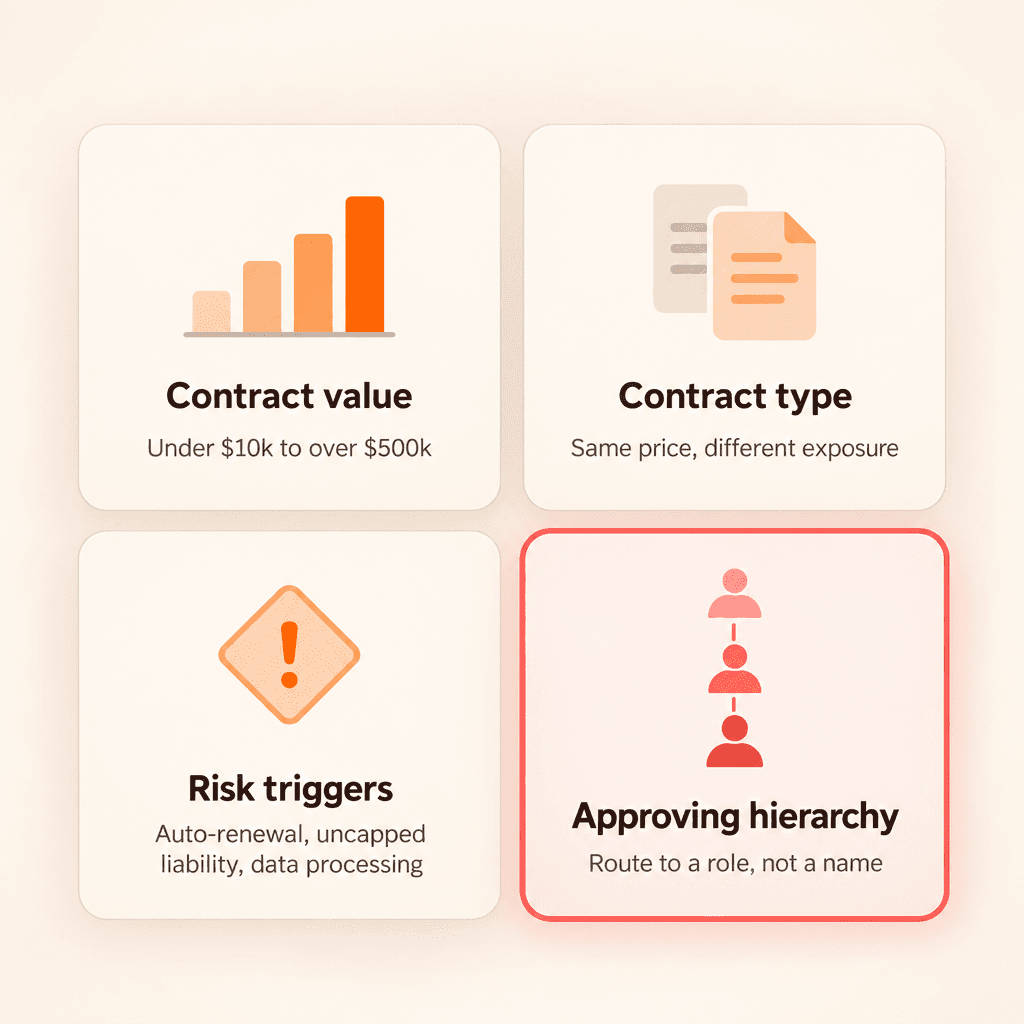
A matrix that only sorts contracts by dollar amount will misclassify risk every day. Yours should capture at least four dimensions:
Contract value. The primary axis, grouped into bands such as under $10,000, $10,000 to $100,000, $100,000 to $500,000, and over $500,000.
Contract type. A $75,000 marketing services agreement and a $75,000 technology licensing agreement carry different exposure and deserve different chains.
Risk triggers. Conditions that escalate a contract regardless of value: auto-renewal, uncapped indemnification, data processing obligations, exclusivity, nonstandard payment terms.
Approving hierarchy. Rules should route to a role, like the VP of the requesting department, not a static named individual.
Legal ops teams frequently describe the same mismatch: the matrix says to route to the requester’s direct manager, but their tooling only sends approvals to a fixed legal or finance group. Design your matrix around roles and hierarchies first. Then confirm your tooling can follow the org chart before you lock in the rows.
Here is a starting template you can adapt:
Tier | Value band | Risk condition | Approval chain | Consent rule |
One | Under $10,000 | Standard template only | Direct manager, or auto-approve | Any one approver |
Two | $10,000 to $100,000 | Nonstandard terms escalate to Tier Three | Manager, Legal, Finance | Any one per step |
Three | $100,000 to $500,000 | Auto-renewal, data processing, uncapped liability | Legal, Finance, VP | All approvers |
Four | Over $500,000 | Any trigger, any deviation | Legal, Finance, CFO, General Counsel | All approvers |
Treat this as a skeleton. Your bands, triggers, and chains should reflect your own exposure profile and signing policy.
Start with value bands, then layer in risk triggers
Value alone leaves blind spots, so use it as the first test and let risk triggers catch what it misses. Contract value works as the primary axis because it is easy to define, easy to measure, and broadly correlated with exposure. But a $50,000 contract with uncapped indemnification, auto-renewal, and broad data processing obligations carries fundamentally different exposure than a $50,000 purchase order on standard terms. Single-variable matrices create blind spots: high-risk contracts sail through low-scrutiny paths because they fall under a dollar threshold.
Fix that by adding override conditions. Any contract with auto-renewal beyond its initial term, uncapped liability, exclusivity, data processing, or regulatory obligations routes to a higher tier even if the dollar amount is small. Value remains the first test, and risk triggers catch what value misses.
This structure matches how internal control frameworks define approvals. The U.S. Government Accountability Office’s Standards for Internal Control describe approval controls as requiring approval by individuals with appropriate authority under established policies and procedures.
“Established policies” is your matrix. “Appropriate authority” comes from matching the approver to the contract’s actual exposure, not just its price.
Define the escalation path, not just the final signer
Many matrices identify only the final signing authority for each tier. Yours should define the complete chain: who reviews legal risk, who reviews financial impact, and in what order.
Sequential chains create checkpoints so each approver sees a contract after the relevant specialists have weighed in. A CFO reviewing a contract that legal has already flagged for liability issues makes a better decision than a CFO reviewing it cold.
You also need an explicit quorum decision for any step assigned to a team rather than a named person. Teams routinely discover late that “any one member” and “all members” are both valid configurations with different implications.
Pick “any one” for redundancy so approvals don’t stall when someone is out of office. Pick “all” when the tier demands documented consensus, such as requiring both the CFO and the General Counsel on high-value contracts. Concord’s approval type selection lets you set this per step, so the choice is deliberate rather than a default you discover later.
Turn the matrix into automated conditional approvals
A documented matrix satisfies the established-policy half of an approval control. Enforcement does the rest. Any control that depends on people remembering to check a spreadsheet will fail at a predictable rate, and the failure rate climbs with contract volume, organizational complexity, and staff turnover.
Automated conditional routing converts the matrix from reference material into an enforced rule. In Concord, approval workflows trigger from contract metadata: value, type, department, clause deviations. Nobody hand-picks a workflow per contract, which matters in high-volume environments where manual selection reintroduces the human bottleneck the matrix was built to remove.
Three design moves make this work:
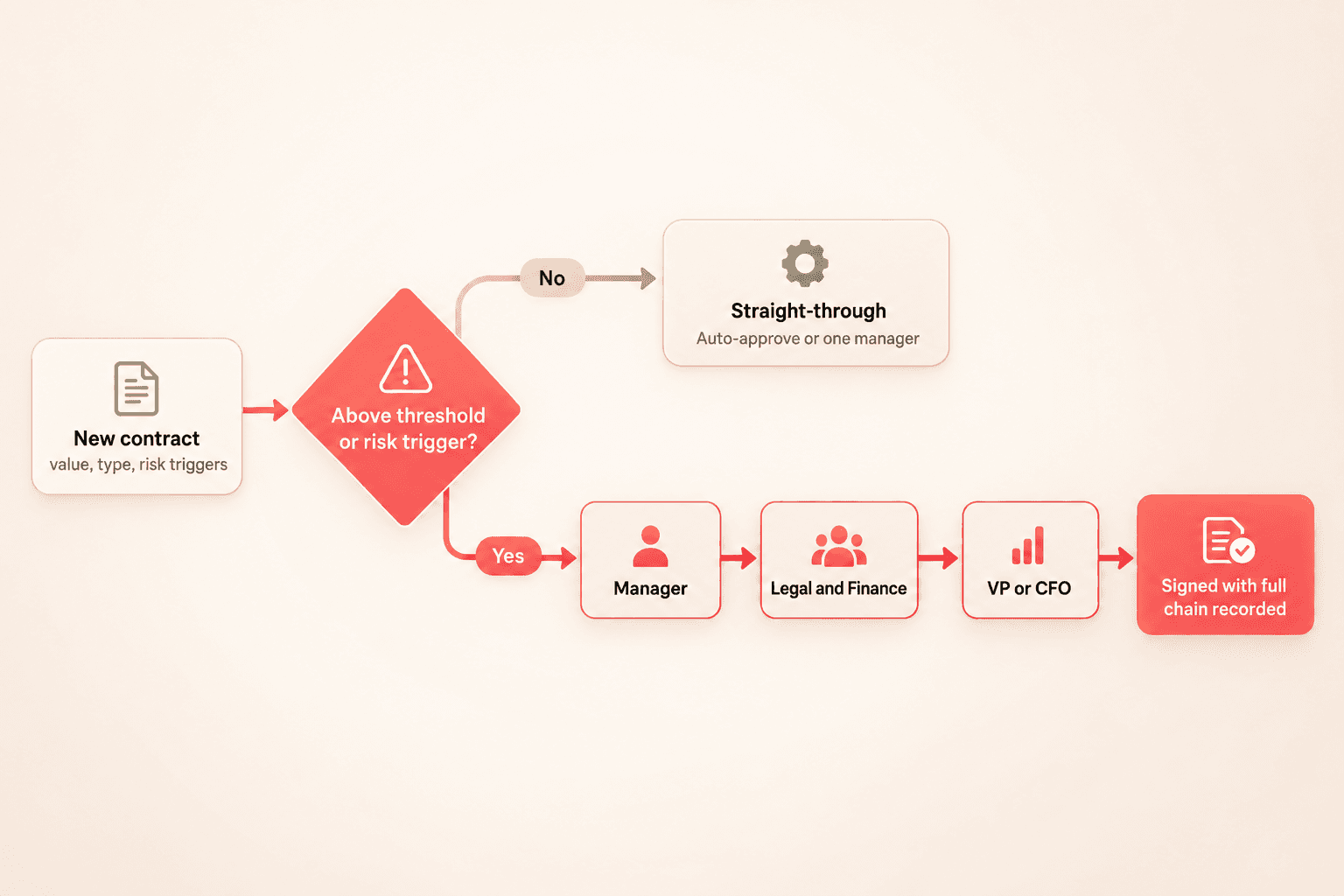
Straight-through tier. Contracts below a value threshold on approved templates with no deviations approve automatically or route to a single manager. This concentrates review capacity on high-risk work instead of spreading it thin over routine NDAs. Predefined criteria, not shortcuts.
Role-based access control. Only people holding the delegated role can approve at each tier. The matrix defines authority; role-based permissions enforce it.
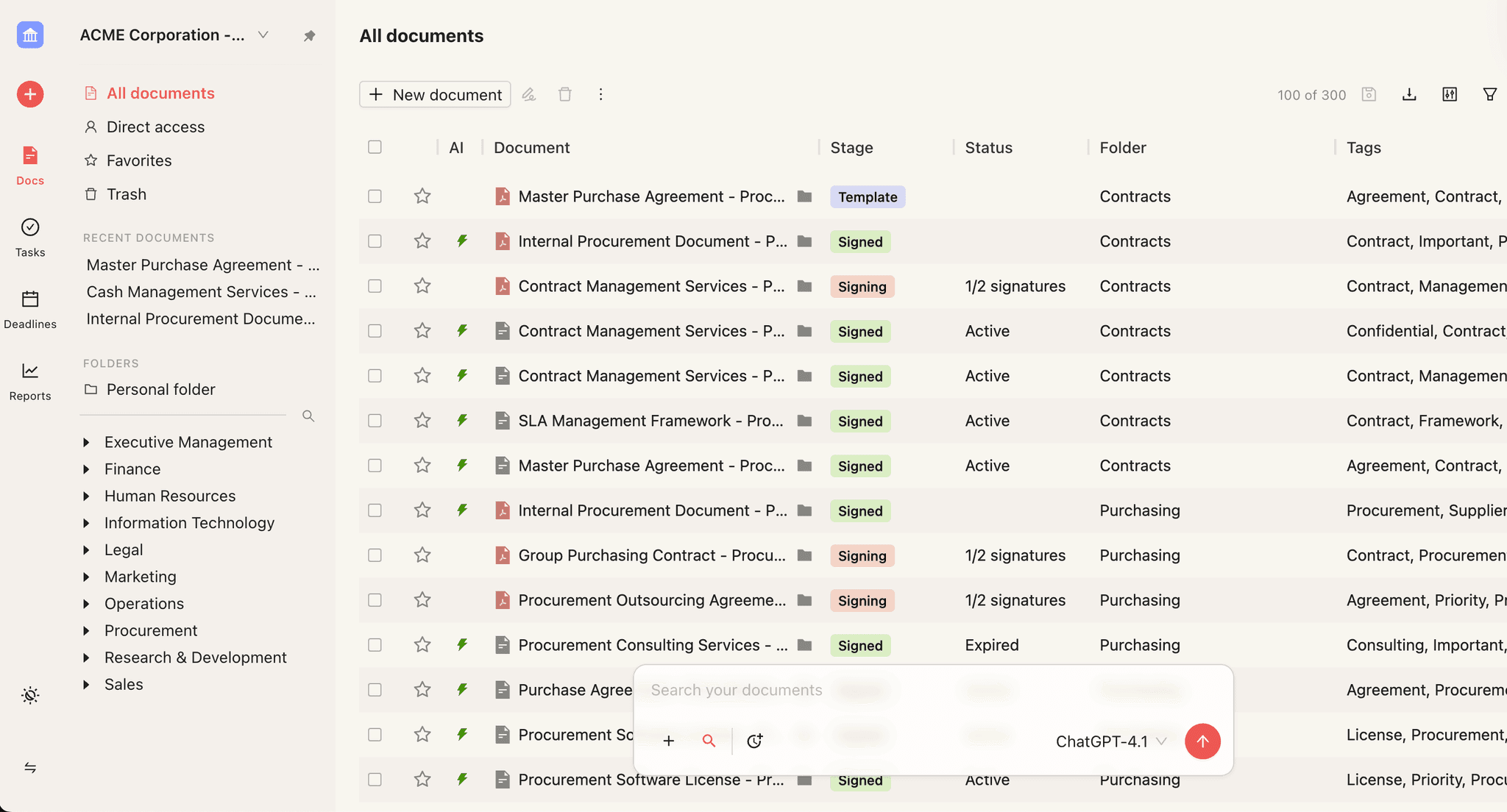
Central oversight. Concord’s approvals management table puts every workflow in one sortable view so you can maintain the full matrix as a living set of rules.
Once your matrix is live, contract templates keep the straight-through lane honest by defining what “standard terms” actually means.
See your own tiers enforced automatically. Book a Concord demo and map each threshold and risk trigger to a conditional approval workflow.
Keep the matrix current and auditable
A delegation holds up only when it stays specific and current, reviewed at least twice a year. The U.S. GAO’s review of delegated leasing authority shows what happens when delegations go stale or exceed their scope: agreements get approved under authority that lapsed, shifted, or never covered the agreement type. Set a review cycle for your matrix, semiannual at minimum, and re-test thresholds, names, and scope at each cycle.
Audit readiness requires the same discipline. An approval you cannot trace to a specific delegation, with defined limits and a timestamp, is an assertion rather than a control.
Concord’s approval workflow state tracking captures the complete workflow, rules, conditions, and assigned approvers, as they existed at the moment of approval. When the matrix changes, historical approvals keep their original context, which is the record your auditors will ask for. For more, see the contract audit trail guide.
Ready to enforce your delegation of authority matrix instead of just documenting it? Book a Concord demo and map every tier to automated conditional approvals.
Build a Delegation of Authority Matrix for Contracts
Your delegation of authority matrix probably lives in a spreadsheet. It lists dollar thresholds, contract types, and the names of people allowed to sign. In practice, most contracts never touch it.
That gap between the documented matrix and actual approval behavior is where risk concentrates. Contracts get signed by people without the authority to sign them. High-exposure terms slip through without review while routine NDAs consume legal time they don’t warrant.
You can close that gap with two moves: design a matrix that accounts for value, contract type, and risk, then map it to automated conditional approvals so it governs in practice. One note before you start: this article is not legal advice, so verify specific delegation requirements and internal-control obligations with your counsel.
Key takeaways
A matrix sorted only by dollar amount misclassifies risk every day. Contract type and risk triggers, like auto-renewal or uncapped liability, should escalate a contract regardless of its value.
Route approvals to a role, such as the VP of the requesting department, not a named person. Named approvers go stale the moment someone changes jobs.
A documented matrix is only half of an approval control. It governs in practice only when automated conditional routing enforces it.
What is a delegation of authority matrix?
A delegation of authority matrix maps contract characteristics such as value, type, and risk level to the roles authorized to approve and sign them. It sets thresholds, escalation paths, and consent rules so every approval follows a documented rule instead of ad hoc judgment.
What belongs in a delegation of authority matrix
A matrix that only sorts contracts by dollar amount will misclassify risk every day. Yours should capture at least four dimensions:
Contract value. The primary axis, grouped into bands such as under $10,000, $10,000 to $100,000, $100,000 to $500,000, and over $500,000.
Contract type. A $75,000 marketing services agreement and a $75,000 technology licensing agreement carry different exposure and deserve different chains.
Risk triggers. Conditions that escalate a contract regardless of value: auto-renewal, uncapped indemnification, data processing obligations, exclusivity, nonstandard payment terms.
Approving hierarchy. Rules should route to a role, like the VP of the requesting department, not a static named individual.
Legal ops teams frequently describe the same mismatch: the matrix says to route to the requester’s direct manager, but their tooling only sends approvals to a fixed legal or finance group. Design your matrix around roles and hierarchies first. Then confirm your tooling can follow the org chart before you lock in the rows.
Here is a starting template you can adapt:
Tier | Value band | Risk condition | Approval chain | Consent rule |
One | Under $10,000 | Standard template only | Direct manager, or auto-approve | Any one approver |
Two | $10,000 to $100,000 | Nonstandard terms escalate to Tier Three | Manager, Legal, Finance | Any one per step |
Three | $100,000 to $500,000 | Auto-renewal, data processing, uncapped liability | Legal, Finance, VP | All approvers |
Four | Over $500,000 | Any trigger, any deviation | Legal, Finance, CFO, General Counsel | All approvers |
Treat this as a skeleton. Your bands, triggers, and chains should reflect your own exposure profile and signing policy.
Start with value bands, then layer in risk triggers
Value alone leaves blind spots, so use it as the first test and let risk triggers catch what it misses. Contract value works as the primary axis because it is easy to define, easy to measure, and broadly correlated with exposure. But a $50,000 contract with uncapped indemnification, auto-renewal, and broad data processing obligations carries fundamentally different exposure than a $50,000 purchase order on standard terms. Single-variable matrices create blind spots: high-risk contracts sail through low-scrutiny paths because they fall under a dollar threshold.
Fix that by adding override conditions. Any contract with auto-renewal beyond its initial term, uncapped liability, exclusivity, data processing, or regulatory obligations routes to a higher tier even if the dollar amount is small. Value remains the first test, and risk triggers catch what value misses.
This structure matches how internal control frameworks define approvals. The U.S. Government Accountability Office’s Standards for Internal Control describe approval controls as requiring approval by individuals with appropriate authority under established policies and procedures.
“Established policies” is your matrix. “Appropriate authority” comes from matching the approver to the contract’s actual exposure, not just its price.
Define the escalation path, not just the final signer
Many matrices identify only the final signing authority for each tier. Yours should define the complete chain: who reviews legal risk, who reviews financial impact, and in what order.
Sequential chains create checkpoints so each approver sees a contract after the relevant specialists have weighed in. A CFO reviewing a contract that legal has already flagged for liability issues makes a better decision than a CFO reviewing it cold.
You also need an explicit quorum decision for any step assigned to a team rather than a named person. Teams routinely discover late that “any one member” and “all members” are both valid configurations with different implications.
Pick “any one” for redundancy so approvals don’t stall when someone is out of office. Pick “all” when the tier demands documented consensus, such as requiring both the CFO and the General Counsel on high-value contracts. Concord’s approval type selection lets you set this per step, so the choice is deliberate rather than a default you discover later.
Turn the matrix into automated conditional approvals
A documented matrix satisfies the established-policy half of an approval control. Enforcement does the rest. Any control that depends on people remembering to check a spreadsheet will fail at a predictable rate, and the failure rate climbs with contract volume, organizational complexity, and staff turnover.
Automated conditional routing converts the matrix from reference material into an enforced rule. In Concord, approval workflows trigger from contract metadata: value, type, department, clause deviations. Nobody hand-picks a workflow per contract, which matters in high-volume environments where manual selection reintroduces the human bottleneck the matrix was built to remove.
Three design moves make this work:
Straight-through tier. Contracts below a value threshold on approved templates with no deviations approve automatically or route to a single manager. This concentrates review capacity on high-risk work instead of spreading it thin over routine NDAs. Predefined criteria, not shortcuts.
Role-based access control. Only people holding the delegated role can approve at each tier. The matrix defines authority; role-based permissions enforce it.
Central oversight. Concord’s approvals management table puts every workflow in one sortable view so you can maintain the full matrix as a living set of rules.
Once your matrix is live, contract templates keep the straight-through lane honest by defining what “standard terms” actually means.
See your own tiers enforced automatically. Book a Concord demo and map each threshold and risk trigger to a conditional approval workflow.
Keep the matrix current and auditable
A delegation holds up only when it stays specific and current, reviewed at least twice a year. The U.S. GAO’s review of delegated leasing authority shows what happens when delegations go stale or exceed their scope: agreements get approved under authority that lapsed, shifted, or never covered the agreement type. Set a review cycle for your matrix, semiannual at minimum, and re-test thresholds, names, and scope at each cycle.
Audit readiness requires the same discipline. An approval you cannot trace to a specific delegation, with defined limits and a timestamp, is an assertion rather than a control.
Concord’s approval workflow state tracking captures the complete workflow, rules, conditions, and assigned approvers, as they existed at the moment of approval. When the matrix changes, historical approvals keep their original context, which is the record your auditors will ask for. For more, see the contract audit trail guide.
Ready to enforce your delegation of authority matrix instead of just documenting it? Book a Concord demo and map every tier to automated conditional approvals.
Need to know
Frequently Asked Questions

Take the "management" out
of contract management.
Customer Support
Legal
Compare
Resources
Customer Support
Company
Legal
Compare
Resources
Customer Support
Company
Legal
Compare
© 2025 Concord. All rights reserved.