Novation vs Assignment: How to Transfer Contract Rights
Novation vs Assignment: How to Transfer Contract Rights
Novation vs Assignment: How to Transfer Contract Rights
Novation vs Assignment: How to Transfer Contract Rights
novation vs assignment, novation agreement, assignment vs novation, contract assignment clause, change of control, contract rights transfer
A signed contract is only half the job. Sooner or later, someone will ask you to move what is inside it: a vendor gets acquired, a business unit spins off, or a customer wants a different entity on the paper. The right mechanism for transferring contract rights depends on whether you are swapping parties or just passing benefits, and the novation vs assignment distinction decides whether your transfer actually holds.
One note before the detail: this article is general information, not legal advice. Consent and notice requirements vary by contract and by jurisdiction, so confirm the mechanics with qualified counsel before you execute any transfer.
Key takeaways
Assignment usually leaves the original contract in place, and the outgoing party may remain liable unless the counterparty releases it.
Novation replaces the original contract and releases the outgoing party, so all affected parties generally need to consent.
Stock purchases, asset purchases, vendor replacements, and subcontracting each point to a different default path.
Link every transfer instrument to the master agreement and carry its consent, notice, date, and obligation data forward.
What is the difference between novation and assignment?
Assignment transfers contractual benefits, and may delegate duties, while the original contract remains in place and the outgoing party may remain liable. Novation replaces the original agreement with a new one and releases the outgoing party, which generally requires consent from everyone affected.
Novation vs assignment: the core difference
Assignment and novation both move contract rights, but they do different legal work. Pick the wrong one and the gap shows up later, in a dispute about who owes what.
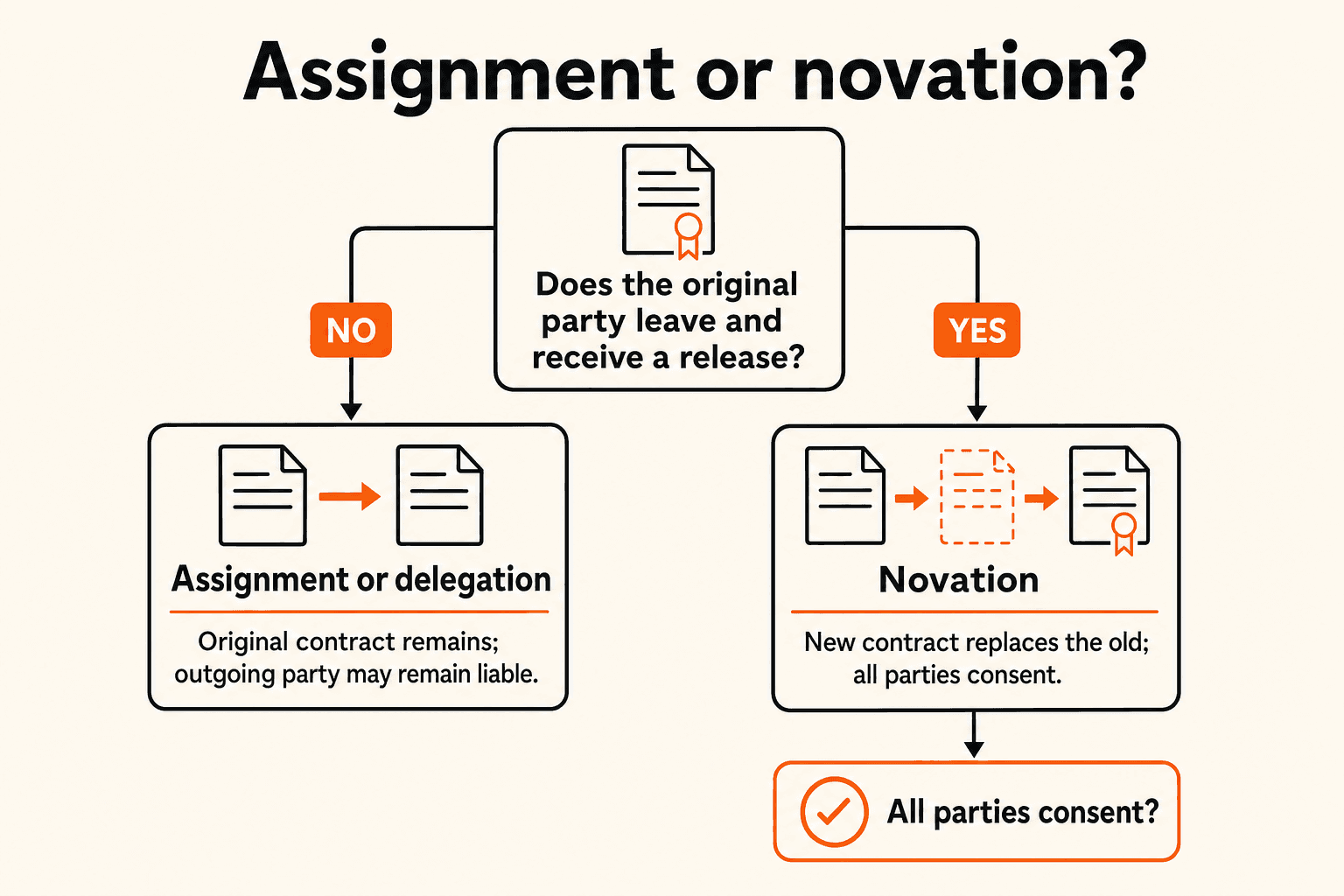
Assignment transfers the benefits of a contract, and sometimes the duties, from one party to another. The original contract stays alive. Unless the counterparty releases them, the outgoing party usually remains liable if the new party fails to perform.
Novation goes further. It extinguishes the original contract and replaces it with a new one among the remaining party and the incoming party. Because the outgoing party walks away released, novation almost always requires consent from everyone involved.
A quick test: is the original party leaving the relationship entirely? If yes, you are likely in novation territory. If the original party stays on the hook while someone else receives the benefits or performs the work, you are looking at assignment or delegation.
Question | Assignment | Novation |
|---|---|---|
What changes? | Rights move; duties may be delegated | One party and the original contract are replaced |
Outgoing party liability | Usually remains unless released | Released under the new agreement |
Consent | Depends on the clause and applicable law | Generally requires all affected parties |
Typical use | Passing benefits or delegating performance | Replacing a contracting party entirely |
What the contract assignment clause controls
Whether you can assign at all depends on the contract assignment clause. Many agreements restrict or prohibit assignment without written consent. Others stay silent, which pushes the question back to default law in your jurisdiction.
Some clauses go further and treat a change of control as an assignment. The change of control vs assignment distinction matters most in deal work: a stock sale changes who owns the entity, not who the entity is. A clause that defines change of control as assignment flips that default and turns a stock deal into a consent-gathering exercise.
Which path fits your scenario
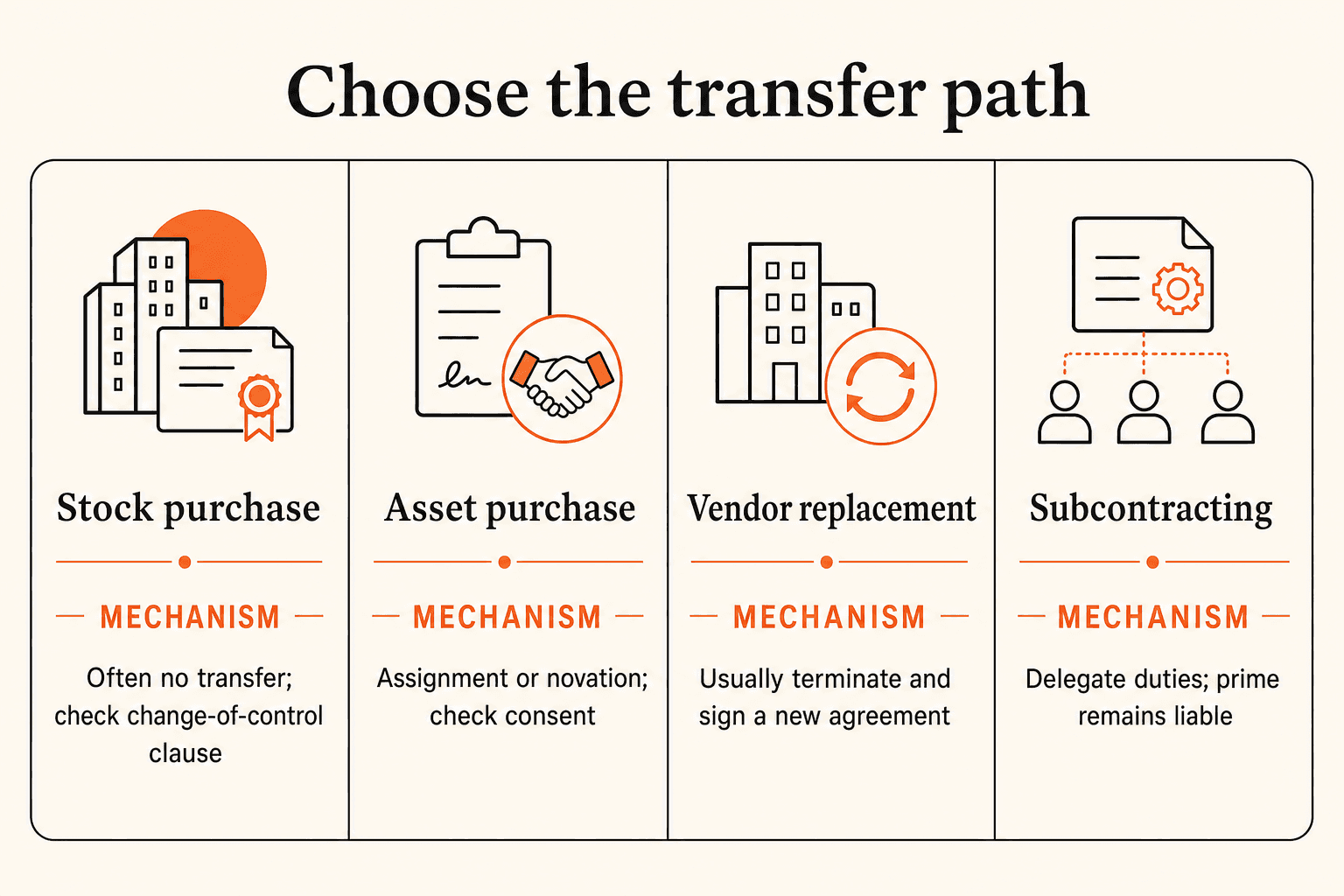
The right mechanism depends on what actually changed. Four common scenarios, four different defaults.
Scenario | Likely path | Check first |
|---|---|---|
Stock purchase | Often no transfer | Change-of-control language |
Asset purchase | Assignment or novation | Assignment restrictions and consent |
Vendor replacement | Usually terminate and sign a new agreement | Whether obligations move midstream |
Subcontracting | Delegation | Whether the prime remains liable |
Stock purchase M&A
In a stock purchase, the legal entity that signed the contract keeps existing; only its ownership changes. Often no transfer occurs at all, so re-papering thousands of agreements wastes time and can reopen terms you wanted left alone.
Review change-of-control language across the portfolio before you touch anything. Many clauses require notice only. Some require consent, and a small number do nothing at all.
Asset purchase M&A
In an asset purchase, specific contracts must move to the buyer. Where the contract permits assignment, you assign with notice or consent as the clause requires. Where the seller needs a clean release, or the clause prohibits assignment, novation becomes the path.
Either way, novation in M&A demands a clause-by-clause review and a documented consent trail. Teams that skip the review discover the gap months later, usually when a counterparty disputes which entity owes which obligation.
Vendor consolidation
A swap of Vendor A for Vendor B on similar terms is usually a termination plus a new agreement, not a transfer at all. Treating it as an assignment creates confusion about which obligations moved. Treating a true mid-stream handoff as a simple swap leaves the outgoing vendor exposed on work already in flight.
The exception matters: if Vendor B genuinely assumes Vendor A’s obligations mid-contract and Vendor A walks away released, that is a novation. It needs consent from all parties, on paper.
Subcontracting and delegation
A prime contractor that hands performance to a subcontractor is delegating duties, not novating. The prime remains liable to the customer. Teams that confuse delegation with novation chase releases they do not need, or worse, assume a release they never received.
Why transfers fail in practice
The legal concepts trip up fewer teams than the paperwork does. Here is the pattern that breaks transfers: the transfer gets negotiated over email, signed in a separate e-signature tool, and filed in a folder far from the master contract.
Three failure modes follow. Notice deadlines slip because nobody tracked the clause’s stated notice window. Re-approvals never trigger because the transfer document looked like routine paperwork, and the audit trail breaks, so months later nobody can say which entity owes what.
The fix is less about legal skill and more about lineage. Every novation agreement or assignment instrument should link back to the master contract, route through the right approvers, and feed its new dates and obligations into your monitoring layer. Strong contract amendment workflows give you that backbone.
Run a clause-level review before you move anything
Blanket assumptions break transfers. One contract allows assignment with notice, the next prohibits it outright, and a third defines change of control as an assignment that demands consent you did not plan to collect.
Filter your portfolio for assignment and change-of-control language before any acquisition, divestiture, or vendor change. Route every flagged contract through a structured approval path so legal reviews the consent language before anyone signs. Good post-signature contract management starts before the transfer, not after.
See how Concord can connect clause review, consent routing, and linked transfer records. Request a demo
Keep transfer lineage visible in your CLM
A disciplined CLM setup turns the legal distinction into a repeatable process. Here is what that looks like in Concord.
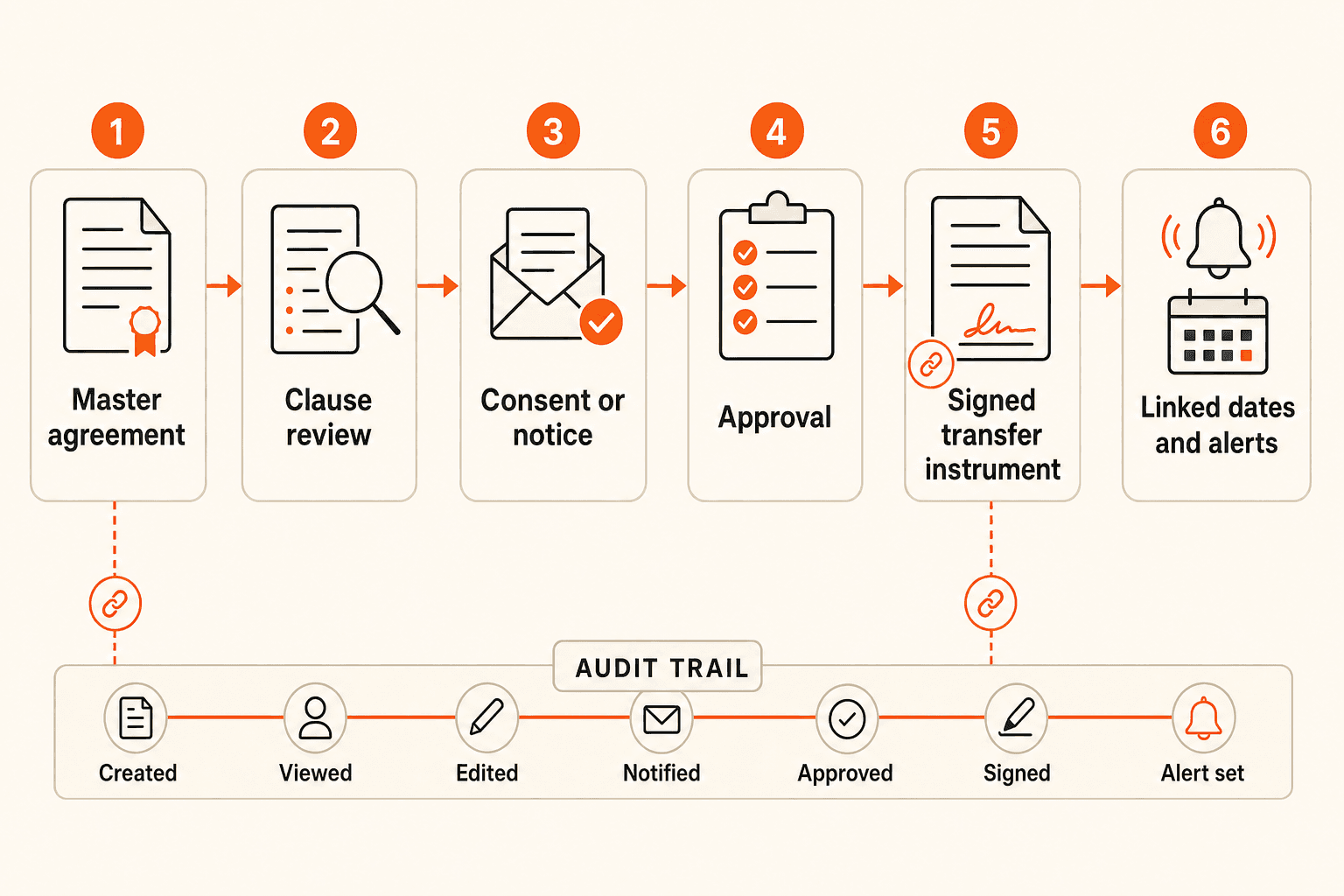
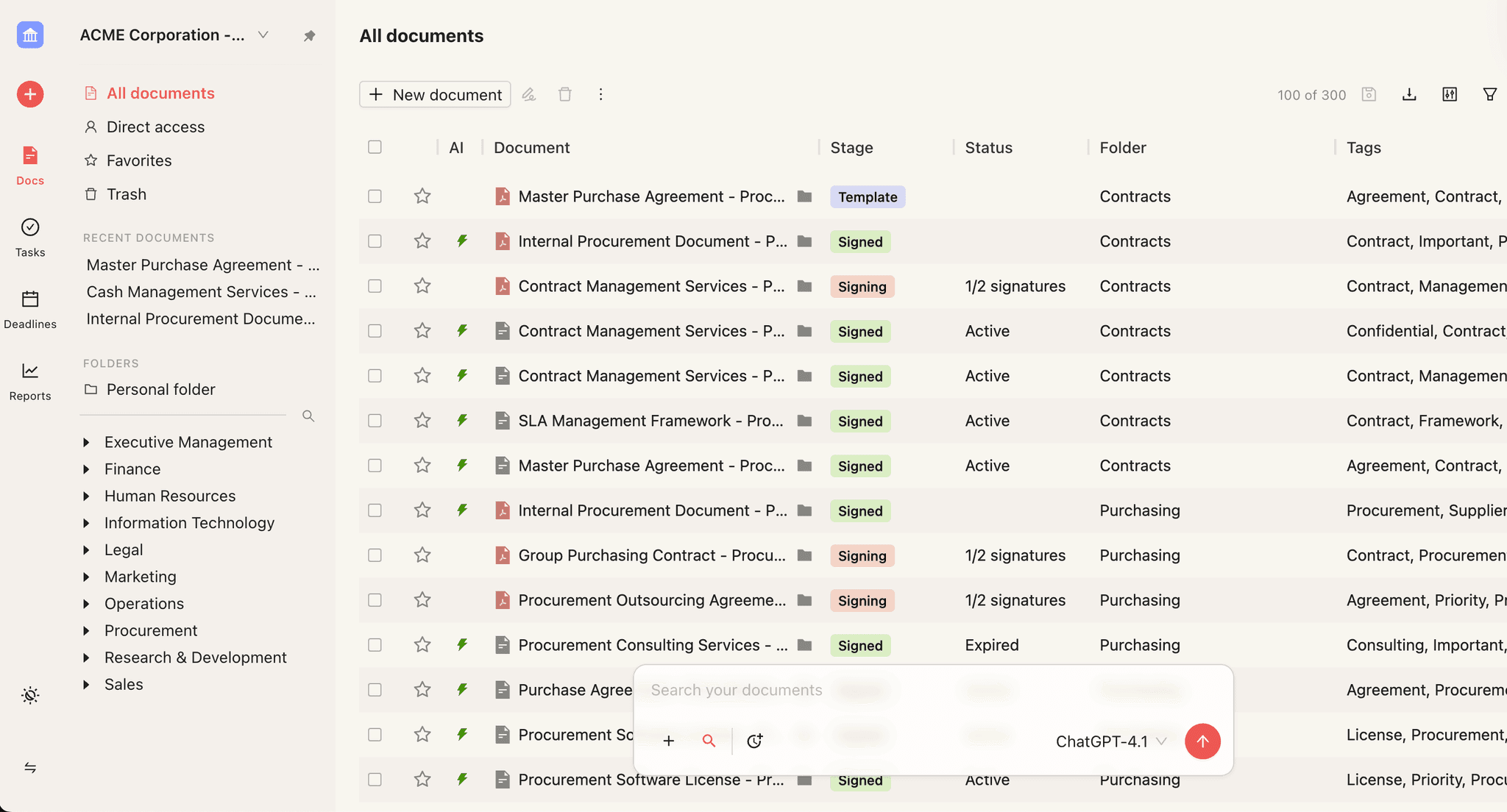
Custom contract properties. Model transfer status, consent status, transfer dates, and incoming-entity fields as custom contract properties. Every novation or assignment becomes searchable and reportable across the portfolio, so you can answer “which contracts moved to the buyer?” in seconds.
Agreement copying. For a novation that replaces an agreement wholesale, copy the existing agreement, including its signature mappings, to build the replacement contract with the new party. The lineage to the original stays intact instead of starting from a blank page.
Linking and bulk actions. Link each assignment or novation document back to the master contract so the relationship is explicit. During an acquisition, bulk actions let you tag, archive, and run AI-powered extraction across the transferred set in one pass.
Field assignment controls. Reserve consent fields and counterparty-approval sections for legal users or groups. Sales and procurement can move the paperwork forward, but legal controls the consent language and the execution path.
Notifications. Trigger alerts when transfer-related intake requests arrive and when a novation or assignment is signed. Notice deadlines and consent milestones stay visible instead of hiding in someone’s inbox.
Data migration. In an acquisition, bring the acquired entity’s contracts into the platform through contract data migration. Then run your assignment and consent review against the imported portfolio instead of chasing files across two companies.
Get the transfer right the first time
Novation vs assignment is not a vocabulary quiz. Pick the wrong mechanism and the original party never gets released, the incoming party never gets bound, and the gap surfaces at the worst possible moment.
Map the scenario first: stock deal, asset deal, vendor swap, or subcontract. Read the clause, collect the consents, and keep every transfer document linked to its master. Then let your CLM carry the dates, obligations, and alerts forward.
Ready to see this in practice? Book a Concord demo and walk through a linked novation workflow, from consent fields to signature to deadline alerts.
A signed contract is only half the job. Sooner or later, someone will ask you to move what is inside it: a vendor gets acquired, a business unit spins off, or a customer wants a different entity on the paper. The right mechanism for transferring contract rights depends on whether you are swapping parties or just passing benefits, and the novation vs assignment distinction decides whether your transfer actually holds.
One note before the detail: this article is general information, not legal advice. Consent and notice requirements vary by contract and by jurisdiction, so confirm the mechanics with qualified counsel before you execute any transfer.
Key takeaways
Assignment usually leaves the original contract in place, and the outgoing party may remain liable unless the counterparty releases it.
Novation replaces the original contract and releases the outgoing party, so all affected parties generally need to consent.
Stock purchases, asset purchases, vendor replacements, and subcontracting each point to a different default path.
Link every transfer instrument to the master agreement and carry its consent, notice, date, and obligation data forward.
What is the difference between novation and assignment?
Assignment transfers contractual benefits, and may delegate duties, while the original contract remains in place and the outgoing party may remain liable. Novation replaces the original agreement with a new one and releases the outgoing party, which generally requires consent from everyone affected.
Novation vs assignment: the core difference
Assignment and novation both move contract rights, but they do different legal work. Pick the wrong one and the gap shows up later, in a dispute about who owes what.
Assignment transfers the benefits of a contract, and sometimes the duties, from one party to another. The original contract stays alive. Unless the counterparty releases them, the outgoing party usually remains liable if the new party fails to perform.
Novation goes further. It extinguishes the original contract and replaces it with a new one among the remaining party and the incoming party. Because the outgoing party walks away released, novation almost always requires consent from everyone involved.
A quick test: is the original party leaving the relationship entirely? If yes, you are likely in novation territory. If the original party stays on the hook while someone else receives the benefits or performs the work, you are looking at assignment or delegation.
Question | Assignment | Novation |
|---|---|---|
What changes? | Rights move; duties may be delegated | One party and the original contract are replaced |
Outgoing party liability | Usually remains unless released | Released under the new agreement |
Consent | Depends on the clause and applicable law | Generally requires all affected parties |
Typical use | Passing benefits or delegating performance | Replacing a contracting party entirely |
What the contract assignment clause controls
Whether you can assign at all depends on the contract assignment clause. Many agreements restrict or prohibit assignment without written consent. Others stay silent, which pushes the question back to default law in your jurisdiction.
Some clauses go further and treat a change of control as an assignment. The change of control vs assignment distinction matters most in deal work: a stock sale changes who owns the entity, not who the entity is. A clause that defines change of control as assignment flips that default and turns a stock deal into a consent-gathering exercise.
Which path fits your scenario
The right mechanism depends on what actually changed. Four common scenarios, four different defaults.
Scenario | Likely path | Check first |
|---|---|---|
Stock purchase | Often no transfer | Change-of-control language |
Asset purchase | Assignment or novation | Assignment restrictions and consent |
Vendor replacement | Usually terminate and sign a new agreement | Whether obligations move midstream |
Subcontracting | Delegation | Whether the prime remains liable |
Stock purchase M&A
In a stock purchase, the legal entity that signed the contract keeps existing; only its ownership changes. Often no transfer occurs at all, so re-papering thousands of agreements wastes time and can reopen terms you wanted left alone.
Review change-of-control language across the portfolio before you touch anything. Many clauses require notice only. Some require consent, and a small number do nothing at all.
Asset purchase M&A
In an asset purchase, specific contracts must move to the buyer. Where the contract permits assignment, you assign with notice or consent as the clause requires. Where the seller needs a clean release, or the clause prohibits assignment, novation becomes the path.
Either way, novation in M&A demands a clause-by-clause review and a documented consent trail. Teams that skip the review discover the gap months later, usually when a counterparty disputes which entity owes which obligation.
Vendor consolidation
A swap of Vendor A for Vendor B on similar terms is usually a termination plus a new agreement, not a transfer at all. Treating it as an assignment creates confusion about which obligations moved. Treating a true mid-stream handoff as a simple swap leaves the outgoing vendor exposed on work already in flight.
The exception matters: if Vendor B genuinely assumes Vendor A’s obligations mid-contract and Vendor A walks away released, that is a novation. It needs consent from all parties, on paper.
Subcontracting and delegation
A prime contractor that hands performance to a subcontractor is delegating duties, not novating. The prime remains liable to the customer. Teams that confuse delegation with novation chase releases they do not need, or worse, assume a release they never received.
Why transfers fail in practice
The legal concepts trip up fewer teams than the paperwork does. Here is the pattern that breaks transfers: the transfer gets negotiated over email, signed in a separate e-signature tool, and filed in a folder far from the master contract.
Three failure modes follow. Notice deadlines slip because nobody tracked the clause’s stated notice window. Re-approvals never trigger because the transfer document looked like routine paperwork, and the audit trail breaks, so months later nobody can say which entity owes what.
The fix is less about legal skill and more about lineage. Every novation agreement or assignment instrument should link back to the master contract, route through the right approvers, and feed its new dates and obligations into your monitoring layer. Strong contract amendment workflows give you that backbone.
Run a clause-level review before you move anything
Blanket assumptions break transfers. One contract allows assignment with notice, the next prohibits it outright, and a third defines change of control as an assignment that demands consent you did not plan to collect.
Filter your portfolio for assignment and change-of-control language before any acquisition, divestiture, or vendor change. Route every flagged contract through a structured approval path so legal reviews the consent language before anyone signs. Good post-signature contract management starts before the transfer, not after.
See how Concord can connect clause review, consent routing, and linked transfer records. Request a demo
Keep transfer lineage visible in your CLM
A disciplined CLM setup turns the legal distinction into a repeatable process. Here is what that looks like in Concord.
Custom contract properties. Model transfer status, consent status, transfer dates, and incoming-entity fields as custom contract properties. Every novation or assignment becomes searchable and reportable across the portfolio, so you can answer “which contracts moved to the buyer?” in seconds.
Agreement copying. For a novation that replaces an agreement wholesale, copy the existing agreement, including its signature mappings, to build the replacement contract with the new party. The lineage to the original stays intact instead of starting from a blank page.
Linking and bulk actions. Link each assignment or novation document back to the master contract so the relationship is explicit. During an acquisition, bulk actions let you tag, archive, and run AI-powered extraction across the transferred set in one pass.
Field assignment controls. Reserve consent fields and counterparty-approval sections for legal users or groups. Sales and procurement can move the paperwork forward, but legal controls the consent language and the execution path.
Notifications. Trigger alerts when transfer-related intake requests arrive and when a novation or assignment is signed. Notice deadlines and consent milestones stay visible instead of hiding in someone’s inbox.
Data migration. In an acquisition, bring the acquired entity’s contracts into the platform through contract data migration. Then run your assignment and consent review against the imported portfolio instead of chasing files across two companies.
Get the transfer right the first time
Novation vs assignment is not a vocabulary quiz. Pick the wrong mechanism and the original party never gets released, the incoming party never gets bound, and the gap surfaces at the worst possible moment.
Map the scenario first: stock deal, asset deal, vendor swap, or subcontract. Read the clause, collect the consents, and keep every transfer document linked to its master. Then let your CLM carry the dates, obligations, and alerts forward.
Ready to see this in practice? Book a Concord demo and walk through a linked novation workflow, from consent fields to signature to deadline alerts.
Need to know
Frequently Asked Questions

Take the "management" out
of contract management.
Customer Support
Legal
Compare
Resources
Customer Support
Company
Legal
Compare
Resources
Customer Support
Company
Legal
Compare
© 2025 Concord. All rights reserved.