How to fix your contract execution funnel
How to fix your contract execution funnel
How to fix your contract execution funnel
How to fix your contract execution funnel
contract management

Your contract execution process follows a pattern that looks a lot like a marketing funnel. Contracts enter at the top (someone requests a new agreement), pass through several stages (drafting, review, approval, negotiation), and exit at the bottom as signed documents. But just like a marketing funnel, drop-off happens at every stage. Most organizations lose the majority of initiated contracts to abandonment, indefinite delays, or process friction long before reaching signature.
The difference between high-performing contract teams and everyone else comes down to one discipline: diagnosing where drop-off occurs and applying targeted fixes at each stage. This post walks through the contract execution funnel stage by stage, identifies the most common failure points, and shows you how to address each one.
Think of your contract execution process as a funnel
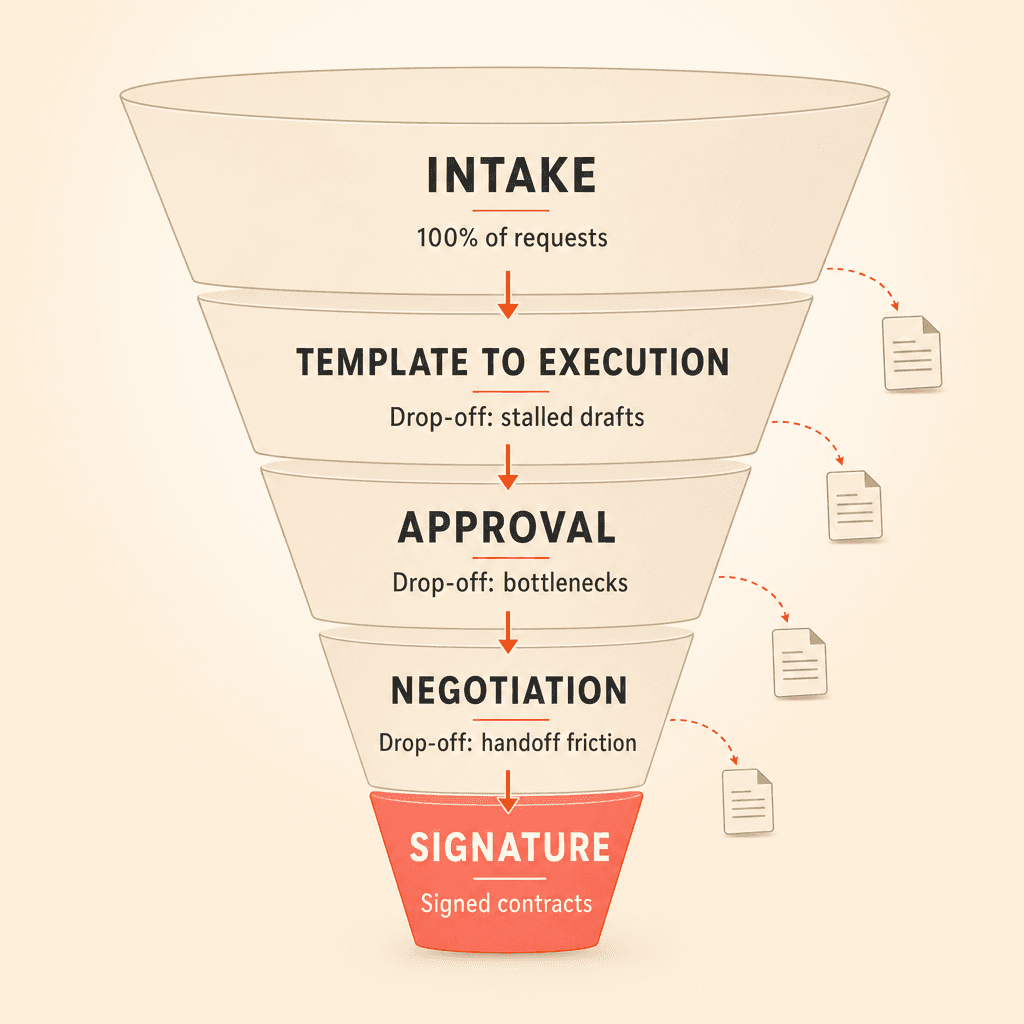
Most teams think of contract execution as a straight line: draft, review, approve, sign. In practice, it behaves more like a conversion funnel. At each transition point, some percentage of contracts stall, get abandoned, or get rerouted outside the system entirely.
The steepest drops tend to happen at two points: intake (where a business user first requests a contract) and the template-to-execution transition (where a selected template must become a fully populated, routable document). The stages in between, including review, approval, and negotiation, each introduce their own friction.
Your first step is to stop treating contract execution as a binary (signed or not signed) and start measuring conversion between stages. Without stage-by-stage visibility, you have no way to know where your process is leaking.
Intake: where the most contracts are lost
The intake stage is where a business user initiates a contract request. It is typically the widest part of the funnel and the point of greatest drop-off.
Legal ops leaders frequently describe intake processes that rely on ad hoc emails, Slack messages, or verbal requests. When the act of requesting a contract requires a business user to figure out which template to use, whom to email, and what information to include, many requests simply never get made. Others get stuck in an inbox.
The fix is structured but simple intake. Contract intake request forms that connect directly to templates, pre-populate required fields, and auto-assign the request to the right reviewer reduce the effort of initiating a contract to something comparable to filing a help desk ticket. The easier you make it to enter the funnel, the more contracts make it past the first stage.
What good intake looks like
A well-configured intake process has three properties:
Low barrier to entry. Business users should not need training to submit a request. The form itself should guide them through required information with dropdowns, checkboxes, and conditional fields.
Automatic template linking. Based on the type of request (NDA, vendor agreement, statement of work), the intake form should connect to the appropriate template without the requester having to locate it.
Immediate routing. The moment a request is submitted, it should land in a structured queue for the assigned reviewer, not in an email thread that competes with hundreds of other messages.
The template-to-execution gap
The transition from "you have selected a template" to "you have a contract ready for signature" is where process complexity spikes. Fields need to be populated, clauses selected, approval workflows triggered, and the right parties added. When this stage requires manual orchestration, such as copying data from a CRM, selecting the right template version, or manually adding approvers, the drop-off is severe.
Teams that handle this transition manually often describe a phenomenon where contracts sit in draft status for days or weeks simply because someone hasn't had time to fill in the blanks. Dynamic contract form fields that pre-fill from integrated data sources and auto-assign signature fields to specific signers can collapse this gap dramatically.
The principle is simple: every manual step between template selection and a routable document is an opportunity for the contract to stall. Eliminate as many of those steps as possible.
Approval workflows: sequence matters more than speed
Approval-stage drop-off is often a design problem, not a speed problem. Organizations with complex approval chains (budget, compliance, IT security, legal review) frequently position deal-killing decisions at the end of the process rather than the beginning.
The result is predictable: teams invest significant time negotiating and reviewing contracts that ultimately get rejected for budget or compliance reasons. This is not just wasted effort. It is a structural source of funnel leakage, because the people involved in those failed contracts lose faith in the process and become less likely to initiate future contracts through the formal system.
Resequence your approvals
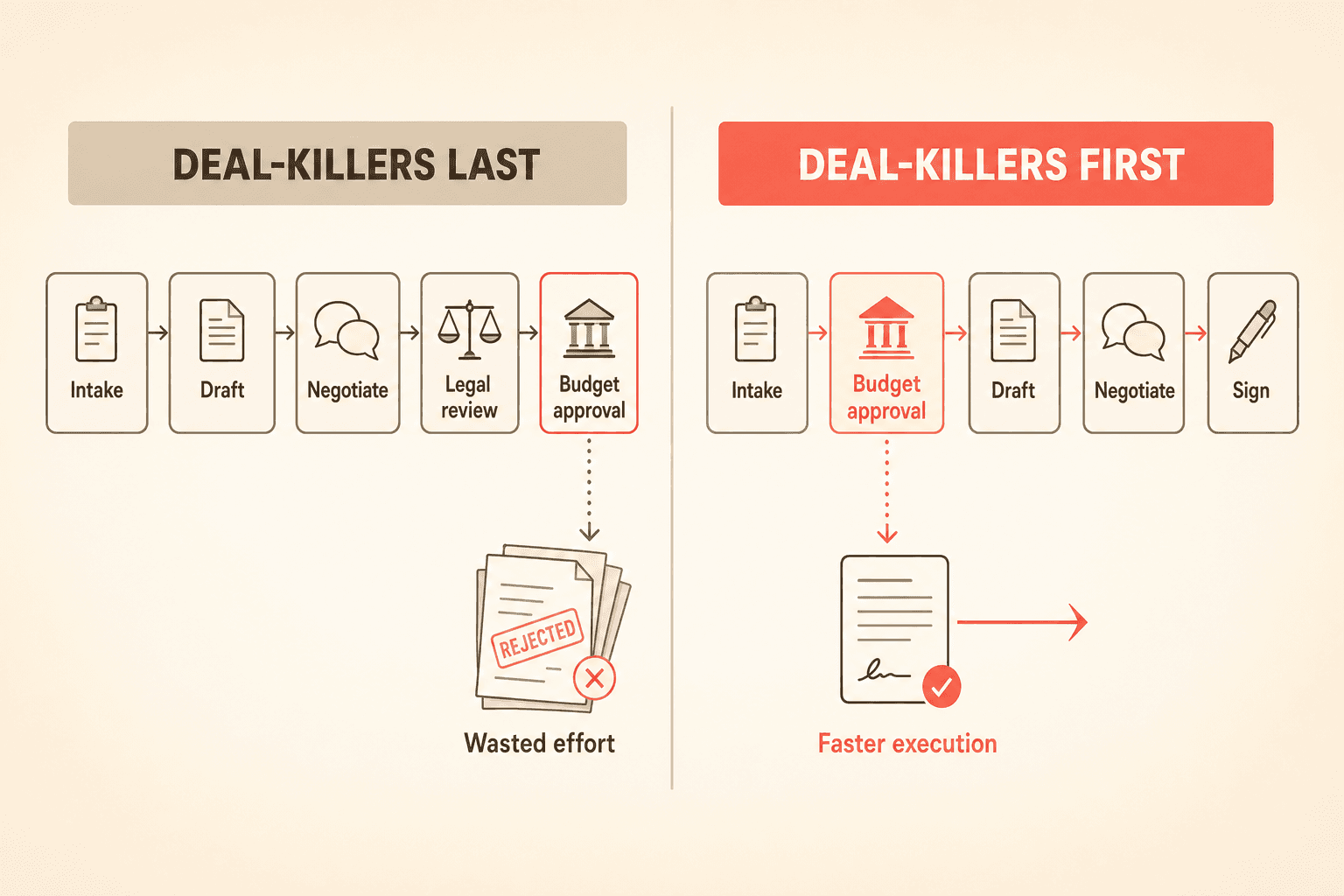
Place go/no-go decisions first. If a contract requires budget approval, make that the first step, not the last. If compliance review is likely to flag certain deal types, build conditional logic that routes those contracts to compliance before they enter negotiation.
Workflow automation that supports conditional routing based on contract type, value, or department lets you build approval chains that filter out non-viable contracts early and let viable ones move faster through subsequent stages. The ability to customize workflow statuses to match your actual process (rather than forcing your team into rigid, pre-defined stages) is equally important. When the tool's stages don't match the team's real workflow, users skip steps, work around the system, or abandon it entirely.
Negotiation drop-off is a handoff problem
Contracts rarely stall because the parties can't agree on terms. They stall because the process of exchanging redlines introduces enough friction that both sides lose momentum.
The typical pattern looks like this: a sales rep generates a contract from a template, sends it to the counterparty as a PDF or Word document, and routes redlines back through email for legal review. This handoff between systems and people is where many contracts go quiet. The requesting team loses visibility into where things stand, and legal has no structured queue to manage inbound reviews.
The fix is reducing the number of handoffs. When negotiation happens inside a centralized platform (or is at least compatible with Word and Google Docs workflows that your counterparties already use), both internal teams and external parties can work from the same version. No more "which draft is current?" confusion. No more reply-all chains with six different attachments.
Third-party paper breaks your funnel
Organizations that handle a mix of template-based contracts and bespoke or third-party paper consistently find that their standardized processes work well for the former and break down for the latter. Bespoke agreements often bypass the normal intake and approval process entirely, resulting in contracts that are either executed but poorly tracked, or that stall because no clear workflow path exists.
You need a way to bring third-party paper into the same funnel as your template-based contracts. This means intake forms that accommodate uploaded documents (not just template-generated ones), approval workflows that can be triggered for any contract regardless of origin, and reporting that captures all contracts in a single view.
You cannot fix what you cannot see
The single most common request from legal and operations leaders exploring CLM tools is the ability to see where contracts are getting stuck. Which approval step is the bottleneck? Which reviewer is sitting on a contract? How long has a given agreement been in draft?
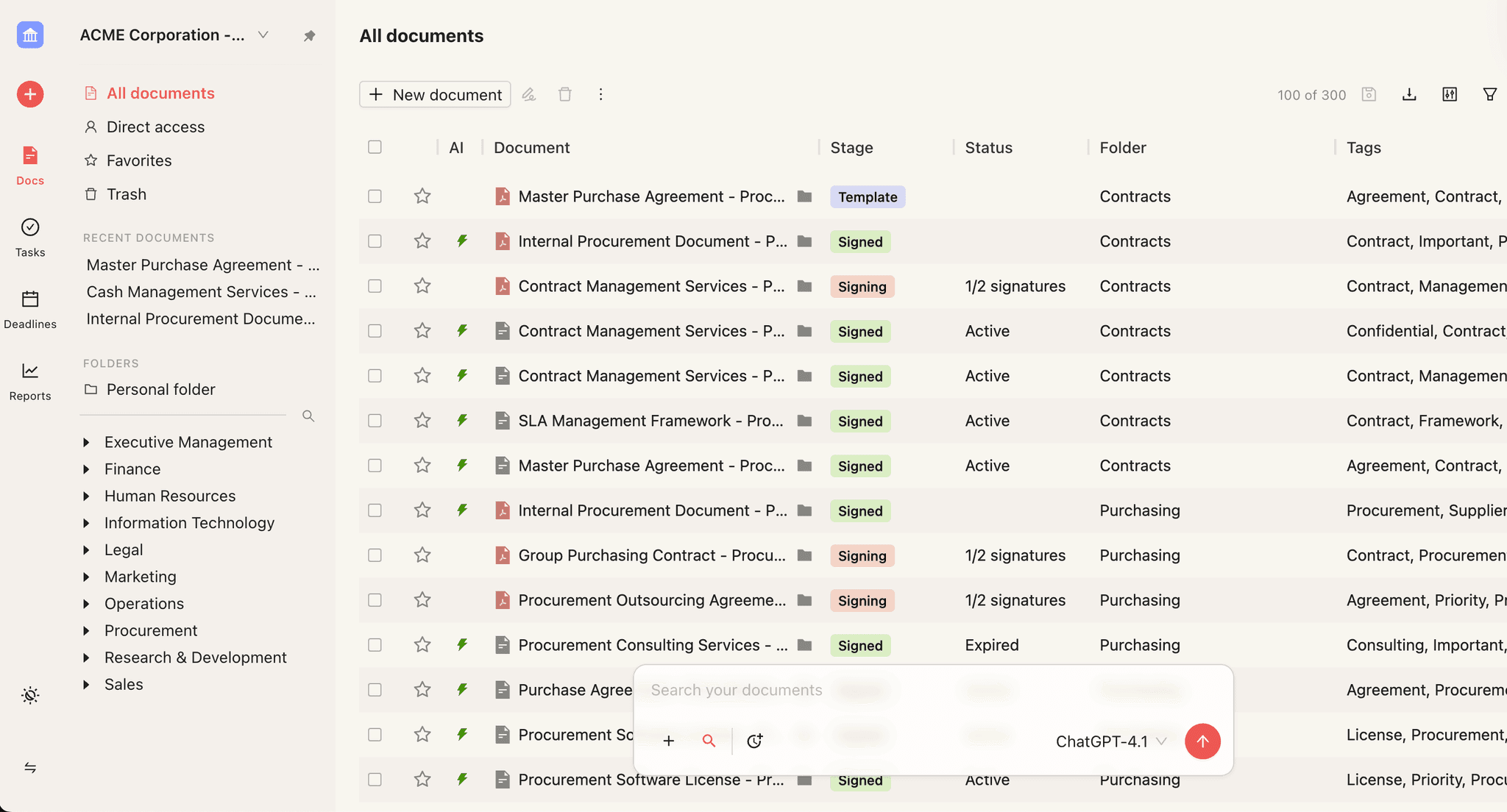
Without real-time status tracking and stage-based reporting, contracts silently stall at approval steps, sit in drafts for weeks, or get lost between reviewers. Workflow automation management capabilities that let you filter contracts by stage, time-in-stage, and assignee transform your contract execution process from a black box into a manageable pipeline.
This visibility also creates accountability. When distributed contract ownership is the norm (contracts managed by department owners or spend requesters rather than a centralized legal team), the lack of visibility means contracts regularly get initiated but not completed. Requesters forget to close out the process, and contracts linger in an ambiguous, partially executed state. Stage-based reporting makes those gaps visible, which is the first step toward closing them.
Start with the repository, then add lifecycle layers
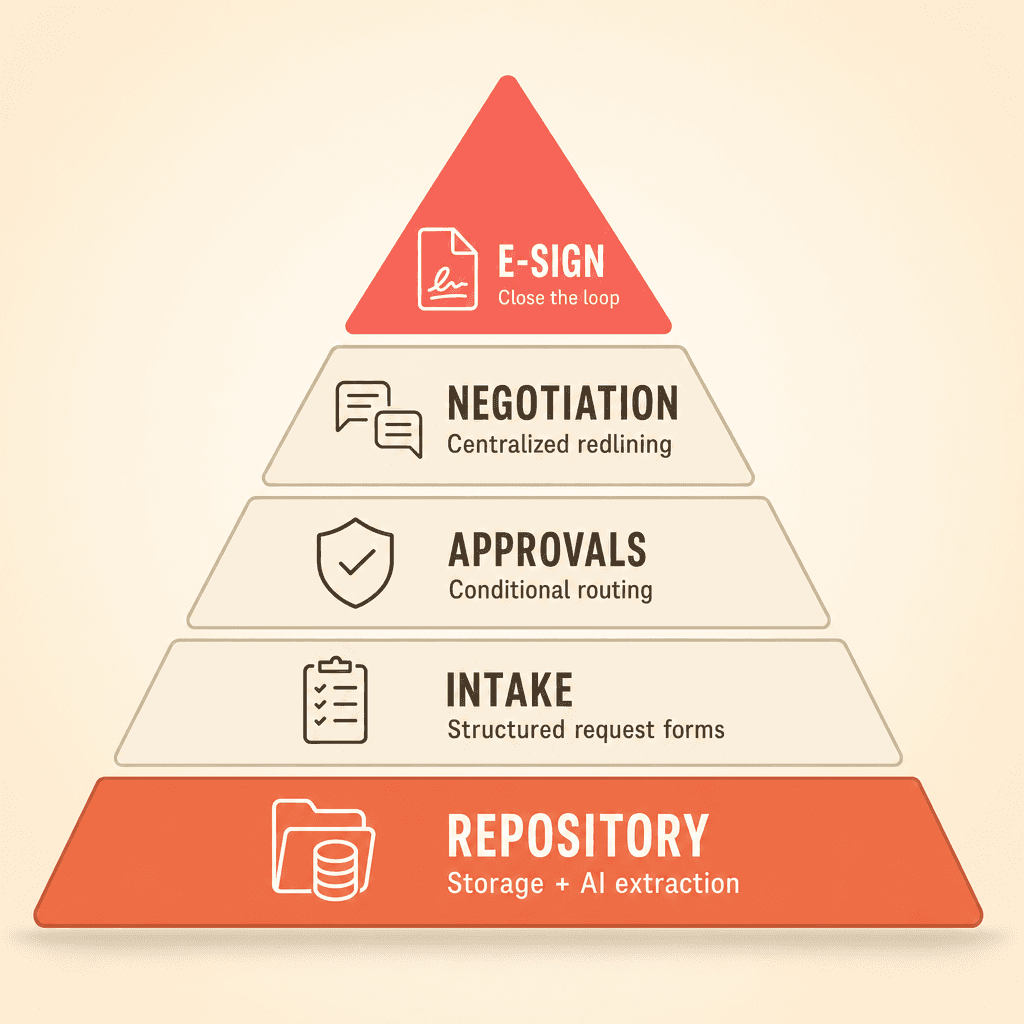
A common pattern among teams that successfully improve their contract execution funnel is a staged approach to adoption. Rather than rolling out intake forms, approval workflows, negotiation tools, and e-signature all at once, they start with document storage and AI extraction. They build the repository first.
From there, they layer in intake forms, then approval workflows, then negotiation and e-signature. Each layer adds incremental value and builds on the habits established in the previous phase. This approach reduces change-management friction and gives your team time to adjust to each new capability before the next one is introduced.
Your contract execution process follows a pattern that looks a lot like a marketing funnel. Contracts enter at the top (someone requests a new agreement), pass through several stages (drafting, review, approval, negotiation), and exit at the bottom as signed documents. But just like a marketing funnel, drop-off happens at every stage. Most organizations lose the majority of initiated contracts to abandonment, indefinite delays, or process friction long before reaching signature.
The difference between high-performing contract teams and everyone else comes down to one discipline: diagnosing where drop-off occurs and applying targeted fixes at each stage. This post walks through the contract execution funnel stage by stage, identifies the most common failure points, and shows you how to address each one.
Think of your contract execution process as a funnel
Most teams think of contract execution as a straight line: draft, review, approve, sign. In practice, it behaves more like a conversion funnel. At each transition point, some percentage of contracts stall, get abandoned, or get rerouted outside the system entirely.
The steepest drops tend to happen at two points: intake (where a business user first requests a contract) and the template-to-execution transition (where a selected template must become a fully populated, routable document). The stages in between, including review, approval, and negotiation, each introduce their own friction.
Your first step is to stop treating contract execution as a binary (signed or not signed) and start measuring conversion between stages. Without stage-by-stage visibility, you have no way to know where your process is leaking.
Intake: where the most contracts are lost
The intake stage is where a business user initiates a contract request. It is typically the widest part of the funnel and the point of greatest drop-off.
Legal ops leaders frequently describe intake processes that rely on ad hoc emails, Slack messages, or verbal requests. When the act of requesting a contract requires a business user to figure out which template to use, whom to email, and what information to include, many requests simply never get made. Others get stuck in an inbox.
The fix is structured but simple intake. Contract intake request forms that connect directly to templates, pre-populate required fields, and auto-assign the request to the right reviewer reduce the effort of initiating a contract to something comparable to filing a help desk ticket. The easier you make it to enter the funnel, the more contracts make it past the first stage.
What good intake looks like
A well-configured intake process has three properties:
Low barrier to entry. Business users should not need training to submit a request. The form itself should guide them through required information with dropdowns, checkboxes, and conditional fields.
Automatic template linking. Based on the type of request (NDA, vendor agreement, statement of work), the intake form should connect to the appropriate template without the requester having to locate it.
Immediate routing. The moment a request is submitted, it should land in a structured queue for the assigned reviewer, not in an email thread that competes with hundreds of other messages.
The template-to-execution gap
The transition from "you have selected a template" to "you have a contract ready for signature" is where process complexity spikes. Fields need to be populated, clauses selected, approval workflows triggered, and the right parties added. When this stage requires manual orchestration, such as copying data from a CRM, selecting the right template version, or manually adding approvers, the drop-off is severe.
Teams that handle this transition manually often describe a phenomenon where contracts sit in draft status for days or weeks simply because someone hasn't had time to fill in the blanks. Dynamic contract form fields that pre-fill from integrated data sources and auto-assign signature fields to specific signers can collapse this gap dramatically.
The principle is simple: every manual step between template selection and a routable document is an opportunity for the contract to stall. Eliminate as many of those steps as possible.
Approval workflows: sequence matters more than speed
Approval-stage drop-off is often a design problem, not a speed problem. Organizations with complex approval chains (budget, compliance, IT security, legal review) frequently position deal-killing decisions at the end of the process rather than the beginning.
The result is predictable: teams invest significant time negotiating and reviewing contracts that ultimately get rejected for budget or compliance reasons. This is not just wasted effort. It is a structural source of funnel leakage, because the people involved in those failed contracts lose faith in the process and become less likely to initiate future contracts through the formal system.
Resequence your approvals
Place go/no-go decisions first. If a contract requires budget approval, make that the first step, not the last. If compliance review is likely to flag certain deal types, build conditional logic that routes those contracts to compliance before they enter negotiation.
Workflow automation that supports conditional routing based on contract type, value, or department lets you build approval chains that filter out non-viable contracts early and let viable ones move faster through subsequent stages. The ability to customize workflow statuses to match your actual process (rather than forcing your team into rigid, pre-defined stages) is equally important. When the tool's stages don't match the team's real workflow, users skip steps, work around the system, or abandon it entirely.
Negotiation drop-off is a handoff problem
Contracts rarely stall because the parties can't agree on terms. They stall because the process of exchanging redlines introduces enough friction that both sides lose momentum.
The typical pattern looks like this: a sales rep generates a contract from a template, sends it to the counterparty as a PDF or Word document, and routes redlines back through email for legal review. This handoff between systems and people is where many contracts go quiet. The requesting team loses visibility into where things stand, and legal has no structured queue to manage inbound reviews.
The fix is reducing the number of handoffs. When negotiation happens inside a centralized platform (or is at least compatible with Word and Google Docs workflows that your counterparties already use), both internal teams and external parties can work from the same version. No more "which draft is current?" confusion. No more reply-all chains with six different attachments.
Third-party paper breaks your funnel
Organizations that handle a mix of template-based contracts and bespoke or third-party paper consistently find that their standardized processes work well for the former and break down for the latter. Bespoke agreements often bypass the normal intake and approval process entirely, resulting in contracts that are either executed but poorly tracked, or that stall because no clear workflow path exists.
You need a way to bring third-party paper into the same funnel as your template-based contracts. This means intake forms that accommodate uploaded documents (not just template-generated ones), approval workflows that can be triggered for any contract regardless of origin, and reporting that captures all contracts in a single view.
You cannot fix what you cannot see
The single most common request from legal and operations leaders exploring CLM tools is the ability to see where contracts are getting stuck. Which approval step is the bottleneck? Which reviewer is sitting on a contract? How long has a given agreement been in draft?
Without real-time status tracking and stage-based reporting, contracts silently stall at approval steps, sit in drafts for weeks, or get lost between reviewers. Workflow automation management capabilities that let you filter contracts by stage, time-in-stage, and assignee transform your contract execution process from a black box into a manageable pipeline.
This visibility also creates accountability. When distributed contract ownership is the norm (contracts managed by department owners or spend requesters rather than a centralized legal team), the lack of visibility means contracts regularly get initiated but not completed. Requesters forget to close out the process, and contracts linger in an ambiguous, partially executed state. Stage-based reporting makes those gaps visible, which is the first step toward closing them.
Start with the repository, then add lifecycle layers
A common pattern among teams that successfully improve their contract execution funnel is a staged approach to adoption. Rather than rolling out intake forms, approval workflows, negotiation tools, and e-signature all at once, they start with document storage and AI extraction. They build the repository first.
From there, they layer in intake forms, then approval workflows, then negotiation and e-signature. Each layer adds incremental value and builds on the habits established in the previous phase. This approach reduces change-management friction and gives your team time to adjust to each new capability before the next one is introduced.
Need to know
Frequently Asked Questions

Take the "management" out
of contract management.
Customer Support
Legal
Compare
Resources
Customer Support
Company
Legal
Compare
Resources
Customer Support
Company
Legal
Compare
© 2025 Concord. All rights reserved.