How to Write a Contract: A Complete 2026 Guide
How to Write a Contract: A Complete 2026 Guide
How to Write a Contract: A Complete 2026 Guide
How to Write a Contract: A Complete 2026 Guide
how to write a contract, contract drafting, essential contract clauses, e-signature validity, contract lifecycle

If you work in legal ops, procurement, sales, or your own company, you can draft an agreement that holds up when you get the fundamentals right and confirm the details with licensed counsel in your jurisdiction. This guide covers formation basics, document structure, essential clauses, execution formalities, and post-signature governance.
One note before the steps: nothing here is legal advice. Treat this as a mechanics lesson, then have a licensed attorney review anything that matters.
Key takeaways
A valid contract starts with mutual assent, consideration, capacity, and a lawful purpose.
A governed structure and consistent defined terms make the agreement easier to interpret and maintain.
Risk clauses should name the triggering event and assign a clear outcome before a dispute occurs.
Writing continues after signature because renewal, notice, expiry, and obligation dates still need active governance.
Step 1: Establish mutual assent
Courts apply an objective theory of mutual assent. Your words and conduct, taken together, either form a contract or fail to. The signed document is strong evidence, but not the only path.
An offer is a clear manifestation of willingness to be bound by specific terms. An acceptance is assent to those terms, delivered in the manner the offer invites. Your draft should define the acceptance mechanism explicitly, whether that is a countersignature, a click-wrap flow, or a signed order form.
You also need evidence hygiene. Teams commonly describe version confusion in email-driven negotiation as the root source of disputes, because contradictory messages can leak into formation. Keep a single current draft and mark superseded versions clearly.
Watch: Keep internal contract revisions private
Step 2: Confirm consideration, capacity, and legality
A contract needs four formation elements: mutual assent, consideration, capacity, and legality.
Element | What it means | What the draft should show |
|---|---|---|
Mutual assent | A clear offer and acceptance | The terms and the acceptance mechanism |
Consideration | A bargained-for exchange of value | What each party gives or promises |
Capacity | Legal ability and authority to agree | Correct parties and authorized signers |
Legality | A lawful purpose | Obligations permitted in the governing jurisdiction |
Consideration means a bargained-for exchange of value. Each side must give a performance or a return promise, so gratuitous promises tend to fail on this element. State plainly what each party exchanges.
Capacity means each signer can legally bind their side. Confirm the counterparty’s signatory has authority, and that any individual party is of legal age and sound mind.
Legality means the purpose of the agreement is lawful. If any of these elements is missing, no drafting style can rescue the document.
Step 3: Structure the document
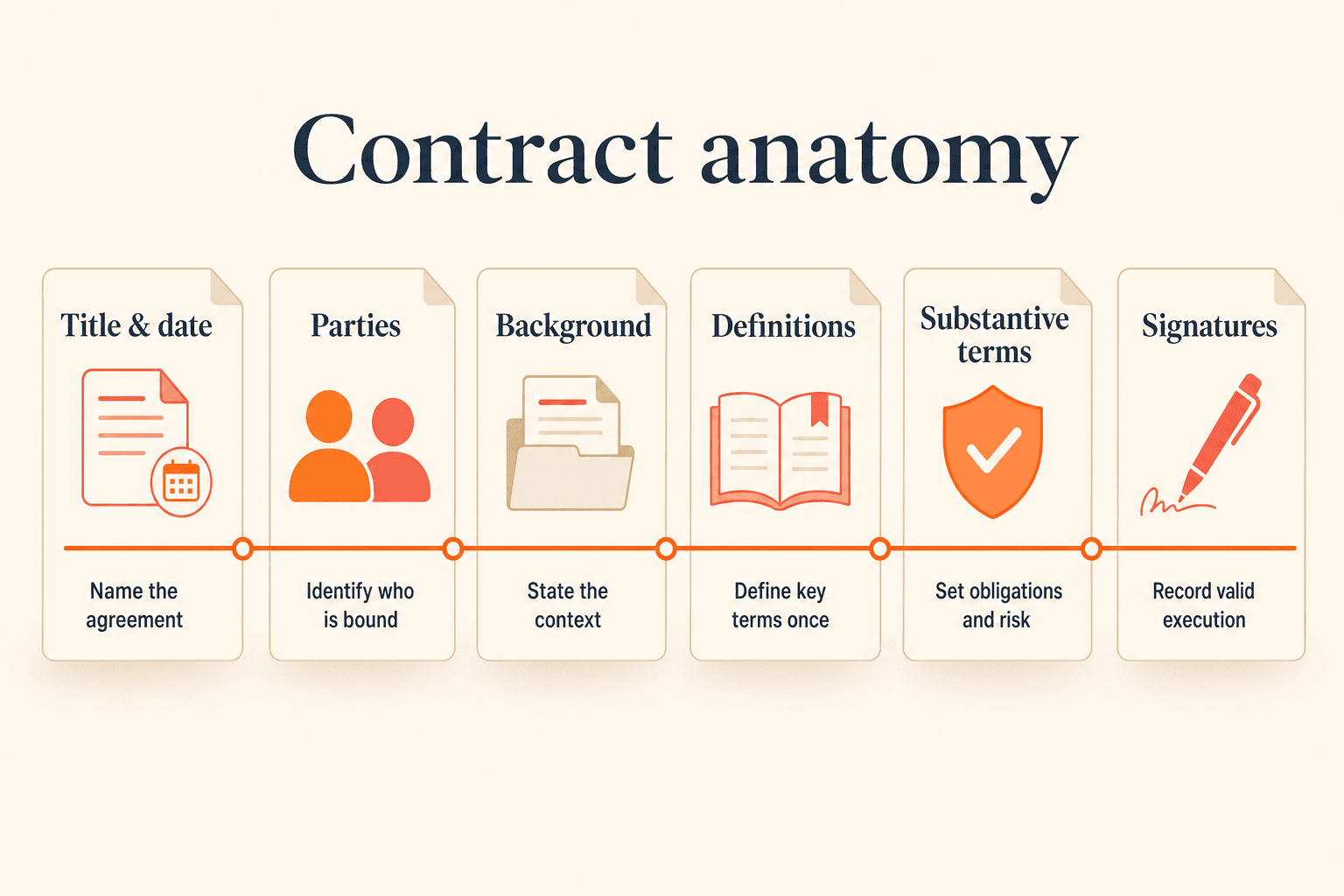
A clean structure makes the substance readable. Most agreements follow the same anatomy: title and date, party identification, recitals or background, definitions, substantive terms, and signature blocks.
Use numbered sections, define terms once, and apply those definitions consistently. When you define “Delivery Date,” use the capitalized form everywhere.
Start from a governed template rather than a blank page. A template enforces the structure above and reduces the risk of a missing section. If your organization lacks one, close that gap before drafting further.
Step 4: Write the clauses that allocate risk
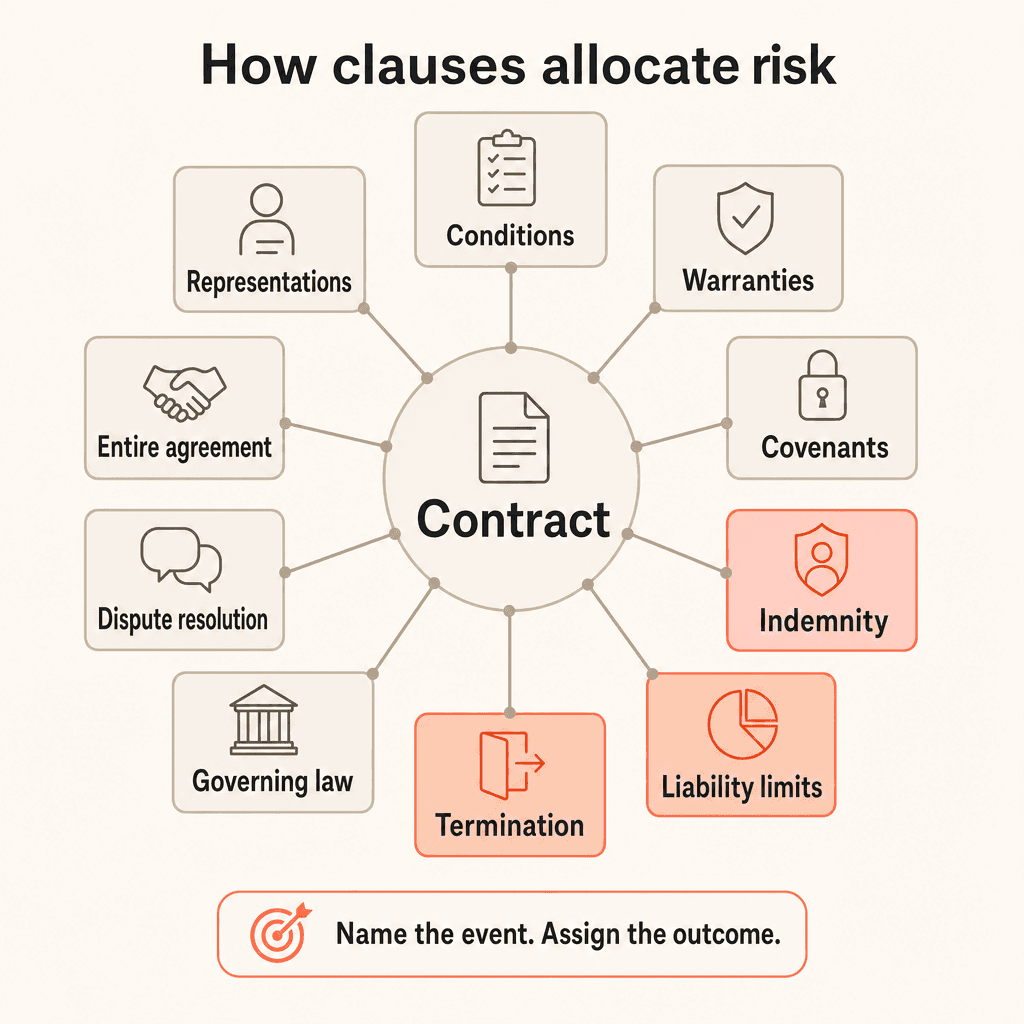
Each risk clause should name a future event and assign a clear outcome before that event occurs.
A contract is a risk-allocation machine, and clauses are the moving parts. Walk through this list whenever you draft:
Conditions precedent: what must be true before obligations kick in.
Representations and warranties: facts each party asserts the other can rely on.
Covenants: promises about future conduct.
Indemnity: who pays when specific harms occur.
Limitation of liability: the cap on downside.
Termination for cause or convenience: how the relationship ends.
Governing law and forum selection: which rules apply and which referee decides.
Arbitration: whether disputes leave the courtroom.
Severability: whether the rest of the agreement survives a void clause.
Entire agreement (integration): the clause that mutes the email thread.
Legal ops leaders frequently report that keeping clause language current, versioned, and consistently applied is as time-consuming as the drafting itself. That is why organizations standardize these clauses in libraries instead of rewriting them deal by deal. See how a clause library supports that standardization.
Want governed templates and versioned clauses in one drafting workflow? See Concord in action.
Step 5: Execute the contract correctly
Execution formalities depend on jurisdiction, and e-signature validity is tiered. Verify the specifics with counsel before you pick a signature method, especially on cross-border deals.
In the United States, the federal ESIGN Act and state UETA implementations give legal effect to electronic signatures and records. Two conditions matter: the parties consent to electronic contracting, and the system reliably associates the signature with the signer and the record. The law is technology-neutral and mandates no particular method.
In the European Union, the picture is layered. Under the eIDAS Regulation (EU) No 910/2014, electronic signatures, seals, and documents cannot be denied legal effect solely because they are electronic. Only qualified electronic signatures, typically issued through a trust service provider, receive the highest presumption of validity and equivalence to handwritten signatures across Member States. Simple and advanced signatures remain valid in many contexts, but the presumption differs.
Some transactions sit outside general e-signature coverage. Certain wills, family-law documents, and real-property transfers may be excluded or require extra formalities, so flag those cases for counsel rather than assuming universal coverage. Read the electronic signature guide for more detail.
Step 6: Govern the contract after signature
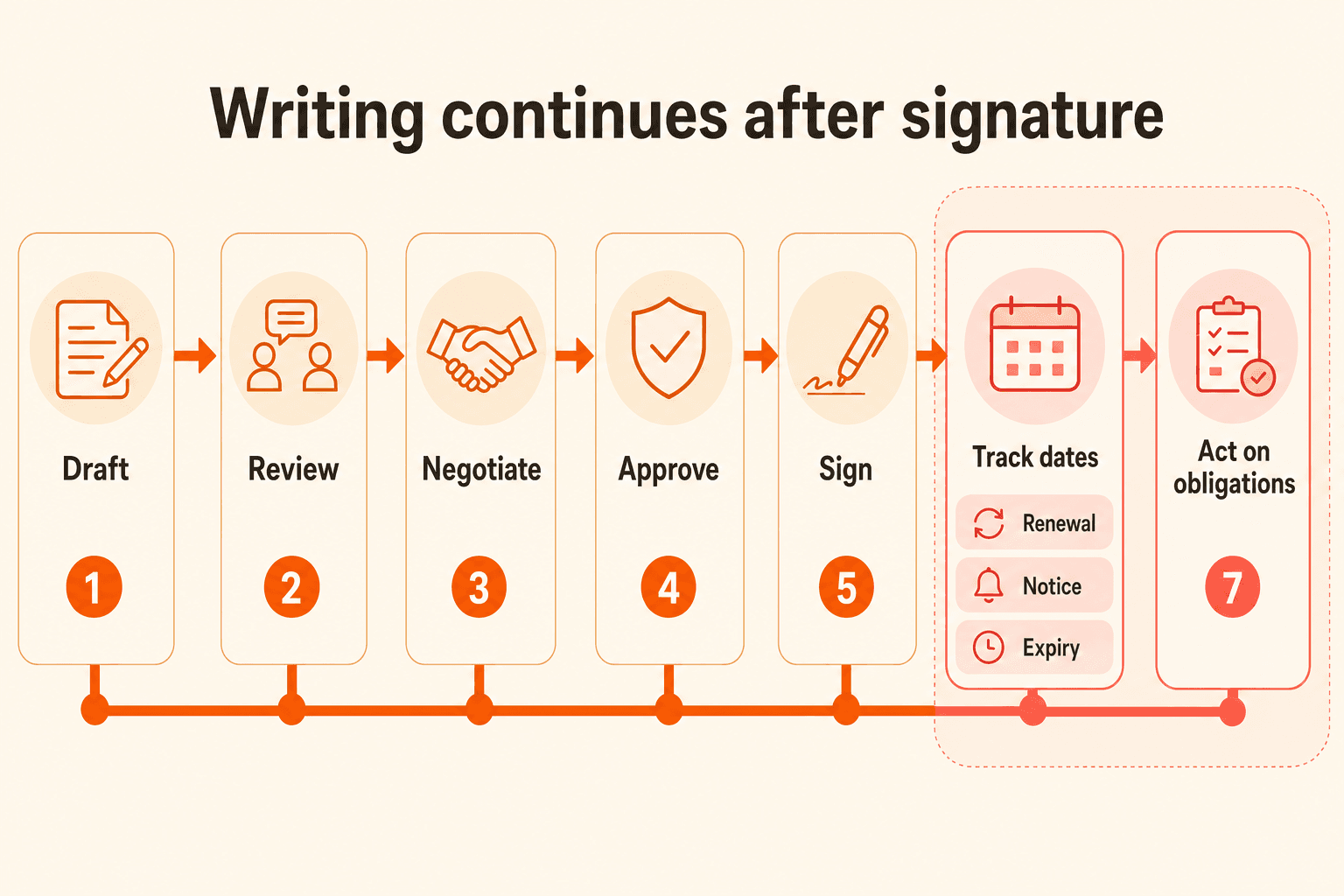
A complete contract-writing process records and governs every renewal, notice, expiry, and time-bound obligation after execution.
A contract that cannot be governed after signing is only half-written. Legal validity means little when renewal, termination-notice, or expiry dates are buried in a folder.
Record the dates that matter at the moment of signature: renewal windows, notice deadlines, expiry, and any obligations with time limits. Then set reminders with enough lead time to act. Legal ops leaders frequently push back on drafting-only tools because the costliest misses happen after signature, not before it.
This is where contract management becomes part of the writing skill itself. You are not finished when the document is signed. You are finished when the signed document is tracked.
Watch: Manage contract deadlines after signature
Pitfalls that undo clean drafting
Three habits account for most formation trouble. First, circulating mismatched versions: contradictory drafts create ambiguity about which terms were accepted. Second, stray email terms: side messages can merge into formation unless an integration clause says otherwise. Third, open-ended language: lines like “we will work it out later” signal that assent never concluded. Clean drafting is evidence hygiene as much as writing skill.
How to write a contract: final checklist
Before you circulate a draft, run this checklist:
Offer and acceptance are explicit, with a defined acceptance mechanism.
Consideration states what each party exchanges.
Signers have capacity and authority.
The purpose of the agreement is lawful.
The structure follows standard anatomy, with defined terms used consistently.
Risk clauses cover indemnity, liability limits, termination, governing law, forum, and integration.
The signature method matches the jurisdiction and transaction type.
Renewal, notice, and expiry dates are recorded in a tracking system.
Counsel has reviewed the draft.
Where contract tooling fits
Step-by-step discipline holds up better when your tooling enforces it. Concord features map directly onto the steps above.
The clause library keeps standard language versioned and ready. Governed templates with data-populated fields, text inputs, dropdowns, checkboxes, and signature fields let business users assemble drafts without starting from a blank page. Conditional logic adjusts terms to the scenario, such as different indemnity language for different deal sizes, without manual redrafting. Reporting and analytics track signatures, expirations, and outstanding documents so the post-signature step runs automatically.
None of this replaces legal review. It shortens the routing, review, and redline loop, which is where cycle time actually bleeds away. Explore contract templates as your next step.
Ready to put this checklist into practice? See how Concord brings governed templates, clause libraries, review, signature, and post-signature tracking into one contract workflow.
If you work in legal ops, procurement, sales, or your own company, you can draft an agreement that holds up when you get the fundamentals right and confirm the details with licensed counsel in your jurisdiction. This guide covers formation basics, document structure, essential clauses, execution formalities, and post-signature governance.
One note before the steps: nothing here is legal advice. Treat this as a mechanics lesson, then have a licensed attorney review anything that matters.
Key takeaways
A valid contract starts with mutual assent, consideration, capacity, and a lawful purpose.
A governed structure and consistent defined terms make the agreement easier to interpret and maintain.
Risk clauses should name the triggering event and assign a clear outcome before a dispute occurs.
Writing continues after signature because renewal, notice, expiry, and obligation dates still need active governance.
Step 1: Establish mutual assent
Courts apply an objective theory of mutual assent. Your words and conduct, taken together, either form a contract or fail to. The signed document is strong evidence, but not the only path.
An offer is a clear manifestation of willingness to be bound by specific terms. An acceptance is assent to those terms, delivered in the manner the offer invites. Your draft should define the acceptance mechanism explicitly, whether that is a countersignature, a click-wrap flow, or a signed order form.
You also need evidence hygiene. Teams commonly describe version confusion in email-driven negotiation as the root source of disputes, because contradictory messages can leak into formation. Keep a single current draft and mark superseded versions clearly.
Watch: Keep internal contract revisions private
Step 2: Confirm consideration, capacity, and legality
A contract needs four formation elements: mutual assent, consideration, capacity, and legality.
Element | What it means | What the draft should show |
|---|---|---|
Mutual assent | A clear offer and acceptance | The terms and the acceptance mechanism |
Consideration | A bargained-for exchange of value | What each party gives or promises |
Capacity | Legal ability and authority to agree | Correct parties and authorized signers |
Legality | A lawful purpose | Obligations permitted in the governing jurisdiction |
Consideration means a bargained-for exchange of value. Each side must give a performance or a return promise, so gratuitous promises tend to fail on this element. State plainly what each party exchanges.
Capacity means each signer can legally bind their side. Confirm the counterparty’s signatory has authority, and that any individual party is of legal age and sound mind.
Legality means the purpose of the agreement is lawful. If any of these elements is missing, no drafting style can rescue the document.
Step 3: Structure the document
A clean structure makes the substance readable. Most agreements follow the same anatomy: title and date, party identification, recitals or background, definitions, substantive terms, and signature blocks.
Use numbered sections, define terms once, and apply those definitions consistently. When you define “Delivery Date,” use the capitalized form everywhere.
Start from a governed template rather than a blank page. A template enforces the structure above and reduces the risk of a missing section. If your organization lacks one, close that gap before drafting further.
Step 4: Write the clauses that allocate risk
Each risk clause should name a future event and assign a clear outcome before that event occurs.
A contract is a risk-allocation machine, and clauses are the moving parts. Walk through this list whenever you draft:
Conditions precedent: what must be true before obligations kick in.
Representations and warranties: facts each party asserts the other can rely on.
Covenants: promises about future conduct.
Indemnity: who pays when specific harms occur.
Limitation of liability: the cap on downside.
Termination for cause or convenience: how the relationship ends.
Governing law and forum selection: which rules apply and which referee decides.
Arbitration: whether disputes leave the courtroom.
Severability: whether the rest of the agreement survives a void clause.
Entire agreement (integration): the clause that mutes the email thread.
Legal ops leaders frequently report that keeping clause language current, versioned, and consistently applied is as time-consuming as the drafting itself. That is why organizations standardize these clauses in libraries instead of rewriting them deal by deal. See how a clause library supports that standardization.
Want governed templates and versioned clauses in one drafting workflow? See Concord in action.
Step 5: Execute the contract correctly
Execution formalities depend on jurisdiction, and e-signature validity is tiered. Verify the specifics with counsel before you pick a signature method, especially on cross-border deals.
In the United States, the federal ESIGN Act and state UETA implementations give legal effect to electronic signatures and records. Two conditions matter: the parties consent to electronic contracting, and the system reliably associates the signature with the signer and the record. The law is technology-neutral and mandates no particular method.
In the European Union, the picture is layered. Under the eIDAS Regulation (EU) No 910/2014, electronic signatures, seals, and documents cannot be denied legal effect solely because they are electronic. Only qualified electronic signatures, typically issued through a trust service provider, receive the highest presumption of validity and equivalence to handwritten signatures across Member States. Simple and advanced signatures remain valid in many contexts, but the presumption differs.
Some transactions sit outside general e-signature coverage. Certain wills, family-law documents, and real-property transfers may be excluded or require extra formalities, so flag those cases for counsel rather than assuming universal coverage. Read the electronic signature guide for more detail.
Step 6: Govern the contract after signature
A complete contract-writing process records and governs every renewal, notice, expiry, and time-bound obligation after execution.
A contract that cannot be governed after signing is only half-written. Legal validity means little when renewal, termination-notice, or expiry dates are buried in a folder.
Record the dates that matter at the moment of signature: renewal windows, notice deadlines, expiry, and any obligations with time limits. Then set reminders with enough lead time to act. Legal ops leaders frequently push back on drafting-only tools because the costliest misses happen after signature, not before it.
This is where contract management becomes part of the writing skill itself. You are not finished when the document is signed. You are finished when the signed document is tracked.
Watch: Manage contract deadlines after signature
Pitfalls that undo clean drafting
Three habits account for most formation trouble. First, circulating mismatched versions: contradictory drafts create ambiguity about which terms were accepted. Second, stray email terms: side messages can merge into formation unless an integration clause says otherwise. Third, open-ended language: lines like “we will work it out later” signal that assent never concluded. Clean drafting is evidence hygiene as much as writing skill.
How to write a contract: final checklist
Before you circulate a draft, run this checklist:
Offer and acceptance are explicit, with a defined acceptance mechanism.
Consideration states what each party exchanges.
Signers have capacity and authority.
The purpose of the agreement is lawful.
The structure follows standard anatomy, with defined terms used consistently.
Risk clauses cover indemnity, liability limits, termination, governing law, forum, and integration.
The signature method matches the jurisdiction and transaction type.
Renewal, notice, and expiry dates are recorded in a tracking system.
Counsel has reviewed the draft.
Where contract tooling fits
Step-by-step discipline holds up better when your tooling enforces it. Concord features map directly onto the steps above.
The clause library keeps standard language versioned and ready. Governed templates with data-populated fields, text inputs, dropdowns, checkboxes, and signature fields let business users assemble drafts without starting from a blank page. Conditional logic adjusts terms to the scenario, such as different indemnity language for different deal sizes, without manual redrafting. Reporting and analytics track signatures, expirations, and outstanding documents so the post-signature step runs automatically.
None of this replaces legal review. It shortens the routing, review, and redline loop, which is where cycle time actually bleeds away. Explore contract templates as your next step.
Ready to put this checklist into practice? See how Concord brings governed templates, clause libraries, review, signature, and post-signature tracking into one contract workflow.
Need to know
Frequently Asked Questions

Take the "management" out
of contract management.
Customer Support
Legal
Compare
Resources
Customer Support
Company
Legal
Compare
Resources
Customer Support
Company
Legal
Compare
© 2025 Concord. All rights reserved.