How construction firms manage contracts across multiple entities
How construction firms manage contracts across multiple entities
How construction firms manage contracts across multiple entities
How construction firms manage contracts across multiple entities
contract management

Construction companies rarely operate as a single legal entity. Your firm probably runs a holding company, one or more operating subsidiaries, real estate entities, project-specific LLCs, and maybe a joint venture or two. Each entity signs its own contracts with general contractors, subcontractors, vendors, insurers, and sometimes with each other.
That complexity makes choosing the right construction contract management software one of the most consequential decisions your leadership team will face. Generic file storage and email-driven workflows cannot keep pace with the volume, variability, and cross-entity dependencies that define construction contracting.
This post walks through the specific challenges multi-entity construction firms encounter and the features that actually address them.
Why generic file storage fails multi-entity construction firms
Your contracts live somewhere right now. Maybe that is a SharePoint folder structure organized by entity. Maybe it is a shared drive with nested project folders. Maybe it is a mix of both, plus email attachments, plus physical binders in a field office.
The problem is not that your contracts are lost. The problem is that they are fragmented. When contracts sit in entity-specific silos, you lose cross-entity searchability, centralized deadline tracking, and any realistic ability to see the full contractual picture during an audit, an entity sale, or a restructuring.
Construction teams frequently describe printing contracts, distributing them through cloud links or email, then watching progress stall when multiple stakeholders fail to respond quickly. When contract volume spikes during a busy bidding season, the lack of a reliable tracking mechanism turns frustration into financial risk.
Entity structure demands purpose-built organization
A mid-market mechanical contracting firm might manage 15 to 20 legal entities. An enterprise general contractor could have hundreds. Each entity has its own contracts, its own compliance obligations, and its own stakeholders.
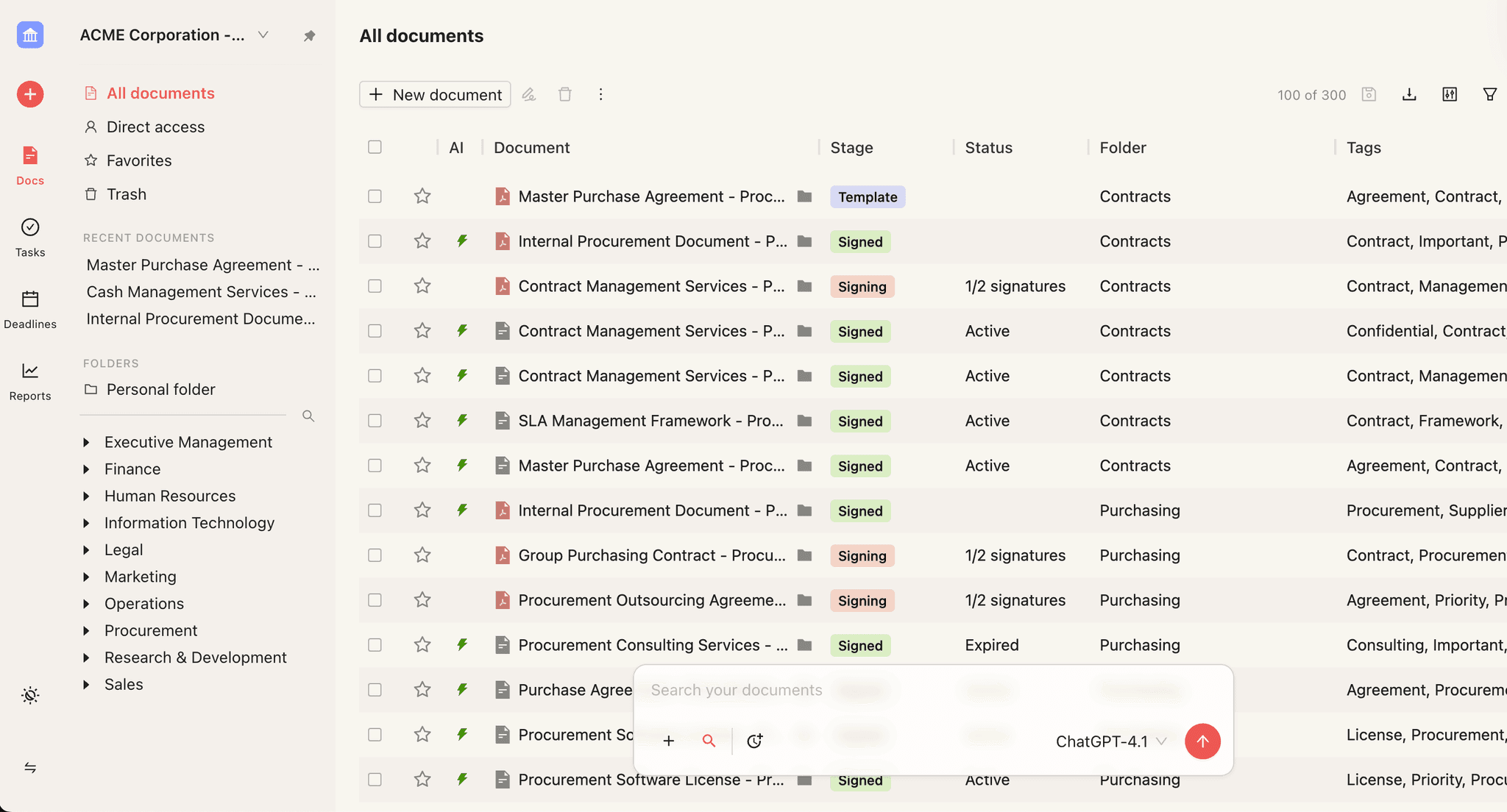
Your CLM needs to mirror that structure, not force you into a flat filing system. Concord's multi-tenant workspace management lets you create separate workspaces for different business units or subsidiaries within a single instance, with complete data isolation between entities. Folder hierarchies can map directly to your corporate structure, and custom contract properties let you tag any contract by entity, project, facility, risk level, or funding source.
The payoff is immediate. Instead of opening four different folder trees to find every contract associated with a specific property, you filter by a single tag. Instead of rebuilding your organizational map inside a tool that was designed for a two-office law firm, you build a structure that looks like your actual company.
Permissions are a compliance requirement, not a convenience feature
When multiple entities share a contract repository, unrestricted access becomes a liability. A project coordinator working on a $5,000 subcontract should not have visibility into a $20 million joint venture agreement. An insurance administrator who needs to track certificate of insurance expirations across all entities has no business reading employment contracts.
Construction companies with multiple divisions consistently ask about restricting visibility along these lines. The answer is folder-based permissions where administrators control who sees which folders and at what access level: viewer, collaborator, creator, or admin.
Concord's multi-tenant data isolation and access control keeps contracts belonging to one entity invisible to users outside that entity's permission scope. Custom roles add another layer, letting you build permission profiles that match your org chart rather than accepting a generic model. Executives who need a consolidated view across all entities get one, while division-level staff see only what is relevant to their work.
Variable approval chains for variable contract values
Construction contracts can range from $5,000 to $20 million within the same company. A small subcontract may need three reviewers: a contract administrator, an estimator, and a project manager. A large master service agreement might require six or seven reviewers, and the specific people change from project to project.
This variability breaks rigid workflows. If your CLM demands the same approval chain for every contract, your team will route around it. If your CLM charges per seat, you will hesitate to add the estimator who only reviews two contracts a month.
Conditional contract logic in Concord lets you build automated workflows that trigger based on contract value, type, or custom fields. A $5,000 subcontract routes to three reviewers. A $20 million JV agreement triggers a longer chain that includes legal counsel and an executive signoff. The workflow adapts to the contract, not the other way around. And unlimited free viewer seats mean every stakeholder who needs access can have it without inflating your licensing costs.
Multi-party contract handling is a make-or-break feature
Construction contracts frequently involve more than two parties. A vendor may serve three facilities under one agreement. Two subsidiaries of the same parent may appear on opposite sides of a lease. A subcontractor agreement may name a GC, an owner, and the sub.
Teams that have used CLM tools treating every contract as a simple two-party relationship, one client and one counterparty, describe the workarounds as unsustainable. At least one organization pattern that surfaces regularly in CLM evaluations is abandoning a previous tool specifically because it handled multi-party contracts poorly.
Concord's entity data management lets you tag contracts with multiple parties, filter by any party, and see all agreements associated with a specific entity or vendor. When your organization has entities appearing on both sides of a contract, the system accommodates that reality instead of forcing you to pick one side.
Document linking preserves the contractual chain of custody
A single construction project can generate a master agreement, multiple statements of work, change orders, amendments, certificates of insurance, and lien waivers. All of these documents relate to each other. Without explicit linking, your team searches by keyword and mentally reconstructs the chain every time someone needs context.
Document linking with relationship types, such as framework, amendment, supersession, and extension, makes the contractual structure visible at a glance. Open a master service agreement and immediately see every SOW, change order, and amendment attached to it. Track which amendment superseded which. Confirm that the current COI is valid without digging through email threads.
This capability supports compliance reviews and audits and reduces the time your contract administrators spend assembling document packages from hours to minutes.
Deadline tracking across entities prevents the most expensive failures
Missed renewal dates, overlooked early termination windows, and expired certificates of insurance represent some of the highest-cost contract failures in construction. When contracts are spread across entities with no unified calendar, these deadlines slip through.
Concord's deadline tracking system sends weekly digest emails, supports calendar sync, and lets users set alerts 30, 60, or 90 days in advance. Combined with AI extraction that automatically identifies renewal dates, termination notice periods, and financial terms at upload, even a backlog of legacy contracts becomes manageable within days rather than months.
Batch AI extraction across your entire organization lets leadership pull cross-entity reports on renewal exposure, total contract value, or expiring COIs, all from a single dashboard.
Protecting institutional knowledge before it walks out the door
Construction firms commonly depend on veteran contract administrators who hold decades of institutional knowledge: which vendor terms are negotiable, which subcontractors require special insurance language, which entity signs which type of agreement. When these individuals approach retirement, the organization faces a knowledge cliff.
A CLM that captures contract metadata, standardizes workflows, and makes historical patterns searchable gives newer staff the context they need to operate confidently. Instead of calling the retiring administrator to ask where the 2019 amendment lives, your team searches by project, entity, or vendor and finds it in seconds. The system builds on itself over time, creating an institutional memory that does not depend on any single person.
Getting your team to actually use it
Construction teams include executives, estimators, project managers, coordinators, contract administrators, accountants, and safety personnel. Many of these roles view new software as unwanted overhead. The most capable CLM in the world fails if your field teams refuse to touch it.
Adoption depends on the system being intuitive enough that non-legal users can submit requests, view contracts, and receive alerts without extensive training. A simple intake form replaces the email chain where someone asks, "Can you send me that subcontract?" Unlimited free viewer seats mean you do not have to ration access. And bulk upload with automated tagging means your initial migration does not require months of manual data entry.
Frequently asked questions
Can a single CLM instance handle contracts for 20 or more separate legal entities?
Yes. Concord supports multi-tenant workspace management within a single instance, with data isolation between entities. Tagging lets you associate any contract with one or many entities simultaneously, and folder-based permissions keep entity-level visibility separate while giving executives a consolidated view. Organizations that have centralized 20-plus entities into a single CLM report that entity sales and reorganizations become significantly faster because the contractual picture is already consolidated.
How does construction contract management software handle contracts where two of our own subsidiaries are on opposite sides?
Concord's multi-party tagging allows you to associate more than two parties with any contract. If your operating entity and your real estate entity appear on both sides of a lease, the system accommodates that structure without forcing you to designate one as a generic counterparty. Both entities can filter and find the contract through their own views.
What happens to our existing backlog of paper and PDF contracts?
Bulk upload and batch AI extraction let you onboard hundreds or thousands of legacy contracts in a fraction of the time manual entry would require. The AI identifies key dates, financial terms, and party names automatically. Your team reviews and confirms the extracted data rather than typing it from scratch.
Ready to see how Concord handles multi-entity contract management for construction firms? Request a personalized demo and bring your messiest organizational chart. Your contracts deserve a system that matches how your company actually operates.
Construction companies rarely operate as a single legal entity. Your firm probably runs a holding company, one or more operating subsidiaries, real estate entities, project-specific LLCs, and maybe a joint venture or two. Each entity signs its own contracts with general contractors, subcontractors, vendors, insurers, and sometimes with each other.
That complexity makes choosing the right construction contract management software one of the most consequential decisions your leadership team will face. Generic file storage and email-driven workflows cannot keep pace with the volume, variability, and cross-entity dependencies that define construction contracting.
This post walks through the specific challenges multi-entity construction firms encounter and the features that actually address them.
Why generic file storage fails multi-entity construction firms
Your contracts live somewhere right now. Maybe that is a SharePoint folder structure organized by entity. Maybe it is a shared drive with nested project folders. Maybe it is a mix of both, plus email attachments, plus physical binders in a field office.
The problem is not that your contracts are lost. The problem is that they are fragmented. When contracts sit in entity-specific silos, you lose cross-entity searchability, centralized deadline tracking, and any realistic ability to see the full contractual picture during an audit, an entity sale, or a restructuring.
Construction teams frequently describe printing contracts, distributing them through cloud links or email, then watching progress stall when multiple stakeholders fail to respond quickly. When contract volume spikes during a busy bidding season, the lack of a reliable tracking mechanism turns frustration into financial risk.
Entity structure demands purpose-built organization
A mid-market mechanical contracting firm might manage 15 to 20 legal entities. An enterprise general contractor could have hundreds. Each entity has its own contracts, its own compliance obligations, and its own stakeholders.
Your CLM needs to mirror that structure, not force you into a flat filing system. Concord's multi-tenant workspace management lets you create separate workspaces for different business units or subsidiaries within a single instance, with complete data isolation between entities. Folder hierarchies can map directly to your corporate structure, and custom contract properties let you tag any contract by entity, project, facility, risk level, or funding source.
The payoff is immediate. Instead of opening four different folder trees to find every contract associated with a specific property, you filter by a single tag. Instead of rebuilding your organizational map inside a tool that was designed for a two-office law firm, you build a structure that looks like your actual company.
Permissions are a compliance requirement, not a convenience feature
When multiple entities share a contract repository, unrestricted access becomes a liability. A project coordinator working on a $5,000 subcontract should not have visibility into a $20 million joint venture agreement. An insurance administrator who needs to track certificate of insurance expirations across all entities has no business reading employment contracts.
Construction companies with multiple divisions consistently ask about restricting visibility along these lines. The answer is folder-based permissions where administrators control who sees which folders and at what access level: viewer, collaborator, creator, or admin.
Concord's multi-tenant data isolation and access control keeps contracts belonging to one entity invisible to users outside that entity's permission scope. Custom roles add another layer, letting you build permission profiles that match your org chart rather than accepting a generic model. Executives who need a consolidated view across all entities get one, while division-level staff see only what is relevant to their work.
Variable approval chains for variable contract values
Construction contracts can range from $5,000 to $20 million within the same company. A small subcontract may need three reviewers: a contract administrator, an estimator, and a project manager. A large master service agreement might require six or seven reviewers, and the specific people change from project to project.
This variability breaks rigid workflows. If your CLM demands the same approval chain for every contract, your team will route around it. If your CLM charges per seat, you will hesitate to add the estimator who only reviews two contracts a month.
Conditional contract logic in Concord lets you build automated workflows that trigger based on contract value, type, or custom fields. A $5,000 subcontract routes to three reviewers. A $20 million JV agreement triggers a longer chain that includes legal counsel and an executive signoff. The workflow adapts to the contract, not the other way around. And unlimited free viewer seats mean every stakeholder who needs access can have it without inflating your licensing costs.
Multi-party contract handling is a make-or-break feature
Construction contracts frequently involve more than two parties. A vendor may serve three facilities under one agreement. Two subsidiaries of the same parent may appear on opposite sides of a lease. A subcontractor agreement may name a GC, an owner, and the sub.
Teams that have used CLM tools treating every contract as a simple two-party relationship, one client and one counterparty, describe the workarounds as unsustainable. At least one organization pattern that surfaces regularly in CLM evaluations is abandoning a previous tool specifically because it handled multi-party contracts poorly.
Concord's entity data management lets you tag contracts with multiple parties, filter by any party, and see all agreements associated with a specific entity or vendor. When your organization has entities appearing on both sides of a contract, the system accommodates that reality instead of forcing you to pick one side.
Document linking preserves the contractual chain of custody
A single construction project can generate a master agreement, multiple statements of work, change orders, amendments, certificates of insurance, and lien waivers. All of these documents relate to each other. Without explicit linking, your team searches by keyword and mentally reconstructs the chain every time someone needs context.
Document linking with relationship types, such as framework, amendment, supersession, and extension, makes the contractual structure visible at a glance. Open a master service agreement and immediately see every SOW, change order, and amendment attached to it. Track which amendment superseded which. Confirm that the current COI is valid without digging through email threads.
This capability supports compliance reviews and audits and reduces the time your contract administrators spend assembling document packages from hours to minutes.
Deadline tracking across entities prevents the most expensive failures
Missed renewal dates, overlooked early termination windows, and expired certificates of insurance represent some of the highest-cost contract failures in construction. When contracts are spread across entities with no unified calendar, these deadlines slip through.
Concord's deadline tracking system sends weekly digest emails, supports calendar sync, and lets users set alerts 30, 60, or 90 days in advance. Combined with AI extraction that automatically identifies renewal dates, termination notice periods, and financial terms at upload, even a backlog of legacy contracts becomes manageable within days rather than months.
Batch AI extraction across your entire organization lets leadership pull cross-entity reports on renewal exposure, total contract value, or expiring COIs, all from a single dashboard.
Protecting institutional knowledge before it walks out the door
Construction firms commonly depend on veteran contract administrators who hold decades of institutional knowledge: which vendor terms are negotiable, which subcontractors require special insurance language, which entity signs which type of agreement. When these individuals approach retirement, the organization faces a knowledge cliff.
A CLM that captures contract metadata, standardizes workflows, and makes historical patterns searchable gives newer staff the context they need to operate confidently. Instead of calling the retiring administrator to ask where the 2019 amendment lives, your team searches by project, entity, or vendor and finds it in seconds. The system builds on itself over time, creating an institutional memory that does not depend on any single person.
Getting your team to actually use it
Construction teams include executives, estimators, project managers, coordinators, contract administrators, accountants, and safety personnel. Many of these roles view new software as unwanted overhead. The most capable CLM in the world fails if your field teams refuse to touch it.
Adoption depends on the system being intuitive enough that non-legal users can submit requests, view contracts, and receive alerts without extensive training. A simple intake form replaces the email chain where someone asks, "Can you send me that subcontract?" Unlimited free viewer seats mean you do not have to ration access. And bulk upload with automated tagging means your initial migration does not require months of manual data entry.
Frequently asked questions
Can a single CLM instance handle contracts for 20 or more separate legal entities?
Yes. Concord supports multi-tenant workspace management within a single instance, with data isolation between entities. Tagging lets you associate any contract with one or many entities simultaneously, and folder-based permissions keep entity-level visibility separate while giving executives a consolidated view. Organizations that have centralized 20-plus entities into a single CLM report that entity sales and reorganizations become significantly faster because the contractual picture is already consolidated.
How does construction contract management software handle contracts where two of our own subsidiaries are on opposite sides?
Concord's multi-party tagging allows you to associate more than two parties with any contract. If your operating entity and your real estate entity appear on both sides of a lease, the system accommodates that structure without forcing you to designate one as a generic counterparty. Both entities can filter and find the contract through their own views.
What happens to our existing backlog of paper and PDF contracts?
Bulk upload and batch AI extraction let you onboard hundreds or thousands of legacy contracts in a fraction of the time manual entry would require. The AI identifies key dates, financial terms, and party names automatically. Your team reviews and confirms the extracted data rather than typing it from scratch.
Ready to see how Concord handles multi-entity contract management for construction firms? Request a personalized demo and bring your messiest organizational chart. Your contracts deserve a system that matches how your company actually operates.

Take the "management" out
of contract management.
Customer Support
Legal
Compare
Resources
Customer Support
Company
Legal
Compare
Resources
Customer Support
Company
Legal
Compare
© 2025 Concord. All rights reserved.