Contract management for sales: close deals faster with CLM
Contract management for sales: close deals faster with CLM
Contract management for sales: close deals faster with CLM
Contract management for sales: close deals faster with CLM
contract management

Your deal is done. The buyer said yes. The budget is approved. And then the contract sits in someone's inbox for two weeks.
If that sounds familiar, you are not alone. Contract management for sales teams remains one of the most overlooked bottlenecks in the revenue cycle. Between email threads, manual approvals, and disconnected signature tools, sales organizations regularly lose days or weeks on every deal after the handshake. A purpose-built contract lifecycle management (CLM) platform collapses that gap by bringing templates, negotiation, approvals, and e-signature into a single workflow tied directly to your CRM.
This post breaks down the specific friction points that slow deals, how CLM addresses each one, and what to look for in a platform built for sales velocity.
The contract black hole between "yes" and "closed-won"
Sales leaders obsess over pipeline stages. They track every milestone from first call to verbal agreement. But between "verbal yes" and "signed contract," most organizations have zero structured visibility. The contract is floating somewhere in email, and the rep, the manager, and RevOps have no idea whether it is sitting in legal review, awaiting redlines from the buyer, or lost in someone's spam folder.
This gap is not just a process inconvenience. It is a pipeline management problem. Every day a contract sits unsigned, the deal is at risk of going cold, getting re-evaluated, or losing executive sponsorship on the buyer side.
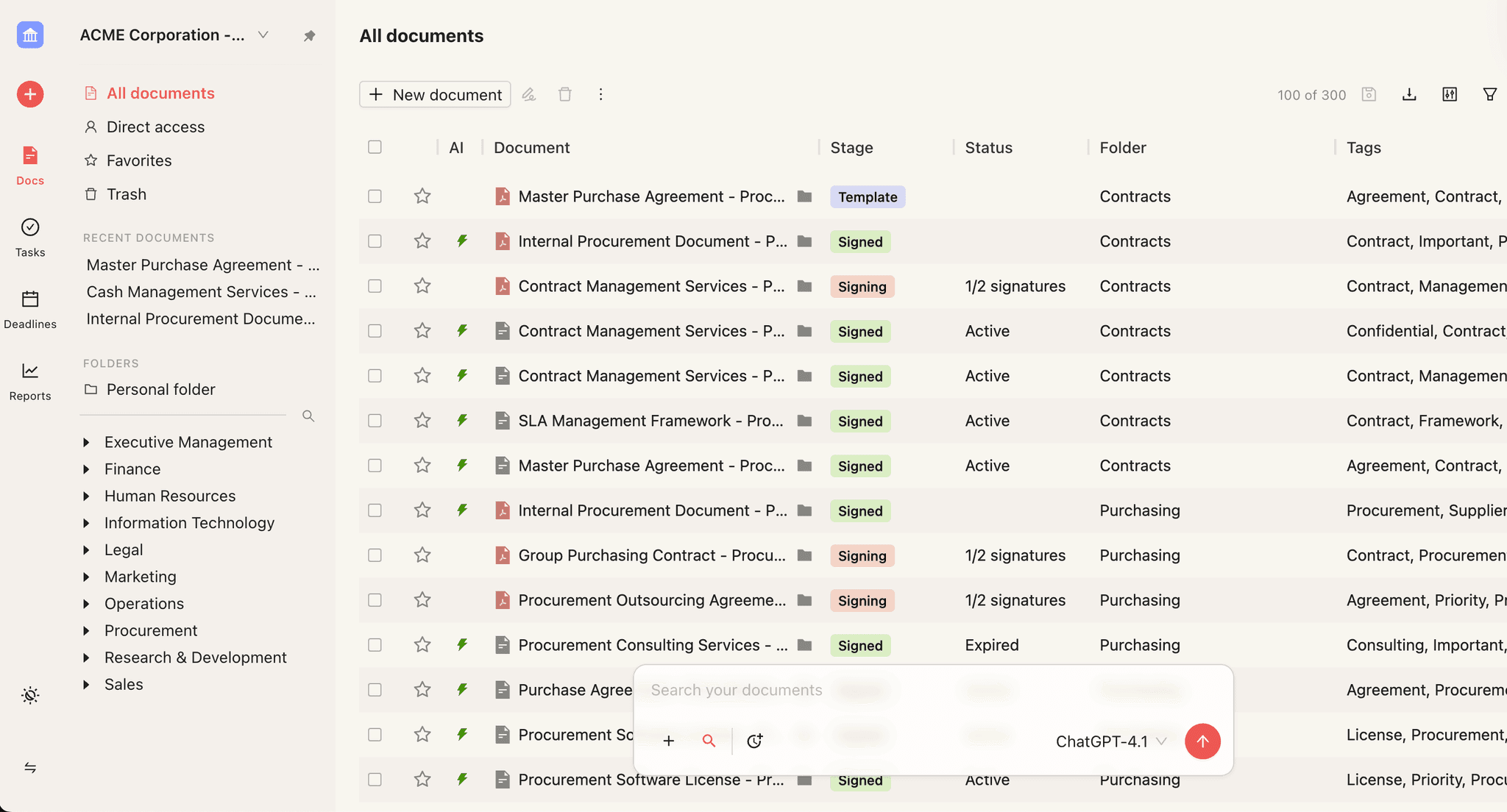
A CLM with real-time agreement lifecycle tracking gives your sales leadership the same visibility into the contract phase that your CRM gives into the selling phase. You can see exactly which stage every contract is in, who is holding it, and what is needed to move it forward.
Six ways email-based contracts kill your deal velocity
The most common contract workflow for sales teams without CLM looks like this:
The rep asks legal to draft a contract.
Legal creates a Word doc or PDF and emails it to the rep.
The rep forwards it to the buyer.
The buyer redlines and sends it back via email.
Legal reviews the redlines in a separate email thread.
Someone sends the final version through a separate e-signature tool.
Each of those handoffs introduces delay, version confusion, and visibility gaps. Legal ops leaders frequently report that a single contract bounces through email multiple times before reaching a final version, with legal, executive leadership, and account teams all touching the document through separate threads.
The fix is not "better email hygiene." It is removing email from the contract workflow entirely.
How CLM fits into the deal cycle
A CLM built for sales teams integrates at every stage of the contract process. Here is how each capability maps to your deal cycle.
Template-driven generation puts reps in control
When a salesperson has to wait for legal to manually draft every contract, the deal stalls. Pre-approved templates with contract clauses management change this equation. Legal approves the template and clause library once. Every subsequent contract generated from that template is already compliant.
The preferred workflow looks like this: the rep pulls deal data from HubSpot or Salesforce, generates a contract from a pre-approved template in seconds, and sends it to the buyer. Legal only re-engages when the buyer requests non-standard terms. Organizations that adopt this self-service model describe legal involvement dropping from "every deal" to "only the complicated ones."
CRM integration is non-negotiable
Teams evaluating CLM tools almost universally ask about CRM integration, and for good reason. The expected workflow is straightforward: deal data flows from your CRM into a contract template, the contract moves through negotiation and signature within the CLM, and status updates sync back to the CRM automatically.
Concord offers native integration with both HubSpot and Salesforce. Your reps never have to re-enter deal data, and your CRM always reflects the current contract status.
Flexible approval workflows match real deal complexity
Not every contract needs the same approval chain. A standard renewal might need one sign-off. A custom enterprise deal might need legal review, finance approval, and executive signature. A CLM that only supports rigid, linear workflows forces simple deals through enterprise-grade approval chains, and that kills adoption fast.
Teams switching from other tools frequently cite inflexible workflows as a core frustration: statuses they cannot change, automated transitions that do not match their actual approval process, and conditional routing that is not supported. Concord supports both linear and conditional approval workflows, so a $5,000 renewal does not get stuck behind the same process as a six-figure custom deal.
Built-in e-signature removes the last-mile bottleneck
When signature requires a separate tool, or worse, a print-sign-scan cycle, it adds another handoff and another place where the deal can stall. Concord's native e-signature capability means the transition from final draft to signed deal is one click, not one more workflow. For teams already committed to DocuSign, Concord integrates with that too.
Organizations that move from email-and-PDF signing to integrated e-signature for sales contracts consistently describe contract execution timelines collapsing from weeks to same-day.
Link-based access keeps buyers moving
Your buyers should never have to create an account, download software, or figure out a login just to review and sign a contract. Concord lets counterparties click a link, view the contract, add redlines, and sign, all without creating an account. Sales teams place high value on this frictionless buyer experience because every extra step is an opportunity for the deal to lose momentum.
Online redlining with Word compatibility means buyers can mark up the document in their browser or in Word, and versions are tracked automatically. No more "which version is the latest?" emails.
Contract visibility as a revenue signal
Here is something most sales organizations overlook: contract engagement data is deal intelligence.
Concord's audit trail shows you who viewed the contract, when they viewed it, whether they shared it with others, and when edits were made. For sales teams, this is the equivalent of email open tracking, but for your most important document. If your buyer shared the contract with their CFO on Tuesday and the CFO viewed it on Wednesday, that tells you something about internal momentum.
Agreement lifecycle tracking turns every contract into a visible, trackable step in your pipeline rather than a black box.
After the signature: stop losing money on renewals
Closing the deal is only half the revenue picture. Account management and sales teams consistently describe missing renewal dates, lacking visibility into when contracts expire, and having no systematic way to surface upcoming deadlines. Every missed renewal is lost revenue. Every auto-renew that slips by without a conversation is a missed upsell opportunity.
Concord's contract deadline management automatically tracks renewals, expirations, and notice periods. Calendar integration syncs these deadlines to Google Calendar, Outlook, or Apple Calendar, so they show up alongside your meeting schedule. Your team stops relying on memory and spreadsheets for revenue retention.
AI that eliminates the post-signature data entry tax
After a contract is signed, someone has to log the key terms back into the CRM or a spreadsheet: effective date, contract value, renewal date, termination clauses. This work is tedious, error-prone, and often skipped entirely, which means your forecasting and renewal data is unreliable.
Concord's AI-powered data extraction automatically pulls parties, financial terms, lifecycle details, and termination notices from uploaded documents. The Copilot feature lets you build reports, search across contracts, and review documents using natural language. Operations leaders who previously spent significant time manually validating contract data across hundreds of agreements can redirect that time toward higher-value work.
Bulk upload with OCR means your existing contract library becomes instantly searchable and extractable from day one.
Getting started without a six-month implementation
Sales teams are motivated by speed. A CLM that takes six months to implement defeats the purpose. Concord's implementation timeline typically runs one to two weeks, which means your team can be generating contracts from templates and closing with built-in e-signature within the same quarter you decide to move forward.
User management with role-based access makes it easy to onboard new reps quickly while controlling who can edit, view, or approve contracts. Your sales ops team scales access without creating risk.
FAQ
Q: Can salespeople generate contracts without involving legal every time?
Yes. With pre-approved templates and a clause library, your reps can generate deal-specific contracts directly from CRM data. Legal pre-approves the template once, and reps self-serve from there. Legal only needs to step in when the buyer requests non-standard terms or significant redlines.
Q: Does Concord integrate with HubSpot and Salesforce?
Yes. Concord offers native CRM integration with both platforms. Deal data flows into contract templates automatically, and contract status syncs back to your CRM so your pipeline always reflects the current state of the paperwork.
Q: What if our buyers are not tech-savvy? Will they struggle with the signing process?
Concord uses link-based access for counterparties. Your buyer clicks a link, views the contract, adds redlines if needed, and signs, all in a browser. No account creation, no software downloads, no learning curve.
Your deal is done. The buyer said yes. The budget is approved. And then the contract sits in someone's inbox for two weeks.
If that sounds familiar, you are not alone. Contract management for sales teams remains one of the most overlooked bottlenecks in the revenue cycle. Between email threads, manual approvals, and disconnected signature tools, sales organizations regularly lose days or weeks on every deal after the handshake. A purpose-built contract lifecycle management (CLM) platform collapses that gap by bringing templates, negotiation, approvals, and e-signature into a single workflow tied directly to your CRM.
This post breaks down the specific friction points that slow deals, how CLM addresses each one, and what to look for in a platform built for sales velocity.
The contract black hole between "yes" and "closed-won"
Sales leaders obsess over pipeline stages. They track every milestone from first call to verbal agreement. But between "verbal yes" and "signed contract," most organizations have zero structured visibility. The contract is floating somewhere in email, and the rep, the manager, and RevOps have no idea whether it is sitting in legal review, awaiting redlines from the buyer, or lost in someone's spam folder.
This gap is not just a process inconvenience. It is a pipeline management problem. Every day a contract sits unsigned, the deal is at risk of going cold, getting re-evaluated, or losing executive sponsorship on the buyer side.
A CLM with real-time agreement lifecycle tracking gives your sales leadership the same visibility into the contract phase that your CRM gives into the selling phase. You can see exactly which stage every contract is in, who is holding it, and what is needed to move it forward.
Six ways email-based contracts kill your deal velocity
The most common contract workflow for sales teams without CLM looks like this:
The rep asks legal to draft a contract.
Legal creates a Word doc or PDF and emails it to the rep.
The rep forwards it to the buyer.
The buyer redlines and sends it back via email.
Legal reviews the redlines in a separate email thread.
Someone sends the final version through a separate e-signature tool.
Each of those handoffs introduces delay, version confusion, and visibility gaps. Legal ops leaders frequently report that a single contract bounces through email multiple times before reaching a final version, with legal, executive leadership, and account teams all touching the document through separate threads.
The fix is not "better email hygiene." It is removing email from the contract workflow entirely.
How CLM fits into the deal cycle
A CLM built for sales teams integrates at every stage of the contract process. Here is how each capability maps to your deal cycle.
Template-driven generation puts reps in control
When a salesperson has to wait for legal to manually draft every contract, the deal stalls. Pre-approved templates with contract clauses management change this equation. Legal approves the template and clause library once. Every subsequent contract generated from that template is already compliant.
The preferred workflow looks like this: the rep pulls deal data from HubSpot or Salesforce, generates a contract from a pre-approved template in seconds, and sends it to the buyer. Legal only re-engages when the buyer requests non-standard terms. Organizations that adopt this self-service model describe legal involvement dropping from "every deal" to "only the complicated ones."
CRM integration is non-negotiable
Teams evaluating CLM tools almost universally ask about CRM integration, and for good reason. The expected workflow is straightforward: deal data flows from your CRM into a contract template, the contract moves through negotiation and signature within the CLM, and status updates sync back to the CRM automatically.
Concord offers native integration with both HubSpot and Salesforce. Your reps never have to re-enter deal data, and your CRM always reflects the current contract status.
Flexible approval workflows match real deal complexity
Not every contract needs the same approval chain. A standard renewal might need one sign-off. A custom enterprise deal might need legal review, finance approval, and executive signature. A CLM that only supports rigid, linear workflows forces simple deals through enterprise-grade approval chains, and that kills adoption fast.
Teams switching from other tools frequently cite inflexible workflows as a core frustration: statuses they cannot change, automated transitions that do not match their actual approval process, and conditional routing that is not supported. Concord supports both linear and conditional approval workflows, so a $5,000 renewal does not get stuck behind the same process as a six-figure custom deal.
Built-in e-signature removes the last-mile bottleneck
When signature requires a separate tool, or worse, a print-sign-scan cycle, it adds another handoff and another place where the deal can stall. Concord's native e-signature capability means the transition from final draft to signed deal is one click, not one more workflow. For teams already committed to DocuSign, Concord integrates with that too.
Organizations that move from email-and-PDF signing to integrated e-signature for sales contracts consistently describe contract execution timelines collapsing from weeks to same-day.
Link-based access keeps buyers moving
Your buyers should never have to create an account, download software, or figure out a login just to review and sign a contract. Concord lets counterparties click a link, view the contract, add redlines, and sign, all without creating an account. Sales teams place high value on this frictionless buyer experience because every extra step is an opportunity for the deal to lose momentum.
Online redlining with Word compatibility means buyers can mark up the document in their browser or in Word, and versions are tracked automatically. No more "which version is the latest?" emails.
Contract visibility as a revenue signal
Here is something most sales organizations overlook: contract engagement data is deal intelligence.
Concord's audit trail shows you who viewed the contract, when they viewed it, whether they shared it with others, and when edits were made. For sales teams, this is the equivalent of email open tracking, but for your most important document. If your buyer shared the contract with their CFO on Tuesday and the CFO viewed it on Wednesday, that tells you something about internal momentum.
Agreement lifecycle tracking turns every contract into a visible, trackable step in your pipeline rather than a black box.
After the signature: stop losing money on renewals
Closing the deal is only half the revenue picture. Account management and sales teams consistently describe missing renewal dates, lacking visibility into when contracts expire, and having no systematic way to surface upcoming deadlines. Every missed renewal is lost revenue. Every auto-renew that slips by without a conversation is a missed upsell opportunity.
Concord's contract deadline management automatically tracks renewals, expirations, and notice periods. Calendar integration syncs these deadlines to Google Calendar, Outlook, or Apple Calendar, so they show up alongside your meeting schedule. Your team stops relying on memory and spreadsheets for revenue retention.
AI that eliminates the post-signature data entry tax
After a contract is signed, someone has to log the key terms back into the CRM or a spreadsheet: effective date, contract value, renewal date, termination clauses. This work is tedious, error-prone, and often skipped entirely, which means your forecasting and renewal data is unreliable.
Concord's AI-powered data extraction automatically pulls parties, financial terms, lifecycle details, and termination notices from uploaded documents. The Copilot feature lets you build reports, search across contracts, and review documents using natural language. Operations leaders who previously spent significant time manually validating contract data across hundreds of agreements can redirect that time toward higher-value work.
Bulk upload with OCR means your existing contract library becomes instantly searchable and extractable from day one.
Getting started without a six-month implementation
Sales teams are motivated by speed. A CLM that takes six months to implement defeats the purpose. Concord's implementation timeline typically runs one to two weeks, which means your team can be generating contracts from templates and closing with built-in e-signature within the same quarter you decide to move forward.
User management with role-based access makes it easy to onboard new reps quickly while controlling who can edit, view, or approve contracts. Your sales ops team scales access without creating risk.
FAQ
Q: Can salespeople generate contracts without involving legal every time?
Yes. With pre-approved templates and a clause library, your reps can generate deal-specific contracts directly from CRM data. Legal pre-approves the template once, and reps self-serve from there. Legal only needs to step in when the buyer requests non-standard terms or significant redlines.
Q: Does Concord integrate with HubSpot and Salesforce?
Yes. Concord offers native CRM integration with both platforms. Deal data flows into contract templates automatically, and contract status syncs back to your CRM so your pipeline always reflects the current state of the paperwork.
Q: What if our buyers are not tech-savvy? Will they struggle with the signing process?
Concord uses link-based access for counterparties. Your buyer clicks a link, views the contract, adds redlines if needed, and signs, all in a browser. No account creation, no software downloads, no learning curve.

Take the "management" out
of contract management.
Customer Support
Legal
Compare
Resources
Customer Support
Company
Legal
Compare
Resources
Customer Support
Company
Legal
Compare
© 2025 Concord. All rights reserved.