Contract management for biotech startups: speed without risk
Contract management for biotech startups: speed without risk
Contract management for biotech startups: speed without risk
Contract management for biotech startups: speed without risk
contract management

Your biotech startup's most valuable assets live inside your contracts. IP assignments, CRO master service agreements, licensing deals with milestone payments and reversion clauses: every document carries outsized consequences for a company your size. Getting biotech contract management right is not optional. It is foundational.
Yet most early and growth-stage biotech companies manage these high-stakes agreements through a patchwork of email threads, shared drives, and spreadsheets. The result is a contracting process that is both painfully slow and dangerously exposed. You do not have to choose between moving fast and managing risk. With the right approach, speed and risk reduction are the same thing.
Why biotech contracts are different
Not all contracts carry equal weight. A SaaS company's vendor agreement is important. A biotech startup's IP assignment agreement can determine whether the company owns its core science. The stakes are categorically different.
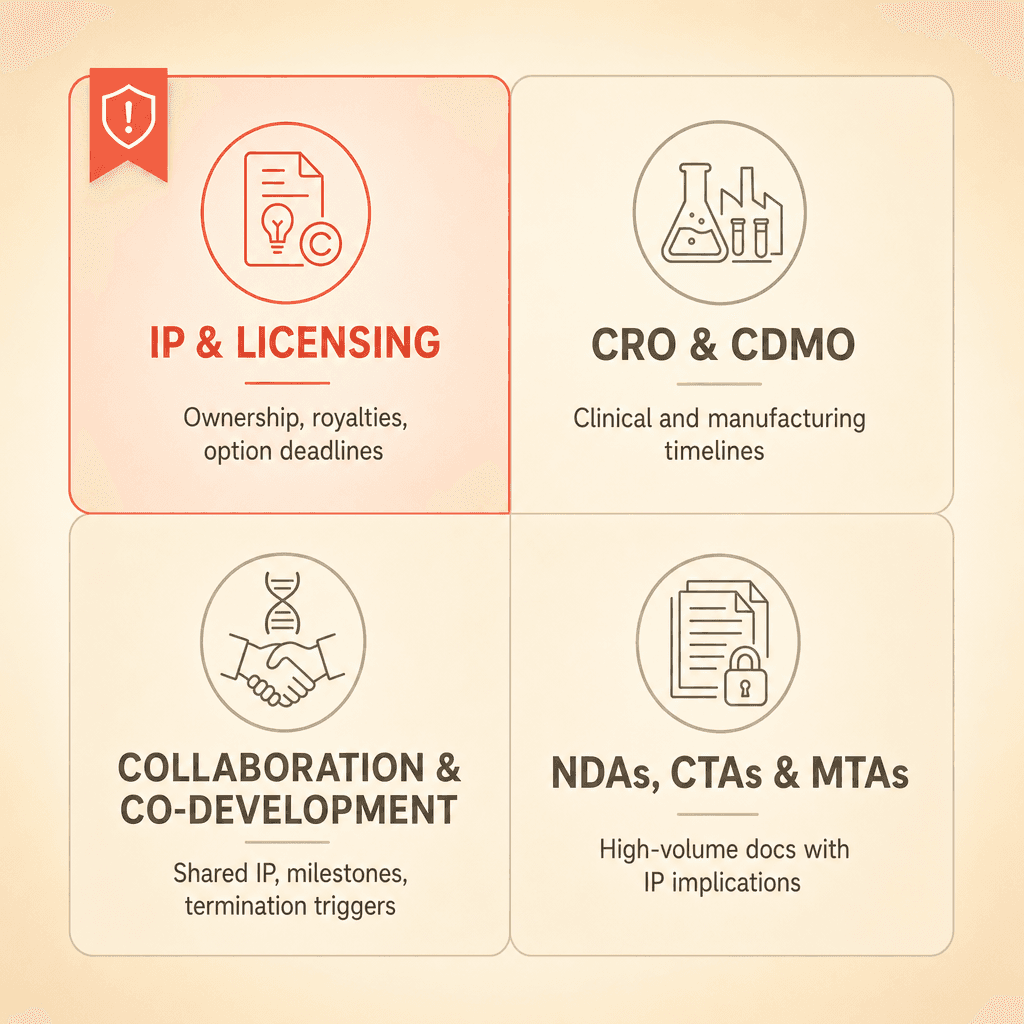
Consider the types of agreements a typical Series A to Series C biotech manages:
IP and licensing agreements. These define ownership of foundational intellectual property, govern royalty structures, and include option exercise windows with hard deadlines. Missing a notice period on a licensing deal can compromise an entire program.
CRO and CDMO contracts. Clinical research organization and contract development and manufacturing organization agreements govern timelines, quality standards, and deliverables for your clinical and manufacturing programs. A missed renewal notice or an untracked amendment can delay a regulatory filing.
Collaboration and co-development agreements. These layer IP rights, milestone payments, and termination triggers into a single document. Version control failures here create ambiguity about who owns what, and when.
NDAs, CTAs, and material transfer agreements. High-volume, seemingly routine documents that still carry IP implications if terms are inconsistent or outdated templates circulate.
The common thread: biotech contracts carry regulatory, financial, and intellectual property exposure simultaneously. Your contracting process must account for all three.
The real cost of fragmented contract management
Operations leaders at growing biotech companies describe themselves as the de facto legal, compliance, and contract owner all at once. With zero to two in-house attorneys, the person managing contracts is often a COO or VP of Operations who also handles vendor management, HR, and board reporting.
In this environment, contracts end up scattered across HubSpot, SharePoint, Google Drive, Notion, and individual laptops. No single source of truth exists. Only one team member can locate a given agreement, creating a single-person bottleneck that slows every downstream process.
The breaking point often arrives during a budgeting cycle, investor due diligence request, or compliance exercise. Someone needs to validate renewal dates, rates, and counterparty names across the entire portfolio, and the only way to do it is to manually open every contract one by one. That moment, when a growing company realizes it must hand-review 90 or more agreements to answer basic questions, is frequently what triggers the search for a CLM.
The false trade-off between speed and risk
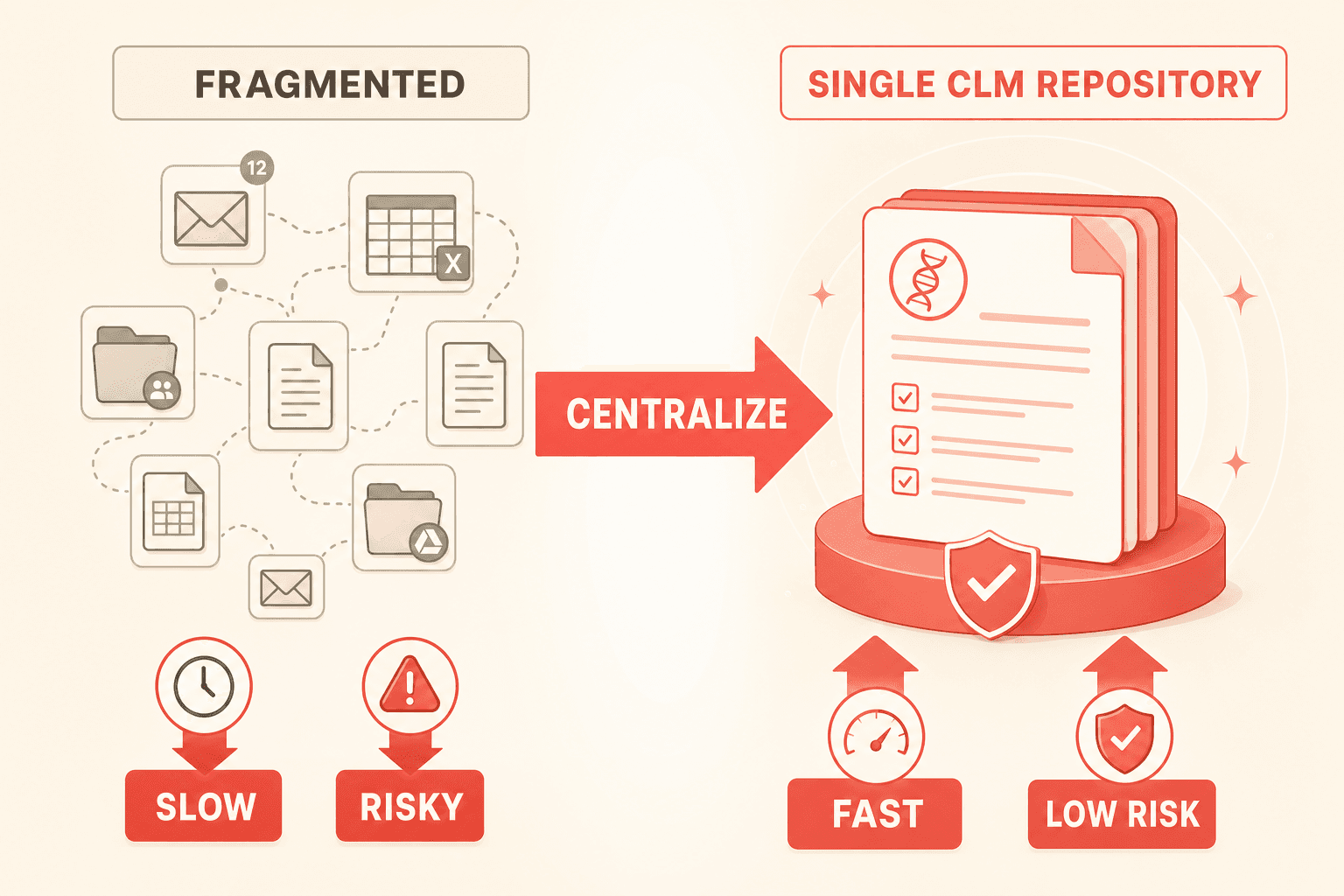
Many biotech leaders frame their contracting challenge as a tension: move fast or be thorough. This framing is wrong.
Fragmented manual processes are the root cause of both slowness and risk. Every step requires manual handoff and searching, which creates delays. Every document lives outside a controlled system, which creates compliance gaps. There is no version control, no audit trail, and no deadline visibility.
Centralizing contracts in a single repository with automated deadline alerts, AI-powered data extraction, and permissioned access eliminates the manual overhead that slows your team down while simultaneously closing the visibility and compliance gaps that create risk. You do not sacrifice thoroughness for speed. You remove the fragmentation that was causing both problems.
What biotech startups actually need from a CLM
Enterprise CLM platforms designed for 500-seat legal departments impose implementation timelines measured in months. They require dedicated administrators, bundle capabilities your 10-person legal function will never touch, and carry price tags that buyers consistently describe as $100,000 or more annually. For a Series B biotech, that is a poor fit on every dimension.
Here is what a biotech startup actually needs, and what separates a right-sized CLM from an enterprise tool that will gather dust:
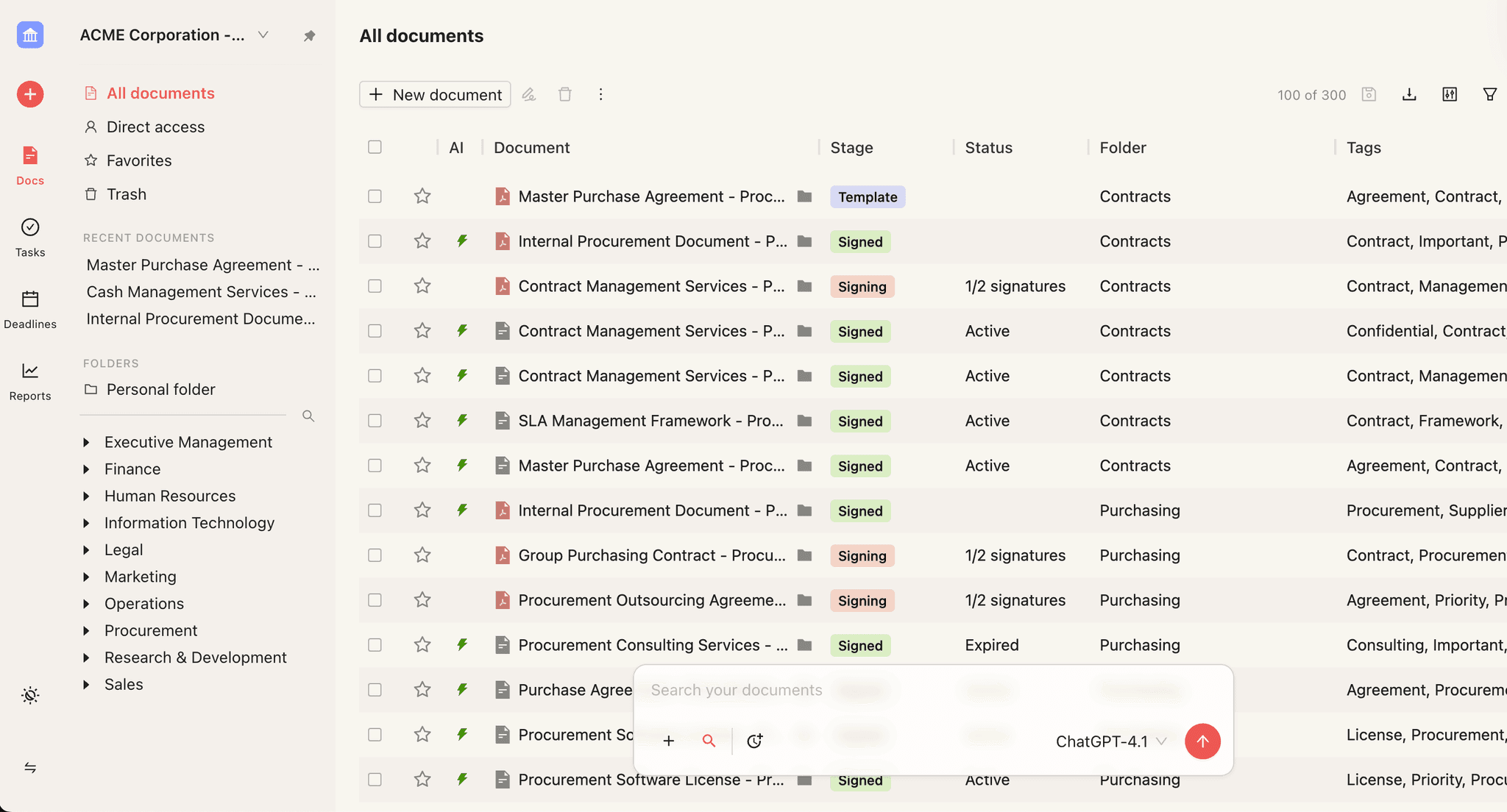
Full lifecycle coverage in a single platform. Your team should not need separate tools for drafting, e-signature, and repository management. A full agreement lifecycle, from creation through negotiation, approval, signature, and ongoing management, should live in one place. Concord's agreement lifecycle management covers this entire arc, including built-in e-signature at no extra per-envelope cost. For a startup sending high volumes of NDAs, clinical trial agreements, and work orders, that cost structure matters.
AI-powered data extraction for legacy contracts. If your company has been operating for several years without a CLM, you are sitting on hundreds of signed PDFs with no structured metadata. AI extraction that automatically pulls parties, dates, renewal terms, financial values, and agreement types from uploaded documents eliminates the need to catalog each legacy contract by hand. Concord's AI data extraction collapses what would be weeks of manual review into a bulk upload process.
Deadline tracking with real visibility. Automated tracking of renewal dates, termination notice windows, and milestone deadlines is non-negotiable for biotech contract management. CRO contracts carry performance milestones. Licensing deals have option exercise windows. You need calendar and list views with filtering, plus alerts that fire before a deadline arrives, not after you have missed it.
Conditional approval workflows. Not every contract requires the same approval path. A standard NDA might need only legal sign-off. A CRO master services agreement might require legal, quality, finance, and executive approval in sequence. A licensing deal above a certain dollar threshold might need board-level review. Your CLM should support templatized approval workflows with conditional routing based on contract type, value, or risk level, rather than forcing every agreement through an identical process.
Contract linking for complex deal structures. Biotech agreements rarely stand alone. A licensing deal may include a master agreement, multiple amendments, side letters, and associated quality agreements. CRO relationships involve master services agreements with dozens of work orders underneath. Document linking and parent-child relationships let you see the full picture of a counterparty relationship at a glance, rather than reconstructing it from scattered folders and email threads.
Template control without complexity. A biotech startup may have a small number of core agreement types, such as independent contractor agreements, service orders, and consulting agreements, but need multiple regional or jurisdictional variants. Templatized creation that avoids rebuilding from scratch each time keeps your team fast without introducing inconsistency.
Version control and audit trails as baseline features. Teams in regulated environments describe legacy processes that lack version history, track changes, or audit trails. This makes it difficult to demonstrate due diligence to regulators, investors, or board members. Your CLM must maintain a complete version history and audit trail for every document, with Microsoft Word compatibility so that lawyers and outside counsel can keep working in their preferred editor while the system maintains the record. Concord's Word plugin handles exactly this.
Permissioned access that protects confidential information. Legal, quality, finance, and executive teams all need access to contracts, but not the same contracts. A permissioned folder structure protects confidential IP and licensing terms from unauthorized internal access. Internal versus external commenting lets your team discuss negotiation strategy without counterparty visibility.
Biotech contract management checklist: right-sized CLM vs. enterprise platform
CapabilityWhat biotech startups needWhat enterprise CLMs typically deliverImplementation timelineTwo weeks or lessThree to six monthsAdmin requirementsSelf-service, no dedicated adminRequires dedicated admin or IT supportE-signatureBuilt-in, unlimited, no per-envelope costSeparate integration, per-envelope pricingAI data extractionAutomatic metadata extraction from uploaded PDFsOften a premium add-onApproval workflowsConditional routing by contract type and valueComplex workflow builders designed for large legal departmentsContract linkingParent-child relationships for deal familiesAvailable but buried in enterprise feature setsPricingDesigned for small-to-midsize teams$100K+ annually for capabilities you will partially useLegacy migrationBulk upload with AI extractionManual migration or expensive professional services
Getting started without the overhead
Implementation speed is a deciding factor for lean teams. Biotech operators frequently describe needing their CLM "many yesterdays ago" and wanting to be fully operational within a single quarter. An average two-week implementation timeline means your team can move from scattered files to a centralized, searchable, auditable contract repository in days, not months.
Concord's reporting and analytics dashboards give COO-level operators a real-time view of the entire contract portfolio without opening individual agreements. Custom reports on contract status, expiration timelines, and key metrics support investor due diligence and board reporting from day one.
Your biotech startup's most valuable assets live inside your contracts. IP assignments, CRO master service agreements, licensing deals with milestone payments and reversion clauses: every document carries outsized consequences for a company your size. Getting biotech contract management right is not optional. It is foundational.
Yet most early and growth-stage biotech companies manage these high-stakes agreements through a patchwork of email threads, shared drives, and spreadsheets. The result is a contracting process that is both painfully slow and dangerously exposed. You do not have to choose between moving fast and managing risk. With the right approach, speed and risk reduction are the same thing.
Why biotech contracts are different
Not all contracts carry equal weight. A SaaS company's vendor agreement is important. A biotech startup's IP assignment agreement can determine whether the company owns its core science. The stakes are categorically different.
Consider the types of agreements a typical Series A to Series C biotech manages:
IP and licensing agreements. These define ownership of foundational intellectual property, govern royalty structures, and include option exercise windows with hard deadlines. Missing a notice period on a licensing deal can compromise an entire program.
CRO and CDMO contracts. Clinical research organization and contract development and manufacturing organization agreements govern timelines, quality standards, and deliverables for your clinical and manufacturing programs. A missed renewal notice or an untracked amendment can delay a regulatory filing.
Collaboration and co-development agreements. These layer IP rights, milestone payments, and termination triggers into a single document. Version control failures here create ambiguity about who owns what, and when.
NDAs, CTAs, and material transfer agreements. High-volume, seemingly routine documents that still carry IP implications if terms are inconsistent or outdated templates circulate.
The common thread: biotech contracts carry regulatory, financial, and intellectual property exposure simultaneously. Your contracting process must account for all three.
The real cost of fragmented contract management
Operations leaders at growing biotech companies describe themselves as the de facto legal, compliance, and contract owner all at once. With zero to two in-house attorneys, the person managing contracts is often a COO or VP of Operations who also handles vendor management, HR, and board reporting.
In this environment, contracts end up scattered across HubSpot, SharePoint, Google Drive, Notion, and individual laptops. No single source of truth exists. Only one team member can locate a given agreement, creating a single-person bottleneck that slows every downstream process.
The breaking point often arrives during a budgeting cycle, investor due diligence request, or compliance exercise. Someone needs to validate renewal dates, rates, and counterparty names across the entire portfolio, and the only way to do it is to manually open every contract one by one. That moment, when a growing company realizes it must hand-review 90 or more agreements to answer basic questions, is frequently what triggers the search for a CLM.
The false trade-off between speed and risk
Many biotech leaders frame their contracting challenge as a tension: move fast or be thorough. This framing is wrong.
Fragmented manual processes are the root cause of both slowness and risk. Every step requires manual handoff and searching, which creates delays. Every document lives outside a controlled system, which creates compliance gaps. There is no version control, no audit trail, and no deadline visibility.
Centralizing contracts in a single repository with automated deadline alerts, AI-powered data extraction, and permissioned access eliminates the manual overhead that slows your team down while simultaneously closing the visibility and compliance gaps that create risk. You do not sacrifice thoroughness for speed. You remove the fragmentation that was causing both problems.
What biotech startups actually need from a CLM
Enterprise CLM platforms designed for 500-seat legal departments impose implementation timelines measured in months. They require dedicated administrators, bundle capabilities your 10-person legal function will never touch, and carry price tags that buyers consistently describe as $100,000 or more annually. For a Series B biotech, that is a poor fit on every dimension.
Here is what a biotech startup actually needs, and what separates a right-sized CLM from an enterprise tool that will gather dust:
Full lifecycle coverage in a single platform. Your team should not need separate tools for drafting, e-signature, and repository management. A full agreement lifecycle, from creation through negotiation, approval, signature, and ongoing management, should live in one place. Concord's agreement lifecycle management covers this entire arc, including built-in e-signature at no extra per-envelope cost. For a startup sending high volumes of NDAs, clinical trial agreements, and work orders, that cost structure matters.
AI-powered data extraction for legacy contracts. If your company has been operating for several years without a CLM, you are sitting on hundreds of signed PDFs with no structured metadata. AI extraction that automatically pulls parties, dates, renewal terms, financial values, and agreement types from uploaded documents eliminates the need to catalog each legacy contract by hand. Concord's AI data extraction collapses what would be weeks of manual review into a bulk upload process.
Deadline tracking with real visibility. Automated tracking of renewal dates, termination notice windows, and milestone deadlines is non-negotiable for biotech contract management. CRO contracts carry performance milestones. Licensing deals have option exercise windows. You need calendar and list views with filtering, plus alerts that fire before a deadline arrives, not after you have missed it.
Conditional approval workflows. Not every contract requires the same approval path. A standard NDA might need only legal sign-off. A CRO master services agreement might require legal, quality, finance, and executive approval in sequence. A licensing deal above a certain dollar threshold might need board-level review. Your CLM should support templatized approval workflows with conditional routing based on contract type, value, or risk level, rather than forcing every agreement through an identical process.
Contract linking for complex deal structures. Biotech agreements rarely stand alone. A licensing deal may include a master agreement, multiple amendments, side letters, and associated quality agreements. CRO relationships involve master services agreements with dozens of work orders underneath. Document linking and parent-child relationships let you see the full picture of a counterparty relationship at a glance, rather than reconstructing it from scattered folders and email threads.
Template control without complexity. A biotech startup may have a small number of core agreement types, such as independent contractor agreements, service orders, and consulting agreements, but need multiple regional or jurisdictional variants. Templatized creation that avoids rebuilding from scratch each time keeps your team fast without introducing inconsistency.
Version control and audit trails as baseline features. Teams in regulated environments describe legacy processes that lack version history, track changes, or audit trails. This makes it difficult to demonstrate due diligence to regulators, investors, or board members. Your CLM must maintain a complete version history and audit trail for every document, with Microsoft Word compatibility so that lawyers and outside counsel can keep working in their preferred editor while the system maintains the record. Concord's Word plugin handles exactly this.
Permissioned access that protects confidential information. Legal, quality, finance, and executive teams all need access to contracts, but not the same contracts. A permissioned folder structure protects confidential IP and licensing terms from unauthorized internal access. Internal versus external commenting lets your team discuss negotiation strategy without counterparty visibility.
Biotech contract management checklist: right-sized CLM vs. enterprise platform
CapabilityWhat biotech startups needWhat enterprise CLMs typically deliverImplementation timelineTwo weeks or lessThree to six monthsAdmin requirementsSelf-service, no dedicated adminRequires dedicated admin or IT supportE-signatureBuilt-in, unlimited, no per-envelope costSeparate integration, per-envelope pricingAI data extractionAutomatic metadata extraction from uploaded PDFsOften a premium add-onApproval workflowsConditional routing by contract type and valueComplex workflow builders designed for large legal departmentsContract linkingParent-child relationships for deal familiesAvailable but buried in enterprise feature setsPricingDesigned for small-to-midsize teams$100K+ annually for capabilities you will partially useLegacy migrationBulk upload with AI extractionManual migration or expensive professional services
Getting started without the overhead
Implementation speed is a deciding factor for lean teams. Biotech operators frequently describe needing their CLM "many yesterdays ago" and wanting to be fully operational within a single quarter. An average two-week implementation timeline means your team can move from scattered files to a centralized, searchable, auditable contract repository in days, not months.
Concord's reporting and analytics dashboards give COO-level operators a real-time view of the entire contract portfolio without opening individual agreements. Custom reports on contract status, expiration timelines, and key metrics support investor due diligence and board reporting from day one.
Need to know
Frequently Asked Questions

Take the "management" out
of contract management.
Customer Support
Legal
Compare
Resources
Customer Support
Company
Legal
Compare
Resources
Customer Support
Company
Legal
Compare
© 2025 Concord. All rights reserved.