Contract compliance checklist: reduce risk across vendor agreements
Contract compliance checklist: reduce risk across vendor agreements
Contract compliance checklist: reduce risk across vendor agreements
Contract compliance checklist: reduce risk across vendor agreements
contract management
Key Takeaways
Compliance is not achieved at signing. Most failures come from the gap between what you sign and what you track afterward.
Organize the work in three phases: onboarding and centralization, active monitoring, and renewal, termination, and audit.
The highest-risk gaps are the ones you cannot see: a vendor missing an NDA, a lapsed certificate of insurance, an auto-renewal nobody reviewed.
Automation matters for consistency, not just speed. Deadline alerts and AI extraction do not degrade with turnover or growth.
Compliance is cross-functional. Procurement, finance, legal, and delivery all need visibility into agreed terms.
Most contract compliance failures don't start with a bad agreement. They start with the gap between what your team signed and what your team tracks afterward. A structured contract compliance checklist, enforced through CLM automation, eliminates the manual tracking that causes missed deadlines, overlooked obligations, and unmonitored renewals across your vendor portfolio.
The checklist below is organized by lifecycle phase: onboarding, active monitoring, and renewal or termination. Each item includes context on why it matters and how automation replaces the manual effort that typically causes compliance to break down.
Phase | Checklist item | How automation helps |
|---|---|---|
Onboarding | 1. Centralize all active vendor agreements in one repository | Bulk upload with OCR and AI extraction brings legacy contracts in |
Onboarding | 2. Link supplemental documents to parent agreements | Document linking ties COIs, amendments, and SOWs to the master |
Onboarding | 3. Tag every agreement with risk level, compliance tier, confidentiality | Custom properties create structured, filterable fields |
Onboarding | 4. Validate extracted metadata for accuracy | Property validation catches bad data at intake |
Active monitoring | 5. Set deadline alerts for every critical date | Calendar and list views, Monday digest, calendar sync |
Active monitoring | 6. Configure lead-time notifications at 90, 60, and 30 days | Configurable lead times give runway before a window closes |
Active monitoring | 7. Audit for missing documentation, not just existing | Custom report builder creates "what is missing" views |
Active monitoring | 8. Make negotiated exceptions visible cross-functionally | Folder permissions, discussion panels, summary sheets |
Renewal & audit | 9. Review auto-renewal clauses 90 or more days before trigger | Deadline event management flags renewals in advance |
Renewal & audit | 10. Run a quarterly compliance report across the portfolio | Custom and pre-built report templates |
Renewal & audit | 11. Verify standard compliance clauses in new agreements | Clause library integrated into document templates |
Renewal & audit | 12. Archive terminated agreements with full audit trail | Lifecycle management keeps a complete record |
Why compliance breaks down after signing
The common misconception is that compliance is achieved at signing. In reality, vendor contract compliance requires ongoing monitoring. Insurance certificates expire, payment deadlines recur, notice windows open and close, and regulatory requirements evolve.
A one-time review at execution leaves months or years of active obligations unmonitored. Your checklist needs to reflect every phase of the contract lifecycle, not just the moment the ink dries.
Teams managing vendor agreements without a centralized system consistently describe contracts scattered across individual email inboxes, personal laptops, and shared drives with no organizing logic. When a key person leaves, entire categories of agreements become inaccessible. Compliance tracking cannot happen when your team does not even know where the contracts are.
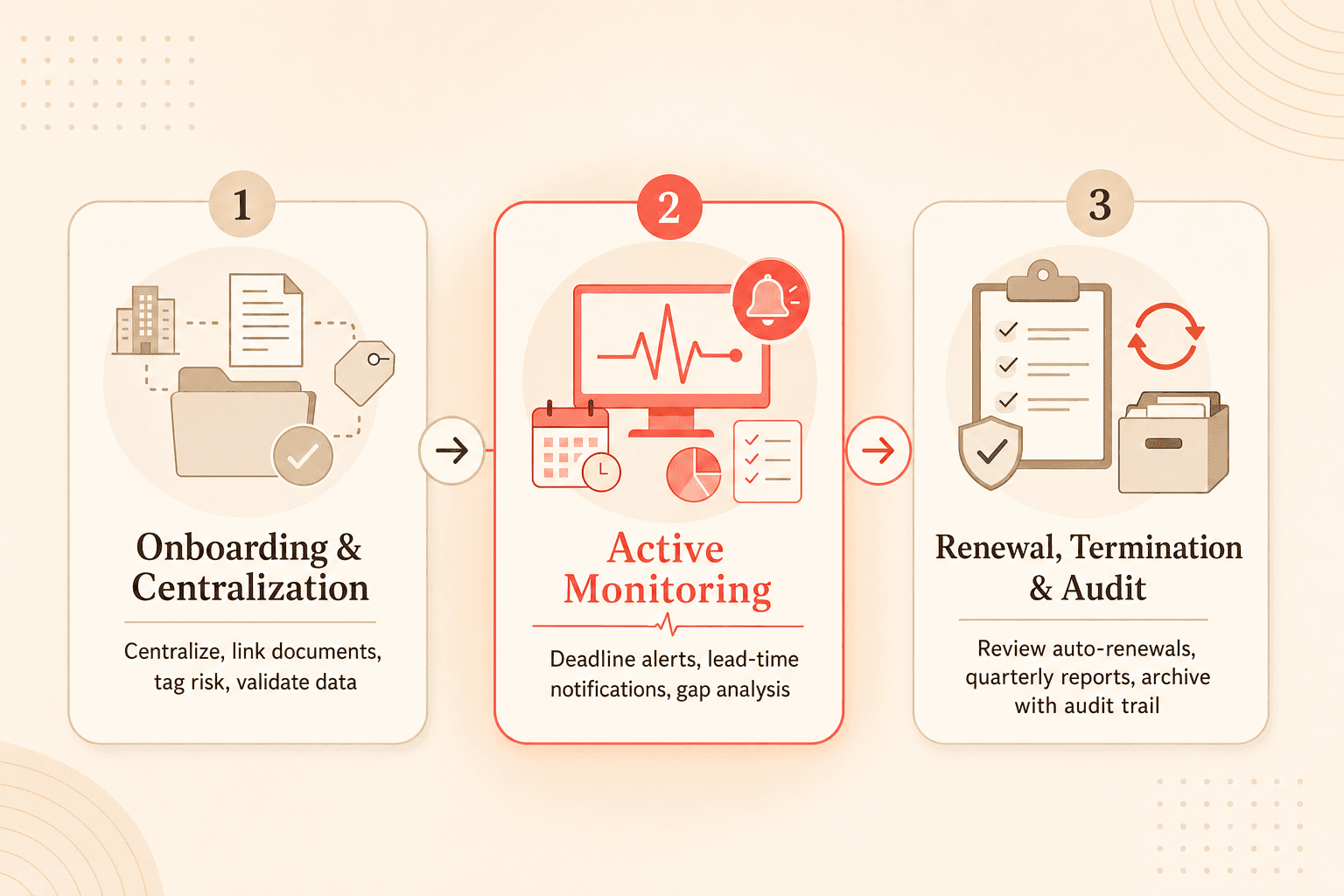
Phase one: onboarding and centralization
Before your team can track compliance, every vendor agreement needs to live in one place with structured, searchable metadata. This phase is about eliminating blind spots.
Checklist item 1: Centralize all active vendor agreements in a single repository. Procurement teams frequently report that historical contracts, sometimes representing years of vendor relationships, have no centralized record. Everything before a certain point is described as "a big black box." Bulk upload with automatic OCR and AI-powered data extraction lets your team bring legacy agreements into a structured system without manually re-entering every field. Learn more about organizing your contract repository.
Checklist item 2: Link supplemental documents to their parent agreements. Certificates of insurance, workers' compensation documents, and compliance certifications all have their own expiration dates and renewal cycles. These documents frequently fall through the cracks because they are not treated as part of the contract lifecycle. Concord's document linking feature creates visible relationships between master agreements, amendments, SOWs, and supplemental documents, so nothing exists as an orphaned file.
Checklist item 3: Tag every agreement with risk level, compliance tier, and confidentiality classification. A repository that stores contracts but cannot categorize them by risk level or required documentation type is a filing cabinet, not a compliance tool. Custom properties in Concord let your team create structured fields for risk classification, background check requirements, compliance tier, and any other attribute specific to your organization. These fields become the foundation for every report and filter you build later.
Checklist item 4: Validate extracted metadata for accuracy. Automated extraction saves significant time, but compliance depends on data integrity. Agreement property validation catches invalid data entries and configuration issues during contract processing, so the dates, dollar values, and custom fields driving your compliance alerts are accurate from the start.
Phase two: active monitoring and obligation tracking
This phase is the automated heartbeat of your compliance program. Without it, your team is relying on memory and manual spreadsheet updates, both of which degrade over time.
Checklist item 5: Set deadline alerts for every critical date. Renewal dates, expiration dates, early termination notice windows, insurance certificate expiry dates: each one represents a compliance obligation that, if missed, creates financial or legal exposure. Concord's contract deadline management feature tracks all of these in calendar view, list view, and through a weekly Monday email digest. Personal calendar sync with Google or Outlook puts deadlines directly in front of the people responsible for acting on them.
Checklist item 6: Configure lead-time notifications for upcoming deadlines. A deadline alert on the day of expiration is too late. Configurable lead times (90 days, 60 days, 30 days) give your team the runway to review, renegotiate, or terminate before a window closes. This is especially critical for auto-renewal clauses, which teams consistently describe as a source of unintended financial commitments.
Checklist item 7: Audit for missing documentation, not just existing documentation. The most dangerous compliance gaps are the ones you do not know about. Your team needs to identify which vendors are missing required documents: a vendor with a master agreement but no NDA, or a contract without a linked certificate of insurance. Concord's custom report builder lets you filter by any metadata field, including custom properties, to build "what's missing" views. Spreadsheets fundamentally cannot support this type of gap analysis at scale.
Checklist item 8: Make negotiated exceptions visible to every team that needs them. Commercial teams negotiate special clauses or exceptions with vendors, but those exceptions rarely reach the teams responsible for delivery or compliance. Folder-based permissions, discussion panels, and centralized summary sheets in Concord make cross-functional visibility structural rather than dependent on email forwarding.
Phase three: renewal, termination, and audit
This is where untracked obligations become real costs. Organizations that lack proactive deadline tracking commonly discover compliance lapses only when something goes wrong: a vendor relationship needs to end and there is no record of the early termination notice window, or an insurance certificate expired months ago and nobody noticed.
Checklist item 9: Review auto-renewal clauses at least 90 days before trigger dates. Auto-renewing vendor agreements create silent financial exposure. Without proactive tracking of renewal dates and termination notice windows, contracts roll over before anyone reviews whether the vendor relationship should continue. Your compliance checklist should flag every auto-renewal clause for review well in advance of its trigger date. Concord's deadline event management automatically monitors approaching deadlines and triggers notifications at configurable intervals.
Checklist item 10: Run a quarterly compliance report across your full vendor portfolio. Custom reports filtered by contract type, risk level, expiration date range, and compliance status give your team a structured view of vendor agreement health. Concord's reporting and analytics capabilities include pre-built templates for expiring contracts and pending signatures, plus the ability to build custom views for any compliance-specific question.
Checklist item 11: Verify that all standard compliance clauses are present in new agreements. A clause library with pre-defined and custom clauses, integrated into document templates, helps your team catch missing compliance language before execution rather than during a retroactive audit. Standardization at the template level prevents the gaps that manual drafting introduces.
Checklist item 12: Archive terminated agreements with full audit trail. Even after a vendor relationship ends, the agreement and its associated documents may carry ongoing obligations: indemnification periods, data deletion requirements, or post-termination non-compete windows. Concord's agreement lifecycle management tracks contract status from draft through execution to renewal or termination, maintaining a complete record at every stage.
Why spreadsheets always fail at compliance tracking
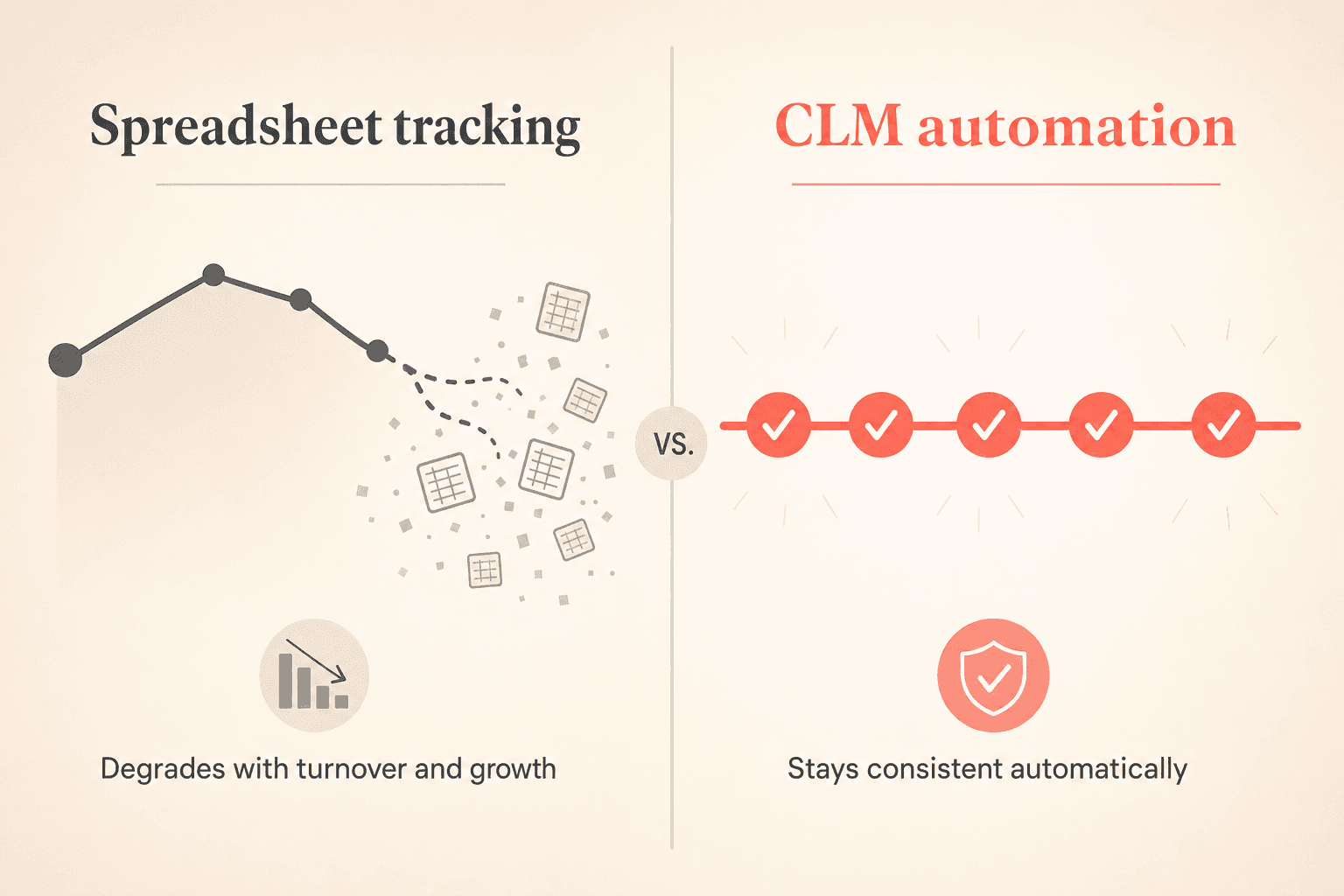
Organizations that have attempted spreadsheet-based compliance tracking describe a consistent lifecycle. The spreadsheet starts strong, gradually becomes unmaintained, and eventually becomes unreliable. The manual effort required to keep it current outpaces the team's capacity, especially as the vendor portfolio grows.
Every new contract, every amendment, every insurance renewal requires someone to update the spreadsheet, and they have to remember to do it. The value of CLM-automated compliance is not just speed. It is consistency. Automated extraction, deadline alerts, and calendar syncing create a compliance tracking layer that does not degrade with employee turnover, workload spikes, or organizational growth.
Cross-functional visibility is a compliance requirement
Compliance is not just a legal function. It requires every team that touches a vendor relationship, procurement, finance, legal, and service delivery, to have visibility into what was agreed. When negotiated terms and obligations are locked inside one team's email threads, the people responsible for fulfilling those obligations are working without critical information.
Concord's permissioned folder structures and discussion panels make this visibility a default rather than something that depends on someone remembering to forward an email. Your compliance checklist should include a quarterly review of who has access to which contract folders and whether the right stakeholders can see the agreements they are responsible for.
Your vendor agreements carry obligations that extend far beyond the signature date. A structured compliance checklist, backed by automation that does not depend on manual upkeep, is how your team stays ahead of deadlines, identifies gaps before they become costly, and keeps every stakeholder informed. Start building your contract compliance checklist in Concord today.
Key Takeaways
Compliance is not achieved at signing. Most failures come from the gap between what you sign and what you track afterward.
Organize the work in three phases: onboarding and centralization, active monitoring, and renewal, termination, and audit.
The highest-risk gaps are the ones you cannot see: a vendor missing an NDA, a lapsed certificate of insurance, an auto-renewal nobody reviewed.
Automation matters for consistency, not just speed. Deadline alerts and AI extraction do not degrade with turnover or growth.
Compliance is cross-functional. Procurement, finance, legal, and delivery all need visibility into agreed terms.
Most contract compliance failures don't start with a bad agreement. They start with the gap between what your team signed and what your team tracks afterward. A structured contract compliance checklist, enforced through CLM automation, eliminates the manual tracking that causes missed deadlines, overlooked obligations, and unmonitored renewals across your vendor portfolio.
The checklist below is organized by lifecycle phase: onboarding, active monitoring, and renewal or termination. Each item includes context on why it matters and how automation replaces the manual effort that typically causes compliance to break down.
Phase | Checklist item | How automation helps |
|---|---|---|
Onboarding | 1. Centralize all active vendor agreements in one repository | Bulk upload with OCR and AI extraction brings legacy contracts in |
Onboarding | 2. Link supplemental documents to parent agreements | Document linking ties COIs, amendments, and SOWs to the master |
Onboarding | 3. Tag every agreement with risk level, compliance tier, confidentiality | Custom properties create structured, filterable fields |
Onboarding | 4. Validate extracted metadata for accuracy | Property validation catches bad data at intake |
Active monitoring | 5. Set deadline alerts for every critical date | Calendar and list views, Monday digest, calendar sync |
Active monitoring | 6. Configure lead-time notifications at 90, 60, and 30 days | Configurable lead times give runway before a window closes |
Active monitoring | 7. Audit for missing documentation, not just existing | Custom report builder creates "what is missing" views |
Active monitoring | 8. Make negotiated exceptions visible cross-functionally | Folder permissions, discussion panels, summary sheets |
Renewal & audit | 9. Review auto-renewal clauses 90 or more days before trigger | Deadline event management flags renewals in advance |
Renewal & audit | 10. Run a quarterly compliance report across the portfolio | Custom and pre-built report templates |
Renewal & audit | 11. Verify standard compliance clauses in new agreements | Clause library integrated into document templates |
Renewal & audit | 12. Archive terminated agreements with full audit trail | Lifecycle management keeps a complete record |
Why compliance breaks down after signing
The common misconception is that compliance is achieved at signing. In reality, vendor contract compliance requires ongoing monitoring. Insurance certificates expire, payment deadlines recur, notice windows open and close, and regulatory requirements evolve.
A one-time review at execution leaves months or years of active obligations unmonitored. Your checklist needs to reflect every phase of the contract lifecycle, not just the moment the ink dries.
Teams managing vendor agreements without a centralized system consistently describe contracts scattered across individual email inboxes, personal laptops, and shared drives with no organizing logic. When a key person leaves, entire categories of agreements become inaccessible. Compliance tracking cannot happen when your team does not even know where the contracts are.
Phase one: onboarding and centralization
Before your team can track compliance, every vendor agreement needs to live in one place with structured, searchable metadata. This phase is about eliminating blind spots.
Checklist item 1: Centralize all active vendor agreements in a single repository. Procurement teams frequently report that historical contracts, sometimes representing years of vendor relationships, have no centralized record. Everything before a certain point is described as "a big black box." Bulk upload with automatic OCR and AI-powered data extraction lets your team bring legacy agreements into a structured system without manually re-entering every field. Learn more about organizing your contract repository.
Checklist item 2: Link supplemental documents to their parent agreements. Certificates of insurance, workers' compensation documents, and compliance certifications all have their own expiration dates and renewal cycles. These documents frequently fall through the cracks because they are not treated as part of the contract lifecycle. Concord's document linking feature creates visible relationships between master agreements, amendments, SOWs, and supplemental documents, so nothing exists as an orphaned file.
Checklist item 3: Tag every agreement with risk level, compliance tier, and confidentiality classification. A repository that stores contracts but cannot categorize them by risk level or required documentation type is a filing cabinet, not a compliance tool. Custom properties in Concord let your team create structured fields for risk classification, background check requirements, compliance tier, and any other attribute specific to your organization. These fields become the foundation for every report and filter you build later.
Checklist item 4: Validate extracted metadata for accuracy. Automated extraction saves significant time, but compliance depends on data integrity. Agreement property validation catches invalid data entries and configuration issues during contract processing, so the dates, dollar values, and custom fields driving your compliance alerts are accurate from the start.
Phase two: active monitoring and obligation tracking
This phase is the automated heartbeat of your compliance program. Without it, your team is relying on memory and manual spreadsheet updates, both of which degrade over time.
Checklist item 5: Set deadline alerts for every critical date. Renewal dates, expiration dates, early termination notice windows, insurance certificate expiry dates: each one represents a compliance obligation that, if missed, creates financial or legal exposure. Concord's contract deadline management feature tracks all of these in calendar view, list view, and through a weekly Monday email digest. Personal calendar sync with Google or Outlook puts deadlines directly in front of the people responsible for acting on them.
Checklist item 6: Configure lead-time notifications for upcoming deadlines. A deadline alert on the day of expiration is too late. Configurable lead times (90 days, 60 days, 30 days) give your team the runway to review, renegotiate, or terminate before a window closes. This is especially critical for auto-renewal clauses, which teams consistently describe as a source of unintended financial commitments.
Checklist item 7: Audit for missing documentation, not just existing documentation. The most dangerous compliance gaps are the ones you do not know about. Your team needs to identify which vendors are missing required documents: a vendor with a master agreement but no NDA, or a contract without a linked certificate of insurance. Concord's custom report builder lets you filter by any metadata field, including custom properties, to build "what's missing" views. Spreadsheets fundamentally cannot support this type of gap analysis at scale.
Checklist item 8: Make negotiated exceptions visible to every team that needs them. Commercial teams negotiate special clauses or exceptions with vendors, but those exceptions rarely reach the teams responsible for delivery or compliance. Folder-based permissions, discussion panels, and centralized summary sheets in Concord make cross-functional visibility structural rather than dependent on email forwarding.
Phase three: renewal, termination, and audit
This is where untracked obligations become real costs. Organizations that lack proactive deadline tracking commonly discover compliance lapses only when something goes wrong: a vendor relationship needs to end and there is no record of the early termination notice window, or an insurance certificate expired months ago and nobody noticed.
Checklist item 9: Review auto-renewal clauses at least 90 days before trigger dates. Auto-renewing vendor agreements create silent financial exposure. Without proactive tracking of renewal dates and termination notice windows, contracts roll over before anyone reviews whether the vendor relationship should continue. Your compliance checklist should flag every auto-renewal clause for review well in advance of its trigger date. Concord's deadline event management automatically monitors approaching deadlines and triggers notifications at configurable intervals.
Checklist item 10: Run a quarterly compliance report across your full vendor portfolio. Custom reports filtered by contract type, risk level, expiration date range, and compliance status give your team a structured view of vendor agreement health. Concord's reporting and analytics capabilities include pre-built templates for expiring contracts and pending signatures, plus the ability to build custom views for any compliance-specific question.
Checklist item 11: Verify that all standard compliance clauses are present in new agreements. A clause library with pre-defined and custom clauses, integrated into document templates, helps your team catch missing compliance language before execution rather than during a retroactive audit. Standardization at the template level prevents the gaps that manual drafting introduces.
Checklist item 12: Archive terminated agreements with full audit trail. Even after a vendor relationship ends, the agreement and its associated documents may carry ongoing obligations: indemnification periods, data deletion requirements, or post-termination non-compete windows. Concord's agreement lifecycle management tracks contract status from draft through execution to renewal or termination, maintaining a complete record at every stage.
Why spreadsheets always fail at compliance tracking
Organizations that have attempted spreadsheet-based compliance tracking describe a consistent lifecycle. The spreadsheet starts strong, gradually becomes unmaintained, and eventually becomes unreliable. The manual effort required to keep it current outpaces the team's capacity, especially as the vendor portfolio grows.
Every new contract, every amendment, every insurance renewal requires someone to update the spreadsheet, and they have to remember to do it. The value of CLM-automated compliance is not just speed. It is consistency. Automated extraction, deadline alerts, and calendar syncing create a compliance tracking layer that does not degrade with employee turnover, workload spikes, or organizational growth.
Cross-functional visibility is a compliance requirement
Compliance is not just a legal function. It requires every team that touches a vendor relationship, procurement, finance, legal, and service delivery, to have visibility into what was agreed. When negotiated terms and obligations are locked inside one team's email threads, the people responsible for fulfilling those obligations are working without critical information.
Concord's permissioned folder structures and discussion panels make this visibility a default rather than something that depends on someone remembering to forward an email. Your compliance checklist should include a quarterly review of who has access to which contract folders and whether the right stakeholders can see the agreements they are responsible for.
Your vendor agreements carry obligations that extend far beyond the signature date. A structured compliance checklist, backed by automation that does not depend on manual upkeep, is how your team stays ahead of deadlines, identifies gaps before they become costly, and keeps every stakeholder informed. Start building your contract compliance checklist in Concord today.
Need to know
Frequently Asked Questions

Take the "management" out
of contract management.
Customer Support
Legal
Compare
Resources
Customer Support
Company
Legal
Compare
Resources
Customer Support
Company
Legal
Compare
© 2025 Concord. All rights reserved.