Concord's MCP Server Changes Where and How You Work With Contracts
Concord's MCP Server Changes Where and How You Work With Contracts
Concord's MCP Server Changes Where and How You Work With Contracts
Concord's MCP Server Changes Where and How You Work With Contracts
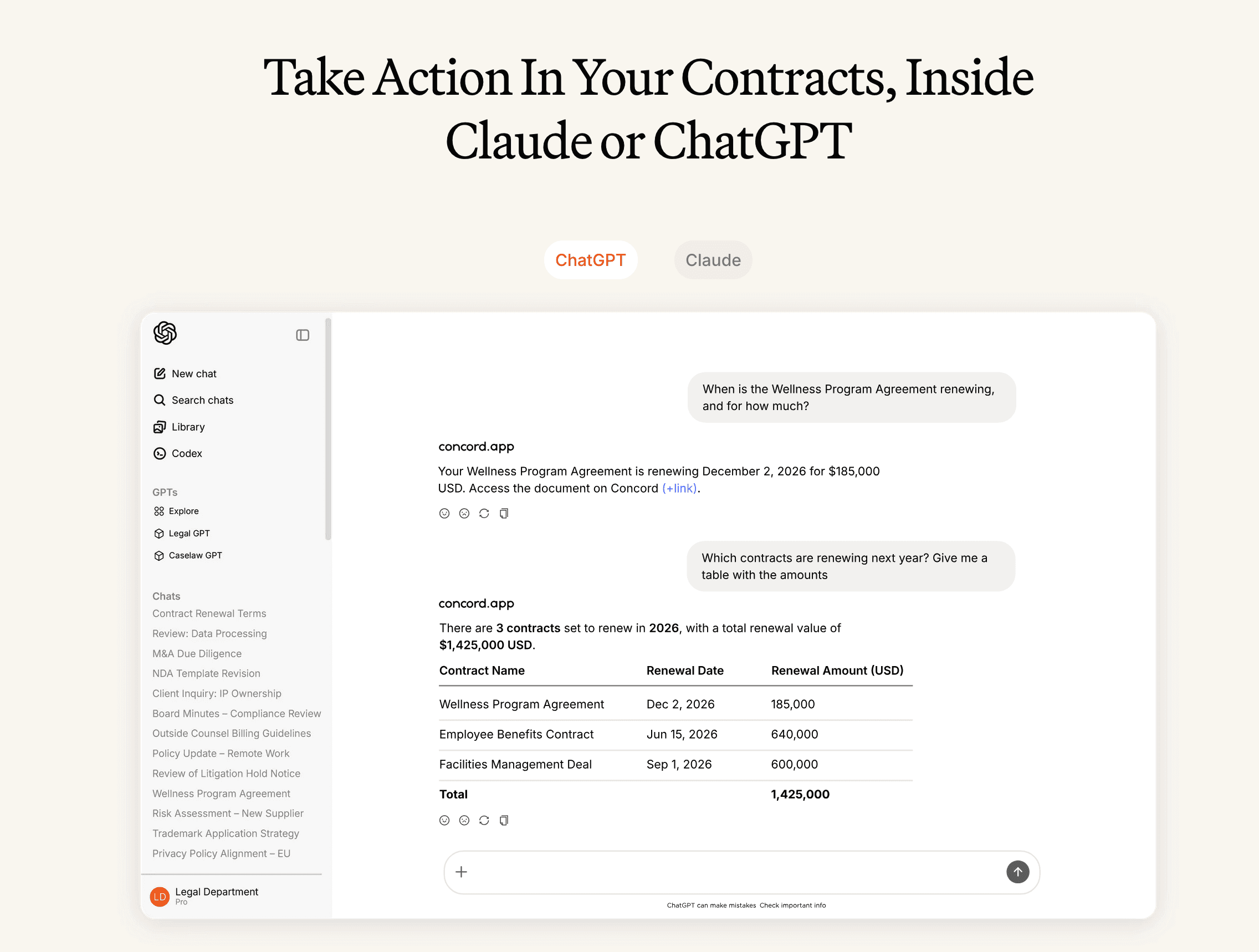
In most contract management systems, you'll hit an invisible boundary:
Your contracts live inside the CLM.
Your thinking happens somewhere else.
You analyze risk in documents.
You prepare for negotiations in chat tools.
You brief leadership in AI assistants.
And every time, contract data gets copied, summarized, or reinterpreted by hand.
Horizon’s MCP server removes that boundary.
Instead of forcing you to come back into the CLM interface to access contract intelligence, Horizon lets you bring that intelligence into the AI tools you already use. Securely. In context. And without flattening your contracts into static exports .
The problem MCP actually solves
Traditional CLM systems assume that insight should live where the contracts live. If you want answers, you log in. If you want analysis, you export. If you want to use AI, you paste snippets and hope nothing important is lost.
That approach breaks down quickly.
It doesn't let you:
Ask an external AI assistant questions about your real contracts
Combine contract context with broader business reasoning
Explore “what if” scenarios grounded in live agreement data
Trust that copied text reflects the full picture
Horizon’s MCP server exists to change that. It makes your contract intelligence accessible beyond Horizon, without giving up control or accuracy.
What the MCP server enables you to do
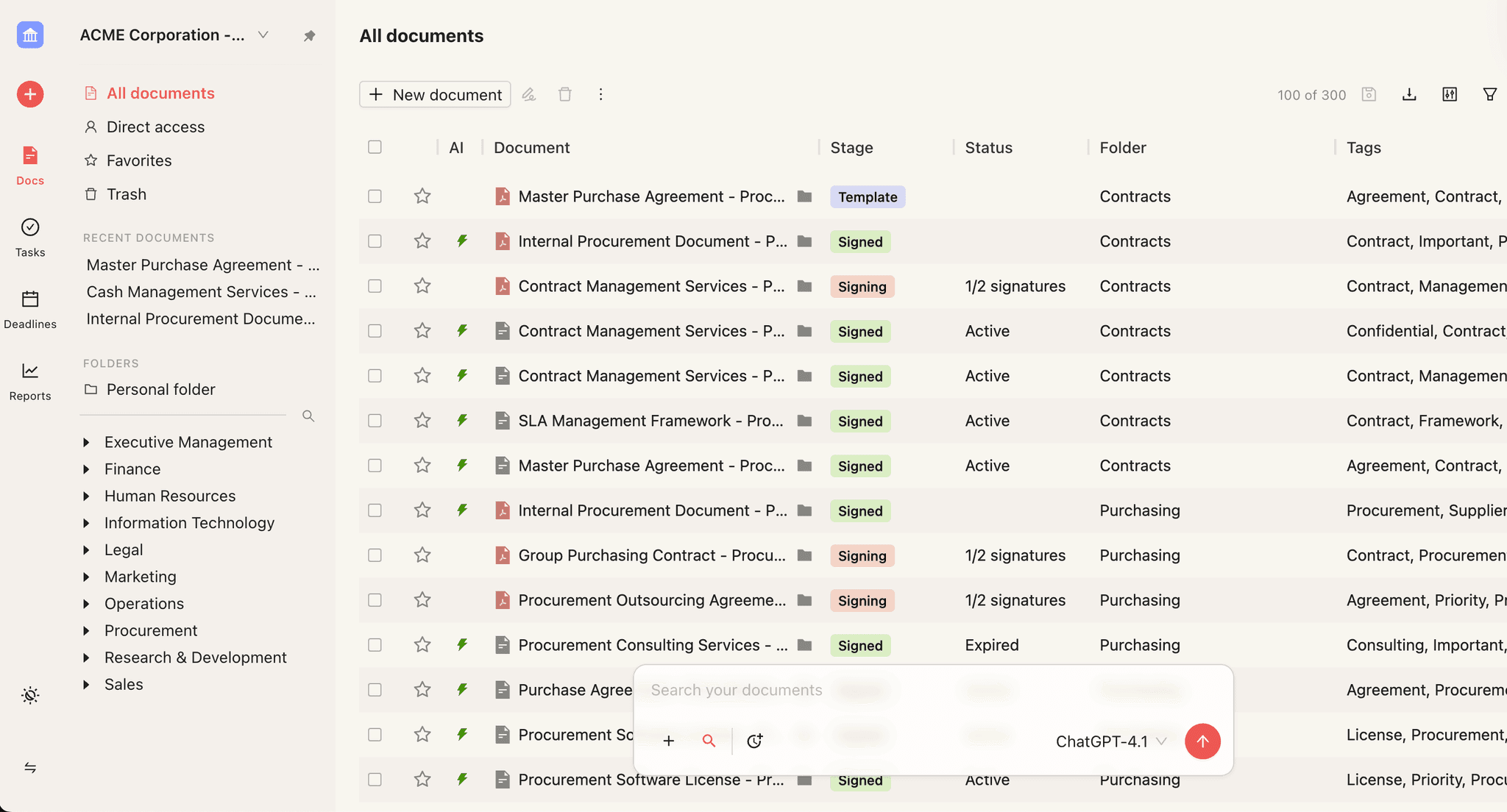
At a practical level, the MCP server lets external AI tools query your Horizon contract data in real time. That means tools like ChatGPT or Claude can reason about your agreements as they actually exist, not as static summaries you pasted in earlier.
What matters is what you can now do.
You can ask better questions in the tools you already trust
Instead of switching contexts, you can stay in the AI environment where you think best and ask questions like:
What renewal risks should I be aware of before this negotiation
Summarize the key obligations across our strategic vendor contracts
How does this customer’s agreement compare to our standard terms
Which contracts would be impacted if we change this policy
These are not generic answers. They are grounded in your real contract portfolio, interpreted through Horizon’s understanding layer.
You can prepare faster for high stakes work
When you are getting ready for a negotiation, board meeting, or audit, speed matters.
With MCP, you can:
Pull live contract context into negotiation prep
Ask follow up questions without re exporting data
Explore edge cases on the fly
Test assumptions before you commit to a position
Instead of assembling context manually, you interrogate it conversationally.
Why this is different from integrations or exports
Many platforms claim to integrate with AI tools. In reality, most of those integrations move static data from one place to another.
The MCP server is different because it supports live, contextual access.
That means:
You are not working with outdated snapshots
You are not limited to predefined summaries
You are not guessing which clauses matter
You are not losing nuance in copy paste workflows
Understanding how contract data moves between systems starts with getting the fundamentals right around AI contract data extraction.
The AI assistant can ask Horizon follow up questions, retrieve additional context, and refine its understanding as the conversation evolves.
This is what makes the experience feel fundamentally different from traditional exports.
Using MCP across real workflows
The value of the MCP server shows up in the moments where CLM systems usually fall short.
During contract review and analysis
You can use an external AI assistant to:
Compare similar clauses across multiple agreements
Identify inconsistencies that warrant escalation
Explain why a particular contract stands out
Surface risks that depend on portfolio wide context
All without leaving the conversation.
During planning and strategy
You can combine contract data with broader business questions, such as:
How much exposure do we have if this vendor relationship changes
Which contracts limit our ability to pivot strategy
Where do contractual obligations cluster across teams or regions
This kind of reasoning is difficult when contract data is locked inside a single interface.
During communication with stakeholders
You can draft clearer explanations, summaries, and recommendations because the AI assistant has access to the underlying facts.
That means fewer caveats.
Fewer assumptions.
Less rework when someone asks “are you sure.”
Security and control still apply
One concern that often comes up is control. The MCP server does not mean your data is suddenly open or uncontrolled.
Access is governed by Horizon’s existing security model. The AI tools do not train on your data. They retrieve only what they are authorized to retrieve, in the moment it is needed .
From a user perspective, this matters because you can take advantage of powerful AI workflows without compromising governance.
How this changes the role of the CLM system
With MCP, Horizon stops being the place you go to look things up and starts becoming the source of truth that powers work everywhere else.
That is a meaningful shift.
Instead of asking “how do I get this out of the CLM,” you start asking “how do I want to think about this problem.”
The system adapts to that choice.
What you could not do before
Before MCP, there were hard limits to how contract data could be used.
You could not:
Let an AI assistant reason over your full contract portfolio
Maintain conversational context across multiple questions
Combine contract intelligence with non contract data
Move fluidly between exploration, analysis, and explanation
Those limits were not about technology. They were about architecture.
The MCP server removes those constraints by treating contract intelligence as something that can travel, not something that has to stay put.
A step toward AI native workflows
It is worth noting that the MCP server is not just a convenience feature. It is a signal of where Horizon is going.
As more work shifts into AI assisted environments, systems that cannot participate in those conversations will become bottlenecks.
By exposing contract intelligence through MCP, Horizon positions your contracts as active participants in AI native workflows, not static records that have to be summarized secondhand.
What this means for you day to day
Over time, the impact becomes subtle but significant.
You spend less time assembling context.
You ask more nuanced questions.
You trust answers more quickly.
You move faster from insight to decision.
And you stop treating contract management as a separate activity that lives in its own silo.
Bringing contract intelligence to where thinking happens
Horizon’s MCP server does not change what your contracts say. It changes where and how you can reason about them.
By letting you bring live contract intelligence into the AI tools you already use, it removes friction that has existed for years between storage and understanding.
You no longer have to choose between powerful AI tools and accurate contract data.
With MCP, you finally get both.
In most contract management systems, you'll hit an invisible boundary:
Your contracts live inside the CLM.
Your thinking happens somewhere else.
You analyze risk in documents.
You prepare for negotiations in chat tools.
You brief leadership in AI assistants.
And every time, contract data gets copied, summarized, or reinterpreted by hand.
Horizon’s MCP server removes that boundary.
Instead of forcing you to come back into the CLM interface to access contract intelligence, Horizon lets you bring that intelligence into the AI tools you already use. Securely. In context. And without flattening your contracts into static exports .
The problem MCP actually solves
Traditional CLM systems assume that insight should live where the contracts live. If you want answers, you log in. If you want analysis, you export. If you want to use AI, you paste snippets and hope nothing important is lost.
That approach breaks down quickly.
It doesn't let you:
Ask an external AI assistant questions about your real contracts
Combine contract context with broader business reasoning
Explore “what if” scenarios grounded in live agreement data
Trust that copied text reflects the full picture
Horizon’s MCP server exists to change that. It makes your contract intelligence accessible beyond Horizon, without giving up control or accuracy.
What the MCP server enables you to do
At a practical level, the MCP server lets external AI tools query your Horizon contract data in real time. That means tools like ChatGPT or Claude can reason about your agreements as they actually exist, not as static summaries you pasted in earlier.
What matters is what you can now do.
You can ask better questions in the tools you already trust
Instead of switching contexts, you can stay in the AI environment where you think best and ask questions like:
What renewal risks should I be aware of before this negotiation
Summarize the key obligations across our strategic vendor contracts
How does this customer’s agreement compare to our standard terms
Which contracts would be impacted if we change this policy
These are not generic answers. They are grounded in your real contract portfolio, interpreted through Horizon’s understanding layer.
You can prepare faster for high stakes work
When you are getting ready for a negotiation, board meeting, or audit, speed matters.
With MCP, you can:
Pull live contract context into negotiation prep
Ask follow up questions without re exporting data
Explore edge cases on the fly
Test assumptions before you commit to a position
Instead of assembling context manually, you interrogate it conversationally.
Why this is different from integrations or exports
Many platforms claim to integrate with AI tools. In reality, most of those integrations move static data from one place to another.
The MCP server is different because it supports live, contextual access.
That means:
You are not working with outdated snapshots
You are not limited to predefined summaries
You are not guessing which clauses matter
You are not losing nuance in copy paste workflows
Understanding how contract data moves between systems starts with getting the fundamentals right around AI contract data extraction.
The AI assistant can ask Horizon follow up questions, retrieve additional context, and refine its understanding as the conversation evolves.
This is what makes the experience feel fundamentally different from traditional exports.
Using MCP across real workflows
The value of the MCP server shows up in the moments where CLM systems usually fall short.
During contract review and analysis
You can use an external AI assistant to:
Compare similar clauses across multiple agreements
Identify inconsistencies that warrant escalation
Explain why a particular contract stands out
Surface risks that depend on portfolio wide context
All without leaving the conversation.
During planning and strategy
You can combine contract data with broader business questions, such as:
How much exposure do we have if this vendor relationship changes
Which contracts limit our ability to pivot strategy
Where do contractual obligations cluster across teams or regions
This kind of reasoning is difficult when contract data is locked inside a single interface.
During communication with stakeholders
You can draft clearer explanations, summaries, and recommendations because the AI assistant has access to the underlying facts.
That means fewer caveats.
Fewer assumptions.
Less rework when someone asks “are you sure.”
Security and control still apply
One concern that often comes up is control. The MCP server does not mean your data is suddenly open or uncontrolled.
Access is governed by Horizon’s existing security model. The AI tools do not train on your data. They retrieve only what they are authorized to retrieve, in the moment it is needed .
From a user perspective, this matters because you can take advantage of powerful AI workflows without compromising governance.
How this changes the role of the CLM system
With MCP, Horizon stops being the place you go to look things up and starts becoming the source of truth that powers work everywhere else.
That is a meaningful shift.
Instead of asking “how do I get this out of the CLM,” you start asking “how do I want to think about this problem.”
The system adapts to that choice.
What you could not do before
Before MCP, there were hard limits to how contract data could be used.
You could not:
Let an AI assistant reason over your full contract portfolio
Maintain conversational context across multiple questions
Combine contract intelligence with non contract data
Move fluidly between exploration, analysis, and explanation
Those limits were not about technology. They were about architecture.
The MCP server removes those constraints by treating contract intelligence as something that can travel, not something that has to stay put.
A step toward AI native workflows
It is worth noting that the MCP server is not just a convenience feature. It is a signal of where Horizon is going.
As more work shifts into AI assisted environments, systems that cannot participate in those conversations will become bottlenecks.
By exposing contract intelligence through MCP, Horizon positions your contracts as active participants in AI native workflows, not static records that have to be summarized secondhand.
What this means for you day to day
Over time, the impact becomes subtle but significant.
You spend less time assembling context.
You ask more nuanced questions.
You trust answers more quickly.
You move faster from insight to decision.
And you stop treating contract management as a separate activity that lives in its own silo.
Bringing contract intelligence to where thinking happens
Horizon’s MCP server does not change what your contracts say. It changes where and how you can reason about them.
By letting you bring live contract intelligence into the AI tools you already use, it removes friction that has existed for years between storage and understanding.
You no longer have to choose between powerful AI tools and accurate contract data.
With MCP, you finally get both.

Take the "management" out
of contract management.
Customer Support
Legal
Compare
Resources
Customer Support
Company
Legal
Compare
Resources
Customer Support
Company
Legal
Compare
© 2025 Concord. All rights reserved.