Horizon's AI Reporting Upgrades Your Trust in Your Contract Data
Horizon's AI Reporting Upgrades Your Trust in Your Contract Data
Horizon's AI Reporting Upgrades Your Trust in Your Contract Data
Horizon's AI Reporting Upgrades Your Trust in Your Contract Data
If you've ever built a contract report for leadership, you know the uncomfortable moment that follows:
Someone asks a simple question.
How many contracts renew this quarter.
How much revenue is tied to auto renewals.
Which agreements include a specific obligation.
And then comes the real concern.
Are we confident this is complete.
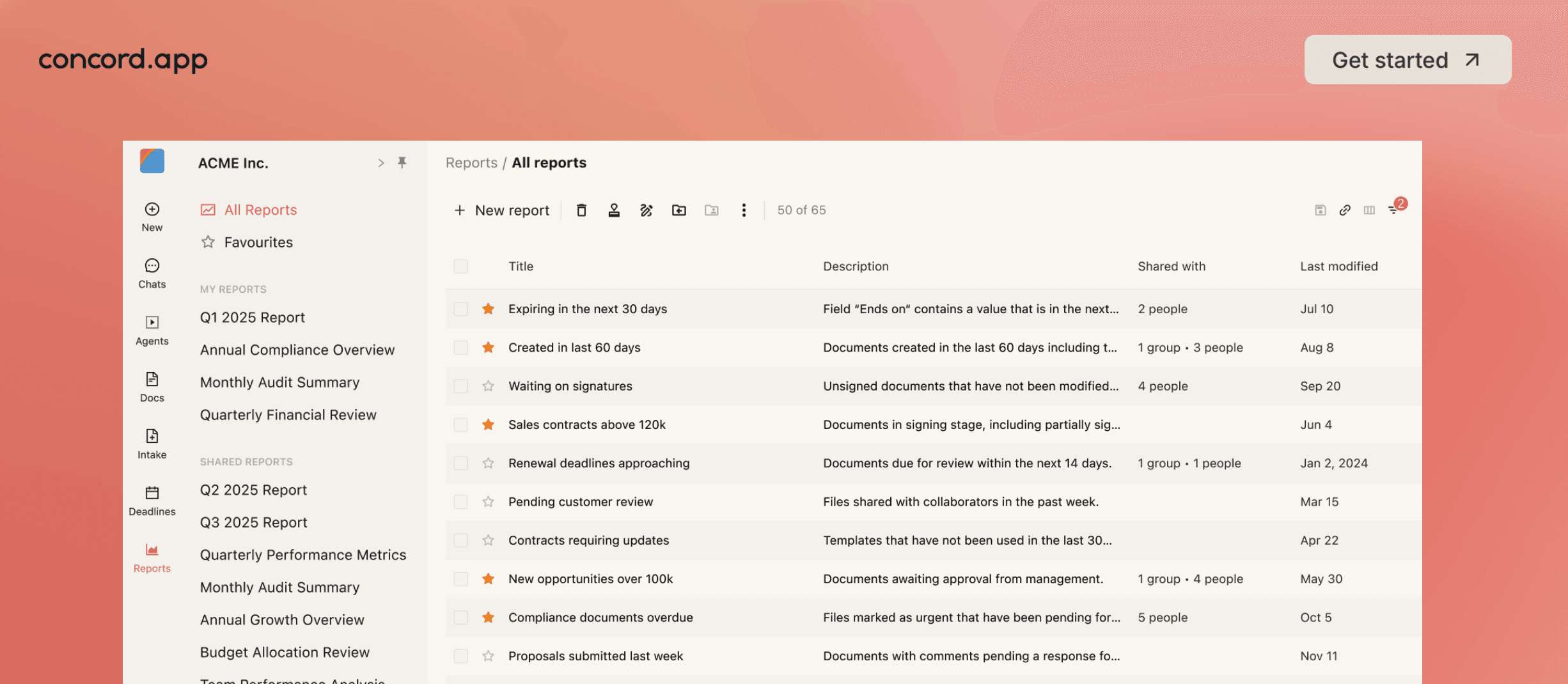
Traditional contract reporting makes you choose between speed and trust. You either move fast with rough numbers, or you slow down to manually validate everything. AI Reporting in Concord Horizon was designed to remove that tradeoff by making reporting deterministic, structured, and reliable at scale .
The limits of search when precision matters
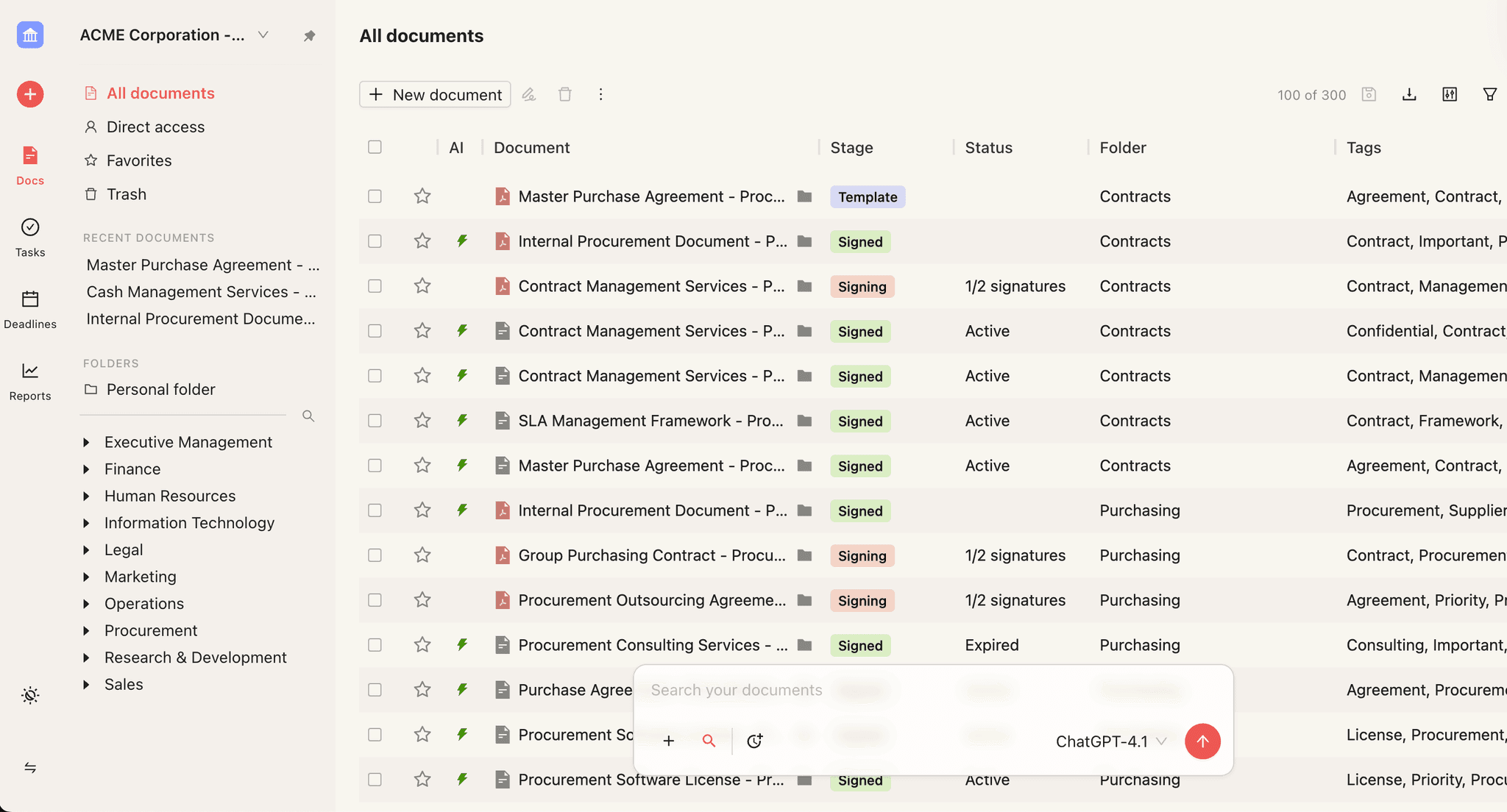
AI Search is powerful when you're exploring your contract portfolio. It helps you investigate patterns, surface examples, and get oriented quickly.
But search, by definition, is not exhaustive.
If you are answering questions like:
How many contracts meet this criteria
What is the total value at risk
Which agreements must be acted on
What needs to be reported for compliance
You need certainty, not suggestions.
AI Reporting exists for exactly those moments. It is built for completeness, repeatability, and confidence, not exploration.
What AI Reporting is designed to do
AI Reporting in Horizon operates on structured data. That includes standard fields, custom properties, and AI extracted data points that have been normalized across your contracts.
Because of that foundation, AI Reporting can give you answers you can rely on, even when the stakes are high.
With AI Reporting, you can:
Generate complete lists of matching contracts
Produce accurate counts and totals
Re run the same report over time and get consistent results
Share outputs with confidence that nothing was missed
This is the difference between asking “what might be happening” and answering “what is happening.”
How you actually use AI Reporting
AI Reporting is not a static dashboard that someone set up months ago. It is a flexible reporting layer that reflects how your data is structured today.
In practice, that means you can build reports around questions like:
All customer contracts signed after a certain date
Every NDA with a specific counterparty
Vendor agreements over a defined value threshold
Contracts with a particular renewal or notice structure
Agreements owned by a specific team or region
Once defined, those reports are deterministic. If a contract matches the criteria, it is included. If it does not, it is excluded. There is no ranking. No relevance scoring. No guesswork .
Why this matters for legal ops
Legal operations teams often become the source of truth by default. That means they are expected to answer questions accurately, quickly, and repeatedly.
AI Reporting changes the nature of that work.
Instead of:
Rebuilding the same reports
Manually checking results
Explaining caveats every time numbers are shared
Acting as a bottleneck for basic insight
You can rely on saved reports that stakeholders trust.
When someone asks for an update, you are not starting from scratch. You are running a report that has already been defined, validated, and agreed upon.
How AI Reporting and AI Search work together
One common mistake is treating AI Search and AI Reporting as competing features. They are designed for different stages of thinking.
You might start with AI Search when:
You are not sure how an issue shows up in contracts
You want to see examples
You are exploring edge cases or anomalies
Once you understand what matters, you switch to AI Reporting to:
Capture the criteria precisely
Quantify impact
Track changes over time
Support decisions that require confidence
This workflow mirrors how people actually work. You explore first, then you measure.
Deterministic outputs build trust
One of the quiet benefits of AI Reporting is how it changes conversations.
When reports are deterministic, you spend less time debating the data and more time discussing what to do about it.
Instead of hearing:
“Is this everything”
“What if something was missed”
“Can we double check that”
“How did you get this number”
You get alignment around next steps.
That trust is hard to earn with search based tools alone. AI Reporting provides it by design.
Custom properties make reports reflect your reality
No two organizations think about contracts the same way. That is why AI Reporting supports custom properties alongside standard fields.
You can report on:
Internal classifications
Risk tiers
Business units
Contract purpose
Any data point that matters to how you operate
Once those properties are defined and populated, they become first class inputs to reporting. You are not forced into someone else’s model of what a contract is supposed to be.
Reporting that fits into real workflows
AI Reporting is not just about generating tables. It is about making contract data usable across the business.
Reports can be:
Saved and reused
Exported for finance or leadership
Shared with stakeholders
Used as inputs to downstream workflows
Instead of treating reporting as a one off task, it becomes a stable layer of operational insight.
Where AI Reporting fits in an AI first platform
It is worth emphasizing that AI Reporting works because Horizon is an AI first platform, not a traditional CLM system with AI added later.
The same intelligence that powers extraction and understanding feeds reporting. That means:
Data is consistently structured
Fields behave predictably
Reports scale as your contract volume grows
That structured foundation depends on accurate data capture — learn how AI contract data extraction works to normalize information across your entire contract portfolio.
You are not stitching together multiple systems or reconciling conflicting views of the data.
What changes when reporting is reliable
When AI Reporting is in place, teams stop avoiding questions that sound hard.
They stop saying “we’ll need to look into that.”
They stop hedging answers with disclaimers.
They stop rebuilding the same analysis every quarter.
Instead, reporting becomes part of how decisions are made, not an obstacle to making them.
A clearer line between exploration and accountability
AI Reporting in Horizon does not try to be everything. It is not fuzzy. It is not conversational. It is not exploratory.
It is precise.
That clarity is its strength. By separating exploration from reporting, Horizon gives you the right tool at the right moment.
Search helps you discover.
Reporting helps you decide.
When both are available and clearly defined, contract data becomes something you can actually rely on, not just something you store.
And for teams that live with contracts every day, that difference matters more than any interface ever could.
If you've ever built a contract report for leadership, you know the uncomfortable moment that follows:
Someone asks a simple question.
How many contracts renew this quarter.
How much revenue is tied to auto renewals.
Which agreements include a specific obligation.
And then comes the real concern.
Are we confident this is complete.
Traditional contract reporting makes you choose between speed and trust. You either move fast with rough numbers, or you slow down to manually validate everything. AI Reporting in Concord Horizon was designed to remove that tradeoff by making reporting deterministic, structured, and reliable at scale .
The limits of search when precision matters
AI Search is powerful when you're exploring your contract portfolio. It helps you investigate patterns, surface examples, and get oriented quickly.
But search, by definition, is not exhaustive.
If you are answering questions like:
How many contracts meet this criteria
What is the total value at risk
Which agreements must be acted on
What needs to be reported for compliance
You need certainty, not suggestions.
AI Reporting exists for exactly those moments. It is built for completeness, repeatability, and confidence, not exploration.
What AI Reporting is designed to do
AI Reporting in Horizon operates on structured data. That includes standard fields, custom properties, and AI extracted data points that have been normalized across your contracts.
Because of that foundation, AI Reporting can give you answers you can rely on, even when the stakes are high.
With AI Reporting, you can:
Generate complete lists of matching contracts
Produce accurate counts and totals
Re run the same report over time and get consistent results
Share outputs with confidence that nothing was missed
This is the difference between asking “what might be happening” and answering “what is happening.”
How you actually use AI Reporting
AI Reporting is not a static dashboard that someone set up months ago. It is a flexible reporting layer that reflects how your data is structured today.
In practice, that means you can build reports around questions like:
All customer contracts signed after a certain date
Every NDA with a specific counterparty
Vendor agreements over a defined value threshold
Contracts with a particular renewal or notice structure
Agreements owned by a specific team or region
Once defined, those reports are deterministic. If a contract matches the criteria, it is included. If it does not, it is excluded. There is no ranking. No relevance scoring. No guesswork .
Why this matters for legal ops
Legal operations teams often become the source of truth by default. That means they are expected to answer questions accurately, quickly, and repeatedly.
AI Reporting changes the nature of that work.
Instead of:
Rebuilding the same reports
Manually checking results
Explaining caveats every time numbers are shared
Acting as a bottleneck for basic insight
You can rely on saved reports that stakeholders trust.
When someone asks for an update, you are not starting from scratch. You are running a report that has already been defined, validated, and agreed upon.
How AI Reporting and AI Search work together
One common mistake is treating AI Search and AI Reporting as competing features. They are designed for different stages of thinking.
You might start with AI Search when:
You are not sure how an issue shows up in contracts
You want to see examples
You are exploring edge cases or anomalies
Once you understand what matters, you switch to AI Reporting to:
Capture the criteria precisely
Quantify impact
Track changes over time
Support decisions that require confidence
This workflow mirrors how people actually work. You explore first, then you measure.
Deterministic outputs build trust
One of the quiet benefits of AI Reporting is how it changes conversations.
When reports are deterministic, you spend less time debating the data and more time discussing what to do about it.
Instead of hearing:
“Is this everything”
“What if something was missed”
“Can we double check that”
“How did you get this number”
You get alignment around next steps.
That trust is hard to earn with search based tools alone. AI Reporting provides it by design.
Custom properties make reports reflect your reality
No two organizations think about contracts the same way. That is why AI Reporting supports custom properties alongside standard fields.
You can report on:
Internal classifications
Risk tiers
Business units
Contract purpose
Any data point that matters to how you operate
Once those properties are defined and populated, they become first class inputs to reporting. You are not forced into someone else’s model of what a contract is supposed to be.
Reporting that fits into real workflows
AI Reporting is not just about generating tables. It is about making contract data usable across the business.
Reports can be:
Saved and reused
Exported for finance or leadership
Shared with stakeholders
Used as inputs to downstream workflows
Instead of treating reporting as a one off task, it becomes a stable layer of operational insight.
Where AI Reporting fits in an AI first platform
It is worth emphasizing that AI Reporting works because Horizon is an AI first platform, not a traditional CLM system with AI added later.
The same intelligence that powers extraction and understanding feeds reporting. That means:
Data is consistently structured
Fields behave predictably
Reports scale as your contract volume grows
That structured foundation depends on accurate data capture — learn how AI contract data extraction works to normalize information across your entire contract portfolio.
You are not stitching together multiple systems or reconciling conflicting views of the data.
What changes when reporting is reliable
When AI Reporting is in place, teams stop avoiding questions that sound hard.
They stop saying “we’ll need to look into that.”
They stop hedging answers with disclaimers.
They stop rebuilding the same analysis every quarter.
Instead, reporting becomes part of how decisions are made, not an obstacle to making them.
A clearer line between exploration and accountability
AI Reporting in Horizon does not try to be everything. It is not fuzzy. It is not conversational. It is not exploratory.
It is precise.
That clarity is its strength. By separating exploration from reporting, Horizon gives you the right tool at the right moment.
Search helps you discover.
Reporting helps you decide.
When both are available and clearly defined, contract data becomes something you can actually rely on, not just something you store.
And for teams that live with contracts every day, that difference matters more than any interface ever could.

Take the "management" out
of contract management.
Customer Support
Legal
Compare
Resources
Customer Support
Company
Legal
Compare
Resources
Customer Support
Company
Legal
Compare
© 2025 Concord. All rights reserved.