The CLM evaluation checklist legal tech consultants actually use
The CLM evaluation checklist legal tech consultants actually use
The CLM evaluation checklist legal tech consultants actually use
The CLM evaluation checklist legal tech consultants actually use
contract management

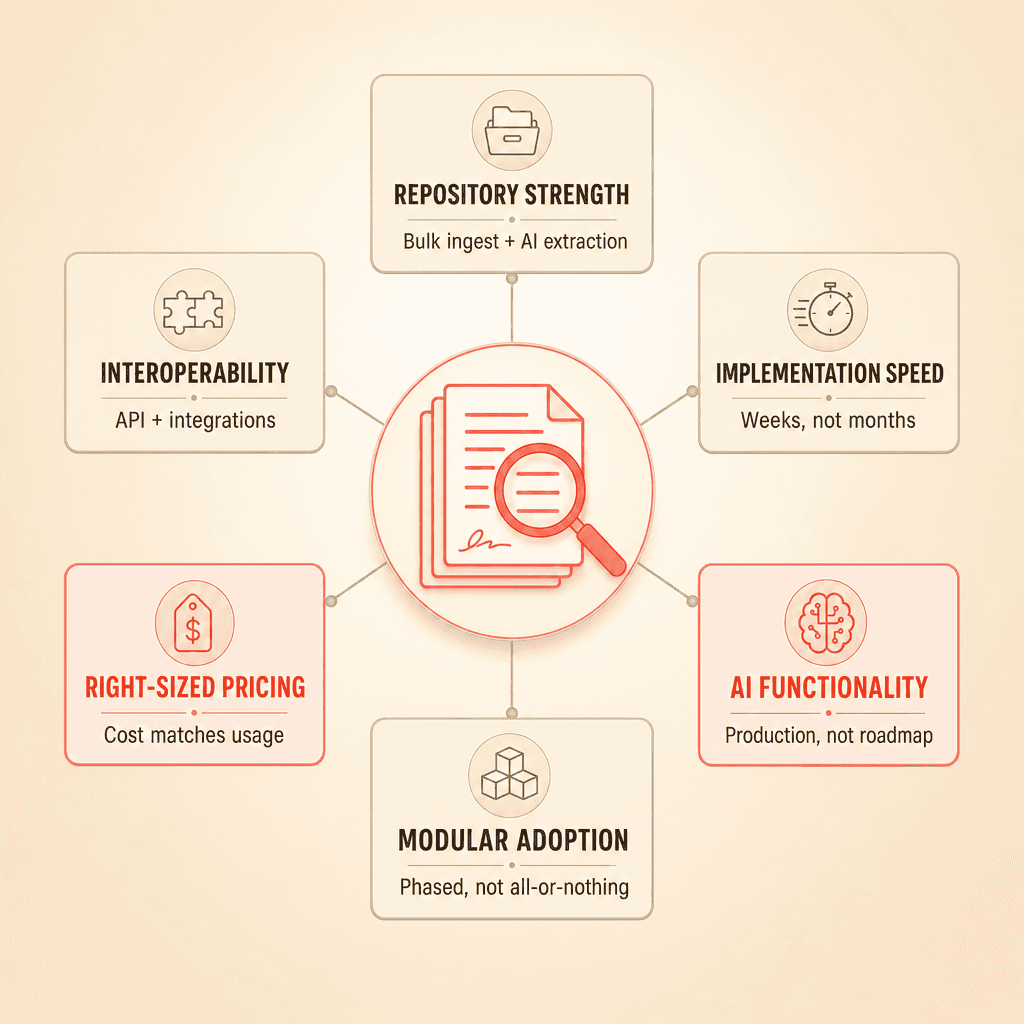
Legal tech consultants approach CLM evaluation criteria differently than the teams who will ultimately use the platform every day. A legal ops manager asks, "Does this fix my problem?" A consultant asks, "Will this fix the problem, will the team actually adopt it, and will I stake my reputation on this recommendation?"
That distinction shapes everything about how consultants assess contract lifecycle management platforms. If you advise clients on legal technology purchases, or if you want to evaluate CLM software with the rigor of someone who does this for a living, this framework covers the six criteria that separate a strong recommendation from a regrettable one.
1. Repository strength and the fragmented-storage problem
Every CLM evaluation starts from the same baseline. Contracts live in email inboxes, shared drives, CRM attachments, and sometimes in filing cabinets that predate the company's current leadership. Legal ops advisors encounter this pattern so frequently that the ability to centralize a scattered contract portfolio has become the first gate in any evaluation.
The question is not just "can the platform store documents?" but rather "how quickly can it ingest, process, and organize thousands of existing agreements?" That means automatic OCR for scanned PDFs, AI-powered extraction of parties, dates, financial terms, renewal deadlines, and termination notice periods, plus bulk upload capabilities that don't require manual tagging of every document.
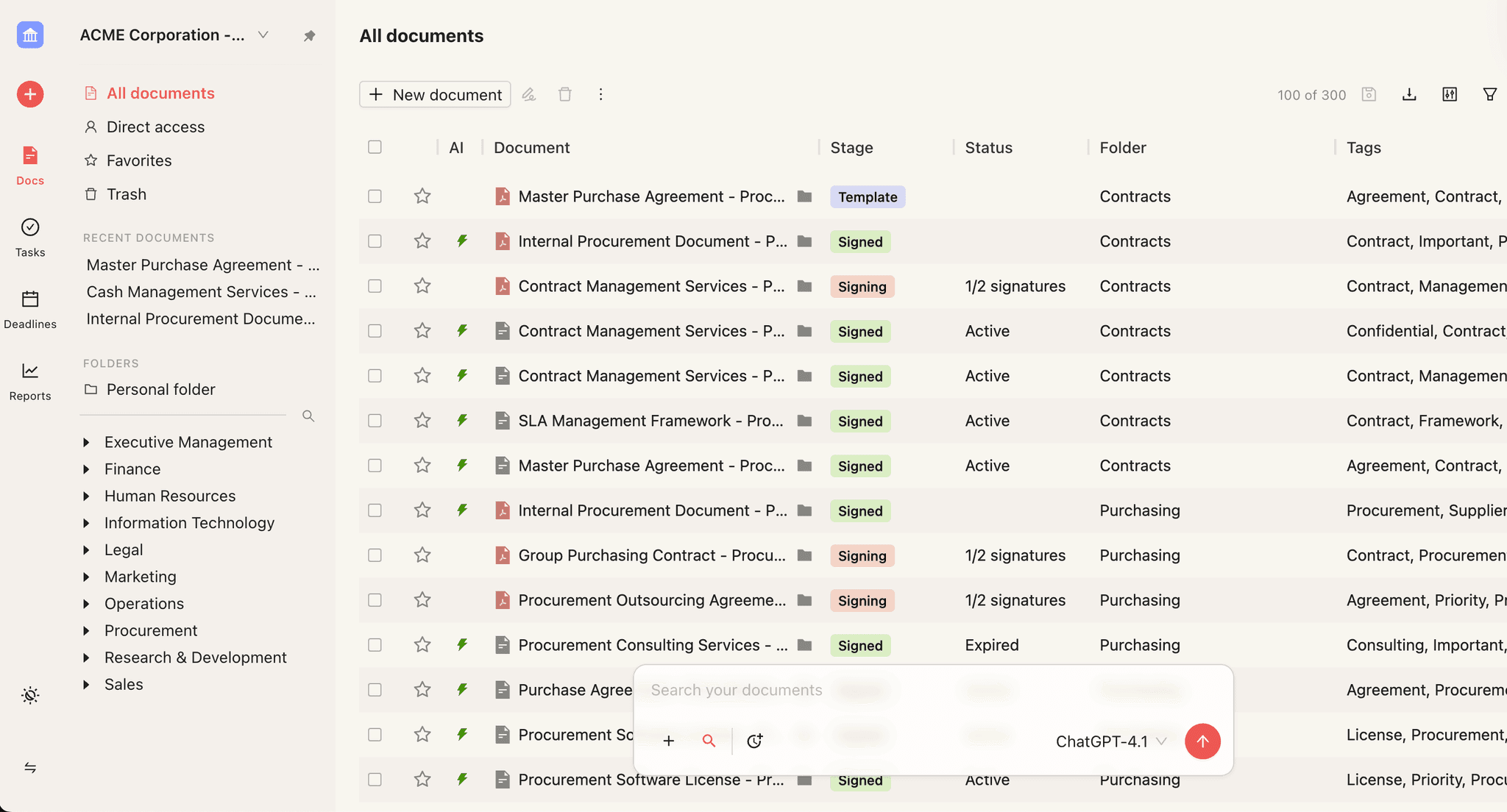
Concord's document management platform handles this through AI-powered data extraction that processes uploaded contracts automatically. For consultants evaluating on behalf of resource-constrained teams, this capability directly addresses the most universal pain point in contract management.
2. Implementation speed that matches client resources
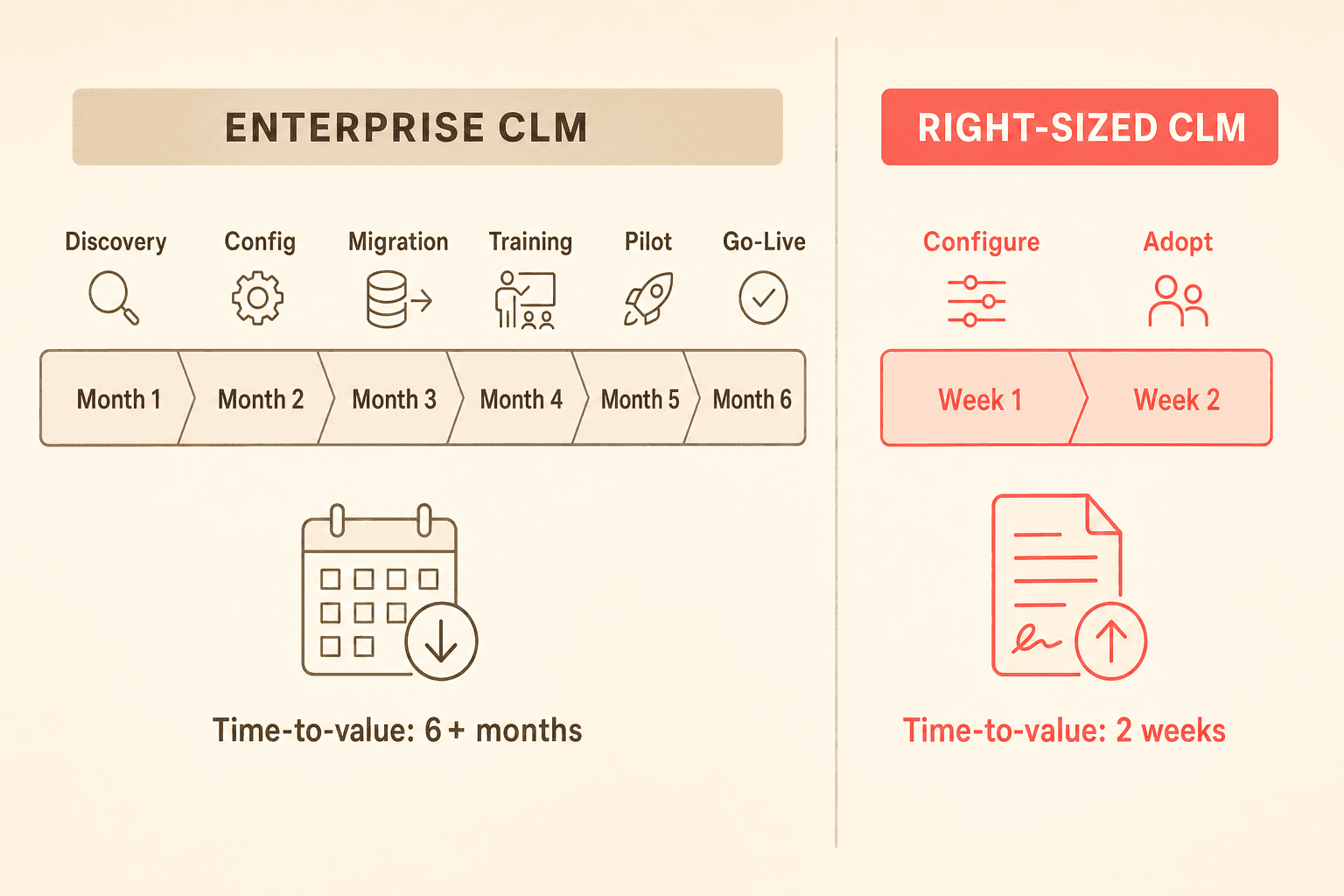
A two-week implementation timeline tells a very different story than a six-month deployment plan. Consultants evaluating CLM platforms for SMB and mid-market legal teams consistently ask about time-to-value because they know their clients don't have dedicated systems administrators or months of runway for a complex rollout.
Implementation speed signals more than just convenience. It reveals how much configuration burden the platform places on the buyer, whether the system requires custom development or works out of the box, and how quickly a team can move from evaluation to daily use.
Platforms that require extensive professional services engagements before a single contract can be uploaded create risk for the consultant. The longer the gap between purchase and productive use, the higher the chance the platform becomes shelfware. Concord's average implementation timeline of roughly two weeks stands in contrast to enterprise deployments that can stretch across quarters.
3. AI capabilities that do functional work, not just marketing work
The difference between "this platform has AI" and "the AI actually does something useful" is a distinction consultants make quickly during evaluations. CLM evaluation criteria for legal tech platforms now treat AI as a core functional requirement rather than an optional add-on.
Functional AI in contract management means several specific things. It means a co-pilot interface where you can ask questions about individual contracts and across your entire repository in natural language. It means the ability to compare agreements against each other to surface deviations, risks, and inconsistencies. It means semantic search that understands what you're looking for, not just the exact words you typed.
Concord's AI-powered contract discussion interface serves as exactly this kind of tool. You can query your contract portfolio, compare terms across agreements, and build reports without constructing complex Boolean searches. For consultants, the ability to demonstrate immediate analytical value during a client demo is a significant differentiator.
The key evaluation question here: are these AI capabilities production features, or are they beta tools and roadmap promises? Consultants need confidence that what they show in a demo is what the client receives at go-live.
4. Modular adoption that supports a phased approach
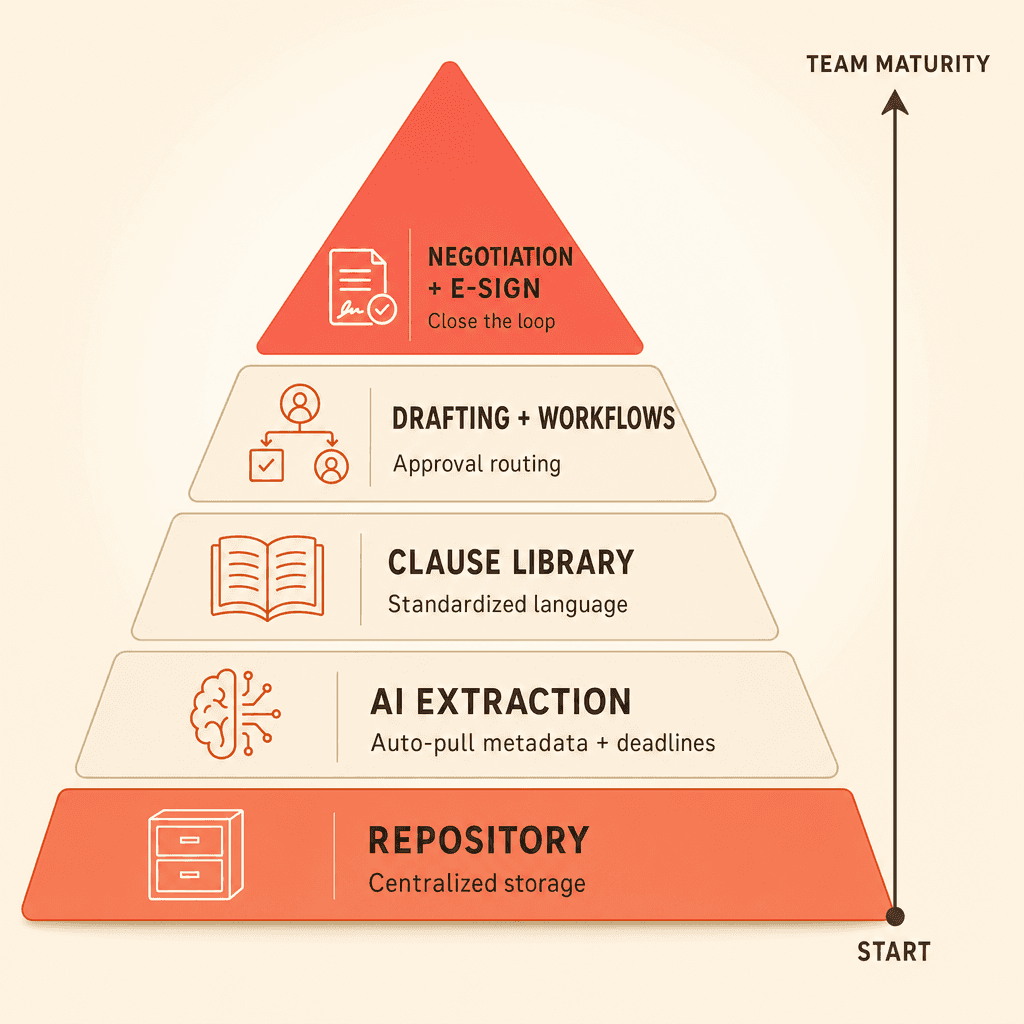
The majority of teams begin their CLM adoption with the repository function: centralizing documents, extracting metadata, and setting up deadline alerts. Drafting workflows, negotiation tracking, approval chains, and clause standardization come later, sometimes months later, sometimes never.
Consultants recognize this phased adoption pattern and evaluate whether a platform supports a "start with the repository, grow into full lifecycle" approach without forcing an all-or-nothing commitment. A platform that requires you to buy and configure the entire suite just to get a functional contract database is harder to recommend than one that lets you adopt capabilities as your team's maturity grows.
This is where the experience of teams that have deployed monolithic CLM platforms becomes instructive. Legal ops leaders who have used all-in-one platforms commonly describe a pattern where the system does some things well and other things poorly. That uneven quality drives a growing preference for platforms that allow modular adoption, letting teams invest in the capabilities they'll actually use.
Concord supports this phased approach through its clause library management and broader document management features. You can start with centralized storage and extraction, then layer in clause standardization, drafting workflows, and approval processes as your needs evolve.
5. Right-sized pricing that matches actual usage
Enterprise CLM platforms can reach six figures annually. Legal ops leaders frequently report paying for capabilities their teams never touch. When a company uses a small fraction of an expensive platform's feature set, the consultant's job is to identify where the actual value sits and recommend accordingly.
Right-sized pricing is not about finding the cheapest option. It's about matching the cost to the capabilities the team will realistically adopt. A platform that offers full lifecycle management at a price point accessible to mid-market legal teams removes a common objection from the evaluation process.
For consultants, recommending a platform that costs substantially less while delivering the core capabilities their client needs is a stronger position than recommending a premium tool and hoping the client grows into it. The underutilization pattern is too well-known for that approach to hold up under scrutiny.
6. Interoperability and technical flexibility
Consultants building legal tech stacks evaluate how well a CLM integrates with existing tools. API access, Microsoft Word integration, connections to e-signature platforms, and compatibility with emerging AI infrastructure all factor into the recommendation.
A platform that requires you to abandon your existing tools or work exclusively within its own interface creates friction. One that connects to your current workflows and plays well alongside other point applications is easier to slot into a diversified technology stack.
Concord offers API access, integrations with common business tools, and compatibility with AI platforms through its MCP server capability. For consultants evaluating on behalf of teams with established tool preferences, this flexibility matters.
How Concord maps to each criterion
Evaluation criterion | What consultants look for | Concord capability |
|---|---|---|
Repository strength | Fast ingestion, automatic OCR, AI extraction | Bulk upload with automatic metadata extraction for parties, dates, financials, renewal terms |
Implementation speed | Weeks, not months | Average implementation measured in weeks, not quarters |
AI functionality | Production-ready co-pilot, semantic search, contract comparison | AI contract discussion interface, cross-portfolio querying, deviation analysis |
Modular adoption | Start with repo, grow into full lifecycle | Repository-first approach with layered access to drafting, approval, and clause management |
Right-sized pricing | Cost matched to actual usage patterns | Mid-market pricing with full lifecycle capability |
Interoperability | API access, integrations, tool compatibility | API, Word integration, e-signature connections, MCP server capability |
Legal tech consultants approach CLM evaluation criteria differently than the teams who will ultimately use the platform every day. A legal ops manager asks, "Does this fix my problem?" A consultant asks, "Will this fix the problem, will the team actually adopt it, and will I stake my reputation on this recommendation?"
That distinction shapes everything about how consultants assess contract lifecycle management platforms. If you advise clients on legal technology purchases, or if you want to evaluate CLM software with the rigor of someone who does this for a living, this framework covers the six criteria that separate a strong recommendation from a regrettable one.
1. Repository strength and the fragmented-storage problem
Every CLM evaluation starts from the same baseline. Contracts live in email inboxes, shared drives, CRM attachments, and sometimes in filing cabinets that predate the company's current leadership. Legal ops advisors encounter this pattern so frequently that the ability to centralize a scattered contract portfolio has become the first gate in any evaluation.
The question is not just "can the platform store documents?" but rather "how quickly can it ingest, process, and organize thousands of existing agreements?" That means automatic OCR for scanned PDFs, AI-powered extraction of parties, dates, financial terms, renewal deadlines, and termination notice periods, plus bulk upload capabilities that don't require manual tagging of every document.
Concord's document management platform handles this through AI-powered data extraction that processes uploaded contracts automatically. For consultants evaluating on behalf of resource-constrained teams, this capability directly addresses the most universal pain point in contract management.
2. Implementation speed that matches client resources
A two-week implementation timeline tells a very different story than a six-month deployment plan. Consultants evaluating CLM platforms for SMB and mid-market legal teams consistently ask about time-to-value because they know their clients don't have dedicated systems administrators or months of runway for a complex rollout.
Implementation speed signals more than just convenience. It reveals how much configuration burden the platform places on the buyer, whether the system requires custom development or works out of the box, and how quickly a team can move from evaluation to daily use.
Platforms that require extensive professional services engagements before a single contract can be uploaded create risk for the consultant. The longer the gap between purchase and productive use, the higher the chance the platform becomes shelfware. Concord's average implementation timeline of roughly two weeks stands in contrast to enterprise deployments that can stretch across quarters.
3. AI capabilities that do functional work, not just marketing work
The difference between "this platform has AI" and "the AI actually does something useful" is a distinction consultants make quickly during evaluations. CLM evaluation criteria for legal tech platforms now treat AI as a core functional requirement rather than an optional add-on.
Functional AI in contract management means several specific things. It means a co-pilot interface where you can ask questions about individual contracts and across your entire repository in natural language. It means the ability to compare agreements against each other to surface deviations, risks, and inconsistencies. It means semantic search that understands what you're looking for, not just the exact words you typed.
Concord's AI-powered contract discussion interface serves as exactly this kind of tool. You can query your contract portfolio, compare terms across agreements, and build reports without constructing complex Boolean searches. For consultants, the ability to demonstrate immediate analytical value during a client demo is a significant differentiator.
The key evaluation question here: are these AI capabilities production features, or are they beta tools and roadmap promises? Consultants need confidence that what they show in a demo is what the client receives at go-live.
4. Modular adoption that supports a phased approach
The majority of teams begin their CLM adoption with the repository function: centralizing documents, extracting metadata, and setting up deadline alerts. Drafting workflows, negotiation tracking, approval chains, and clause standardization come later, sometimes months later, sometimes never.
Consultants recognize this phased adoption pattern and evaluate whether a platform supports a "start with the repository, grow into full lifecycle" approach without forcing an all-or-nothing commitment. A platform that requires you to buy and configure the entire suite just to get a functional contract database is harder to recommend than one that lets you adopt capabilities as your team's maturity grows.
This is where the experience of teams that have deployed monolithic CLM platforms becomes instructive. Legal ops leaders who have used all-in-one platforms commonly describe a pattern where the system does some things well and other things poorly. That uneven quality drives a growing preference for platforms that allow modular adoption, letting teams invest in the capabilities they'll actually use.
Concord supports this phased approach through its clause library management and broader document management features. You can start with centralized storage and extraction, then layer in clause standardization, drafting workflows, and approval processes as your needs evolve.
5. Right-sized pricing that matches actual usage
Enterprise CLM platforms can reach six figures annually. Legal ops leaders frequently report paying for capabilities their teams never touch. When a company uses a small fraction of an expensive platform's feature set, the consultant's job is to identify where the actual value sits and recommend accordingly.
Right-sized pricing is not about finding the cheapest option. It's about matching the cost to the capabilities the team will realistically adopt. A platform that offers full lifecycle management at a price point accessible to mid-market legal teams removes a common objection from the evaluation process.
For consultants, recommending a platform that costs substantially less while delivering the core capabilities their client needs is a stronger position than recommending a premium tool and hoping the client grows into it. The underutilization pattern is too well-known for that approach to hold up under scrutiny.
6. Interoperability and technical flexibility
Consultants building legal tech stacks evaluate how well a CLM integrates with existing tools. API access, Microsoft Word integration, connections to e-signature platforms, and compatibility with emerging AI infrastructure all factor into the recommendation.
A platform that requires you to abandon your existing tools or work exclusively within its own interface creates friction. One that connects to your current workflows and plays well alongside other point applications is easier to slot into a diversified technology stack.
Concord offers API access, integrations with common business tools, and compatibility with AI platforms through its MCP server capability. For consultants evaluating on behalf of teams with established tool preferences, this flexibility matters.
How Concord maps to each criterion
Evaluation criterion | What consultants look for | Concord capability |
|---|---|---|
Repository strength | Fast ingestion, automatic OCR, AI extraction | Bulk upload with automatic metadata extraction for parties, dates, financials, renewal terms |
Implementation speed | Weeks, not months | Average implementation measured in weeks, not quarters |
AI functionality | Production-ready co-pilot, semantic search, contract comparison | AI contract discussion interface, cross-portfolio querying, deviation analysis |
Modular adoption | Start with repo, grow into full lifecycle | Repository-first approach with layered access to drafting, approval, and clause management |
Right-sized pricing | Cost matched to actual usage patterns | Mid-market pricing with full lifecycle capability |
Interoperability | API access, integrations, tool compatibility | API, Word integration, e-signature connections, MCP server capability |
Need to know
Frequently Asked Questions

Take the "management" out
of contract management.
Customer Support
Legal
Compare
Resources
Customer Support
Company
Legal
Compare
Resources
Customer Support
Company
Legal
Compare
© 2025 Concord. All rights reserved.