Blackline vs redline: contract redlining best practices
Blackline vs redline: contract redlining best practices
Blackline vs redline: contract redlining best practices
Blackline vs redline: contract redlining best practices
contract management

Contract redlining remains one of the most frustrating bottlenecks in any legal team's workflow. Understanding the difference between blackline vs redline documents, and adopting structured negotiation practices, can dramatically cut your cycle times and reduce costly errors. Yet most teams still rely on messy email chains, confusing Word markups, and disconnected tools that make every negotiation round feel like a guessing game.
According to a 2023 World Commerce & Contracting study, poor contract management costs organizations an average of 9 percent of their annual revenue. A significant portion of that waste originates in the negotiation and redlining phase, where miscommunication, lost edits, and unclear version history compound into delays that stretch contracts from days into weeks or months.
This guide covers what you need to know about redlining and blacklining, the most common challenges teams face, and how to build a better negotiation workflow.
What is redlining a contract?
Redlining is the process of marking up proposed changes to a contract during negotiation. The term dates back to the days when lawyers would literally use red pens to strike through, insert, or annotate language on printed documents. Today, redlining happens digitally, typically through tracked changes in tools like Microsoft Word or within a CLM platform.
A redlined document shows every proposed edit in context: deletions appear with strikethrough formatting, insertions appear in colored text, and comments sit alongside the clauses they reference. The purpose is transparency. Both parties can see exactly what the other side wants to change and respond accordingly.
What is a blackline document?
A blackline (sometimes called a "blackline comparison") is a document that shows the differences between two versions of a contract without revealing the individual editing history. Think of it as a clean comparison report: it highlights what changed between Version A and Version B, but it strips away the messy trail of who typed what and when.
Blackline documents are most useful when you need to:
Compare a final draft against the original to confirm all agreed changes were incorporated
Share a summary of changes with executives or board members who do not need to see every tracked edit
Verify that no unauthorized modifications were slipped into a document between rounds
When to use redline vs blackline
Your choice depends on where you are in the negotiation cycle. During active negotiation rounds, redlining is the right approach because both parties need full visibility into proposed changes and the ability to accept or reject each one. Once a round concludes and you want to compare the current version against a prior version, a blackline comparison gives you a cleaner, more readable view. For a deeper look at how these concepts fit into the broader contract lifecycle, check out the contract management fundamentals guide.
Top redlining challenges teams face
According to our research, version control and change tracking confusion appeared as a recurring pain point across the majority of customer and prospect conversations analyzed. Here are the most common issues:
Email chain chaos
Sending contract drafts back and forth via email creates a tangled web of attachments, reply-all threads, and conflicting versions. One contract administrator at a major construction firm described a familiar scenario: "A lot of times when we send out terms and conditions to our vendors, they want to redline everything and then we end up on these email trains that will absolutely confuse the world."
A 2024 Deloitte Legal Department survey found that 56 percent of in-house legal teams still rely primarily on email for contract negotiations. That reliance introduces risk at every step.
Lost change history
When someone clicks "Accept All Changes" in a Word document, the editing history vanishes. If a dispute arises later, or if you simply need to understand what was modified between drafts, you are left with no trail. According to our research, this pain point surfaced repeatedly across multiple industries, from construction to healthcare.
Confusion over change attribution
Contracts often pass through multiple internal reviewers and external counterparties. Figuring out which changes came from your team and which came from the other side becomes a puzzle, especially when initials and abbreviations pile up in the margins of a Word document.
External party adoption friction
Not every counterparty will adopt your preferred tool. According to a 2023 CLOC State of the Industry report, 61 percent of legal departments cite external collaboration as a top barrier to technology adoption. Your redlining workflow needs to accommodate parties who prefer Word, PDF, or other formats without sacrificing version control.
Redlining best practices for faster contract negotiation
1\. Centralize your negotiation in one platform
Moving redlining out of email and into a single contract workspace eliminates version confusion. Every edit, comment, and version is captured in one place with a full audit trail. One head of legal at an online gaming company described the impact directly: "With Concord, projects that used to take two weeks to do manually can now be done in a single afternoon."
That kind of time savings is not unusual. According to verified customer data, one optical retailer reduced contract execution time from one month to three minutes, a 97 percent improvement.
2\. Separate internal and external collaboration
One of the most effective workflow improvements is the ability to collaborate with your internal colleagues on a contract without the external party seeing your notes, strategy discussions, or preliminary markups. You review internally first, align on your position, then publish the edited version externally. This prevents premature concessions and keeps your negotiation strategy confidential. You can learn more about structuring this kind of workflow in the contract negotiation and collaboration guide.
3\. Maintain granular edit controls
Assign specific permission levels to each participant. Full editors can make changes, limited editors can suggest changes for approval, and viewers can read without modifying anything. This prevents unauthorized edits while still allowing structured collaboration.
4\. Keep every version accessible
Your platform should automatically save every version of a document so you can compare any two drafts side by side. This solves the blackline comparison need natively, without requiring a separate tool or manual document comparison.
One contract administrator at a national construction firm highlighted the cost of getting this right: "Concord has saved us thousands of dollars every month in labor hours."
5\. Build a contract playbook
A playbook defines your preferred language for common clauses, acceptable fallback positions, and hard limits that require escalation. With a playbook in place, your team spends less time debating each redline and more time executing. One university, for example, saw a 30 percent reduction in time spent correcting and organizing contracts after adopting structured workflows.
6\. Set approval workflows before external sharing
Multi-step approval routing catches issues before they reach the counterparty. Define conditions for when contracts need senior review, legal sign-off, or compliance checks. This prevents the costly cycle of sending out a draft, realizing an error, and having to retract it.
The role of AI-assisted redlining
Artificial intelligence is beginning to reshape how teams approach contract review and markup. Current AI capabilities already allow you to upload a contract and ask the system to identify risks, flag unusual obligations, and suggest alternative language. One purchasing manager at a mid-size university described his experience: "I just click the button and the AI pulls all the key terms out of the contract."
The next frontier is automated redlining, where AI reads your playbook and applies suggested markups directly to the document. You then review the suggestions and accept or reject each one, similar to how you would handle a human colleague's tracked changes. This approach has the potential to reduce first-pass review time significantly, especially for high-volume teams processing thousands of contracts per year. One university client, for instance, handles over 4,000 contracts annually.
According to a 2024 Gartner report, 50 percent of enterprise legal departments plan to adopt AI-powered contract review tools by 2027. For teams managing large contract portfolios, early adoption of AI-assisted review and redlining could meaningfully reduce turnaround times. For more on how AI fits into the contract lifecycle, visit the AI-powered contract management guide.
How a CLM platform solves common redlining problems
A purpose-built CLM platform addresses the full range of redlining pain points:
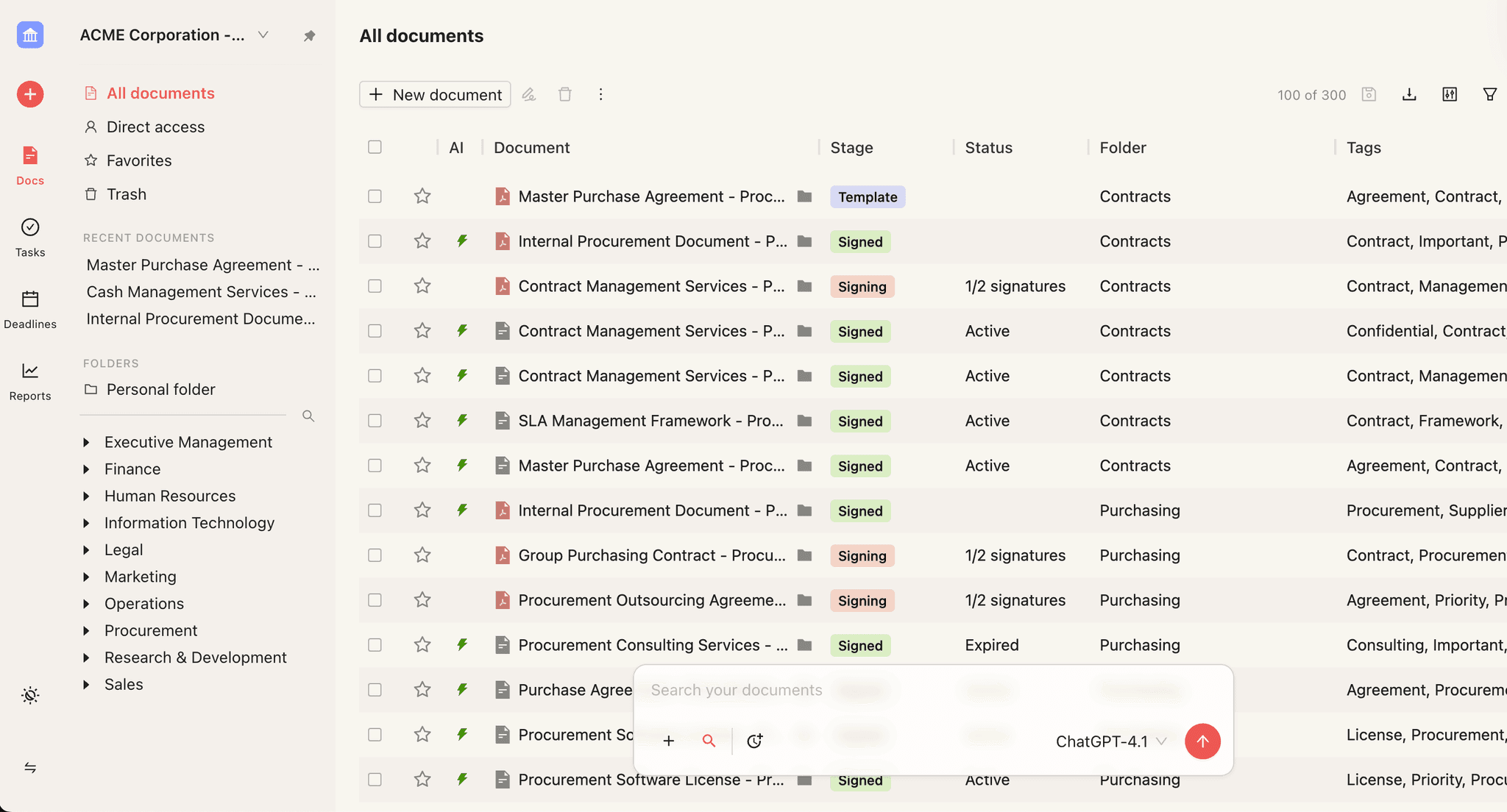
Built-in track changes: Mark up documents directly in the platform with tracked insertions, deletions, and comments, no separate Word file required.
Internal vs. public modes: Collaborate privately with your team before sharing edits externally.
Word and Google Docs compatibility: Export to Word for counterparties who prefer it, then drag the file back in with automatic versioning.
Full audit trail: See every change, who made it, and when, eliminating attribution confusion.
Version comparison: Compare any two versions side by side to generate blackline-style reports.
Discussion panel: Replace email threads with threaded, contextual conversations attached to each document.
One senior director of legal operations at a digital media company captured the value simply: "Concord does what it says it's going to do. It's simple, affordable, and just works."
Frequently asked questions
What is the main difference between blackline vs redline documents?
A redline shows tracked changes in real time during active negotiation, including who proposed each edit. A blackline compares two finalized versions of a document to show what changed between them, without the detailed editing history. Redlines are for negotiation; blacklines are for verification and review.
Can external parties who do not use my CLM platform still participate in redlining?
Yes. Most modern CLM platforms, including Concord, allow you to export documents to Microsoft Word for counterparties who prefer that format. When they return the edited file, you can upload it back into the platform, and the system automatically tracks the new version and highlights changes.
How does AI-assisted redlining differ from traditional tracked changes?
Traditional tracked changes require a human to manually read each clause and mark edits. AI-assisted redlining uses your predefined playbook to suggest changes automatically. You still review and approve every suggestion, but the first pass happens in seconds rather than hours.
Take the chaos out of contract redlining
If your team is still managing redlines through email chains and disconnected Word files, you are spending time on coordination that should be spent on negotiation strategy. Concord brings your entire redlining workflow into one platform with built-in track changes, version comparison, internal collaboration, and AI-powered review. Request a demo to see how your team can move from weeks of back-and-forth to same-day contract turnaround.
Contract redlining remains one of the most frustrating bottlenecks in any legal team's workflow. Understanding the difference between blackline vs redline documents, and adopting structured negotiation practices, can dramatically cut your cycle times and reduce costly errors. Yet most teams still rely on messy email chains, confusing Word markups, and disconnected tools that make every negotiation round feel like a guessing game.
According to a 2023 World Commerce & Contracting study, poor contract management costs organizations an average of 9 percent of their annual revenue. A significant portion of that waste originates in the negotiation and redlining phase, where miscommunication, lost edits, and unclear version history compound into delays that stretch contracts from days into weeks or months.
This guide covers what you need to know about redlining and blacklining, the most common challenges teams face, and how to build a better negotiation workflow.
What is redlining a contract?
Redlining is the process of marking up proposed changes to a contract during negotiation. The term dates back to the days when lawyers would literally use red pens to strike through, insert, or annotate language on printed documents. Today, redlining happens digitally, typically through tracked changes in tools like Microsoft Word or within a CLM platform.
A redlined document shows every proposed edit in context: deletions appear with strikethrough formatting, insertions appear in colored text, and comments sit alongside the clauses they reference. The purpose is transparency. Both parties can see exactly what the other side wants to change and respond accordingly.
What is a blackline document?
A blackline (sometimes called a "blackline comparison") is a document that shows the differences between two versions of a contract without revealing the individual editing history. Think of it as a clean comparison report: it highlights what changed between Version A and Version B, but it strips away the messy trail of who typed what and when.
Blackline documents are most useful when you need to:
Compare a final draft against the original to confirm all agreed changes were incorporated
Share a summary of changes with executives or board members who do not need to see every tracked edit
Verify that no unauthorized modifications were slipped into a document between rounds
When to use redline vs blackline
Your choice depends on where you are in the negotiation cycle. During active negotiation rounds, redlining is the right approach because both parties need full visibility into proposed changes and the ability to accept or reject each one. Once a round concludes and you want to compare the current version against a prior version, a blackline comparison gives you a cleaner, more readable view. For a deeper look at how these concepts fit into the broader contract lifecycle, check out the contract management fundamentals guide.
Top redlining challenges teams face
According to our research, version control and change tracking confusion appeared as a recurring pain point across the majority of customer and prospect conversations analyzed. Here are the most common issues:
Email chain chaos
Sending contract drafts back and forth via email creates a tangled web of attachments, reply-all threads, and conflicting versions. One contract administrator at a major construction firm described a familiar scenario: "A lot of times when we send out terms and conditions to our vendors, they want to redline everything and then we end up on these email trains that will absolutely confuse the world."
A 2024 Deloitte Legal Department survey found that 56 percent of in-house legal teams still rely primarily on email for contract negotiations. That reliance introduces risk at every step.
Lost change history
When someone clicks "Accept All Changes" in a Word document, the editing history vanishes. If a dispute arises later, or if you simply need to understand what was modified between drafts, you are left with no trail. According to our research, this pain point surfaced repeatedly across multiple industries, from construction to healthcare.
Confusion over change attribution
Contracts often pass through multiple internal reviewers and external counterparties. Figuring out which changes came from your team and which came from the other side becomes a puzzle, especially when initials and abbreviations pile up in the margins of a Word document.
External party adoption friction
Not every counterparty will adopt your preferred tool. According to a 2023 CLOC State of the Industry report, 61 percent of legal departments cite external collaboration as a top barrier to technology adoption. Your redlining workflow needs to accommodate parties who prefer Word, PDF, or other formats without sacrificing version control.
Redlining best practices for faster contract negotiation
1\. Centralize your negotiation in one platform
Moving redlining out of email and into a single contract workspace eliminates version confusion. Every edit, comment, and version is captured in one place with a full audit trail. One head of legal at an online gaming company described the impact directly: "With Concord, projects that used to take two weeks to do manually can now be done in a single afternoon."
That kind of time savings is not unusual. According to verified customer data, one optical retailer reduced contract execution time from one month to three minutes, a 97 percent improvement.
2\. Separate internal and external collaboration
One of the most effective workflow improvements is the ability to collaborate with your internal colleagues on a contract without the external party seeing your notes, strategy discussions, or preliminary markups. You review internally first, align on your position, then publish the edited version externally. This prevents premature concessions and keeps your negotiation strategy confidential. You can learn more about structuring this kind of workflow in the contract negotiation and collaboration guide.
3\. Maintain granular edit controls
Assign specific permission levels to each participant. Full editors can make changes, limited editors can suggest changes for approval, and viewers can read without modifying anything. This prevents unauthorized edits while still allowing structured collaboration.
4\. Keep every version accessible
Your platform should automatically save every version of a document so you can compare any two drafts side by side. This solves the blackline comparison need natively, without requiring a separate tool or manual document comparison.
One contract administrator at a national construction firm highlighted the cost of getting this right: "Concord has saved us thousands of dollars every month in labor hours."
5\. Build a contract playbook
A playbook defines your preferred language for common clauses, acceptable fallback positions, and hard limits that require escalation. With a playbook in place, your team spends less time debating each redline and more time executing. One university, for example, saw a 30 percent reduction in time spent correcting and organizing contracts after adopting structured workflows.
6\. Set approval workflows before external sharing
Multi-step approval routing catches issues before they reach the counterparty. Define conditions for when contracts need senior review, legal sign-off, or compliance checks. This prevents the costly cycle of sending out a draft, realizing an error, and having to retract it.
The role of AI-assisted redlining
Artificial intelligence is beginning to reshape how teams approach contract review and markup. Current AI capabilities already allow you to upload a contract and ask the system to identify risks, flag unusual obligations, and suggest alternative language. One purchasing manager at a mid-size university described his experience: "I just click the button and the AI pulls all the key terms out of the contract."
The next frontier is automated redlining, where AI reads your playbook and applies suggested markups directly to the document. You then review the suggestions and accept or reject each one, similar to how you would handle a human colleague's tracked changes. This approach has the potential to reduce first-pass review time significantly, especially for high-volume teams processing thousands of contracts per year. One university client, for instance, handles over 4,000 contracts annually.
According to a 2024 Gartner report, 50 percent of enterprise legal departments plan to adopt AI-powered contract review tools by 2027. For teams managing large contract portfolios, early adoption of AI-assisted review and redlining could meaningfully reduce turnaround times. For more on how AI fits into the contract lifecycle, visit the AI-powered contract management guide.
How a CLM platform solves common redlining problems
A purpose-built CLM platform addresses the full range of redlining pain points:
Built-in track changes: Mark up documents directly in the platform with tracked insertions, deletions, and comments, no separate Word file required.
Internal vs. public modes: Collaborate privately with your team before sharing edits externally.
Word and Google Docs compatibility: Export to Word for counterparties who prefer it, then drag the file back in with automatic versioning.
Full audit trail: See every change, who made it, and when, eliminating attribution confusion.
Version comparison: Compare any two versions side by side to generate blackline-style reports.
Discussion panel: Replace email threads with threaded, contextual conversations attached to each document.
One senior director of legal operations at a digital media company captured the value simply: "Concord does what it says it's going to do. It's simple, affordable, and just works."
Frequently asked questions
What is the main difference between blackline vs redline documents?
A redline shows tracked changes in real time during active negotiation, including who proposed each edit. A blackline compares two finalized versions of a document to show what changed between them, without the detailed editing history. Redlines are for negotiation; blacklines are for verification and review.
Can external parties who do not use my CLM platform still participate in redlining?
Yes. Most modern CLM platforms, including Concord, allow you to export documents to Microsoft Word for counterparties who prefer that format. When they return the edited file, you can upload it back into the platform, and the system automatically tracks the new version and highlights changes.
How does AI-assisted redlining differ from traditional tracked changes?
Traditional tracked changes require a human to manually read each clause and mark edits. AI-assisted redlining uses your predefined playbook to suggest changes automatically. You still review and approve every suggestion, but the first pass happens in seconds rather than hours.
Take the chaos out of contract redlining
If your team is still managing redlines through email chains and disconnected Word files, you are spending time on coordination that should be spent on negotiation strategy. Concord brings your entire redlining workflow into one platform with built-in track changes, version comparison, internal collaboration, and AI-powered review. Request a demo to see how your team can move from weeks of back-and-forth to same-day contract turnaround.

Take the "management" out
of contract management.
Customer Support
Legal
Compare
Resources
Customer Support
Company
Legal
Compare
Resources
Customer Support
Company
Legal
Compare
© 2025 Concord. All rights reserved.