Why Most Contract Dashboards Go Unused... and What to Do About It
Why Most Contract Dashboards Go Unused... and What to Do About It
Why Most Contract Dashboards Go Unused... and What to Do About It
Why Most Contract Dashboards Go Unused... and What to Do About It

Most contract teams have dashboards. Very few rely on them.
Legal ops builds them. Procurement reviews them once. Executives glance at them and then ask a follow-up question that the dashboard cannot answer. Within weeks, the dashboard becomes background noise, and the real work moves back to emails, exports, and spreadsheets.
This is not a failure of discipline or training. It is a mismatch between how dashboards are designed and how contract questions actually show up.
The real problem dashboards are trying and failing to solve
Dashboards are built for monitoring. Contract work is driven by questions.
Dashboards assume you already know:
Which metrics matter
Which filters to apply
Which view answers the question
But contract questions almost never arrive that way.
They arrive as interruptions:
“Which vendor contracts renew next quarter?”
“Do any of these have unusual notice terms?”
“Why is this number different from last month?”
“What do we need to act on right now?”
Research on analytics adoption consistently shows that dashboards struggle because users scan for answers rather than explore visualizations. In a Simple BI case study on a dashboard that got ignored, executives skipped charts entirely and went straight to asking someone for interpretation.
Contract stakeholders behave the same way.
Static views don’t survive dynamic questions
Traditional dashboards are static by design. They answer predefined questions. Contract work is the opposite. It is exception-driven and constantly changing.
This is one reason business intelligence adoption remains stubbornly low. IBM’s analysis of BI adoption challenges points out that many dashboards fail because users do not know which question to ask or how to translate business concerns into filters and metrics.
In contract management, that gap is even wider because:
Meaning lives in clause language, not just fields
Risk depends on exceptions, not averages
Follow-up questions matter more than initial counts
A dashboard might tell you how many contracts renew in Q4. It cannot tell you which of those renewals matter or why.
Metrics overload makes dashboards easy to ignore
When dashboards do get opened, they are often overloaded with KPIs that lack direction.
Product and analytics teams have documented how metrics overload leads to paralysis rather than clarity, a pattern described in LogRocket’s breakdown of when too much data becomes a problem.
Contract dashboards frequently fall into this trap:
Counts without context
Trends without implications
Visuals without recommended actions
The result is predictable. Stakeholders stop looking, not because the data is wrong, but because it does not help them decide what to do next.
Dashboards live outside the work
Another structural problem is where dashboards live.
Dashboards are usually separate destinations. You have to remember to open them. Modern work does not operate that way. Decisions happen in email, chat, documents, and AI tools.
Analytics research has noted that traditional BI tools struggle because they are not embedded in workflows. Helical Insight explains in its analysis of why traditional BI tools fail that insights disconnected from daily work rarely drive action.
Contract dashboards suffer from this exact problem. By the time someone opens the dashboard, the question has already moved on.
The contract-specific failure mode
Dashboards work best when data is clean, structured, and stable.
Contracts are none of those things.
Much of what matters in a contract is unstructured text. Obligations, notice mechanics, exceptions, and negotiated language determine risk and action. A dashboard can surface dates and counts, but it cannot interpret meaning without human intervention.
That is why dashboards so often become a starting point rather than an answer. Someone still has to explain what the numbers imply. That someone is usually legal ops.
What problem Concord actually solves
Concord Horizon is not trying to build better dashboards. It is solving a different problem.
The real problem is that contract questions are question-first, not view-first. Horizon replaces static dashboards with a model that matches how questions actually emerge.
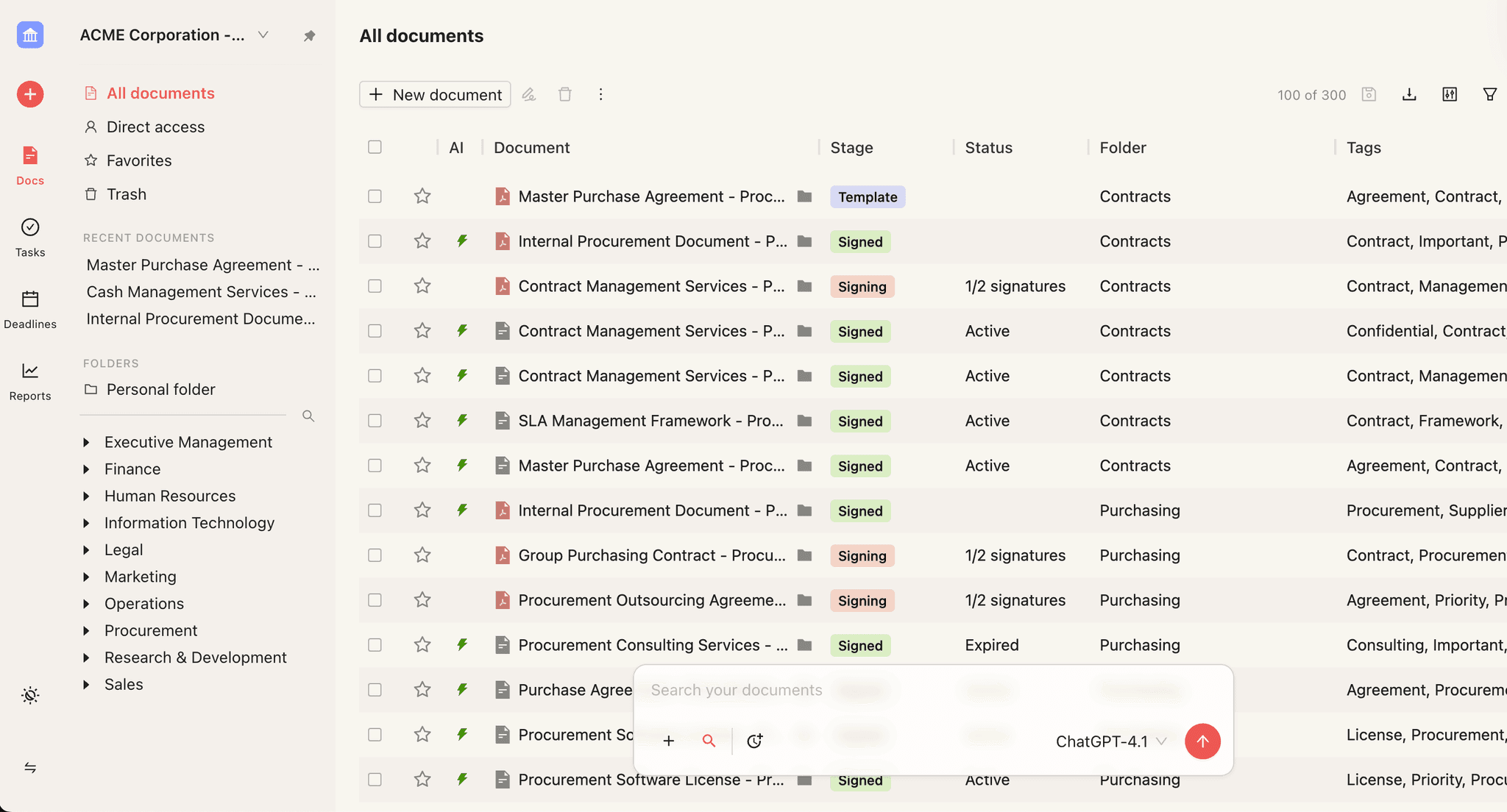
Instead of asking users to navigate charts, Horizon lets them ask questions directly through AI Copilot and get answers grounded in the full contract portfolio.
When the question is ambiguous or exploratory, AI Search lets you investigate patterns and examples across contract language, not just metadata.
When the question requires precision and trust, AI Reporting produces complete, deterministic outputs suitable for leadership, audits, or compliance.
This separation matters. Exploration and reporting are different jobs. Dashboards try to do both and usually fail at each.
Before and after
Before Horizon:
A stakeholder opens a dashboard
Gets a partial answer
Asks follow-up questions
Data is exported
Someone validates the results manually
After Horizon:
The stakeholder asks the question directly
Explores exceptions if needed
Confirms the full set
Triggers action without leaving the workflow
No dashboard required.
Insight where work happens
Horizon also removes the “separate destination” problem. Through the Model Context Protocol, contract intelligence can be accessed inside external AI tools where analysis and planning already happen.
Dashboards assume people will come to the data. Horizon brings answers to where decisions are made.
The real takeaway
Dashboards are not useless. They are just misapplied.
They are good at monitoring known metrics. Contract work is about answering new questions under time pressure.
Most contract dashboards go unused because they are the wrong interface for the job. Concord Horizon solves that by replacing static views with conversational, decision-ready intelligence.
When the system is built for questions instead of charts, usage stops being a problem.
Most contract teams have dashboards. Very few rely on them.
Legal ops builds them. Procurement reviews them once. Executives glance at them and then ask a follow-up question that the dashboard cannot answer. Within weeks, the dashboard becomes background noise, and the real work moves back to emails, exports, and spreadsheets.
This is not a failure of discipline or training. It is a mismatch between how dashboards are designed and how contract questions actually show up.
The real problem dashboards are trying and failing to solve
Dashboards are built for monitoring. Contract work is driven by questions.
Dashboards assume you already know:
Which metrics matter
Which filters to apply
Which view answers the question
But contract questions almost never arrive that way.
They arrive as interruptions:
“Which vendor contracts renew next quarter?”
“Do any of these have unusual notice terms?”
“Why is this number different from last month?”
“What do we need to act on right now?”
Research on analytics adoption consistently shows that dashboards struggle because users scan for answers rather than explore visualizations. In a Simple BI case study on a dashboard that got ignored, executives skipped charts entirely and went straight to asking someone for interpretation.
Contract stakeholders behave the same way.
Static views don’t survive dynamic questions
Traditional dashboards are static by design. They answer predefined questions. Contract work is the opposite. It is exception-driven and constantly changing.
This is one reason business intelligence adoption remains stubbornly low. IBM’s analysis of BI adoption challenges points out that many dashboards fail because users do not know which question to ask or how to translate business concerns into filters and metrics.
In contract management, that gap is even wider because:
Meaning lives in clause language, not just fields
Risk depends on exceptions, not averages
Follow-up questions matter more than initial counts
A dashboard might tell you how many contracts renew in Q4. It cannot tell you which of those renewals matter or why.
Metrics overload makes dashboards easy to ignore
When dashboards do get opened, they are often overloaded with KPIs that lack direction.
Product and analytics teams have documented how metrics overload leads to paralysis rather than clarity, a pattern described in LogRocket’s breakdown of when too much data becomes a problem.
Contract dashboards frequently fall into this trap:
Counts without context
Trends without implications
Visuals without recommended actions
The result is predictable. Stakeholders stop looking, not because the data is wrong, but because it does not help them decide what to do next.
Dashboards live outside the work
Another structural problem is where dashboards live.
Dashboards are usually separate destinations. You have to remember to open them. Modern work does not operate that way. Decisions happen in email, chat, documents, and AI tools.
Analytics research has noted that traditional BI tools struggle because they are not embedded in workflows. Helical Insight explains in its analysis of why traditional BI tools fail that insights disconnected from daily work rarely drive action.
Contract dashboards suffer from this exact problem. By the time someone opens the dashboard, the question has already moved on.
The contract-specific failure mode
Dashboards work best when data is clean, structured, and stable.
Contracts are none of those things.
Much of what matters in a contract is unstructured text. Obligations, notice mechanics, exceptions, and negotiated language determine risk and action. A dashboard can surface dates and counts, but it cannot interpret meaning without human intervention.
That is why dashboards so often become a starting point rather than an answer. Someone still has to explain what the numbers imply. That someone is usually legal ops.
What problem Concord actually solves
Concord Horizon is not trying to build better dashboards. It is solving a different problem.
The real problem is that contract questions are question-first, not view-first. Horizon replaces static dashboards with a model that matches how questions actually emerge.
Instead of asking users to navigate charts, Horizon lets them ask questions directly through AI Copilot and get answers grounded in the full contract portfolio.
When the question is ambiguous or exploratory, AI Search lets you investigate patterns and examples across contract language, not just metadata.
When the question requires precision and trust, AI Reporting produces complete, deterministic outputs suitable for leadership, audits, or compliance.
This separation matters. Exploration and reporting are different jobs. Dashboards try to do both and usually fail at each.
Before and after
Before Horizon:
A stakeholder opens a dashboard
Gets a partial answer
Asks follow-up questions
Data is exported
Someone validates the results manually
After Horizon:
The stakeholder asks the question directly
Explores exceptions if needed
Confirms the full set
Triggers action without leaving the workflow
No dashboard required.
Insight where work happens
Horizon also removes the “separate destination” problem. Through the Model Context Protocol, contract intelligence can be accessed inside external AI tools where analysis and planning already happen.
Dashboards assume people will come to the data. Horizon brings answers to where decisions are made.
The real takeaway
Dashboards are not useless. They are just misapplied.
They are good at monitoring known metrics. Contract work is about answering new questions under time pressure.
Most contract dashboards go unused because they are the wrong interface for the job. Concord Horizon solves that by replacing static views with conversational, decision-ready intelligence.
When the system is built for questions instead of charts, usage stops being a problem.

Take the "management" out
of contract management.
Customer Support
Legal
Compare
Resources
Customer Support
Company
Legal
Compare
Resources
Customer Support
Company
Legal
Compare
© 2025 Concord. All rights reserved.