Why companies overpay for enterprise CLM: right-sizing your contract platform
Why companies overpay for enterprise CLM: right-sizing your contract platform
Why companies overpay for enterprise CLM: right-sizing your contract platform
Why companies overpay for enterprise CLM: right-sizing your contract platform
contract management

Your legal team has three people. Your contract volume is growing but manageable. So why are you paying six figures a year for a contract lifecycle management platform built for a Fortune 500 legal department?
If you have been evaluating CLM tools and finding yourself priced out before the first demo ends, you are not alone. The enterprise CLM alternative conversation is happening across mid-market companies everywhere, and for good reason. The mismatch between what most teams need and what enterprise platforms sell is costing companies tens of thousands of dollars annually in unused capability.
The enterprise CLM tax is a market-structure problem
Enterprise CLM platforms exist to serve legal departments with dozens of attorneys, multi-entity corporate structures, and deep integration requirements across ERP, procurement, and compliance systems. Their pricing, implementation timelines, and feature density reflect that reality.
The problem is not that these platforms are bad. The problem is that they were designed for a fundamentally different buyer profile. When a mid-market company with a lean legal team buys one, the outcome is predictable: overspending, underutilization, and adoption failure.
Legal ops leaders at growing companies frequently describe enterprise platforms as "way more than what we need" and "out of budget" before completing a single demo cycle. The sticker shock hits early, and it hits hard. Annual costs of $50,000 to $100,000 or more are common for platforms where the buying team will activate a small fraction of available features.
This is not a value judgment on enterprise vendors. It is a market-structure observation. These tools are priced for organizations that will use their full depth. If that is not your organization, you are subsidizing capability you will never touch.
Feature count is not feature value
Enterprise platforms compete partly on feature breadth: the number of configurable fields, workflow branches, integration endpoints, and admin controls they can list in an RFP response. For enterprise procurement teams running formal evaluations across complex organizations, that breadth matters.
For a mid-market legal team, it creates noise. The core of what they need comes down to a centralized contract repository, deadline tracking, document review, and basic approval workflows.
Every unused feature adds clutter to the interface, cognitive load during onboarding, and surface area that someone has to maintain. A right-sized CLM delivers the features that matter for your actual workflow without the overhead of features that do not.
Enterprise sales processes waste your time too
The cost of an enterprise CLM is not limited to the subscription price. The procurement process itself consumes resources that lean teams cannot afford to spend.
Buyers report needing three or four calls with enterprise CLM vendors before seeing the product. Pricing is opaque by design, requiring multiple discovery conversations, custom scoping, and negotiation before a number surfaces. Demos stretch across weeks. Access to the actual platform comes late in the cycle, if it comes at all before a signature.
For a legal ops manager juggling contract reviews, compliance questions, and board reporting, spending six weeks just to get a price quote is an unreasonable ask. Transparent, published pricing allows you to self-qualify, compare options in parallel, and bring a clear budget request to your CFO without a drawn-out back-and-forth. The evaluation process itself becomes faster and cheaper.
Implementation speed is a direct cost driver
A CLM that takes three to six months to implement does not just delay time to value. It consumes internal resources throughout the implementation window. For a two or three person legal team, those months represent hundreds of hours spent on configuration calls, data mapping sessions, template migration workshops, and user training cohorts.
Meanwhile, contracts continue living in email inboxes, Salesforce, SharePoint folders, and Google Drive. The very problems that prompted the CLM purchase persist through the entire implementation period.
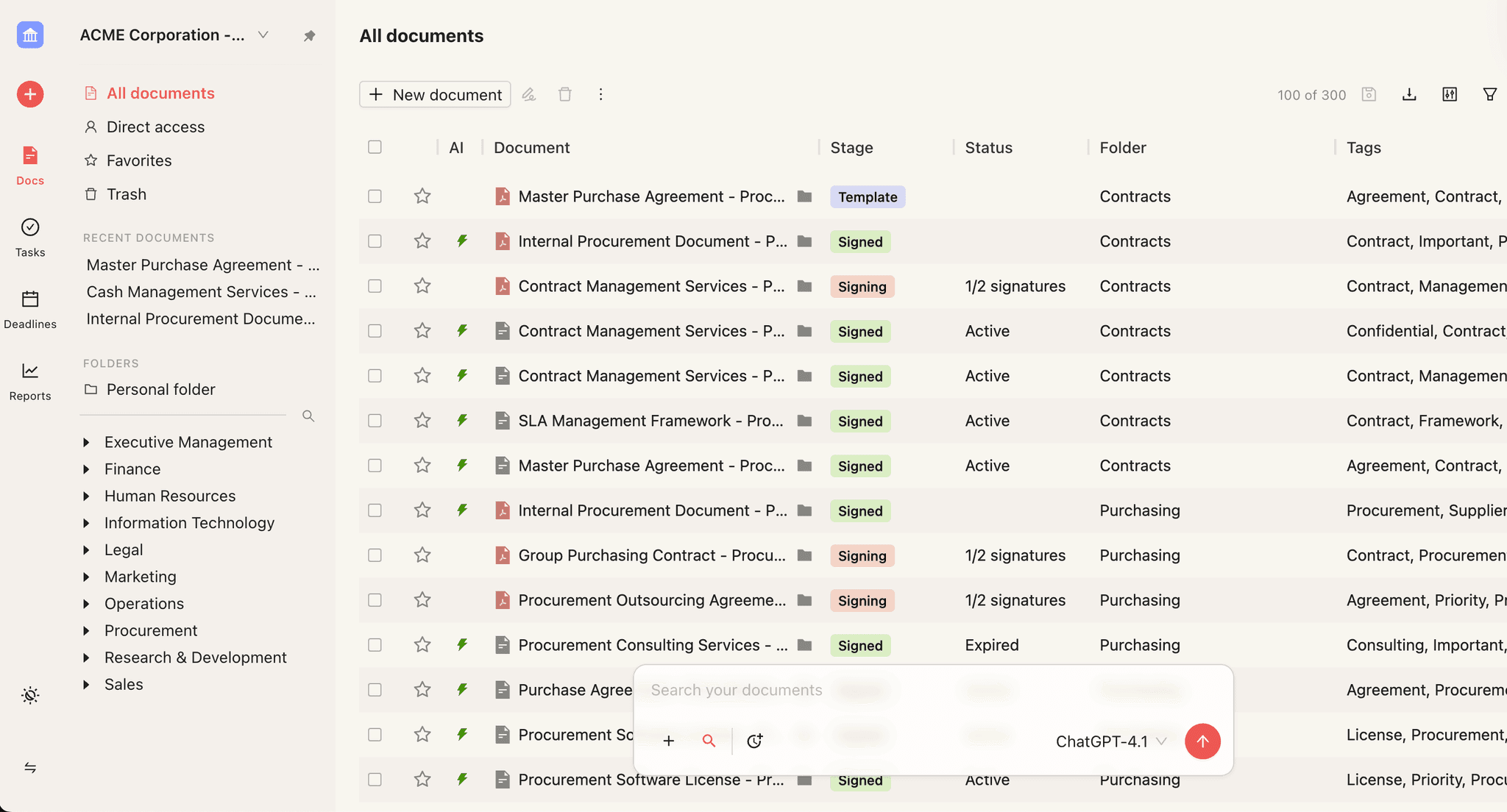
A platform that implements in one to two weeks eliminates this cost entirely. Your team starts working inside the system in the same month the decision is made. With Concord's agreement lifecycle management capabilities, teams move from scattered contracts to a single source of truth in days, not quarters.
UI complexity kills adoption, and adoption is everything
A CLM only delivers value if people use it. This sounds obvious, but it is the single biggest reason enterprise CLM investments fail at mid-market companies.
Enterprise platforms accumulate features in layers over years, resulting in interfaces that legal teams describe as "complicated" and "convoluted." Buyers consistently prefer systems that feel intuitive right away, comparing the ideal experience to tools like Google Docs rather than something requiring specialized training.
Legal ops leaders frequently report that end users resist platforms requiring too many clicks to accomplish basic tasks. When adoption stalls, the downstream benefits (centralized data, tracked deadlines, reduced missed renewals, faster signing cycles) never materialize. You end up paying enterprise prices for a tool that sits unused while contracts keep flowing through email.
A CLM designed around simplicity drives adoption organically. When the interface feels familiar, your team uses it without being forced to. That is where the real return on investment lives.
Right-sizing does not mean downgrading
The word "alternative" can imply compromise. It should not. The right-sized CLM argument is not about accepting less. It is about matching capability to need.
Full lifecycle contract management, from intake through drafting, negotiation, approval, signature, and post-execution tracking, does not require enterprise-scale infrastructure. Mid-market buyers consistently ask for the same set of capabilities:
Centralized repository with searchable metadata
Deadline management with automated renewal and expiration alerts
Redlining and negotiation tools for real-time collaboration
Approval workflows that route contracts to the right people
Built-in e-signature without third-party add-ons
AI-powered data extraction for key terms and dates
Clause library management for reusable, pre-approved language
Every one of these capabilities is available without a six-figure price tag or a six-month implementation timeline. Teams that right-size their CLM get the same outcomes. They just stop paying for the features they were never going to use.
How to evaluate whether you are overpaying
If you are currently on an enterprise CLM, or evaluating one, ask yourself these questions:
How many features does your team actually use? Log in and count the modules, dashboards, and tools your team touches in a typical week. If the number is small relative to what is available, you are paying for shelf space.
How long did implementation take, or how long is it projected to take? If the answer is measured in months, calculate what that time costs in internal labor and delayed value.
What is your per-user cost, and how does it scale? Enterprise platforms often charge per seat in ways that become unpredictable as your team grows. Concord's user management model includes unlimited viewer seats, so you pay only for the access levels you need.
Can your team use the platform without dedicated training sessions? If onboarding requires workshops and certification, the complexity tax extends well beyond the subscription fee.
FAQ
Q: Is a right-sized CLM appropriate for companies with complex compliance requirements?
Yes. Right-sized does not mean simplified to the point of sacrificing governance. Features like audit trails, permission controls, entity lifecycle management, and soft-delete protection address compliance needs without requiring enterprise-tier pricing. The question is whether your compliance requirements genuinely demand the depth of an enterprise platform or whether a well-designed mid-market CLM covers them fully.
Q: What if my company grows into needing enterprise-level features later?
Starting with a platform that fits your current needs does not lock you into a permanent ceiling. Many teams find that a right-sized CLM covers their requirements well beyond initial expectations. If your organization eventually reaches the scale and complexity where enterprise features become necessary, you will make that transition with clean data, established processes, and a clear understanding of what you actually need, rather than paying for it speculatively from day one.
Q: How does Concord compare to enterprise CLMs like Ironclad or Agiloft?
Concord delivers full lifecycle contract management, including repository, redlining, approvals, e-signature, AI extraction, and deadline tracking, at a fraction of the cost and implementation time of enterprise platforms. The core difference is design philosophy: Concord is built for teams that need complete contract management without the overhead of configuring a platform designed for organizations ten times their size.
Stop paying for features you will never use
If your CLM costs more to manage than the contracts it holds, something is misaligned. Concord gives mid-market legal and ops teams full lifecycle contract management with transparent pricing, fast implementation, and an interface your team will actually adopt. See Concord's pricing and start right-sizing your contract platform today.
Your legal team has three people. Your contract volume is growing but manageable. So why are you paying six figures a year for a contract lifecycle management platform built for a Fortune 500 legal department?
If you have been evaluating CLM tools and finding yourself priced out before the first demo ends, you are not alone. The enterprise CLM alternative conversation is happening across mid-market companies everywhere, and for good reason. The mismatch between what most teams need and what enterprise platforms sell is costing companies tens of thousands of dollars annually in unused capability.
The enterprise CLM tax is a market-structure problem
Enterprise CLM platforms exist to serve legal departments with dozens of attorneys, multi-entity corporate structures, and deep integration requirements across ERP, procurement, and compliance systems. Their pricing, implementation timelines, and feature density reflect that reality.
The problem is not that these platforms are bad. The problem is that they were designed for a fundamentally different buyer profile. When a mid-market company with a lean legal team buys one, the outcome is predictable: overspending, underutilization, and adoption failure.
Legal ops leaders at growing companies frequently describe enterprise platforms as "way more than what we need" and "out of budget" before completing a single demo cycle. The sticker shock hits early, and it hits hard. Annual costs of $50,000 to $100,000 or more are common for platforms where the buying team will activate a small fraction of available features.
This is not a value judgment on enterprise vendors. It is a market-structure observation. These tools are priced for organizations that will use their full depth. If that is not your organization, you are subsidizing capability you will never touch.
Feature count is not feature value
Enterprise platforms compete partly on feature breadth: the number of configurable fields, workflow branches, integration endpoints, and admin controls they can list in an RFP response. For enterprise procurement teams running formal evaluations across complex organizations, that breadth matters.
For a mid-market legal team, it creates noise. The core of what they need comes down to a centralized contract repository, deadline tracking, document review, and basic approval workflows.
Every unused feature adds clutter to the interface, cognitive load during onboarding, and surface area that someone has to maintain. A right-sized CLM delivers the features that matter for your actual workflow without the overhead of features that do not.
Enterprise sales processes waste your time too
The cost of an enterprise CLM is not limited to the subscription price. The procurement process itself consumes resources that lean teams cannot afford to spend.
Buyers report needing three or four calls with enterprise CLM vendors before seeing the product. Pricing is opaque by design, requiring multiple discovery conversations, custom scoping, and negotiation before a number surfaces. Demos stretch across weeks. Access to the actual platform comes late in the cycle, if it comes at all before a signature.
For a legal ops manager juggling contract reviews, compliance questions, and board reporting, spending six weeks just to get a price quote is an unreasonable ask. Transparent, published pricing allows you to self-qualify, compare options in parallel, and bring a clear budget request to your CFO without a drawn-out back-and-forth. The evaluation process itself becomes faster and cheaper.
Implementation speed is a direct cost driver
A CLM that takes three to six months to implement does not just delay time to value. It consumes internal resources throughout the implementation window. For a two or three person legal team, those months represent hundreds of hours spent on configuration calls, data mapping sessions, template migration workshops, and user training cohorts.
Meanwhile, contracts continue living in email inboxes, Salesforce, SharePoint folders, and Google Drive. The very problems that prompted the CLM purchase persist through the entire implementation period.
A platform that implements in one to two weeks eliminates this cost entirely. Your team starts working inside the system in the same month the decision is made. With Concord's agreement lifecycle management capabilities, teams move from scattered contracts to a single source of truth in days, not quarters.
UI complexity kills adoption, and adoption is everything
A CLM only delivers value if people use it. This sounds obvious, but it is the single biggest reason enterprise CLM investments fail at mid-market companies.
Enterprise platforms accumulate features in layers over years, resulting in interfaces that legal teams describe as "complicated" and "convoluted." Buyers consistently prefer systems that feel intuitive right away, comparing the ideal experience to tools like Google Docs rather than something requiring specialized training.
Legal ops leaders frequently report that end users resist platforms requiring too many clicks to accomplish basic tasks. When adoption stalls, the downstream benefits (centralized data, tracked deadlines, reduced missed renewals, faster signing cycles) never materialize. You end up paying enterprise prices for a tool that sits unused while contracts keep flowing through email.
A CLM designed around simplicity drives adoption organically. When the interface feels familiar, your team uses it without being forced to. That is where the real return on investment lives.
Right-sizing does not mean downgrading
The word "alternative" can imply compromise. It should not. The right-sized CLM argument is not about accepting less. It is about matching capability to need.
Full lifecycle contract management, from intake through drafting, negotiation, approval, signature, and post-execution tracking, does not require enterprise-scale infrastructure. Mid-market buyers consistently ask for the same set of capabilities:
Centralized repository with searchable metadata
Deadline management with automated renewal and expiration alerts
Redlining and negotiation tools for real-time collaboration
Approval workflows that route contracts to the right people
Built-in e-signature without third-party add-ons
AI-powered data extraction for key terms and dates
Clause library management for reusable, pre-approved language
Every one of these capabilities is available without a six-figure price tag or a six-month implementation timeline. Teams that right-size their CLM get the same outcomes. They just stop paying for the features they were never going to use.
How to evaluate whether you are overpaying
If you are currently on an enterprise CLM, or evaluating one, ask yourself these questions:
How many features does your team actually use? Log in and count the modules, dashboards, and tools your team touches in a typical week. If the number is small relative to what is available, you are paying for shelf space.
How long did implementation take, or how long is it projected to take? If the answer is measured in months, calculate what that time costs in internal labor and delayed value.
What is your per-user cost, and how does it scale? Enterprise platforms often charge per seat in ways that become unpredictable as your team grows. Concord's user management model includes unlimited viewer seats, so you pay only for the access levels you need.
Can your team use the platform without dedicated training sessions? If onboarding requires workshops and certification, the complexity tax extends well beyond the subscription fee.
FAQ
Q: Is a right-sized CLM appropriate for companies with complex compliance requirements?
Yes. Right-sized does not mean simplified to the point of sacrificing governance. Features like audit trails, permission controls, entity lifecycle management, and soft-delete protection address compliance needs without requiring enterprise-tier pricing. The question is whether your compliance requirements genuinely demand the depth of an enterprise platform or whether a well-designed mid-market CLM covers them fully.
Q: What if my company grows into needing enterprise-level features later?
Starting with a platform that fits your current needs does not lock you into a permanent ceiling. Many teams find that a right-sized CLM covers their requirements well beyond initial expectations. If your organization eventually reaches the scale and complexity where enterprise features become necessary, you will make that transition with clean data, established processes, and a clear understanding of what you actually need, rather than paying for it speculatively from day one.
Q: How does Concord compare to enterprise CLMs like Ironclad or Agiloft?
Concord delivers full lifecycle contract management, including repository, redlining, approvals, e-signature, AI extraction, and deadline tracking, at a fraction of the cost and implementation time of enterprise platforms. The core difference is design philosophy: Concord is built for teams that need complete contract management without the overhead of configuring a platform designed for organizations ten times their size.
Stop paying for features you will never use
If your CLM costs more to manage than the contracts it holds, something is misaligned. Concord gives mid-market legal and ops teams full lifecycle contract management with transparent pricing, fast implementation, and an interface your team will actually adopt. See Concord's pricing and start right-sizing your contract platform today.

Take the "management" out
of contract management.
Customer Support
Legal
Compare
Resources
Customer Support
Company
Legal
Compare
Resources
Customer Support
Company
Legal
Compare
© 2025 Concord. All rights reserved.