How to choose procurement contract management software
How to choose procurement contract management software
How to choose procurement contract management software
How to choose procurement contract management software
contract management
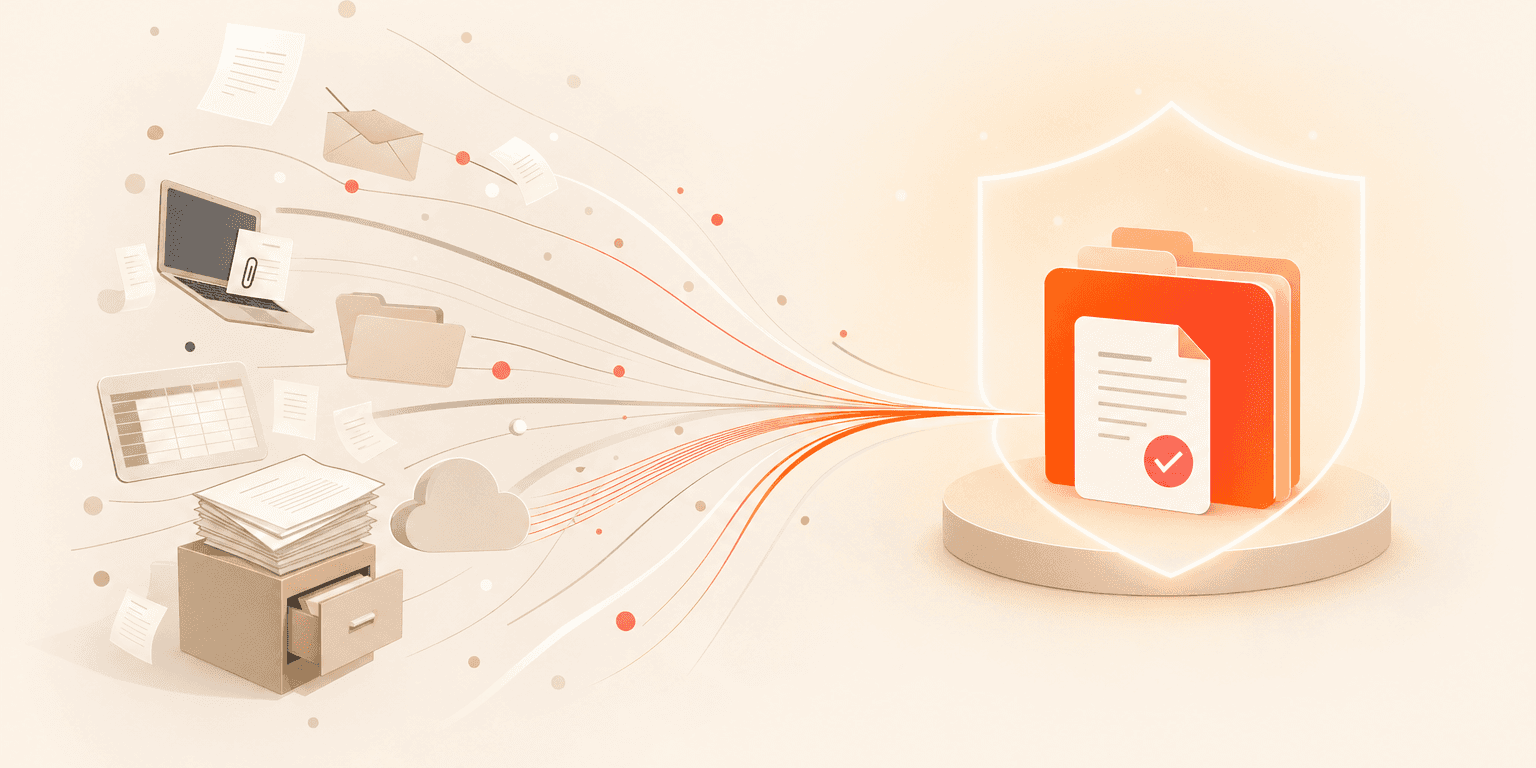
If your vendor contracts live in six different places, you already know the problem. Procurement teams juggle email attachments, shared drives, personal laptops, spreadsheets, and legacy file systems just to answer a simple question: "When does this contract renew?" The right procurement contract management software puts every vendor agreement in one place and maps directly to the workflows your team actually uses, from intake through renewal.
This guide gives you a structured framework for evaluating CLM platforms based on how procurement teams work, not how software vendors market their features.
What is procurement contract management software?
Procurement contract management software is a category of CLM (contract lifecycle management) tools designed to centralize, track, and manage vendor agreements across their full lifecycle. That lifecycle includes intake requests, negotiation, approvals, execution, compliance monitoring, renewal tracking, and reporting.
The distinction matters because many CLM platforms are built with legal teams as the primary user. Procurement teams have different priorities: vendor onboarding, rate tracking, termination notice windows, compliance certificate management, and portfolio-level visibility across hundreds or thousands of supplier relationships. A CLM that works for procurement must address these workflows directly.
Why scattered contracts cost you more than you think
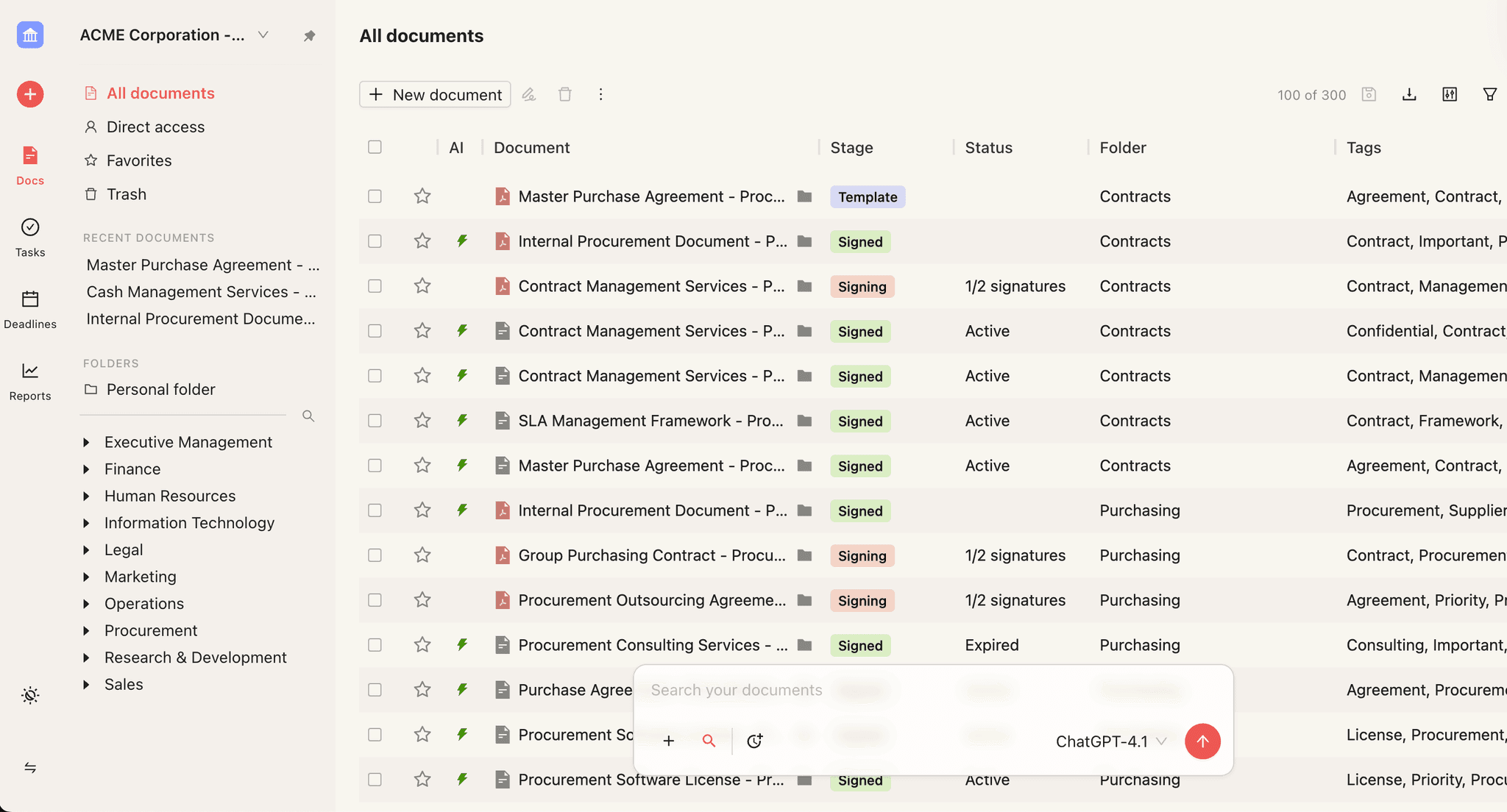
According to our research, procurement and legal teams typically manage vendor contracts across four to six disconnected storage locations. Contracts sit in Outlook inboxes, Google Drive folders, SharePoint sites, CRM records, and sometimes on individual employees' hard drives. Agreements predating a certain year are often completely unaccounted for.
Procurement and legal teams typically manage vendor contracts across four to six disconnected storage locations — inboxes, shared drives, SharePoint, CRM records, and individual laptops.
This fragmentation creates three compounding problems:
Missed deadlines and unintended renewals. Teams tracking renewal dates in spreadsheets report that those spreadsheets are inconsistently updated. When a 30, 60, or 90-day termination notice window passes unnoticed, you are locked into another contract term, often at unfavorable rates.
Single-point-of-failure risk. Critical knowledge about vendor terms, clause exceptions, and negotiation history frequently resides with one or two long-tenured employees. If those individuals leave, the institutional memory leaves with them.
Unreliable reporting. When folder structures and naming conventions vary by person, getting an accurate count of active vendor contracts, identifying duplicates, or distinguishing current agreements from archived ones becomes nearly impossible.
A procurement workflow-to-CLM capability map
Most buyer's guides list features in isolation. The more useful approach is to map each stage of your procurement workflow to the CLM capabilities you need at that stage.
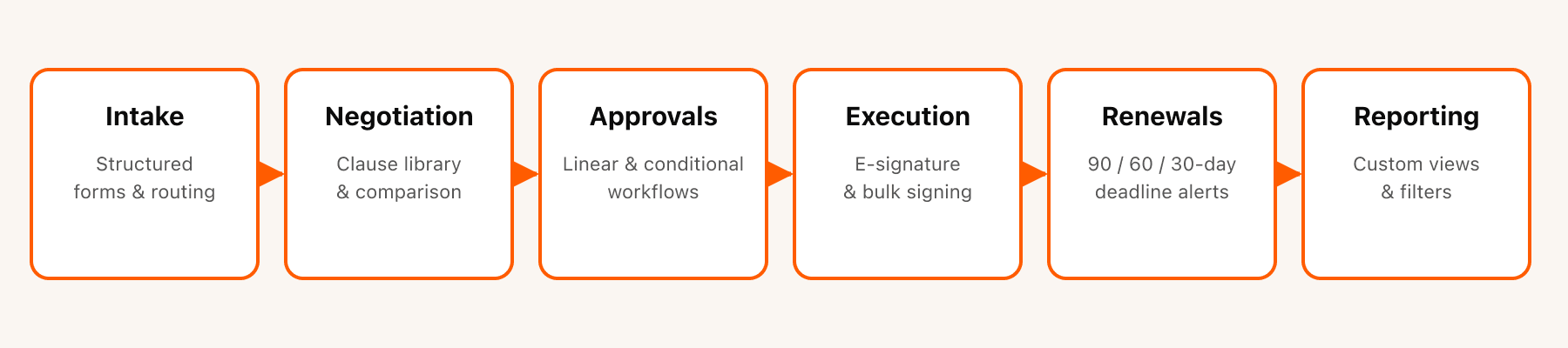
Intake: Your team needs structured intake forms so internal stakeholders can submit vendor contract requests with required details and attachments. The CLM should route these submissions into workflows automatically. Look for platforms offering free viewer seats so requesters do not need paid licenses. Concord's intake forms handle this with configurable fields and automatic routing.
Negotiation: A centralized clause library allows your team to negotiate from consistent positions. You should be able to search across your entire portfolio, extract key clauses, and compare terms between agreements to spot exceptions to standard language. Concord's clause management tools give procurement teams this capability without opening every document individually.
Approvals: Replace email-based approval chains with configurable linear and conditional workflows. Your CLM should support multi-stakeholder review across legal, finance, operations, and executive approvers with notifications and reminders for pending reviews. Concord's approval workflows provide structured routing that tracks exactly where each contract sits in the review chain.
Execution: Built-in e-signature eliminates the need for a separate signing tool. Look for platforms that support bulk signing when you are processing multiple vendor agreements simultaneously.
Renewals and compliance: Automated deadline alerts at configurable intervals (90, 60, 30 days) are non-negotiable. Calendar and list views with filtering let you see upcoming renewals across your entire vendor portfolio at a glance. Tagging and custom properties support compliance tracking for certificates, regulatory requirements, and audit documentation.
Reporting: You need visibility into contract counts by type, status (active versus expired), financial commitments, and vendor relationship summaries. Look for customizable views and filtering capabilities that let you build reports without IT support.
Workflow stage → capability → Concord feature
Stage | Procurement need | Required CLM capability | Concord feature |
|---|---|---|---|
Intake | Route vendor contract requests from stakeholders | Structured forms with automatic workflow routing | Intake forms with configurable fields and free viewer seats |
Negotiation | Negotiate from consistent clause positions | Centralized clause library with cross-portfolio search | Clause management with extraction and comparison |
Approvals | Multi-stakeholder review across legal, finance, ops | Linear and conditional workflows with audit trails | Approval workflows with structured routing and reminders |
Execution | Sign multiple vendor agreements quickly | Built-in e-signature with bulk signing support | Native e-signature, bulk operations across contracts |
Renewals & compliance | Catch termination windows, track certifications | Automated alerts at 90 / 60 / 30 days, tagging, custom properties | Deadline tracking, custom fields, calendar and list views |
Reporting | Answer portfolio-level questions without IT support | Customizable views and filtering on contract metadata | Saved views, filters, exports |
Your requirements checklist
Use this list when evaluating any CLM platform for procurement use:
Centralized repository that supports all document types (MSAs, SOWs, NDAs, change orders, addenda)
Folder organization by vendor, region, department, or contract type
AI-powered data extraction and OCR for scanned documents and third-party paper
Automatic metadata population (parties, dates, duration, financial amounts, renewal terms)
Configurable deadline alerts for renewals, expirations, and termination notice periods
Structured intake forms with automatic workflow routing
Linear and conditional approval workflows with audit trails
Clause library with search, extraction, and comparison capabilities
Third-party/vendor registry with classification, duplicate merging, and search
Bulk operations for signing, archiving, tagging, and extracting data across multiple contracts
Role-based access controls and permission management
API access and integration support for ERP, P2P, and CRM systems
Security certifications (SOC 2, GDPR compliance, SSO, encryption)
How to evaluate a CLM for vendor contracts
Beyond the feature checklist, consider these comparison criteria when narrowing your options:
Procurement-first versus legal-first design. Ask vendors how their platform handles vendor onboarding intake, rate tracking, and compliance certificate management specifically.
Implementation speed. Procurement teams often manage hundreds or thousands of legacy contracts that need to be migrated. Ask about bulk upload and AI extraction capabilities for existing documents. Some CLM platforms require months of setup. Concord's average implementation takes about two weeks.
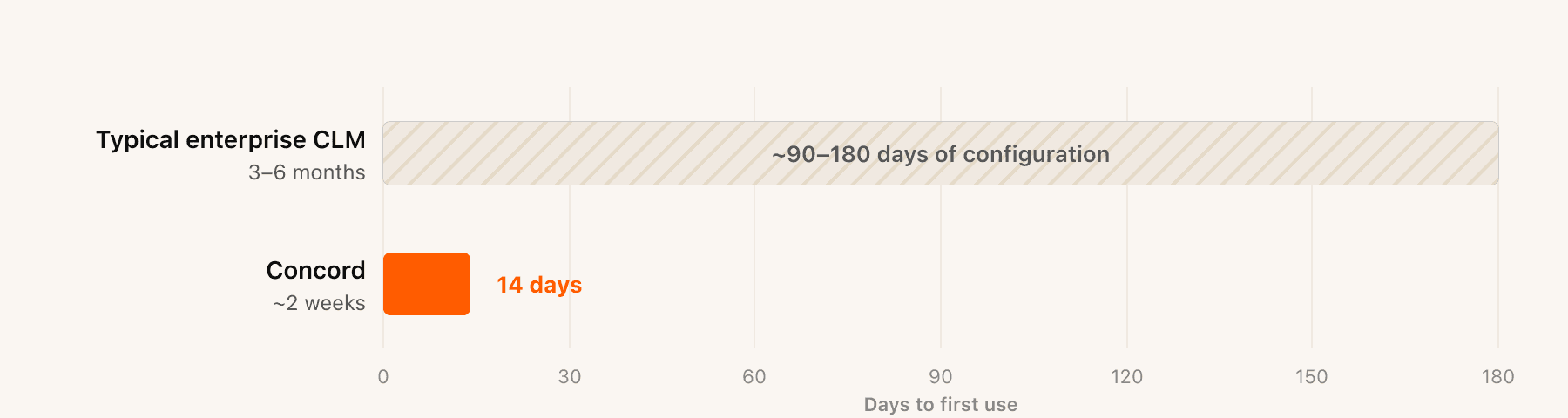
Concord's average implementation takes approximately two weeks, compared to three to six months for many enterprise CLM platforms.
Total cost of access. Many CLM platforms charge per-seat fees that make it expensive to include every stakeholder who touches a vendor contract. Look for plans that offer free viewer seats or flexible user models so finance, operations, and department heads can access contracts without inflating your license costs.
Migration support. Your new CLM should support bulk operations for importing, tagging, and extracting data from legacy contracts. AI-powered OCR should handle scanned PDFs and documents signed outside the system.
Integration capability. Procurement teams typically use ERP systems, P2P platforms, and CRMs alongside their CLM. Confirm that the platform offers an open API and supports the connectors your tech stack requires. Concord offers API access and integration support through its Business plan.
Start with the repository, then expand
Nearly every procurement team follows the same adoption pattern: centralize first, then layer on workflows. Your first priority is getting every vendor contract into a single system of record with accurate metadata and deadline tracking. Once that foundation is in place, you add negotiation tools, approval workflows, e-signature, and advanced reporting.
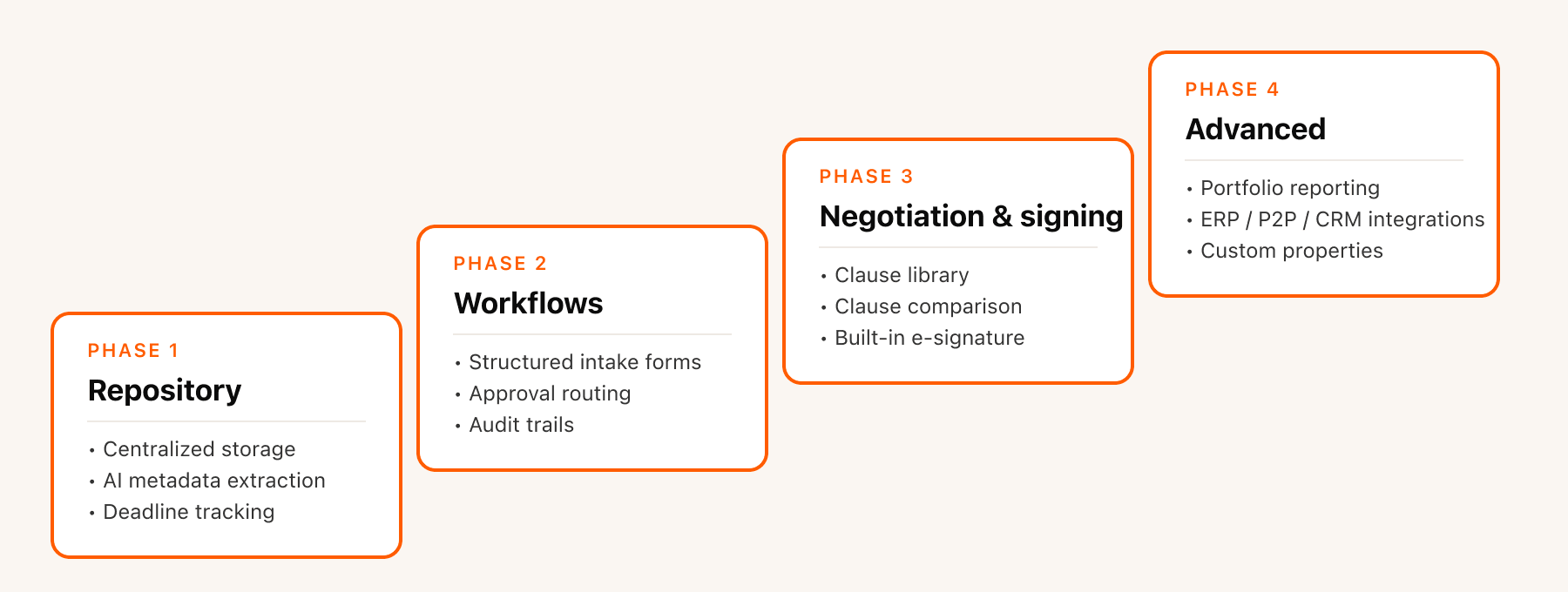
This phased approach reduces implementation risk and delivers immediate value. On day one, your team can search across the entire vendor portfolio, see every upcoming renewal, and stop relying on a single person's memory for contract details.
Frequently asked questions
What is the difference between a CLM and a contract repository? A contract repository is a storage system for documents. A CLM platform covers the full contract lifecycle: intake, authoring, negotiation, approvals, e-signature, deadline tracking, compliance monitoring, and reporting. A repository is one component of a CLM. Most procurement teams need the full lifecycle, but the repository is the right starting point.
Repository vs full CLM: capability comparison
Capability | Contract repository | Full CLM platform |
|---|---|---|
Centralized document storage | Yes | Yes |
Metadata extraction and OCR | Manual entry only | Automated, AI-powered |
Deadline and renewal alerts | Not included | Configurable at 90 / 60 / 30 days |
Clause library and comparison | Not included | Searchable across portfolio |
Structured intake forms | Not included | Configurable fields and routing |
Approval workflows | Not included | Linear and conditional with audit trails |
Built-in e-signature | Not included | Included, supports bulk signing |
Portfolio-level reporting | Basic file search only | Customizable views and filters |
ERP / P2P / CRM integrations | Not included | Open API access |
How long does CLM implementation take for procurement teams? Implementation timelines vary widely. Some enterprise CLM platforms require three to six months of configuration. Concord's average implementation takes approximately two weeks, including bulk migration of existing contracts. The key factor is whether the platform supports AI-powered extraction and bulk operations that accelerate the migration of legacy vendor agreements.
Can a CLM replace the contract module in our P2P or source-to-pay platform? In many organizations, the contract management component of P2P systems is minimal or unused. A dedicated CLM fills that gap by providing full lifecycle capabilities, including clause management, approval workflows, and automated deadline tracking, that P2P contract modules typically lack.
Take the next step
If your vendor contracts are scattered across inboxes, drives, and spreadsheets, you are already paying for a CLM problem you have not yet solved. Concord gives procurement teams a centralized system of record for every vendor agreement, with AI-powered extraction, configurable workflows, and deadline management built in. See how it works for your team by requesting a demo at concord.app.
If your vendor contracts live in six different places, you already know the problem. Procurement teams juggle email attachments, shared drives, personal laptops, spreadsheets, and legacy file systems just to answer a simple question: "When does this contract renew?" The right procurement contract management software puts every vendor agreement in one place and maps directly to the workflows your team actually uses, from intake through renewal.
This guide gives you a structured framework for evaluating CLM platforms based on how procurement teams work, not how software vendors market their features.
What is procurement contract management software?
Procurement contract management software is a category of CLM (contract lifecycle management) tools designed to centralize, track, and manage vendor agreements across their full lifecycle. That lifecycle includes intake requests, negotiation, approvals, execution, compliance monitoring, renewal tracking, and reporting.
The distinction matters because many CLM platforms are built with legal teams as the primary user. Procurement teams have different priorities: vendor onboarding, rate tracking, termination notice windows, compliance certificate management, and portfolio-level visibility across hundreds or thousands of supplier relationships. A CLM that works for procurement must address these workflows directly.
Why scattered contracts cost you more than you think
According to our research, procurement and legal teams typically manage vendor contracts across four to six disconnected storage locations. Contracts sit in Outlook inboxes, Google Drive folders, SharePoint sites, CRM records, and sometimes on individual employees' hard drives. Agreements predating a certain year are often completely unaccounted for.
Procurement and legal teams typically manage vendor contracts across four to six disconnected storage locations — inboxes, shared drives, SharePoint, CRM records, and individual laptops.
This fragmentation creates three compounding problems:
Missed deadlines and unintended renewals. Teams tracking renewal dates in spreadsheets report that those spreadsheets are inconsistently updated. When a 30, 60, or 90-day termination notice window passes unnoticed, you are locked into another contract term, often at unfavorable rates.
Single-point-of-failure risk. Critical knowledge about vendor terms, clause exceptions, and negotiation history frequently resides with one or two long-tenured employees. If those individuals leave, the institutional memory leaves with them.
Unreliable reporting. When folder structures and naming conventions vary by person, getting an accurate count of active vendor contracts, identifying duplicates, or distinguishing current agreements from archived ones becomes nearly impossible.
A procurement workflow-to-CLM capability map
Most buyer's guides list features in isolation. The more useful approach is to map each stage of your procurement workflow to the CLM capabilities you need at that stage.
Intake: Your team needs structured intake forms so internal stakeholders can submit vendor contract requests with required details and attachments. The CLM should route these submissions into workflows automatically. Look for platforms offering free viewer seats so requesters do not need paid licenses. Concord's intake forms handle this with configurable fields and automatic routing.
Negotiation: A centralized clause library allows your team to negotiate from consistent positions. You should be able to search across your entire portfolio, extract key clauses, and compare terms between agreements to spot exceptions to standard language. Concord's clause management tools give procurement teams this capability without opening every document individually.
Approvals: Replace email-based approval chains with configurable linear and conditional workflows. Your CLM should support multi-stakeholder review across legal, finance, operations, and executive approvers with notifications and reminders for pending reviews. Concord's approval workflows provide structured routing that tracks exactly where each contract sits in the review chain.
Execution: Built-in e-signature eliminates the need for a separate signing tool. Look for platforms that support bulk signing when you are processing multiple vendor agreements simultaneously.
Renewals and compliance: Automated deadline alerts at configurable intervals (90, 60, 30 days) are non-negotiable. Calendar and list views with filtering let you see upcoming renewals across your entire vendor portfolio at a glance. Tagging and custom properties support compliance tracking for certificates, regulatory requirements, and audit documentation.
Reporting: You need visibility into contract counts by type, status (active versus expired), financial commitments, and vendor relationship summaries. Look for customizable views and filtering capabilities that let you build reports without IT support.
Workflow stage → capability → Concord feature
Stage | Procurement need | Required CLM capability | Concord feature |
|---|---|---|---|
Intake | Route vendor contract requests from stakeholders | Structured forms with automatic workflow routing | Intake forms with configurable fields and free viewer seats |
Negotiation | Negotiate from consistent clause positions | Centralized clause library with cross-portfolio search | Clause management with extraction and comparison |
Approvals | Multi-stakeholder review across legal, finance, ops | Linear and conditional workflows with audit trails | Approval workflows with structured routing and reminders |
Execution | Sign multiple vendor agreements quickly | Built-in e-signature with bulk signing support | Native e-signature, bulk operations across contracts |
Renewals & compliance | Catch termination windows, track certifications | Automated alerts at 90 / 60 / 30 days, tagging, custom properties | Deadline tracking, custom fields, calendar and list views |
Reporting | Answer portfolio-level questions without IT support | Customizable views and filtering on contract metadata | Saved views, filters, exports |
Your requirements checklist
Use this list when evaluating any CLM platform for procurement use:
Centralized repository that supports all document types (MSAs, SOWs, NDAs, change orders, addenda)
Folder organization by vendor, region, department, or contract type
AI-powered data extraction and OCR for scanned documents and third-party paper
Automatic metadata population (parties, dates, duration, financial amounts, renewal terms)
Configurable deadline alerts for renewals, expirations, and termination notice periods
Structured intake forms with automatic workflow routing
Linear and conditional approval workflows with audit trails
Clause library with search, extraction, and comparison capabilities
Third-party/vendor registry with classification, duplicate merging, and search
Bulk operations for signing, archiving, tagging, and extracting data across multiple contracts
Role-based access controls and permission management
API access and integration support for ERP, P2P, and CRM systems
Security certifications (SOC 2, GDPR compliance, SSO, encryption)
How to evaluate a CLM for vendor contracts
Beyond the feature checklist, consider these comparison criteria when narrowing your options:
Procurement-first versus legal-first design. Ask vendors how their platform handles vendor onboarding intake, rate tracking, and compliance certificate management specifically.
Implementation speed. Procurement teams often manage hundreds or thousands of legacy contracts that need to be migrated. Ask about bulk upload and AI extraction capabilities for existing documents. Some CLM platforms require months of setup. Concord's average implementation takes about two weeks.
Concord's average implementation takes approximately two weeks, compared to three to six months for many enterprise CLM platforms.
Total cost of access. Many CLM platforms charge per-seat fees that make it expensive to include every stakeholder who touches a vendor contract. Look for plans that offer free viewer seats or flexible user models so finance, operations, and department heads can access contracts without inflating your license costs.
Migration support. Your new CLM should support bulk operations for importing, tagging, and extracting data from legacy contracts. AI-powered OCR should handle scanned PDFs and documents signed outside the system.
Integration capability. Procurement teams typically use ERP systems, P2P platforms, and CRMs alongside their CLM. Confirm that the platform offers an open API and supports the connectors your tech stack requires. Concord offers API access and integration support through its Business plan.
Start with the repository, then expand
Nearly every procurement team follows the same adoption pattern: centralize first, then layer on workflows. Your first priority is getting every vendor contract into a single system of record with accurate metadata and deadline tracking. Once that foundation is in place, you add negotiation tools, approval workflows, e-signature, and advanced reporting.
This phased approach reduces implementation risk and delivers immediate value. On day one, your team can search across the entire vendor portfolio, see every upcoming renewal, and stop relying on a single person's memory for contract details.
Frequently asked questions
What is the difference between a CLM and a contract repository? A contract repository is a storage system for documents. A CLM platform covers the full contract lifecycle: intake, authoring, negotiation, approvals, e-signature, deadline tracking, compliance monitoring, and reporting. A repository is one component of a CLM. Most procurement teams need the full lifecycle, but the repository is the right starting point.
Repository vs full CLM: capability comparison
Capability | Contract repository | Full CLM platform |
|---|---|---|
Centralized document storage | Yes | Yes |
Metadata extraction and OCR | Manual entry only | Automated, AI-powered |
Deadline and renewal alerts | Not included | Configurable at 90 / 60 / 30 days |
Clause library and comparison | Not included | Searchable across portfolio |
Structured intake forms | Not included | Configurable fields and routing |
Approval workflows | Not included | Linear and conditional with audit trails |
Built-in e-signature | Not included | Included, supports bulk signing |
Portfolio-level reporting | Basic file search only | Customizable views and filters |
ERP / P2P / CRM integrations | Not included | Open API access |
How long does CLM implementation take for procurement teams? Implementation timelines vary widely. Some enterprise CLM platforms require three to six months of configuration. Concord's average implementation takes approximately two weeks, including bulk migration of existing contracts. The key factor is whether the platform supports AI-powered extraction and bulk operations that accelerate the migration of legacy vendor agreements.
Can a CLM replace the contract module in our P2P or source-to-pay platform? In many organizations, the contract management component of P2P systems is minimal or unused. A dedicated CLM fills that gap by providing full lifecycle capabilities, including clause management, approval workflows, and automated deadline tracking, that P2P contract modules typically lack.
Take the next step
If your vendor contracts are scattered across inboxes, drives, and spreadsheets, you are already paying for a CLM problem you have not yet solved. Concord gives procurement teams a centralized system of record for every vendor agreement, with AI-powered extraction, configurable workflows, and deadline management built in. See how it works for your team by requesting a demo at concord.app.

Take the "management" out
of contract management.
Customer Support
Legal
Compare
Resources
Customer Support
Company
Legal
Compare
Resources
Customer Support
Company
Legal
Compare
© 2025 Concord. All rights reserved.