Higher education contract management at scale
Higher education contract management at scale
Higher education contract management at scale
Higher education contract management at scale
contract management
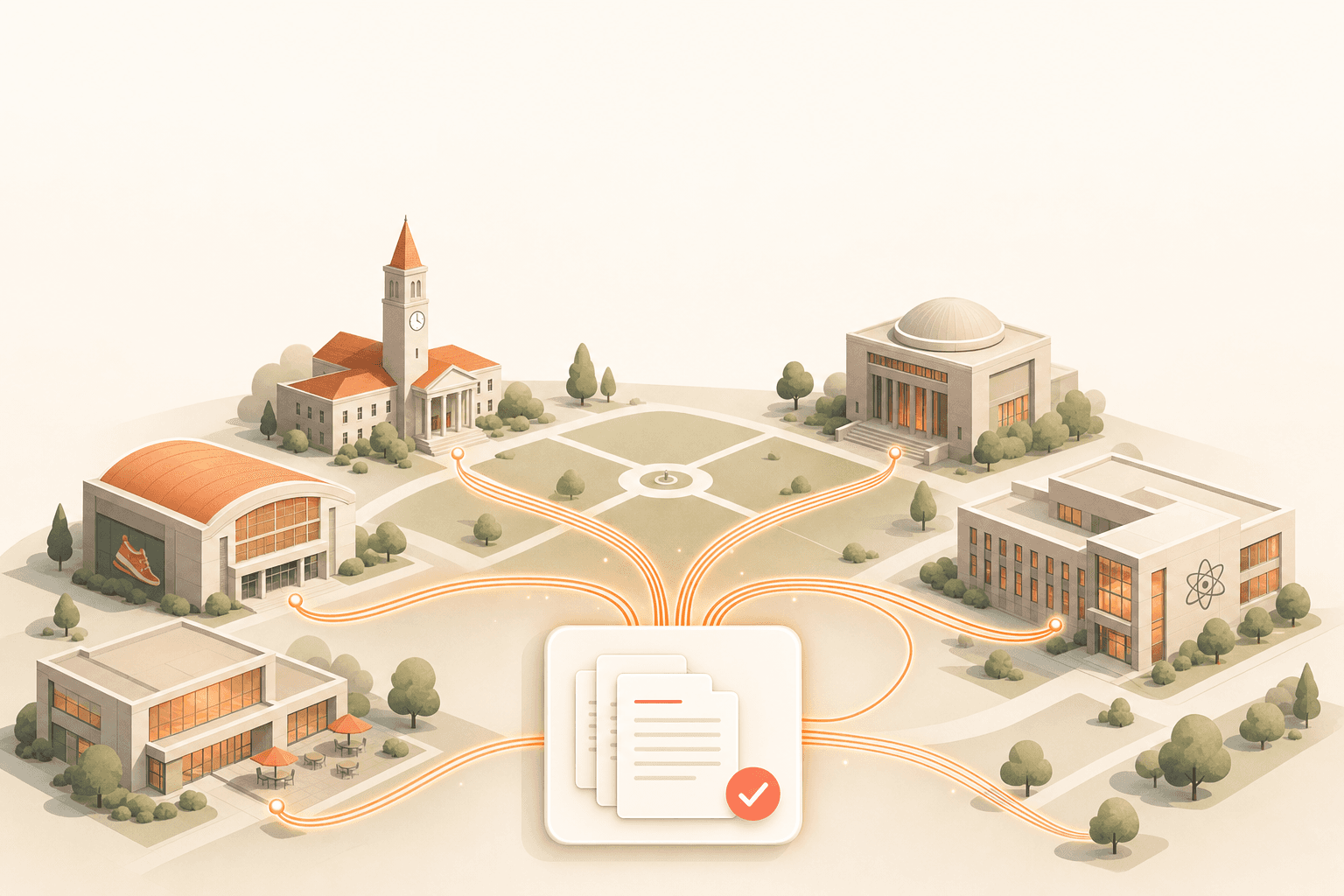
Higher education contract management presents a unique set of challenges that most corporate-focused tools were never designed to handle. Colleges and universities operate under decentralized purchasing models, rigid fiscal-year budget cycles, multi-stakeholder approval chains, accreditation requirements, and staffing constraints that make fragmented, manual approaches unsustainable as contract volumes grow. If your institution is still relying on shared drives, email threads, and personal calendars to track vendor agreements, you already know the cost of that approach. You just may not have quantified it yet.
This post walks through the core challenges higher education procurement teams face and explains how a centralized contract lifecycle management platform addresses each one.
Decentralization is the root cause, not the exception
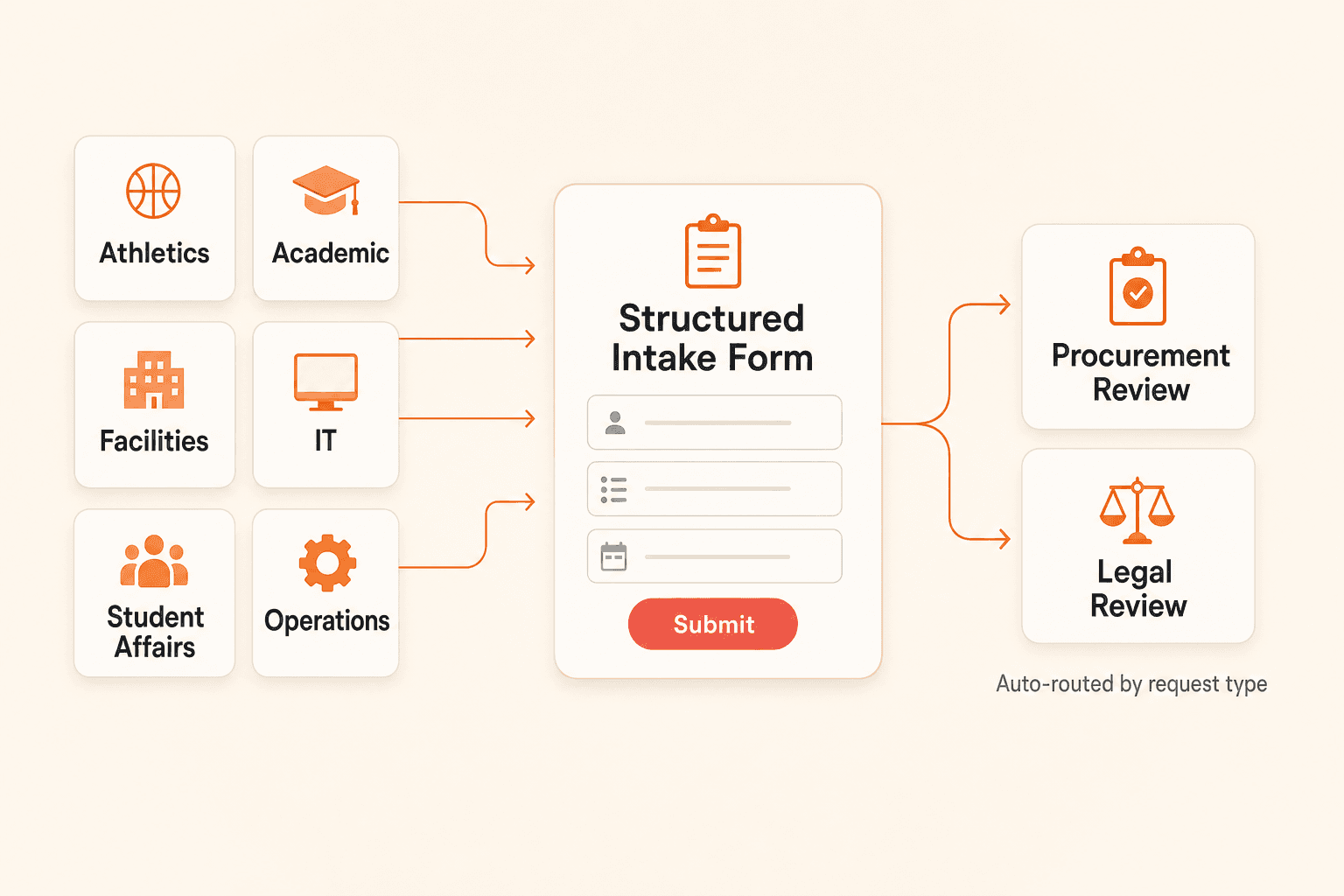
Higher education purchasing is structurally decentralized. Athletics, academic divisions, facilities, IT, student affairs, and dozens of other departments all initiate vendor relationships independently. Contracts end up stored on individual workstations, local drives, shared folders, and, in some cases, physical filing cabinets.
Even institutions that maintain a nominal central repository often discover during audits that significant volumes of agreements sit outside it. Departments route around the system, and coverage gaps emerge.
The temptation is to fix this with policy: a directive from the provost or CFO requiring all contracts to flow through procurement. But higher education's shared-governance model makes top-down mandates difficult to enforce. The practical answer is not to eliminate decentralization but to channel it through a structured intake path that routes contracts through the right approval chain before execution.
Concord's contract intake management feature gives every department a structured request form with required fields that prevent incomplete submissions. Requests route automatically to procurement or legal for review. Departments keep their autonomy; your team keeps oversight.
Missing deadlines means missing budget windows
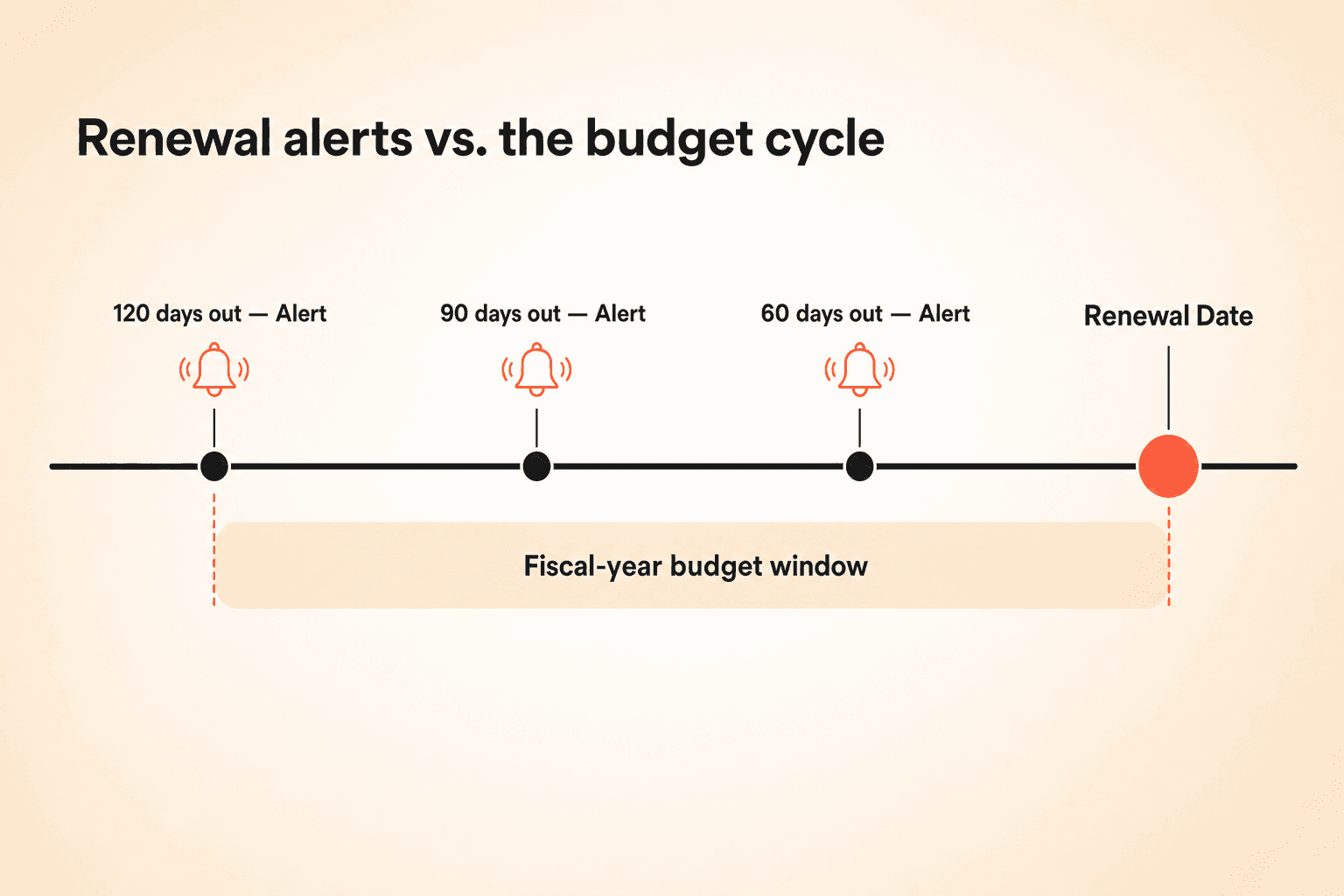
Higher education operates on fiscal-year budget cycles with limited flexibility. When contract renewal dates are invisible, buried in PDFs on someone's desktop, procurement cannot align vendor negotiations with budget planning windows.
The pattern is familiar: a software subscription auto-renews for another year because the termination notice deadline passed without anyone flagging it. A facilities contract rolls over at last year's rate because no one initiated a rebid in time. For institutions already operating under budget pressure, every missed deadline is a direct hit to the operating budget.
Automated deadline alerts that surface renewals 60, 90, or 120 days in advance give budget officers the lead time to evaluate, renegotiate, or terminate before auto-renewal clauses lock in another year of spend. Concord's agreement lifecycle management tools let you set these alerts at the contract level and route notifications to the appropriate stakeholders.
Higher education contract management requires real approval workflows
Many institutions have invoice approval thresholds that route to a VP or CFO above a certain dollar amount. Those same institutions often lack equivalent workflow controls for contracts. Agreements sometimes get executed without procurement or legal review, occasionally leading to commitments the institution cannot fulfill.
Higher education contracts routinely require sign-off from department heads, procurement, legal, and sometimes a VP or president depending on dollar thresholds. When this approval chain runs through email threads and paper routing slips, contracts stall for days or weeks. Configurable approval workflows with built-in notifications compress this timeline by putting the right document in front of the right approver at the right time, with a clear audit trail of who approved what and when.
Pima Community College, a multi-campus community college district, adopted Concord to bring structure to its contract approval process. With grants representing roughly 20 percent of its operating budget, the institution needed a system that could shorten contract development cycles and give its general counsel faster review turnaround. The structured workflow approach replaced informal routing and reduced the time from contract initiation to execution.
Accreditation and grant compliance demand audit trails you can actually produce
Whether the driver is regional accreditation, Title IV compliance, or federal grant requirements, your institution needs to demonstrate documented decision-making around vendor contracts. Accreditation bodies want evidence of how vendor selection and contract decisions were made. Grant-funded contracts carry additional compliance requirements around development timelines and approval documentation.
Without a system of record, these audit trails get assembled retroactively from hallway conversations and email threads. That process is labor-intensive and unreliable. When the accreditation review team or a federal auditor asks how a particular vendor was selected, "Let me check with Janet in facilities" is not an adequate answer.
A platform that captures discussion, approval routing, and version history in real time makes compliance a byproduct of the normal workflow rather than a separate project. Concord's contract property management features let you add custom fields for grant-specific data, insurance certificate expiration dates, or any other accreditation-relevant metadata alongside standard contract terms. Every comment, approval, and document version is preserved automatically.
The legacy contract problem is solvable
Most institutions considering a CLM platform already have hundreds or thousands of executed contracts in various formats and locations. The barrier to adoption is not the future workflow. It is the migration of existing agreements.
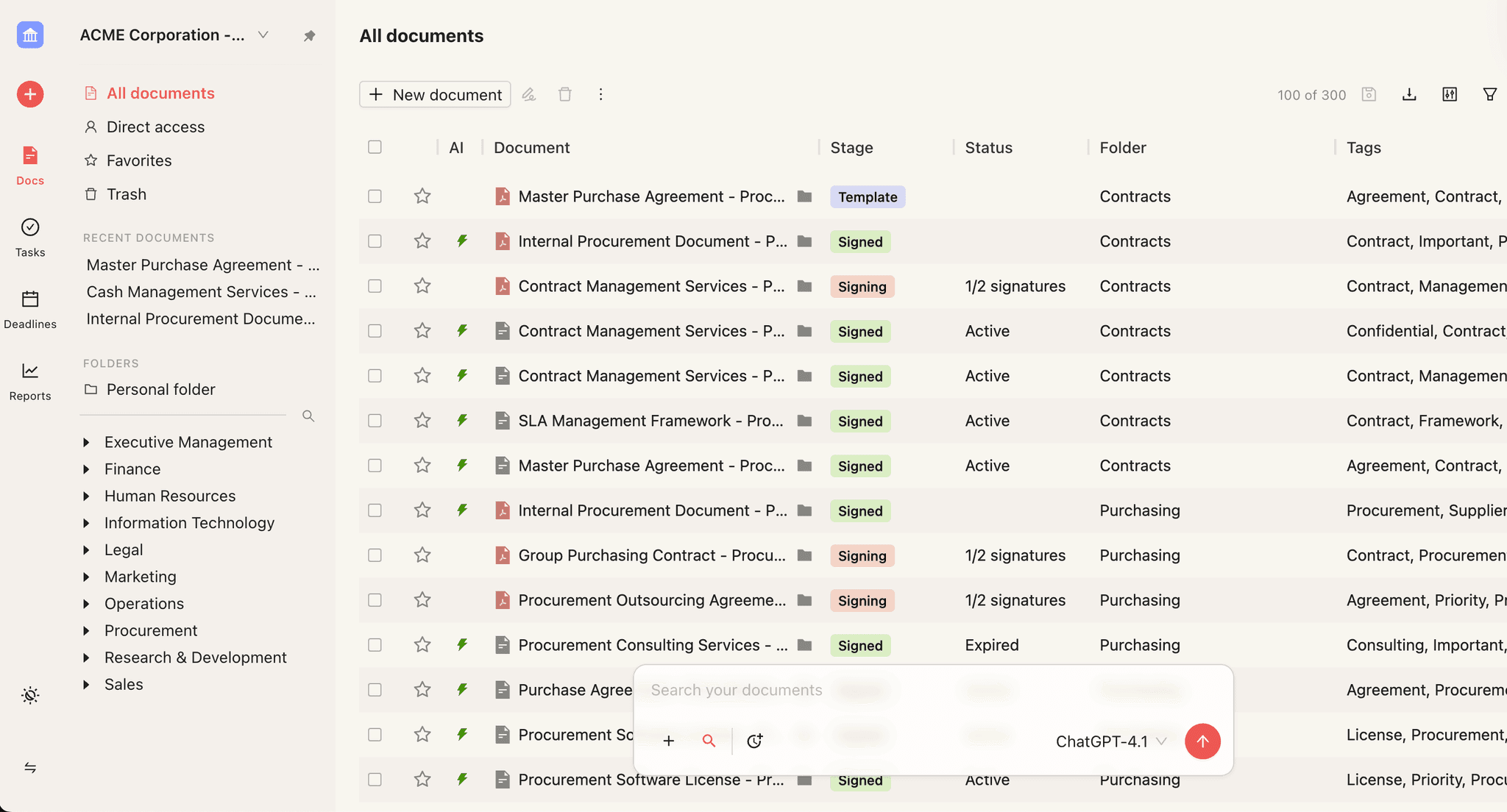
If you had to manually open each PDF, read the terms, and type key dates and financial figures into a database, the project would take months of staff time you do not have. AI-powered data extraction changes this calculation entirely. Concord's bulk contract upload and organization management features let you upload existing agreements in batches. The system automatically reads uploaded contracts, identifies key dates, parties, and financial terms, and populates a structured repository.
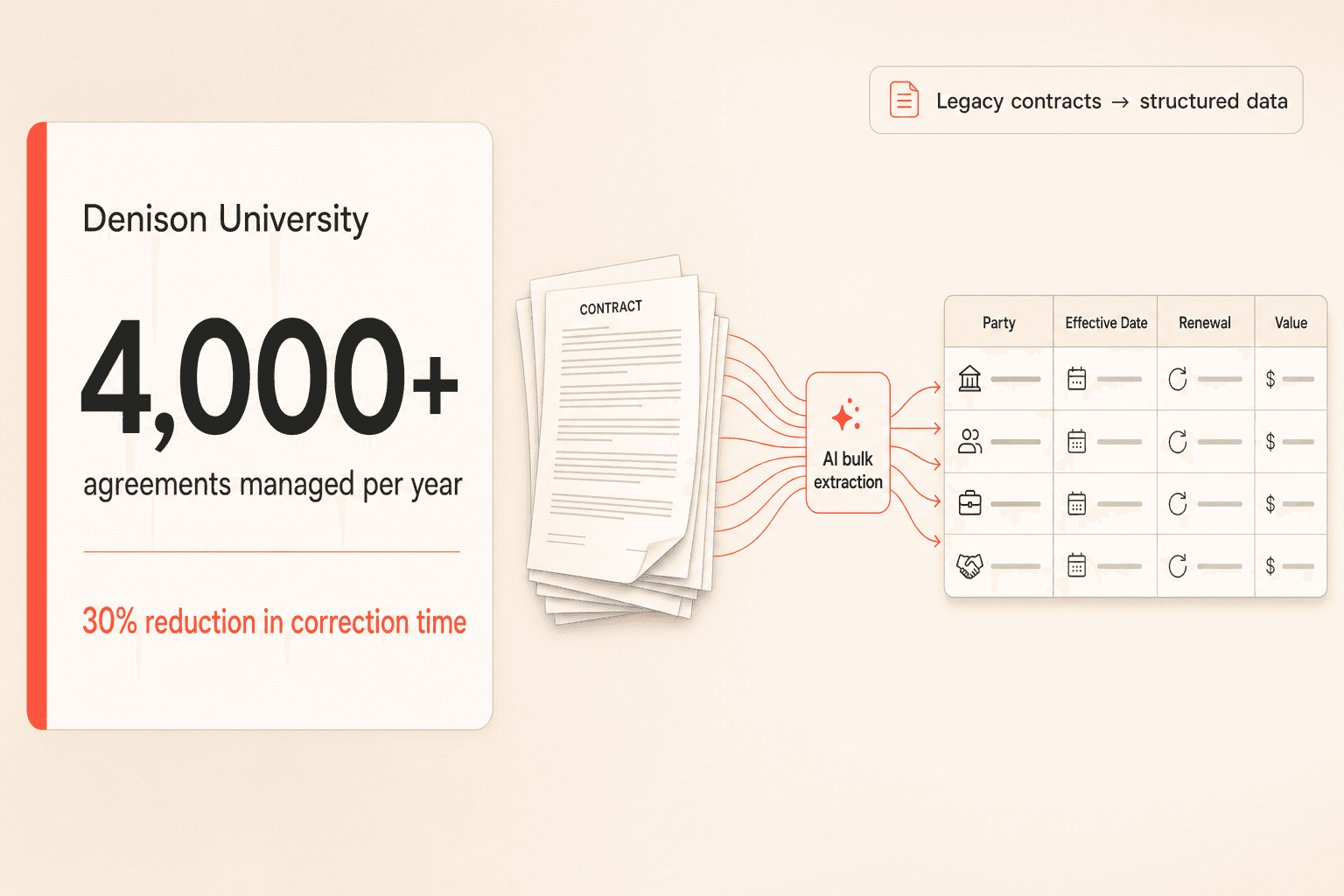
Denison University, a private liberal arts institution managing more than 4,000 agreements per year, used Concord to centralize its contract portfolio and reduce correction time by 30 percent. Template automation and structured workflows replaced manual processes that had previously consumed significant staff hours.
Institutional knowledge cannot live in one person's head
Several patterns emerge consistently in conversations with higher education procurement professionals. One of the most concerning is the concentration of institutional knowledge in a single person, often a long-tenured administrator who has managed vendor relationships for decades.
When that person retires or departs, the institution loses context about vendor terms, negotiation history, pricing benchmarks, and informal commitments. A centralized contract repository with searchable metadata, discussion history, and linked vendor records transforms that knowledge from personal memory into institutional infrastructure.
Concord's third-party management feature maintains a centralized vendor database across all contracts. You can filter by vendor to see every active agreement with a single supplier, which is critical during budget review cycles and invaluable during staff transitions.
Print-sign-scan persistence is costing you weeks
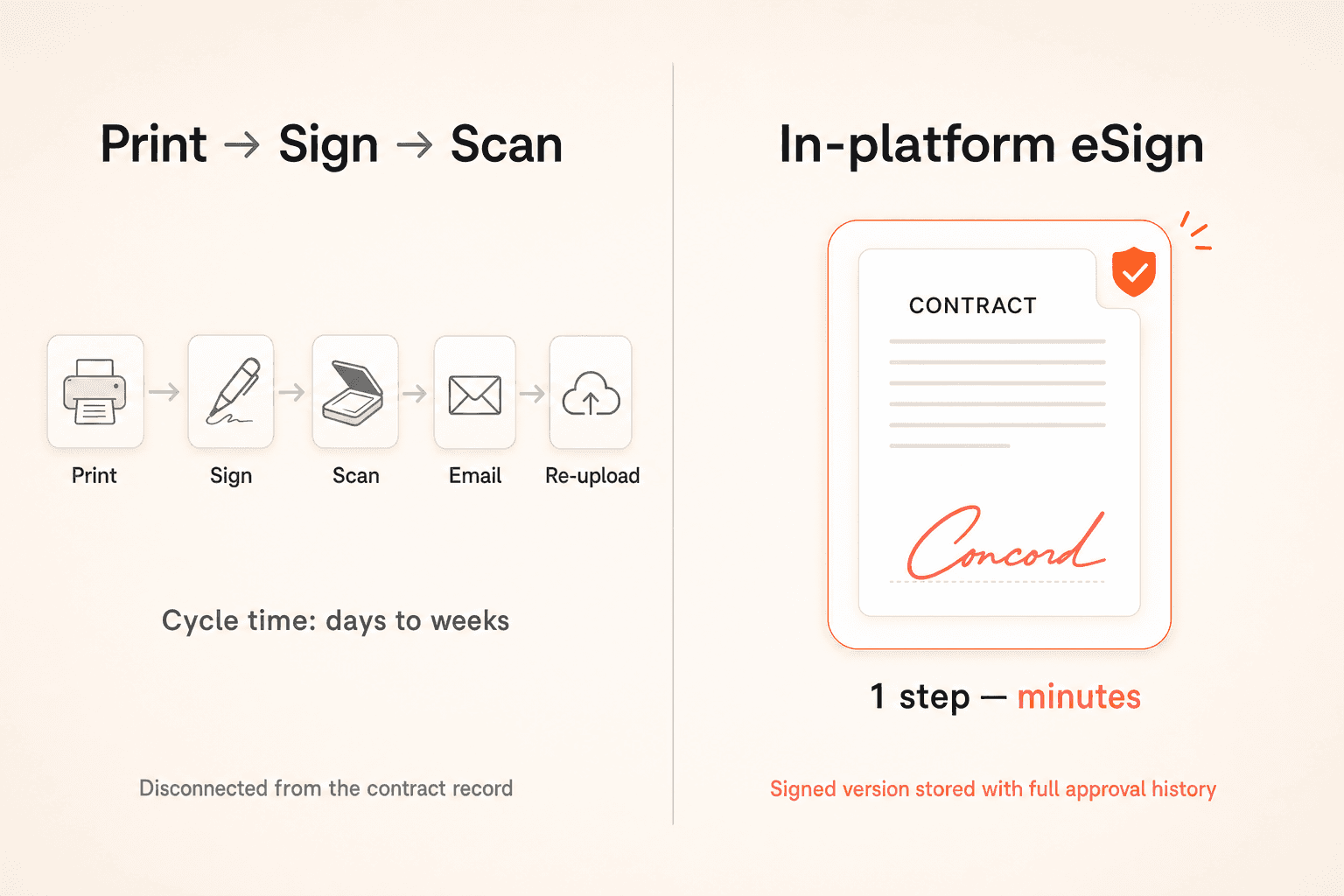
Despite the widespread availability of electronic signature tools, many higher education institutions still rely on print-sign-scan workflows for contract execution. This adds days or weeks to cycle times, creates version control problems, and disconnects the signature step from the contract record.
Built-in electronic signatures within your CLM platform keep the execution step connected to the contract record. The signed version is automatically stored alongside the full approval history, eliminating the version control confusion that comes with scanning and re-uploading.
Affordable pricing matters more than feature lists
Higher education procurement leaders consistently push back on six-figure CLM platforms, and rightly so. The institutions that need higher education contract management tools most, mid-sized colleges with lean procurement teams, are the ones least able to justify enterprise pricing.
A pricing model that offers unlimited viewer seats at no cost alongside paid editor and approver seats aligns with the reality that dozens of campus stakeholders need visibility into contracts even if only a handful manage them day-to-day. Concord offers this structure, along with an option for unlimited user plans, so your entire campus community can access the contracts relevant to their work without inflating your per-seat costs.
Frequently asked questions
Can a CLM platform work with our existing decentralized purchasing model?
Yes. The goal is not to centralize all purchasing decisions into a single office. A well-configured CLM platform channels decentralized contract requests through structured intake forms that route automatically to procurement and legal for review. Departments maintain their ability to initiate vendor relationships while your team maintains visibility and approval authority.
How long does it typically take to migrate existing contracts into a new system?
The timeline depends on the volume and format of your existing agreements. With AI-powered bulk extraction, what would otherwise require months of manual data entry can be compressed significantly. Most institutions can upload and extract key data from their legacy contract portfolio in a fraction of the time a manual approach would require.
Does Concord support the multi-level approval chains common in higher education?
Concord's approval workflows are fully configurable. You can set threshold-based routing rules, such as requiring VP approval for contracts above a certain dollar amount, and build sequential or parallel approval chains that match your institution's governance structure.
Higher education contract management presents a unique set of challenges that most corporate-focused tools were never designed to handle. Colleges and universities operate under decentralized purchasing models, rigid fiscal-year budget cycles, multi-stakeholder approval chains, accreditation requirements, and staffing constraints that make fragmented, manual approaches unsustainable as contract volumes grow. If your institution is still relying on shared drives, email threads, and personal calendars to track vendor agreements, you already know the cost of that approach. You just may not have quantified it yet.
This post walks through the core challenges higher education procurement teams face and explains how a centralized contract lifecycle management platform addresses each one.
Decentralization is the root cause, not the exception
Higher education purchasing is structurally decentralized. Athletics, academic divisions, facilities, IT, student affairs, and dozens of other departments all initiate vendor relationships independently. Contracts end up stored on individual workstations, local drives, shared folders, and, in some cases, physical filing cabinets.
Even institutions that maintain a nominal central repository often discover during audits that significant volumes of agreements sit outside it. Departments route around the system, and coverage gaps emerge.
The temptation is to fix this with policy: a directive from the provost or CFO requiring all contracts to flow through procurement. But higher education's shared-governance model makes top-down mandates difficult to enforce. The practical answer is not to eliminate decentralization but to channel it through a structured intake path that routes contracts through the right approval chain before execution.
Concord's contract intake management feature gives every department a structured request form with required fields that prevent incomplete submissions. Requests route automatically to procurement or legal for review. Departments keep their autonomy; your team keeps oversight.
Missing deadlines means missing budget windows
Higher education operates on fiscal-year budget cycles with limited flexibility. When contract renewal dates are invisible, buried in PDFs on someone's desktop, procurement cannot align vendor negotiations with budget planning windows.
The pattern is familiar: a software subscription auto-renews for another year because the termination notice deadline passed without anyone flagging it. A facilities contract rolls over at last year's rate because no one initiated a rebid in time. For institutions already operating under budget pressure, every missed deadline is a direct hit to the operating budget.
Automated deadline alerts that surface renewals 60, 90, or 120 days in advance give budget officers the lead time to evaluate, renegotiate, or terminate before auto-renewal clauses lock in another year of spend. Concord's agreement lifecycle management tools let you set these alerts at the contract level and route notifications to the appropriate stakeholders.
Higher education contract management requires real approval workflows
Many institutions have invoice approval thresholds that route to a VP or CFO above a certain dollar amount. Those same institutions often lack equivalent workflow controls for contracts. Agreements sometimes get executed without procurement or legal review, occasionally leading to commitments the institution cannot fulfill.
Higher education contracts routinely require sign-off from department heads, procurement, legal, and sometimes a VP or president depending on dollar thresholds. When this approval chain runs through email threads and paper routing slips, contracts stall for days or weeks. Configurable approval workflows with built-in notifications compress this timeline by putting the right document in front of the right approver at the right time, with a clear audit trail of who approved what and when.
Pima Community College, a multi-campus community college district, adopted Concord to bring structure to its contract approval process. With grants representing roughly 20 percent of its operating budget, the institution needed a system that could shorten contract development cycles and give its general counsel faster review turnaround. The structured workflow approach replaced informal routing and reduced the time from contract initiation to execution.
Accreditation and grant compliance demand audit trails you can actually produce
Whether the driver is regional accreditation, Title IV compliance, or federal grant requirements, your institution needs to demonstrate documented decision-making around vendor contracts. Accreditation bodies want evidence of how vendor selection and contract decisions were made. Grant-funded contracts carry additional compliance requirements around development timelines and approval documentation.
Without a system of record, these audit trails get assembled retroactively from hallway conversations and email threads. That process is labor-intensive and unreliable. When the accreditation review team or a federal auditor asks how a particular vendor was selected, "Let me check with Janet in facilities" is not an adequate answer.
A platform that captures discussion, approval routing, and version history in real time makes compliance a byproduct of the normal workflow rather than a separate project. Concord's contract property management features let you add custom fields for grant-specific data, insurance certificate expiration dates, or any other accreditation-relevant metadata alongside standard contract terms. Every comment, approval, and document version is preserved automatically.
The legacy contract problem is solvable
Most institutions considering a CLM platform already have hundreds or thousands of executed contracts in various formats and locations. The barrier to adoption is not the future workflow. It is the migration of existing agreements.
If you had to manually open each PDF, read the terms, and type key dates and financial figures into a database, the project would take months of staff time you do not have. AI-powered data extraction changes this calculation entirely. Concord's bulk contract upload and organization management features let you upload existing agreements in batches. The system automatically reads uploaded contracts, identifies key dates, parties, and financial terms, and populates a structured repository.
Denison University, a private liberal arts institution managing more than 4,000 agreements per year, used Concord to centralize its contract portfolio and reduce correction time by 30 percent. Template automation and structured workflows replaced manual processes that had previously consumed significant staff hours.
Institutional knowledge cannot live in one person's head
Several patterns emerge consistently in conversations with higher education procurement professionals. One of the most concerning is the concentration of institutional knowledge in a single person, often a long-tenured administrator who has managed vendor relationships for decades.
When that person retires or departs, the institution loses context about vendor terms, negotiation history, pricing benchmarks, and informal commitments. A centralized contract repository with searchable metadata, discussion history, and linked vendor records transforms that knowledge from personal memory into institutional infrastructure.
Concord's third-party management feature maintains a centralized vendor database across all contracts. You can filter by vendor to see every active agreement with a single supplier, which is critical during budget review cycles and invaluable during staff transitions.
Print-sign-scan persistence is costing you weeks
Despite the widespread availability of electronic signature tools, many higher education institutions still rely on print-sign-scan workflows for contract execution. This adds days or weeks to cycle times, creates version control problems, and disconnects the signature step from the contract record.
Built-in electronic signatures within your CLM platform keep the execution step connected to the contract record. The signed version is automatically stored alongside the full approval history, eliminating the version control confusion that comes with scanning and re-uploading.
Affordable pricing matters more than feature lists
Higher education procurement leaders consistently push back on six-figure CLM platforms, and rightly so. The institutions that need higher education contract management tools most, mid-sized colleges with lean procurement teams, are the ones least able to justify enterprise pricing.
A pricing model that offers unlimited viewer seats at no cost alongside paid editor and approver seats aligns with the reality that dozens of campus stakeholders need visibility into contracts even if only a handful manage them day-to-day. Concord offers this structure, along with an option for unlimited user plans, so your entire campus community can access the contracts relevant to their work without inflating your per-seat costs.
Frequently asked questions
Can a CLM platform work with our existing decentralized purchasing model?
Yes. The goal is not to centralize all purchasing decisions into a single office. A well-configured CLM platform channels decentralized contract requests through structured intake forms that route automatically to procurement and legal for review. Departments maintain their ability to initiate vendor relationships while your team maintains visibility and approval authority.
How long does it typically take to migrate existing contracts into a new system?
The timeline depends on the volume and format of your existing agreements. With AI-powered bulk extraction, what would otherwise require months of manual data entry can be compressed significantly. Most institutions can upload and extract key data from their legacy contract portfolio in a fraction of the time a manual approach would require.
Does Concord support the multi-level approval chains common in higher education?
Concord's approval workflows are fully configurable. You can set threshold-based routing rules, such as requiring VP approval for contracts above a certain dollar amount, and build sequential or parallel approval chains that match your institution's governance structure.

Take the "management" out
of contract management.
Customer Support
Legal
Compare
Resources
Customer Support
Company
Legal
Compare
Resources
Customer Support
Company
Legal
Compare
© 2025 Concord. All rights reserved.