Contract data hygiene: clean up your repository in 5 steps
Contract data hygiene: clean up your repository in 5 steps
Contract data hygiene: clean up your repository in 5 steps
Contract data hygiene: clean up your repository in 5 steps
contract management

Your contract repository should be a reliable source of truth. For many teams, it's anything but that. Years of uploads without tagging, inconsistent folder structures inherited from departed colleagues, and contracts scattered across shared drives, legacy systems, and individual desktops have turned your contract data management system into a digital junk drawer.
The frustrating part? You already know the principle: good data in, good data out. But the gap between knowing and doing is where most repositories degrade. Contracts get dumped in without metadata, versions pile up without clear labels, and before long, nobody trusts the reports coming out of the system.
The good news is that cleanup is a finite project, not an endless obligation. With a structured framework, you can restore confidence in your repository and unlock the downstream benefits (deadline alerts, compliance reporting, renewal tracking) that depend on accurate data.
Why contract data management cleanup matters more than you think
The real cost of messy contract data stays invisible until a crisis makes it painfully obvious. A missed early termination notice that locks you into another year. An auto-renewed agreement that should have been cancelled months ago. A compliance audit that can't locate a fully executed agreement.
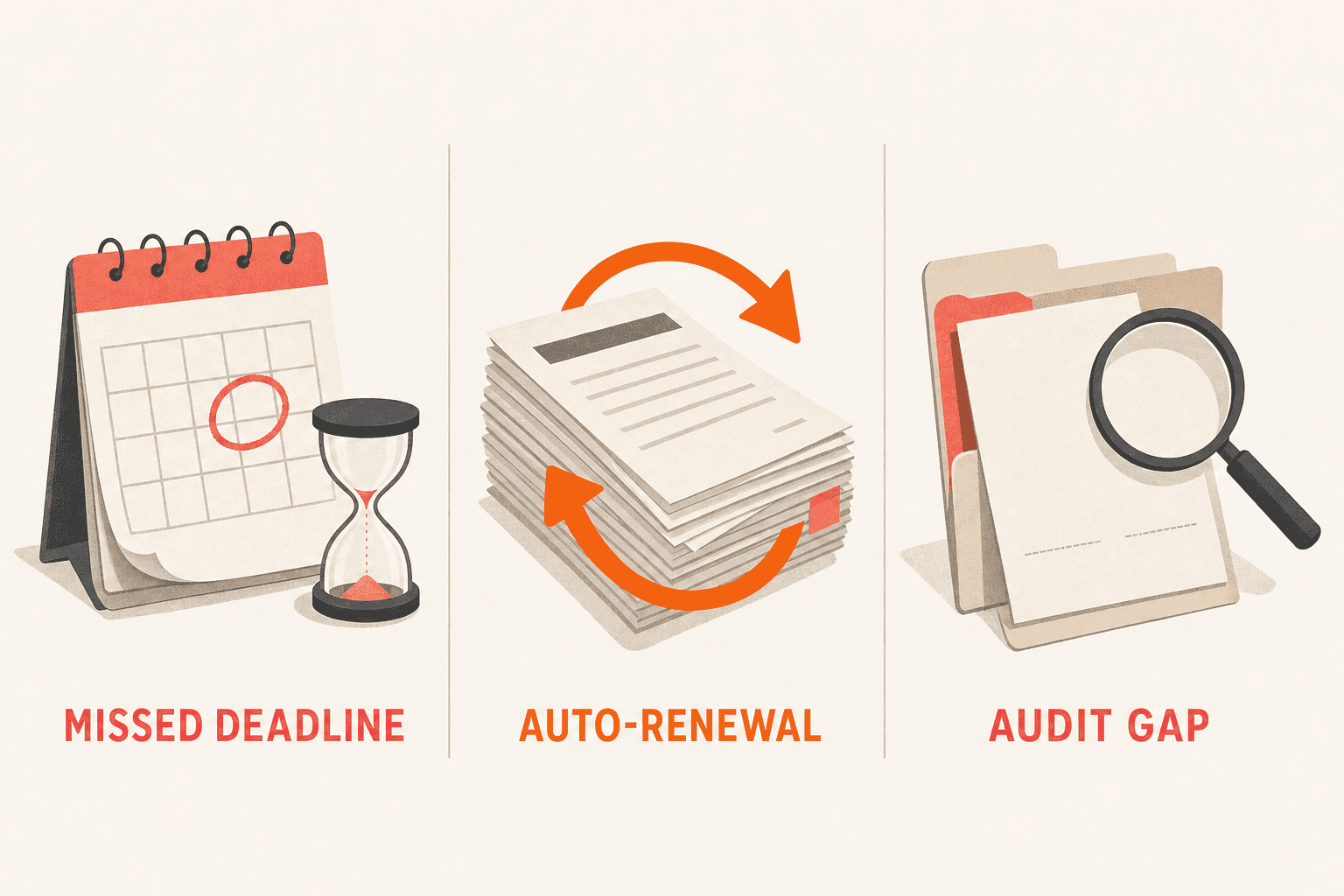
These moments rarely show up as a line item in your budget. They show up as last-minute scrambles, regulatory penalties, and lost negotiating leverage. Legal ops leaders frequently describe these incidents as the catalyst that finally pushed their organizations to invest in cleanup.
Every other benefit your CLM promises depends on clean data underneath it. Deadline alerts mean nothing if your effective dates are wrong. Renewal tracking fails if half your contracts lack renewal terms. Spend visibility is fiction if financial values are missing or inconsistent.
The logical sequence is straightforward: clean first, then report. Skip the cleanup step, and you'll produce unreliable outputs that erode trust in the system itself.
The 5-step contract repository cleanup framework
A step-by-step framework prevents what might be called "cleanup theater," the phenomenon where teams reorganize a few folders, tag a handful of contracts, and then drift back to old habits. Each step below has a clear purpose and a defined exit point.
Step 1: Audit and purge
Before you organize anything, you need to understand what you have and remove what you don't need. Start by running filtered reports to identify expired contracts still sitting in active folders, duplicate files, and documents that don't belong in your repository at all (internal memos, email chains, draft templates that were never executed).
Pay special attention to historical versions. Organizations commonly accumulate years of contract editions within the same folder, with 2020, 2021, 2022, and 2023 versions stacked together and no clear indication of which is the current active agreement. This clutter undermines confidence in search results and makes accurate reporting nearly impossible.
Concord's reporting and filtering tools let you build saved views that surface these problems systematically. Look for contracts missing key metadata, agreements past their expiration dates, and files with identical counterparty names. The platform's archive functionality lets you move completed contracts out of the active view while keeping them searchable in your database, and the contract data cleanup feature automatically removes orphaned files when contracts are deleted, preventing storage bloat.
Step 2: Restructure your folders
Teams frequently stall at this step because of debates about the "right" structure. Should you organize by vendor? Department? Contract type? Project?
Here is the honest truth: folder structure matters less than consistency. A vendor-based hierarchy that made sense when your company had 50 suppliers may break down at 500. A department-based structure works until contracts span multiple business units.
Pick a structure that maps to how your team actually searches for contracts. For most mid-market organizations, a two-level hierarchy works well: top-level folders by department or business unit, with subfolders by contract type (master agreements, statements of work, NDAs, amendments). Concord's folder-based organization supports customizable main and subfolder structures with permission-based access controls, so you can restrict visibility by team while maintaining a unified repository.
The key exit criterion for this step: every contract in your repository has exactly one logical home, and your team can articulate the folder logic in a single sentence.
Step 3: Establish your minimum viable metadata set
This step is the turning point. Records administrators who complete their cleanup efforts consistently describe defining a standard set of required properties as the moment the project shifted from "tidying up" to "building a real system."
Your minimum viable metadata set should include the fields you need to answer your most common questions. A strong starting point:
Field | Why it matters |
|---|---|
Contract type | Filtering by MSA, SOW, NDA, amendment, etc. |
Counterparty name | Searching by relationship |
Department stakeholder | Routing renewals and approvals |
Primary signer | Audit trail and authority tracking |
Effective date | Lifecycle tracking |
Expiration or renewal date | Deadline alerts |
Renewal terms | Auto-renewal visibility |
Financial value | Spend reporting |
Concord's custom properties and tags let you create any field your organization needs beyond the defaults, including risk level, payment deadlines, line of business, or certificate of insurance expiration. These tags become the backbone of your filtering and reporting system going forward.
Step 4: Validate and populate extracted data
This is where most cleanup projects historically died. Opening every contract, reading through the terms, and manually transcribing key dates, financial values, and party names into spreadsheets is tedious, error-prone, and unrewarding. Multiple teams describe building elaborate tracking spreadsheets because they felt they had no alternative.
AI-powered extraction changes the economics of this step entirely. Concord's AI data extraction automatically populates agreement category, document type, parties, description, lifecycle details (signature dates, effective dates, duration, renewal terms, early termination notices), and financial terms upon upload. What previously required a team member to open every single contract now happens automatically.
For your backlog, Concord's bulk upload with OCR accepts zip folders of contracts in any format, including scanned images and text PDFs. The system runs OCR to make them fully searchable and triggers AI extraction across the entire batch. A migration that would take months of manual effort compresses into a process that takes minutes.
Custom AI extraction takes this further by letting you train the system to pull domain-specific fields, such as processing fee percentages, payment terms, or jurisdiction clauses. This is how you operationalize the minimum viable metadata set from step three: you define exactly what fields matter, and the AI populates them across your entire repository.
After extraction runs, spot-check the results. Pull a sample of contracts from each type and verify that the extracted metadata matches the source document. Flag any systematic errors (for example, if the AI consistently misreads a particular clause format) and adjust your extraction configuration.
Step 5: Identify and consolidate redundant versions
With your metadata populated, you can now run filtered reports to find potential duplicates and redundant versions. Look for contracts with the same counterparty and overlapping date ranges. Flag instances where multiple versions of the same agreement exist without clear version labels.
This step also surfaces a less obvious problem: contracts that were signed internally but never returned fully executed by the counterparty. These partially executed agreements sit in your repository without clear flags, creating uncertainty about enforceability. Use custom tags to mark execution status so these gaps become visible in reports.
Contract linking is critical here. Concord lets you link related documents, connecting master agreements to their amendments, SOWs to MSAs, and parent contracts to subsidiaries. These relationships make document hierarchies visible and help you spot gaps. If every customer should have an MSA, an NDA, and a SOW, linked relationships make it obvious which customers are missing documents.
Be transparent with yourself: this step involves more manual judgment than the others. Deciding which version is authoritative, resolving naming conflicts from multi-source migrations, and confirming execution status all require human review. The AI handles the heavy lifting of surfacing candidates; you make the final calls.
Maintaining hygiene going forward
The effort of cleanup is front-loaded. Once your metadata standards are established and your backlog is processed, ongoing maintenance is minimal. Each new contract enters the system with the right tags, the right folder, and the right extracted data from day one.
To prevent regression, build three habits into your workflow. First, treat your minimum viable metadata set as a quality gate. No contract gets uploaded without those fields populated. Second, schedule a quarterly audit using saved reports to identify contracts missing metadata or sitting in the wrong folders. Third, use Concord's Co-Pilot AI assistant to run natural-language queries ("show me all contracts expiring next quarter" or "contracts missing a renewal term") as a quick hygiene check.
The discipline compounds: better data this quarter means better reports next quarter and better decisions in six months.
Frequently asked questions
How long does a full contract repository cleanup typically take?
The timeline depends on your repository size and how much metadata already exists. Teams with a few hundred contracts and some existing structure can complete the framework in two to four weeks. Larger repositories (several thousand contracts migrated from multiple systems) may take six to eight weeks. AI extraction dramatically compresses the most time-consuming step, populating metadata, which is why most teams report that the audit and folder restructuring phases take longer than the data extraction phase itself.
What if our contracts are stored across multiple systems and formats?
Multi-source migrations are one of the most common triggers for cleanup projects. Each source brings its own naming conventions, folder logic, and metadata gaps. Concord's bulk upload feature accepts contracts in any format, including scanned images, and runs OCR to make them searchable before triggering AI extraction. The key is to consolidate everything into one repository first, then apply the five-step framework rather than trying to clean each source separately.
Can we clean up our repository without switching to a new CLM?
The five-step framework applies regardless of what tool you use. That said, AI-powered extraction and bulk upload capabilities are what make the difference between a cleanup project that takes weeks and one that takes months. If your current platform requires manual metadata entry for every contract, the bottleneck that caused the mess in the first place will slow down the cleanup just as much.
Take the first step toward a trustworthy repository
If your repository has become a document dump, you're not alone, and the fix is more structured than it is complicated. Concord's AI extraction, bulk upload, and custom metadata tools are built to accelerate every step of this framework. Request a demo to see how your team can turn a messy repository into a reliable system that actually supports your reporting, compliance, and renewal workflows.
Your contract repository should be a reliable source of truth. For many teams, it's anything but that. Years of uploads without tagging, inconsistent folder structures inherited from departed colleagues, and contracts scattered across shared drives, legacy systems, and individual desktops have turned your contract data management system into a digital junk drawer.
The frustrating part? You already know the principle: good data in, good data out. But the gap between knowing and doing is where most repositories degrade. Contracts get dumped in without metadata, versions pile up without clear labels, and before long, nobody trusts the reports coming out of the system.
The good news is that cleanup is a finite project, not an endless obligation. With a structured framework, you can restore confidence in your repository and unlock the downstream benefits (deadline alerts, compliance reporting, renewal tracking) that depend on accurate data.
Why contract data management cleanup matters more than you think
The real cost of messy contract data stays invisible until a crisis makes it painfully obvious. A missed early termination notice that locks you into another year. An auto-renewed agreement that should have been cancelled months ago. A compliance audit that can't locate a fully executed agreement.
These moments rarely show up as a line item in your budget. They show up as last-minute scrambles, regulatory penalties, and lost negotiating leverage. Legal ops leaders frequently describe these incidents as the catalyst that finally pushed their organizations to invest in cleanup.
Every other benefit your CLM promises depends on clean data underneath it. Deadline alerts mean nothing if your effective dates are wrong. Renewal tracking fails if half your contracts lack renewal terms. Spend visibility is fiction if financial values are missing or inconsistent.
The logical sequence is straightforward: clean first, then report. Skip the cleanup step, and you'll produce unreliable outputs that erode trust in the system itself.
The 5-step contract repository cleanup framework
A step-by-step framework prevents what might be called "cleanup theater," the phenomenon where teams reorganize a few folders, tag a handful of contracts, and then drift back to old habits. Each step below has a clear purpose and a defined exit point.
Step 1: Audit and purge
Before you organize anything, you need to understand what you have and remove what you don't need. Start by running filtered reports to identify expired contracts still sitting in active folders, duplicate files, and documents that don't belong in your repository at all (internal memos, email chains, draft templates that were never executed).
Pay special attention to historical versions. Organizations commonly accumulate years of contract editions within the same folder, with 2020, 2021, 2022, and 2023 versions stacked together and no clear indication of which is the current active agreement. This clutter undermines confidence in search results and makes accurate reporting nearly impossible.
Concord's reporting and filtering tools let you build saved views that surface these problems systematically. Look for contracts missing key metadata, agreements past their expiration dates, and files with identical counterparty names. The platform's archive functionality lets you move completed contracts out of the active view while keeping them searchable in your database, and the contract data cleanup feature automatically removes orphaned files when contracts are deleted, preventing storage bloat.
Step 2: Restructure your folders
Teams frequently stall at this step because of debates about the "right" structure. Should you organize by vendor? Department? Contract type? Project?
Here is the honest truth: folder structure matters less than consistency. A vendor-based hierarchy that made sense when your company had 50 suppliers may break down at 500. A department-based structure works until contracts span multiple business units.
Pick a structure that maps to how your team actually searches for contracts. For most mid-market organizations, a two-level hierarchy works well: top-level folders by department or business unit, with subfolders by contract type (master agreements, statements of work, NDAs, amendments). Concord's folder-based organization supports customizable main and subfolder structures with permission-based access controls, so you can restrict visibility by team while maintaining a unified repository.
The key exit criterion for this step: every contract in your repository has exactly one logical home, and your team can articulate the folder logic in a single sentence.
Step 3: Establish your minimum viable metadata set
This step is the turning point. Records administrators who complete their cleanup efforts consistently describe defining a standard set of required properties as the moment the project shifted from "tidying up" to "building a real system."
Your minimum viable metadata set should include the fields you need to answer your most common questions. A strong starting point:
Field | Why it matters |
|---|---|
Contract type | Filtering by MSA, SOW, NDA, amendment, etc. |
Counterparty name | Searching by relationship |
Department stakeholder | Routing renewals and approvals |
Primary signer | Audit trail and authority tracking |
Effective date | Lifecycle tracking |
Expiration or renewal date | Deadline alerts |
Renewal terms | Auto-renewal visibility |
Financial value | Spend reporting |
Concord's custom properties and tags let you create any field your organization needs beyond the defaults, including risk level, payment deadlines, line of business, or certificate of insurance expiration. These tags become the backbone of your filtering and reporting system going forward.
Step 4: Validate and populate extracted data
This is where most cleanup projects historically died. Opening every contract, reading through the terms, and manually transcribing key dates, financial values, and party names into spreadsheets is tedious, error-prone, and unrewarding. Multiple teams describe building elaborate tracking spreadsheets because they felt they had no alternative.
AI-powered extraction changes the economics of this step entirely. Concord's AI data extraction automatically populates agreement category, document type, parties, description, lifecycle details (signature dates, effective dates, duration, renewal terms, early termination notices), and financial terms upon upload. What previously required a team member to open every single contract now happens automatically.
For your backlog, Concord's bulk upload with OCR accepts zip folders of contracts in any format, including scanned images and text PDFs. The system runs OCR to make them fully searchable and triggers AI extraction across the entire batch. A migration that would take months of manual effort compresses into a process that takes minutes.
Custom AI extraction takes this further by letting you train the system to pull domain-specific fields, such as processing fee percentages, payment terms, or jurisdiction clauses. This is how you operationalize the minimum viable metadata set from step three: you define exactly what fields matter, and the AI populates them across your entire repository.
After extraction runs, spot-check the results. Pull a sample of contracts from each type and verify that the extracted metadata matches the source document. Flag any systematic errors (for example, if the AI consistently misreads a particular clause format) and adjust your extraction configuration.
Step 5: Identify and consolidate redundant versions
With your metadata populated, you can now run filtered reports to find potential duplicates and redundant versions. Look for contracts with the same counterparty and overlapping date ranges. Flag instances where multiple versions of the same agreement exist without clear version labels.
This step also surfaces a less obvious problem: contracts that were signed internally but never returned fully executed by the counterparty. These partially executed agreements sit in your repository without clear flags, creating uncertainty about enforceability. Use custom tags to mark execution status so these gaps become visible in reports.
Contract linking is critical here. Concord lets you link related documents, connecting master agreements to their amendments, SOWs to MSAs, and parent contracts to subsidiaries. These relationships make document hierarchies visible and help you spot gaps. If every customer should have an MSA, an NDA, and a SOW, linked relationships make it obvious which customers are missing documents.
Be transparent with yourself: this step involves more manual judgment than the others. Deciding which version is authoritative, resolving naming conflicts from multi-source migrations, and confirming execution status all require human review. The AI handles the heavy lifting of surfacing candidates; you make the final calls.
Maintaining hygiene going forward
The effort of cleanup is front-loaded. Once your metadata standards are established and your backlog is processed, ongoing maintenance is minimal. Each new contract enters the system with the right tags, the right folder, and the right extracted data from day one.
To prevent regression, build three habits into your workflow. First, treat your minimum viable metadata set as a quality gate. No contract gets uploaded without those fields populated. Second, schedule a quarterly audit using saved reports to identify contracts missing metadata or sitting in the wrong folders. Third, use Concord's Co-Pilot AI assistant to run natural-language queries ("show me all contracts expiring next quarter" or "contracts missing a renewal term") as a quick hygiene check.
The discipline compounds: better data this quarter means better reports next quarter and better decisions in six months.
Frequently asked questions
How long does a full contract repository cleanup typically take?
The timeline depends on your repository size and how much metadata already exists. Teams with a few hundred contracts and some existing structure can complete the framework in two to four weeks. Larger repositories (several thousand contracts migrated from multiple systems) may take six to eight weeks. AI extraction dramatically compresses the most time-consuming step, populating metadata, which is why most teams report that the audit and folder restructuring phases take longer than the data extraction phase itself.
What if our contracts are stored across multiple systems and formats?
Multi-source migrations are one of the most common triggers for cleanup projects. Each source brings its own naming conventions, folder logic, and metadata gaps. Concord's bulk upload feature accepts contracts in any format, including scanned images, and runs OCR to make them searchable before triggering AI extraction. The key is to consolidate everything into one repository first, then apply the five-step framework rather than trying to clean each source separately.
Can we clean up our repository without switching to a new CLM?
The five-step framework applies regardless of what tool you use. That said, AI-powered extraction and bulk upload capabilities are what make the difference between a cleanup project that takes weeks and one that takes months. If your current platform requires manual metadata entry for every contract, the bottleneck that caused the mess in the first place will slow down the cleanup just as much.
Take the first step toward a trustworthy repository
If your repository has become a document dump, you're not alone, and the fix is more structured than it is complicated. Concord's AI extraction, bulk upload, and custom metadata tools are built to accelerate every step of this framework. Request a demo to see how your team can turn a messy repository into a reliable system that actually supports your reporting, compliance, and renewal workflows.

Take the "management" out
of contract management.
Customer Support
Legal
Compare
Resources
Customer Support
Company
Legal
Compare
Resources
Customer Support
Company
Legal
Compare
© 2025 Concord. All rights reserved.