Contract Analytics Software That Leaders Will Actually Use
Contract Analytics Software That Leaders Will Actually Use
Contract Analytics Software That Leaders Will Actually Use
Contract Analytics Software That Leaders Will Actually Use
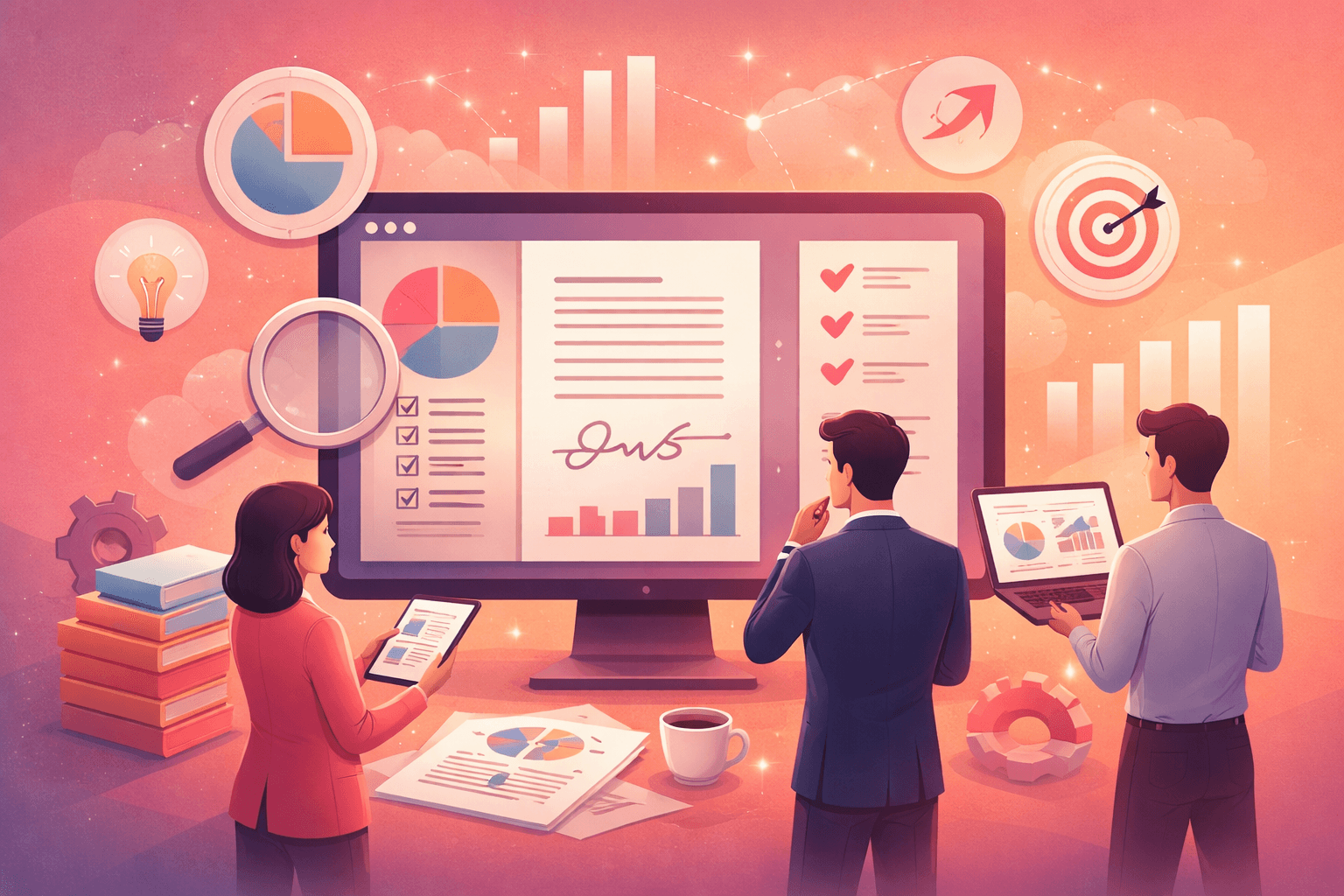
Dashboards fail in leadership meetings for one reason. They describe the world, but they do not tell anyone what to do next.
That gap is getting harder to ignore across analytics. In a February 2025 Gartner press release, Gartner reported that 30% of chief data and analytics officers cite the inability to measure impact on business outcomes as their top challenge, and contract analytics is a repeat offender because “interesting metrics” rarely convert into an owned decision.
If you want contract analytics software leaders actually use, replace dashboards with decision questions. Then build a loop from question to answer to action.
Why contract dashboards stop getting opened
Dashboards tend to die in two predictable ways.
One is overload. People get a wall of charts and no clear path to action, which is the core point in KPMG’s future without dashboards.
The other is misalignment. Leaders engage when metrics map to initiatives and shared definitions, which is exactly what MIT Sloan’s dashboard lessons keep coming back to.
Contracts add a third failure mode.
Contracts are negotiated text. If your system cannot produce complete, repeatable answers to leadership questions, executives learn to treat the analytics as directional.
The quality of those answers depends entirely on how well your system reads and structures contract language, which is where AI contract data extraction becomes the foundation for every decision question you build.
Directional dies the moment a CFO asks, “Are we looking at all contracts or just the ones that happen to be tagged correctly?”
The replacement for dashboards is a decision question
A dashboard question asks for a metric.
How many contracts renew next quarter
How many are missing signatures
What is our total vendor spend
A decision question asks for a list that drives a meeting.
Which renewals in the next 90 days should we escalate this week, and who owns each one
Which terms are driving margin leakage big enough to justify a commercial fix
Which counterparties create concentration risk, and what contract terms make it harder to change course
A decision question has four properties:
Clear scope
Time window
Definition of what matters
A next step someone can own
When your contract analytics software starts here, adoption changes because the output has a purpose on day one.
How we run decision questions in Concord Horizon
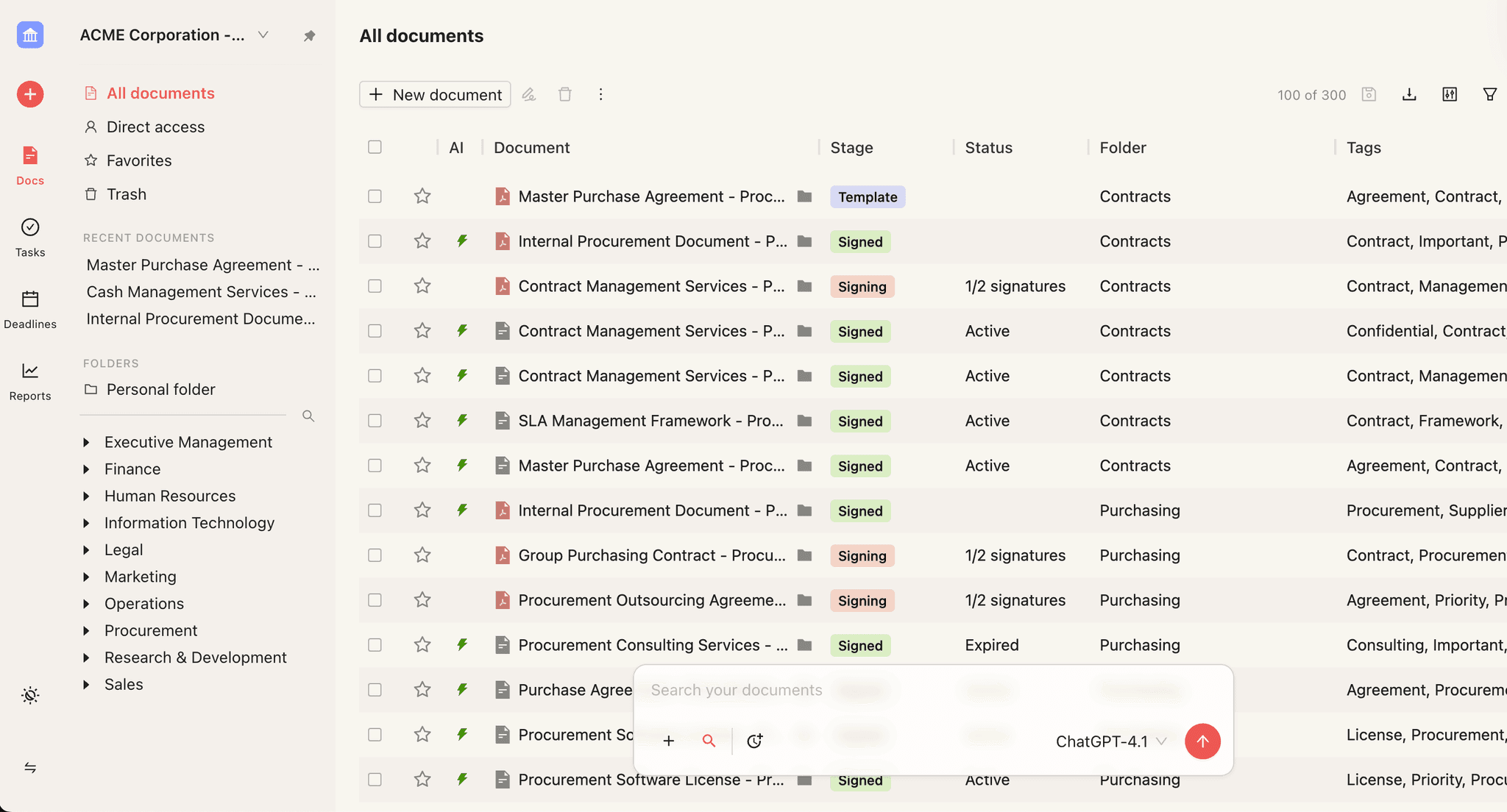
In Concord Horizon, conversation is the starting point because that is how people actually work. Copilot Chat is the home page in Horizon, so most analytics work begins by asking the question directly, not by hunting through filters and widgets.
From there, Horizon supports two modes that map to how leaders think.
Exploration mode for examples
When you need to understand what is happening, you need a handful of representative contracts quickly. That is the investigative workflow built into Horizon’s conversational experience.
Exploration is what you use to answer questions like:
Show me examples of unusual termination language
Find contracts with data residency obligations
Pull a few agreements with non standard payment terms
Examples help you form a view. They do not give you a decision-ready list.
Decision mode for complete answers
When you need numbers leadership will act on, you need completeness and repeatability. That is exactly what AI Reporting is for. You ask a question in plain language, then convert it into a live report you can reuse in the same weekly or monthly cadence.
If your team has ever lost a leadership meeting to the question “where did that number come from,” the discipline behind decision-grade reporting matters. Our post on AI Reporting and trust in contract data explains why structured reporting is the backbone for repeatable outputs instead of one-off analysis.
A simple rule keeps this clean.
Use exploration to find patterns and examples. Use reporting when you need the full list and the number.
Three decision loops leaders keep using
1) Renewal escalation that becomes a weekly action list
Decision question
Which renewals in the next 60 to 120 days should we escalate this week, and what is the recommended action?
How it runs in Horizon
Start in Copilot Chat with the question, then build a reusable report in AI Reporting so the output is the same kind of table every week.
What leaders get
A short list that drives a meeting, with owners assigned per renewal. The report is not the deliverable. The deliverable is the escalation list.
2) Margin leakage you can fix with one policy change
Decision question
Which pricing, discount, or credit terms are driving avoidable leakage, and what is the smallest change that removes most of it?
How it runs in Horizon
Use exploration to surface a small set of contracts that show the pattern clearly, then lock the criteria into reporting so you can quantify scope in a repeatable way, using the approach behind AI Reporting trust and determinism.
What leaders get
A list of fixes that compound, typically a template change plus a targeted renegotiation program.
3) Concentration risk tied to a governance decision
Decision question
Which counterparties create concentration risk, and which contract terms reduce our ability to change course?
How it runs in Horizon
Use reporting to produce the full list by counterparty and renewal window, then use exploration to pull the clause examples that explain why a relationship is sticky. This pairing is the fastest way to keep a meeting focused on actions instead of debating the data model.
What leaders get
A set of concrete plays: addendum program, renegotiation timeline, sourcing plan, or internal control change.
A 30 day rollout that replaces dashboards
Week 1: Pick two decisions
Pick two leadership decisions and stop there. Contract analytics software fails fastest when it tries to serve every stakeholder at once.
Week 2: Write the questions in meeting language
Write the decision questions exactly as they will be asked in the weekly or monthly review.
Week 3: Build repeatable reports
Turn each decision question into a reusable output in AI Reporting, then align definitions so the same question produces the same kind of answer month after month.
Week 4: Publish the operating rhythm
Weekly renewal escalations. Monthly margin leakage review. Quarterly concentration risk review. Adoption follows cadence, not dashboards.
What to demand in a contract analytics software demo
If you are evaluating contract analytics software, bring two decision questions and ask the vendor to do four things live:
Turn each question into a complete list, not a handful of examples
Show how the logic stays repeatable over time
Drill into underlying agreements when you challenge a line item
Leave you with an artifact your leadership team can review after the meeting
That is the difference between analytics that looks good and analytics that changes decisions.
Dashboards fail in leadership meetings for one reason. They describe the world, but they do not tell anyone what to do next.
That gap is getting harder to ignore across analytics. In a February 2025 Gartner press release, Gartner reported that 30% of chief data and analytics officers cite the inability to measure impact on business outcomes as their top challenge, and contract analytics is a repeat offender because “interesting metrics” rarely convert into an owned decision.
If you want contract analytics software leaders actually use, replace dashboards with decision questions. Then build a loop from question to answer to action.
Why contract dashboards stop getting opened
Dashboards tend to die in two predictable ways.
One is overload. People get a wall of charts and no clear path to action, which is the core point in KPMG’s future without dashboards.
The other is misalignment. Leaders engage when metrics map to initiatives and shared definitions, which is exactly what MIT Sloan’s dashboard lessons keep coming back to.
Contracts add a third failure mode.
Contracts are negotiated text. If your system cannot produce complete, repeatable answers to leadership questions, executives learn to treat the analytics as directional.
The quality of those answers depends entirely on how well your system reads and structures contract language, which is where AI contract data extraction becomes the foundation for every decision question you build.
Directional dies the moment a CFO asks, “Are we looking at all contracts or just the ones that happen to be tagged correctly?”
The replacement for dashboards is a decision question
A dashboard question asks for a metric.
How many contracts renew next quarter
How many are missing signatures
What is our total vendor spend
A decision question asks for a list that drives a meeting.
Which renewals in the next 90 days should we escalate this week, and who owns each one
Which terms are driving margin leakage big enough to justify a commercial fix
Which counterparties create concentration risk, and what contract terms make it harder to change course
A decision question has four properties:
Clear scope
Time window
Definition of what matters
A next step someone can own
When your contract analytics software starts here, adoption changes because the output has a purpose on day one.
How we run decision questions in Concord Horizon
In Concord Horizon, conversation is the starting point because that is how people actually work. Copilot Chat is the home page in Horizon, so most analytics work begins by asking the question directly, not by hunting through filters and widgets.
From there, Horizon supports two modes that map to how leaders think.
Exploration mode for examples
When you need to understand what is happening, you need a handful of representative contracts quickly. That is the investigative workflow built into Horizon’s conversational experience.
Exploration is what you use to answer questions like:
Show me examples of unusual termination language
Find contracts with data residency obligations
Pull a few agreements with non standard payment terms
Examples help you form a view. They do not give you a decision-ready list.
Decision mode for complete answers
When you need numbers leadership will act on, you need completeness and repeatability. That is exactly what AI Reporting is for. You ask a question in plain language, then convert it into a live report you can reuse in the same weekly or monthly cadence.
If your team has ever lost a leadership meeting to the question “where did that number come from,” the discipline behind decision-grade reporting matters. Our post on AI Reporting and trust in contract data explains why structured reporting is the backbone for repeatable outputs instead of one-off analysis.
A simple rule keeps this clean.
Use exploration to find patterns and examples. Use reporting when you need the full list and the number.
Three decision loops leaders keep using
1) Renewal escalation that becomes a weekly action list
Decision question
Which renewals in the next 60 to 120 days should we escalate this week, and what is the recommended action?
How it runs in Horizon
Start in Copilot Chat with the question, then build a reusable report in AI Reporting so the output is the same kind of table every week.
What leaders get
A short list that drives a meeting, with owners assigned per renewal. The report is not the deliverable. The deliverable is the escalation list.
2) Margin leakage you can fix with one policy change
Decision question
Which pricing, discount, or credit terms are driving avoidable leakage, and what is the smallest change that removes most of it?
How it runs in Horizon
Use exploration to surface a small set of contracts that show the pattern clearly, then lock the criteria into reporting so you can quantify scope in a repeatable way, using the approach behind AI Reporting trust and determinism.
What leaders get
A list of fixes that compound, typically a template change plus a targeted renegotiation program.
3) Concentration risk tied to a governance decision
Decision question
Which counterparties create concentration risk, and which contract terms reduce our ability to change course?
How it runs in Horizon
Use reporting to produce the full list by counterparty and renewal window, then use exploration to pull the clause examples that explain why a relationship is sticky. This pairing is the fastest way to keep a meeting focused on actions instead of debating the data model.
What leaders get
A set of concrete plays: addendum program, renegotiation timeline, sourcing plan, or internal control change.
A 30 day rollout that replaces dashboards
Week 1: Pick two decisions
Pick two leadership decisions and stop there. Contract analytics software fails fastest when it tries to serve every stakeholder at once.
Week 2: Write the questions in meeting language
Write the decision questions exactly as they will be asked in the weekly or monthly review.
Week 3: Build repeatable reports
Turn each decision question into a reusable output in AI Reporting, then align definitions so the same question produces the same kind of answer month after month.
Week 4: Publish the operating rhythm
Weekly renewal escalations. Monthly margin leakage review. Quarterly concentration risk review. Adoption follows cadence, not dashboards.
What to demand in a contract analytics software demo
If you are evaluating contract analytics software, bring two decision questions and ask the vendor to do four things live:
Turn each question into a complete list, not a handful of examples
Show how the logic stays repeatable over time
Drill into underlying agreements when you challenge a line item
Leave you with an artifact your leadership team can review after the meeting
That is the difference between analytics that looks good and analytics that changes decisions.

Take the "management" out
of contract management.
Customer Support
Legal
Compare
Resources
Customer Support
Company
Legal
Compare
Resources
Customer Support
Company
Legal
Compare
© 2025 Concord. All rights reserved.