
Concord has launched its all-new AI native platform, Horizon!
Concord has launched its all-new AI native platform, Horizon!
Concord has launched its all-new AI native platform!

What Is a Boilerplate Clause? 10 Common Types & Sample Wording
What Is a Boilerplate Clause? 10 Common Types & Sample Wording
What Is a Boilerplate Clause? 10 Common Types & Sample Wording
What Is a Boilerplate Clause? 10 Common Types & Sample Wording

A boilerplate clause is a standardized provision that appears in nearly every contract, typically grouped at the end, covering procedural matters like which state's law applies, what happens in a force majeure event, and how the parties give each other formal notice. They look like filler. They aren't.
This guide covers contract boilerplate specifically. If you're researching marketing/PR boilerplate (the company description at the bottom of a press release) or software boilerplate (template code), this isn't that.
What is a boilerplate clause?
Boilerplate clauses are the standardized provisions that handle how a contract operates rather than what the parties are exchanging. The body of a contract describes the deal: who pays whom, what gets delivered, on what schedule. The boilerplate handles everything else. Which courts have jurisdiction. What happens when something goes wrong. How amendments get made. What counts as official notice.
The same boilerplate language tends to appear across thousands of contracts because the underlying questions (which state's law? written notice required?) recur in nearly every commercial relationship. Reusing tested wording is faster and lower-risk than drafting from scratch.
The catch: standardized doesn't mean negotiated, and "we always use this" doesn't mean it's right for the deal in front of you. Boilerplate is where one-sided language quietly accumulates.
The 10 most common boilerplate clauses (with sample wording)
The exact list varies by jurisdiction and contract type, but most commercial agreements include some version of these.
1. Governing law
Specifies which state's (or country's) law will be used to interpret the contract. Often the most heavily negotiated boilerplate clause because it can determine outcomes more than any single substantive term.
This Agreement shall be governed by and construed in accordance with the laws of the State of Delaware, without regard to its conflict of laws principles.
What to watch for: a counterparty proposing their home state when you have no presence there.
2. Jurisdiction and venue
Specifies which courts can hear a dispute. Distinct from governing law: a Delaware-governed contract can still require lawsuits be filed in California courts.
The parties consent to the exclusive jurisdiction of the state and federal courts located in San Francisco County, California, for any action arising under this Agreement.
What to watch for: an inconvenient venue can effectively price small disputes out of court.
3. Entire agreement (merger / integration)
States that the written contract is the complete and final understanding between the parties, overriding any prior emails, verbal promises, or term sheets.
This Agreement constitutes the entire agreement between the parties with respect to its subject matter and supersedes all prior negotiations, representations, or agreements, whether written or oral.
What to watch for: this is what makes verbal side-deals unenforceable. If your salesperson promised something in an email, get it in the contract.
4. Severability
Protects the rest of the contract if a court strikes down one provision.
If any provision of this Agreement is held to be invalid or unenforceable, the remaining provisions shall continue in full force and effect.
Without severability, a single bad clause can take the whole contract down.
5. Force majeure
Excuses performance when extraordinary events outside either party's control prevent it. Heavily revisited after COVID-19 because pre-2020 force majeure clauses often didn't list pandemics.
Neither party shall be liable for any failure or delay in performance caused by acts of God, war, terrorism, pandemic, government action, or other event beyond its reasonable control.
What to watch for: clauses still using narrow, pre-2020 language.
6. Indemnification
One party agrees to cover the other's losses arising from specified claims (often IP infringement, third-party injury, or breach of warranty).
Vendor shall indemnify, defend, and hold harmless Customer from any third-party claims, damages, or expenses arising out of Vendor's breach of this Agreement or Vendor's negligent acts.
Three questions to ask of any indemnification clause: Is it mutual? Is it capped? Does it include defense costs?
7. Notice
Specifies how parties must formally communicate (usually for breach, termination, or assignment). "Email to the account manager" is rarely sufficient.
All notices shall be in writing and delivered by certified mail or nationally recognized overnight courier to the addresses set forth on the signature page.
What to watch for: contracts that still require fax or registered mail when both parties operate digitally.
8. Waiver
Prevents a party from accidentally giving up its rights by not enforcing them once.
No failure or delay by either party in exercising any right under this Agreement shall operate as a waiver of that right.
9. Assignment
Controls whether either party can transfer the contract to a third party. Typically relevant in mergers, acquisitions, or restructurings.
Neither party may assign this Agreement without the prior written consent of the other party, except in connection with a merger, acquisition, or sale of substantially all of its assets.
What to watch for: counterparties that allow free assignment to themselves but block yours.
10. Counterparts
Allows the contract to be signed in separate copies, including electronically, and treated as a single document.
This Agreement may be executed in counterparts, including by electronic signature, each of which shall be deemed an original and all of which together shall constitute one Agreement.
This is one boilerplate clause that's almost always uncontroversial.
Other clauses you'll commonly see: no third-party beneficiaries, attorney's fees, dispute resolution / arbitration, headings (stating section titles are for convenience only), and amendment procedures.
How to review boilerplate clauses
When a contract lands on your desk, do this before anything else:
Read the governing law and venue first. They affect everything else. If they're not your home state and you're a small party to the deal, push back.
Check force majeure for pandemic and cyber language. Pre-2020 force majeure clauses are still circulating in templates.
Find the indemnification clause and ask three questions. Is it mutual? Is it capped? Does it include defense costs?
Verify the notice clause matches how you actually operate. If it requires certified mail and your team works in Slack, you'll miss notices.
Read the entire agreement clause. If you're relying on anything outside the four corners of the contract, a side email or a verbal commitment, get it inside the document.
Check assignment rights. A counterparty that can freely assign while you can't is a real risk if they get acquired.
Confirm severability is present. Without it, one struck provision can void the whole contract.
This isn't a substitute for legal review. It's the screen that tells you which contracts need legal review most.
The real downsides of boilerplate
Boilerplate's biggest risks are the ones it makes easy to overlook.
It quietly favors whoever drafted it. A vendor's standard MSA will almost always include indemnification flowing one way and assignment rights flowing the other. "Standard" is not the same as "balanced."
It goes stale. Force majeure clauses written before 2020 often didn't anticipate pandemics or supply-chain disruption. Data-handling provisions written before 2018 often predate GDPR. Templates that haven't been refreshed in five years are carrying language built for a world that no longer exists.
It varies in enforceability. A mandatory arbitration clause that holds up in Texas may get struck in California. A non-compete embedded in boilerplate may be unenforceable in the state where the employee actually works. The same wording does not always produce the same outcome.
It encourages skipped review. "It's just boilerplate" is the most expensive sentence in contract operations. The clauses people skim are exactly where one-sided terms get parked.
Why is it called "boilerplate"?
The term comes from 19th-century newspapers. Steel plates engraved with pre-set advertising copy and syndicated articles were shipped to local papers and dropped directly into the press: same content, every paper, no rewriting. The plates resembled the iron sheeting used in steam boilers, so the syndicated copy got called "boilerplate." The legal world picked up the metaphor in the early 20th century.
Common questions
Are boilerplate clauses negotiable?
Yes, all of them. Whether your counterparty will agree to changes is a different question, but nothing in a contract is unnegotiable by definition.
Are boilerplate clauses enforceable?
Generally yes, with caveats by jurisdiction. A few clause types (mandatory arbitration, class-action waivers, certain limitations of liability) face stricter scrutiny depending on the state.
Can you remove a boilerplate clause from a contract?
You can, but it's almost always a mistake. Severability, governing law, notice, and entire-agreement clauses each prevent specific failure modes. Removing them creates ambiguity that defaults to whatever the local court decides.
What happens if a contract has no boilerplate at all?
Default rules from the governing jurisdiction fill the gaps. Those defaults are rarely what either party would have chosen if they'd thought about it.
Is boilerplate the same as standard terms and conditions?
Closely related but not identical. Standard T&Cs are usually a complete document. Boilerplate is a category of clause that appears within a contract.
Do boilerplate clauses differ in B2B vs. consumer contracts?
Yes, materially. Consumer-facing boilerplate is constrained by consumer-protection statutes that don't apply between businesses. Arbitration clauses, in particular, are treated more skeptically in consumer contexts.
Managing boilerplate at scale
For an individual contract, the review checklist above is enough. The harder problem is the portfolio. Hundreds or thousands of active contracts, each with slightly different boilerplate, drafted over years, by different lawyers, against different templates.
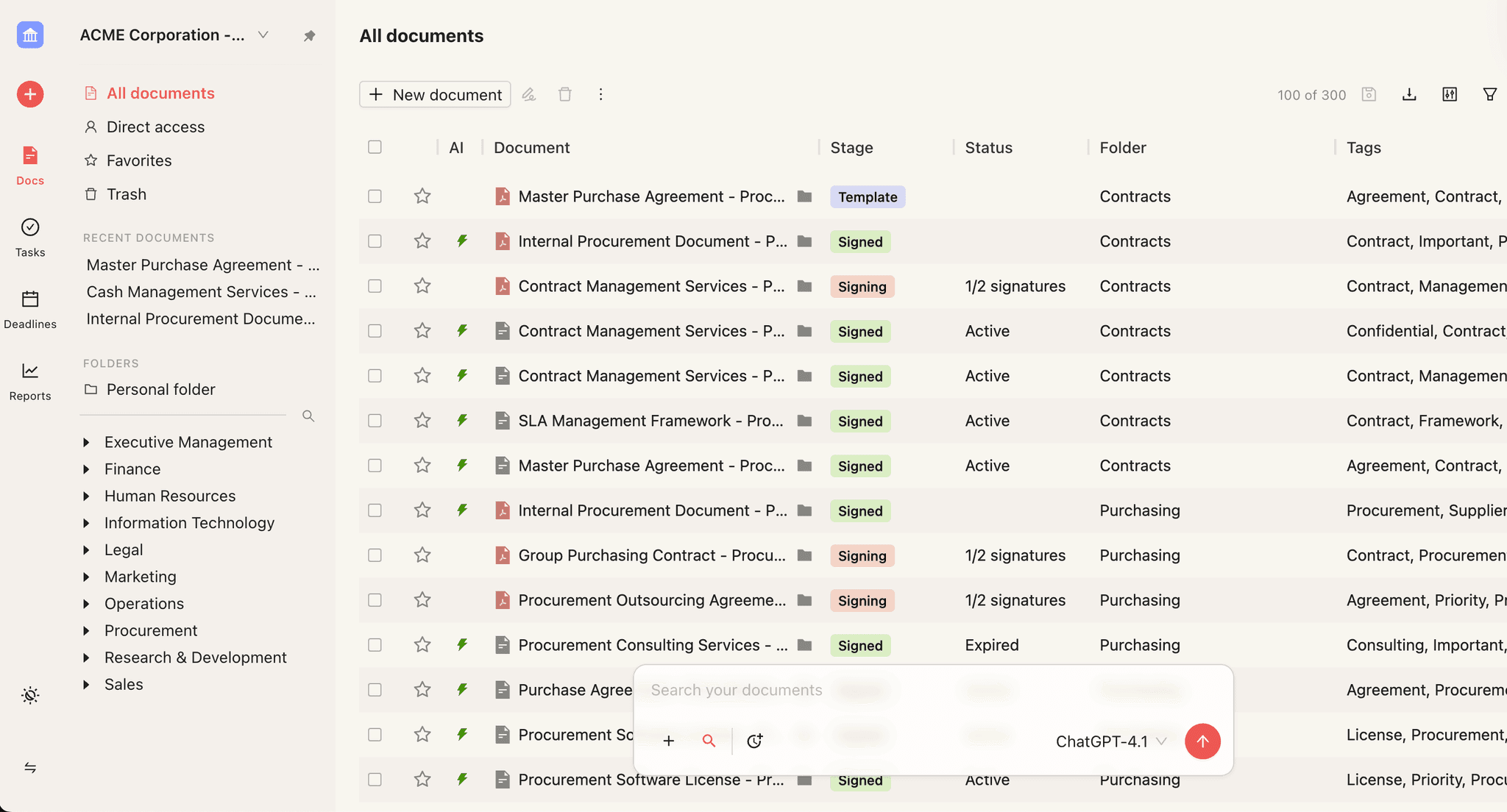
Concord's clause library lets legal teams maintain approved boilerplate language in one place and pull it into new contracts directly, so every agreement starts from current, reviewed wording rather than whatever was in the last MSA someone copied. That doesn't replace legal review. It changes which problem legal is solving: from "find and rewrite the clause" to "decide what the clause should say."
This article is informational and is not legal advice. For drafting or reviewing actual contracts, consult qualified counsel.
A boilerplate clause is a standardized provision that appears in nearly every contract, typically grouped at the end, covering procedural matters like which state's law applies, what happens in a force majeure event, and how the parties give each other formal notice. They look like filler. They aren't.
This guide covers contract boilerplate specifically. If you're researching marketing/PR boilerplate (the company description at the bottom of a press release) or software boilerplate (template code), this isn't that.
What is a boilerplate clause?
Boilerplate clauses are the standardized provisions that handle how a contract operates rather than what the parties are exchanging. The body of a contract describes the deal: who pays whom, what gets delivered, on what schedule. The boilerplate handles everything else. Which courts have jurisdiction. What happens when something goes wrong. How amendments get made. What counts as official notice.
The same boilerplate language tends to appear across thousands of contracts because the underlying questions (which state's law? written notice required?) recur in nearly every commercial relationship. Reusing tested wording is faster and lower-risk than drafting from scratch.
The catch: standardized doesn't mean negotiated, and "we always use this" doesn't mean it's right for the deal in front of you. Boilerplate is where one-sided language quietly accumulates.
The 10 most common boilerplate clauses (with sample wording)
The exact list varies by jurisdiction and contract type, but most commercial agreements include some version of these.
1. Governing law
Specifies which state's (or country's) law will be used to interpret the contract. Often the most heavily negotiated boilerplate clause because it can determine outcomes more than any single substantive term.
This Agreement shall be governed by and construed in accordance with the laws of the State of Delaware, without regard to its conflict of laws principles.
What to watch for: a counterparty proposing their home state when you have no presence there.
2. Jurisdiction and venue
Specifies which courts can hear a dispute. Distinct from governing law: a Delaware-governed contract can still require lawsuits be filed in California courts.
The parties consent to the exclusive jurisdiction of the state and federal courts located in San Francisco County, California, for any action arising under this Agreement.
What to watch for: an inconvenient venue can effectively price small disputes out of court.
3. Entire agreement (merger / integration)
States that the written contract is the complete and final understanding between the parties, overriding any prior emails, verbal promises, or term sheets.
This Agreement constitutes the entire agreement between the parties with respect to its subject matter and supersedes all prior negotiations, representations, or agreements, whether written or oral.
What to watch for: this is what makes verbal side-deals unenforceable. If your salesperson promised something in an email, get it in the contract.
4. Severability
Protects the rest of the contract if a court strikes down one provision.
If any provision of this Agreement is held to be invalid or unenforceable, the remaining provisions shall continue in full force and effect.
Without severability, a single bad clause can take the whole contract down.
5. Force majeure
Excuses performance when extraordinary events outside either party's control prevent it. Heavily revisited after COVID-19 because pre-2020 force majeure clauses often didn't list pandemics.
Neither party shall be liable for any failure or delay in performance caused by acts of God, war, terrorism, pandemic, government action, or other event beyond its reasonable control.
What to watch for: clauses still using narrow, pre-2020 language.
6. Indemnification
One party agrees to cover the other's losses arising from specified claims (often IP infringement, third-party injury, or breach of warranty).
Vendor shall indemnify, defend, and hold harmless Customer from any third-party claims, damages, or expenses arising out of Vendor's breach of this Agreement or Vendor's negligent acts.
Three questions to ask of any indemnification clause: Is it mutual? Is it capped? Does it include defense costs?
7. Notice
Specifies how parties must formally communicate (usually for breach, termination, or assignment). "Email to the account manager" is rarely sufficient.
All notices shall be in writing and delivered by certified mail or nationally recognized overnight courier to the addresses set forth on the signature page.
What to watch for: contracts that still require fax or registered mail when both parties operate digitally.
8. Waiver
Prevents a party from accidentally giving up its rights by not enforcing them once.
No failure or delay by either party in exercising any right under this Agreement shall operate as a waiver of that right.
9. Assignment
Controls whether either party can transfer the contract to a third party. Typically relevant in mergers, acquisitions, or restructurings.
Neither party may assign this Agreement without the prior written consent of the other party, except in connection with a merger, acquisition, or sale of substantially all of its assets.
What to watch for: counterparties that allow free assignment to themselves but block yours.
10. Counterparts
Allows the contract to be signed in separate copies, including electronically, and treated as a single document.
This Agreement may be executed in counterparts, including by electronic signature, each of which shall be deemed an original and all of which together shall constitute one Agreement.
This is one boilerplate clause that's almost always uncontroversial.
Other clauses you'll commonly see: no third-party beneficiaries, attorney's fees, dispute resolution / arbitration, headings (stating section titles are for convenience only), and amendment procedures.
How to review boilerplate clauses
When a contract lands on your desk, do this before anything else:
Read the governing law and venue first. They affect everything else. If they're not your home state and you're a small party to the deal, push back.
Check force majeure for pandemic and cyber language. Pre-2020 force majeure clauses are still circulating in templates.
Find the indemnification clause and ask three questions. Is it mutual? Is it capped? Does it include defense costs?
Verify the notice clause matches how you actually operate. If it requires certified mail and your team works in Slack, you'll miss notices.
Read the entire agreement clause. If you're relying on anything outside the four corners of the contract, a side email or a verbal commitment, get it inside the document.
Check assignment rights. A counterparty that can freely assign while you can't is a real risk if they get acquired.
Confirm severability is present. Without it, one struck provision can void the whole contract.
This isn't a substitute for legal review. It's the screen that tells you which contracts need legal review most.
The real downsides of boilerplate
Boilerplate's biggest risks are the ones it makes easy to overlook.
It quietly favors whoever drafted it. A vendor's standard MSA will almost always include indemnification flowing one way and assignment rights flowing the other. "Standard" is not the same as "balanced."
It goes stale. Force majeure clauses written before 2020 often didn't anticipate pandemics or supply-chain disruption. Data-handling provisions written before 2018 often predate GDPR. Templates that haven't been refreshed in five years are carrying language built for a world that no longer exists.
It varies in enforceability. A mandatory arbitration clause that holds up in Texas may get struck in California. A non-compete embedded in boilerplate may be unenforceable in the state where the employee actually works. The same wording does not always produce the same outcome.
It encourages skipped review. "It's just boilerplate" is the most expensive sentence in contract operations. The clauses people skim are exactly where one-sided terms get parked.
Why is it called "boilerplate"?
The term comes from 19th-century newspapers. Steel plates engraved with pre-set advertising copy and syndicated articles were shipped to local papers and dropped directly into the press: same content, every paper, no rewriting. The plates resembled the iron sheeting used in steam boilers, so the syndicated copy got called "boilerplate." The legal world picked up the metaphor in the early 20th century.
Common questions
Are boilerplate clauses negotiable?
Yes, all of them. Whether your counterparty will agree to changes is a different question, but nothing in a contract is unnegotiable by definition.
Are boilerplate clauses enforceable?
Generally yes, with caveats by jurisdiction. A few clause types (mandatory arbitration, class-action waivers, certain limitations of liability) face stricter scrutiny depending on the state.
Can you remove a boilerplate clause from a contract?
You can, but it's almost always a mistake. Severability, governing law, notice, and entire-agreement clauses each prevent specific failure modes. Removing them creates ambiguity that defaults to whatever the local court decides.
What happens if a contract has no boilerplate at all?
Default rules from the governing jurisdiction fill the gaps. Those defaults are rarely what either party would have chosen if they'd thought about it.
Is boilerplate the same as standard terms and conditions?
Closely related but not identical. Standard T&Cs are usually a complete document. Boilerplate is a category of clause that appears within a contract.
Do boilerplate clauses differ in B2B vs. consumer contracts?
Yes, materially. Consumer-facing boilerplate is constrained by consumer-protection statutes that don't apply between businesses. Arbitration clauses, in particular, are treated more skeptically in consumer contexts.
Managing boilerplate at scale
For an individual contract, the review checklist above is enough. The harder problem is the portfolio. Hundreds or thousands of active contracts, each with slightly different boilerplate, drafted over years, by different lawyers, against different templates.
Concord's clause library lets legal teams maintain approved boilerplate language in one place and pull it into new contracts directly, so every agreement starts from current, reviewed wording rather than whatever was in the last MSA someone copied. That doesn't replace legal review. It changes which problem legal is solving: from "find and rewrite the clause" to "decide what the clause should say."
This article is informational and is not legal advice. For drafting or reviewing actual contracts, consult qualified counsel.
Need to know
Frequently Asked Questions

Take the "management" out
of contract management.
Customer Support
Legal
Compare
Resources
Customer Support
Company
Legal
Compare
Resources
Customer Support
Company
Legal
Compare
© 2025 Concord. All rights reserved.