Pay Up? Why You Shouldn't Have to Pay for E-Signature
Pay Up? Why You Shouldn't Have to Pay for E-Signature
Pay Up? Why You Shouldn't Have to Pay for E-Signature
Pay Up? Why You Shouldn't Have to Pay for E-Signature
contract management

You've just signed a document at a bank, a leasing office, or for a brand new phone. Probably, you're pretty excited about the new purchase! But then something peculiar happens. They ask you to pay for your signature. Likely, you've just paid a lot for something in the contract, and it would be surprisingly poor service to pay for your own signature.
Paying to sign is not how contracts work in your everyday life, and electronic document signing should feel the same. Of course, you're not actually asking someone to pay for their signature, but you are being charged to provide electronic signatures.
Before you think we're yelling "E-signature Liberté!" next to a Bastille (our founders are French, but we promise, this has never occurred), there's a more practical, long-term reason why you shouldn't have to pay for electronic signature — and what to invest in instead.
E-Signature as a Service is Limited
Today, the market for e-signature tools is crowded. Whether you're choosing between an electronic signature vs. a digital signature, there are dozens of apps and platforms offering some variation of signing functionality.
To better understand the different formats available, it helps to review electronic signature examples across common business use cases and document types.
For business professionals and casual consumers alike, word processors and digital documents are taken for granted as part of daily life. But electronic signatures are still treated as a premium add-on — a separate line item on your software budget.
When you pay for a standalone e-signature tool, you're typically paying for three core steps: uploading a document, collecting a signature, and storing the result. Most providers also bundle in signature notification tracking and basic storage. That's it.
Those three steps don't cover all the stages of contract management. They don't solve the bottlenecks that arise during contract negotiation, redlining, version control, or deadline tracking. You're still left stitching together disconnected tools to manage what should be a single, coherent process.
The result? Getting a document signed can take far longer than it should — and that's before accounting for the back-and-forth that precedes the signature itself.
Contract Management is Different Than Document Management
Contract management isn't the same as document management. You might be thinking that's obvious — not all documents require a signature. But what you're paying for with a standalone e-signature solution often doesn't reflect that distinction.
Many services market document management as part of their e-signature plan. In practice, most are storage solutions. Storage solutions let you find a file. They don't help you track obligations within it, manage expiration dates, flag missing signatures, or report on contract performance.
A paid e-signature solution is like getting a seat at a great game. Automating the entire contract management process is like getting the best seat — where you can actually see everything that's happening, not just the final play.
When you invest in a system built only around the signature action, you're investing in something that doesn't scale with your operational needs. It solves one moment in a much longer process.
E-Signature Scratches the Need — Contract Management Addresses It
In your office, whether you're at a small construction firm, a legal department, or an education, procurement, or healthcare organization, e-signature software probably feels like a satisfying solution. But getting to that signature is rarely satisfying.
Ask yourself if any of these sound familiar:
You've recreated a document because you couldn't find the version a former colleague created.
You lost track of a document in email. Multiple threads with the same recipient made it nearly impossible to locate an important change or agreed-upon term.
You don't have a reliable way to edit or annotate a PDF without downloading a separate tool.
You're not alone. Research consistently shows that most business professionals spend significant time on contract-related tasks that should be automated. Only a minority of companies have fully digitized every step of their contract process — the rest are filling the gaps with manual workarounds, email chains, and disconnected tools.
Electronic signature software pulls you partway out of that hole. Contract management software gives you a foothold at every stage.
The Hidden Cost of a Fragmented Contract Process
Consider what it actually costs when your contract process is split across tools. Your sales reps close a deal, but the contract is still in legal review. Partners agree to terms, but final versions are circulating via email, printed for wet signatures, and scanned back in. By the time you have an executed agreement, weeks have passed — and that's on a good day.
As a procurement analyst, company controller, sales director, or business owner, you need to analyze revenue against targets, track contract values, and make time-sensitive decisions. When your contract data lives in email threads and storage folders rather than a structured system, that analysis requires manual effort — and manual effort introduces error.
Human error in financial and operational decisions is a documented problem. When critical data is scattered across systems that weren't designed to work together, the risk compounds. A contract management platform that connects drafting, negotiation, signing, and reporting reduces that risk at the source.
What Full Contract Automation Actually Looks Like
Automated contract management handles each of these problems. It reduces human error, cuts lag time, and removes negotiation hold-ups. Sending and requesting electronic signatures is part of the process — but so are all the steps that come before and after.
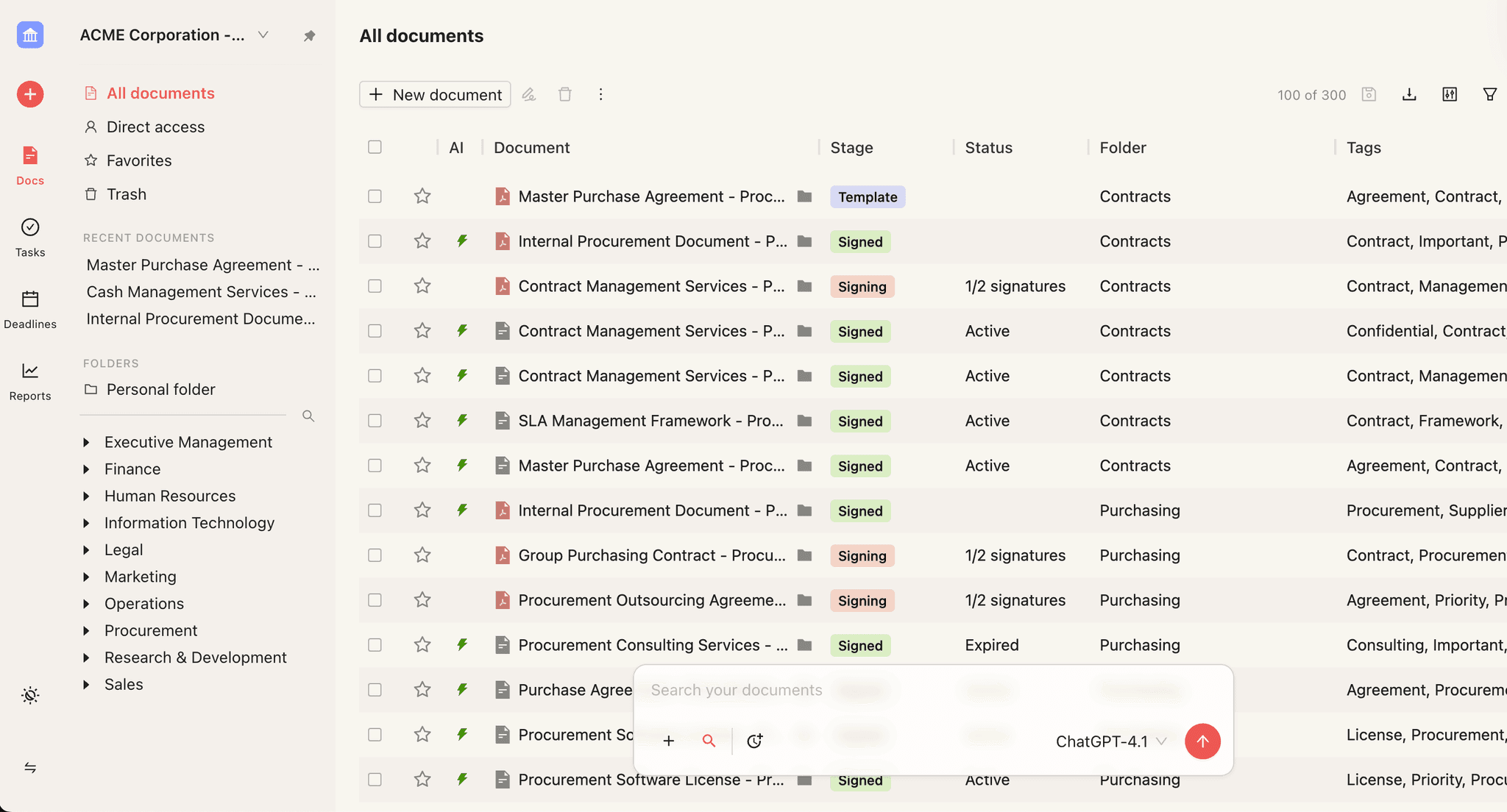
With Concord, you get a complete contract management platform that includes:
Template building so you're not starting from scratch every time
Real-time editing so collaborators can work in the same document without version chaos
Approval workflows with conditions based on field values or contract content
Signature tracking so you always know which agreements are fully executed and which still need attention
Bulk signature requests so you can collect signatures across multiple agreements at once — without processing them one by one
Renewal and deadline tracking so nothing expires without warning
Audit trails and signature history for every document, automatically
Reporting so your contract data actually informs business decisions
Unlimited viewers so anyone on your team can track the status of any contract
And when it comes to electronic signatures specifically, Concord provides unlimited signatures — no per-envelope fees, no signature caps, no surprise overages.
Think of E-Signature as a Starting Point, Not a Destination
In the same way that dedicated MP3 players gave way to smartphones that did everything better, standalone e-signature tools are a starting point — not a long-term strategy. If your organization has already invested in an e-signature plan, that's a reasonable first step. But it's just one step in a process that has many more.
Concord makes the next step straightforward. You get a free trial and plans for every size of business and budget. You'll never have to track the number of signatures you send and receive — there is no limit.
Take a few minutes to sign up for a free trial, and explore Concord's free short weekly training session and Q&A to see how much time your team can save before you ever get to the signature line.
You've just signed a document at a bank, a leasing office, or for a brand new phone. Probably, you're pretty excited about the new purchase! But then something peculiar happens. They ask you to pay for your signature. Likely, you've just paid a lot for something in the contract, and it would be surprisingly poor service to pay for your own signature.
Paying to sign is not how contracts work in your everyday life, and electronic document signing should feel the same. Of course, you're not actually asking someone to pay for their signature, but you are being charged to provide electronic signatures.
Before you think we're yelling "E-signature Liberté!" next to a Bastille (our founders are French, but we promise, this has never occurred), there's a more practical, long-term reason why you shouldn't have to pay for electronic signature — and what to invest in instead.
E-Signature as a Service is Limited
Today, the market for e-signature tools is crowded. Whether you're choosing between an electronic signature vs. a digital signature, there are dozens of apps and platforms offering some variation of signing functionality.
To better understand the different formats available, it helps to review electronic signature examples across common business use cases and document types.
For business professionals and casual consumers alike, word processors and digital documents are taken for granted as part of daily life. But electronic signatures are still treated as a premium add-on — a separate line item on your software budget.
When you pay for a standalone e-signature tool, you're typically paying for three core steps: uploading a document, collecting a signature, and storing the result. Most providers also bundle in signature notification tracking and basic storage. That's it.
Those three steps don't cover all the stages of contract management. They don't solve the bottlenecks that arise during contract negotiation, redlining, version control, or deadline tracking. You're still left stitching together disconnected tools to manage what should be a single, coherent process.
The result? Getting a document signed can take far longer than it should — and that's before accounting for the back-and-forth that precedes the signature itself.
Contract Management is Different Than Document Management
Contract management isn't the same as document management. You might be thinking that's obvious — not all documents require a signature. But what you're paying for with a standalone e-signature solution often doesn't reflect that distinction.
Many services market document management as part of their e-signature plan. In practice, most are storage solutions. Storage solutions let you find a file. They don't help you track obligations within it, manage expiration dates, flag missing signatures, or report on contract performance.
A paid e-signature solution is like getting a seat at a great game. Automating the entire contract management process is like getting the best seat — where you can actually see everything that's happening, not just the final play.
When you invest in a system built only around the signature action, you're investing in something that doesn't scale with your operational needs. It solves one moment in a much longer process.
E-Signature Scratches the Need — Contract Management Addresses It
In your office, whether you're at a small construction firm, a legal department, or an education, procurement, or healthcare organization, e-signature software probably feels like a satisfying solution. But getting to that signature is rarely satisfying.
Ask yourself if any of these sound familiar:
You've recreated a document because you couldn't find the version a former colleague created.
You lost track of a document in email. Multiple threads with the same recipient made it nearly impossible to locate an important change or agreed-upon term.
You don't have a reliable way to edit or annotate a PDF without downloading a separate tool.
You're not alone. Research consistently shows that most business professionals spend significant time on contract-related tasks that should be automated. Only a minority of companies have fully digitized every step of their contract process — the rest are filling the gaps with manual workarounds, email chains, and disconnected tools.
Electronic signature software pulls you partway out of that hole. Contract management software gives you a foothold at every stage.
The Hidden Cost of a Fragmented Contract Process
Consider what it actually costs when your contract process is split across tools. Your sales reps close a deal, but the contract is still in legal review. Partners agree to terms, but final versions are circulating via email, printed for wet signatures, and scanned back in. By the time you have an executed agreement, weeks have passed — and that's on a good day.
As a procurement analyst, company controller, sales director, or business owner, you need to analyze revenue against targets, track contract values, and make time-sensitive decisions. When your contract data lives in email threads and storage folders rather than a structured system, that analysis requires manual effort — and manual effort introduces error.
Human error in financial and operational decisions is a documented problem. When critical data is scattered across systems that weren't designed to work together, the risk compounds. A contract management platform that connects drafting, negotiation, signing, and reporting reduces that risk at the source.
What Full Contract Automation Actually Looks Like
Automated contract management handles each of these problems. It reduces human error, cuts lag time, and removes negotiation hold-ups. Sending and requesting electronic signatures is part of the process — but so are all the steps that come before and after.
With Concord, you get a complete contract management platform that includes:
Template building so you're not starting from scratch every time
Real-time editing so collaborators can work in the same document without version chaos
Approval workflows with conditions based on field values or contract content
Signature tracking so you always know which agreements are fully executed and which still need attention
Bulk signature requests so you can collect signatures across multiple agreements at once — without processing them one by one
Renewal and deadline tracking so nothing expires without warning
Audit trails and signature history for every document, automatically
Reporting so your contract data actually informs business decisions
Unlimited viewers so anyone on your team can track the status of any contract
And when it comes to electronic signatures specifically, Concord provides unlimited signatures — no per-envelope fees, no signature caps, no surprise overages.
Think of E-Signature as a Starting Point, Not a Destination
In the same way that dedicated MP3 players gave way to smartphones that did everything better, standalone e-signature tools are a starting point — not a long-term strategy. If your organization has already invested in an e-signature plan, that's a reasonable first step. But it's just one step in a process that has many more.
Concord makes the next step straightforward. You get a free trial and plans for every size of business and budget. You'll never have to track the number of signatures you send and receive — there is no limit.
Take a few minutes to sign up for a free trial, and explore Concord's free short weekly training session and Q&A to see how much time your team can save before you ever get to the signature line.

Take the "management" out
of contract management.
Customer Support
Legal
Compare
Resources
Customer Support
Company
Legal
Compare
Resources
Customer Support
Company
Legal
Compare
© 2025 Concord. All rights reserved.