5 Contract Management Platform Myths That Hold Businesses Back
5 Contract Management Platform Myths That Hold Businesses Back
5 Contract Management Platform Myths That Hold Businesses Back
5 Contract Management Platform Myths That Hold Businesses Back

When people think of contract management, certain assumptions tend to follow. Some come from years of working with legacy tools. Others come from stories shared across legal and ops teams. Here is a look at five of the most common myths, and why accepting any of them as normal puts your business at a disadvantage.
When organizations start evaluating contract management platforms, they often arrive with a mental model built on outdated experiences. Maybe the last system they used required a six-month implementation. Maybe it lived on a shared drive that no one fully trusted. Maybe it locked contract data inside a format that made reporting nearly impossible. Those experiences are real, but they do not have to be universal.
Key takeaways
A cloud contract platform gives you more visibility and control than email and shared drives, not less. Role-based permissions and instant search put every contract one click away.
Purpose-built platforms are more secure than local drives or inboxes, with encryption, audit trails, and access controls many compliance frameworks now require.
Modern implementation takes days or weeks, not the six to twelve months older enterprise systems demanded.
One template cannot cover every contract type. A clause and template library keeps drafting fast and consistent.
The right platform retires redundant tools and connects to the ones you keep through native integrations and an open API.
What is a contract management platform?
A contract management platform is software that centralizes the full contract lifecycle, from drafting and negotiation to signature, storage, and renewal tracking, in one system. It replaces scattered email threads, shared drives, and spreadsheets with role-based access, search, and automated deadline alerts, so teams keep control and visibility over every agreement.
The myth | The reality |
|---|---|
You will lose control, visibility, and access to your contracts | You gain real-time status, role-based permissions, and instant search across every contract |
It is less secure than what you use now | Purpose-built platforms add encryption, audit trails, and access controls that local drives and inboxes lack |
Implementation takes months and heavy IT lift | Modern platforms are live in days or weeks, not quarters |
One template covers everything | A clause and template library matches each contract type and cuts drafting errors |
It replaces tools your team actually needs | It retires redundant tools and connects to your CRM, ERP, and HRIS through integrations and an open API |
Myth #1: You will lose control, visibility, and access to your contracts
Reality: a centralized platform gives you more visibility and control than scattered files, not less.
This is one of the most persistent fears, and it tends to surface most in teams that have been managing contracts in email threads, shared folders, or on individual desktops. The instinct makes sense. If everything lives in one centralized place, what happens if something goes wrong?
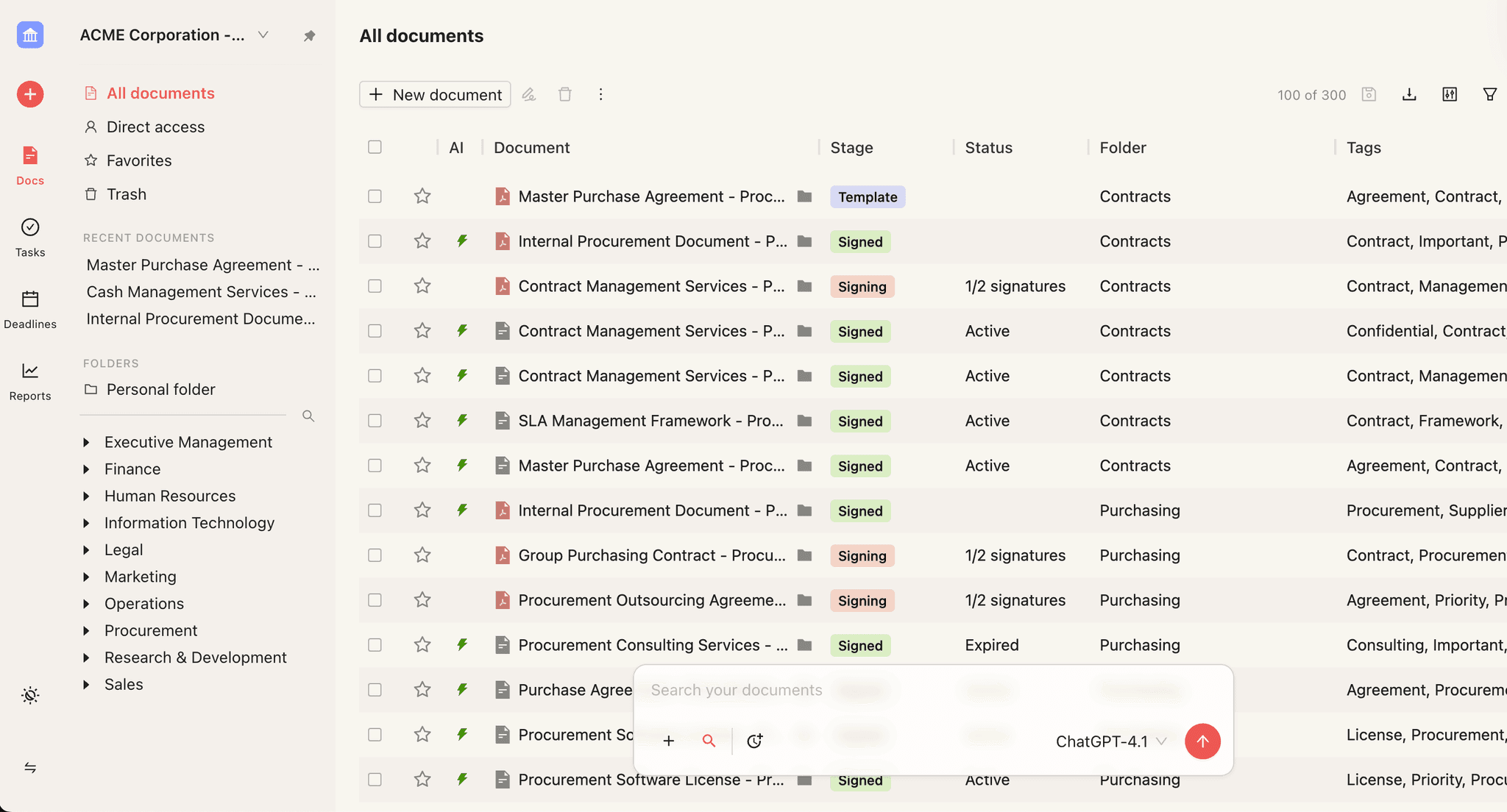
In practice, the opposite is true. A cloud-based contract management platform gives you more visibility, not less. You can see where every contract is in the process, from draft and review to negotiation, signature, and fully executed, at any point in time. Role-based permissions mean you control who can view, edit, or approve any given document.
Teams that manage high volumes of agreements, across procurement, HR, sales, and legal, frequently describe the shift from email-based tracking to a centralized platform as the single change that gave them real clarity. Deadline tracking across renewals, expirations, and notice periods means nothing slips through because it was buried in an inbox.
Myth #2: The platform will not be as secure as what you were using before
Reality: a purpose-built platform is more secure than the drives and inboxes most teams use today.
Security concerns around cloud platforms are understandable, but the frame of reference matters. Storing contracts on local drives, in personal email accounts, or in general-purpose file storage introduces more risk than it removes. Those environments are not built with contract security in mind.
A purpose-built platform should offer bank-level security, including encryption at rest and in transit, audit trails for every action taken on a document, and access controls that let administrators manage permissions at a granular level. Many compliance frameworks, including those common in financial services, healthcare, and government contracting, now require that sensitive documents live in systems with these controls in place.
The right question is not whether the cloud is secure. It is whether the specific platform you are evaluating has the security architecture your contracts require.
Myth #3: Implementation will take months and require heavy IT involvement
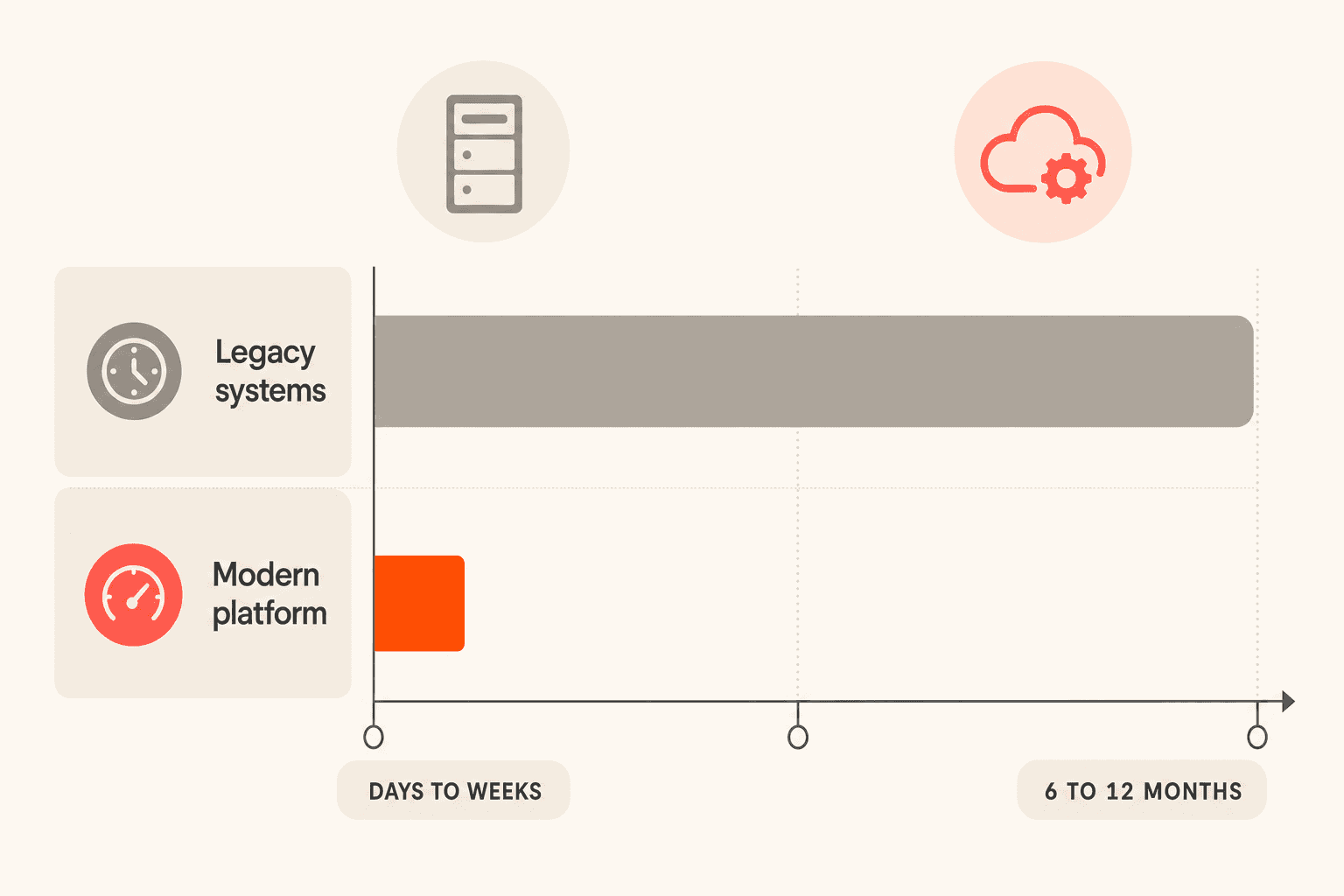
Reality: modern platforms are live in days or weeks, not the six to twelve months legacy systems required.
This myth has a real origin. Older enterprise contract management systems often did take six to twelve months to implement, required extensive configuration by IT, and generated significant internal resistance along the way. If that is your frame of reference, skepticism is fair.
But modern platforms are built differently. Implementation should be measured in days or weeks, not quarters. When a platform is intuitive enough that your team can start creating, sending, and tracking contracts without extensive training, much the way they would pick up a tool like Google Docs, adoption follows naturally.
If a vendor is quoting a multi-month implementation timeline for a mid-sized team, that is worth scrutinizing. The platform should work around your existing processes, not demand that you rebuild everything to accommodate it.
See how quickly Concord stands up for a team your size. Book a demo and walk your own contracts through setup.
Myth #4: One template is enough for everything
Reality: different contract types need different templates, and a good platform makes that easy to manage.
Once a team gets comfortable on a new platform, it is tempting to default to a single contract template for most situations: the NDA that handles everything, the MSA that covers all vendor relationships, the employment agreement that applies company-wide. It is a shortcut that feels efficient but quietly creates problems.
Different contract types carry different legal and business requirements. A template designed for a simple one-page NDA is not appropriate for a multi-party service agreement with complex indemnification language. Using the same structure for both increases the chance that something important gets overlooked or left ambiguous.
A well-organized platform supports a purpose-built clause and template library. You can maintain distinct templates for different use cases, from vendor agreements and customer contracts to partnership terms and employment documents, and control who sees which templates based on their role.
Myth #5: The platform will replace tools your team actually needs
Reality: the goal is to retire redundant tools and connect to the ones you keep, not replace what works.
Concerns about replacing existing tools are common, and they are not entirely unfounded. Any major software change involves some consolidation. But the goal of a contract management platform is not to tear out everything your team already uses. It is to remove the friction that comes from managing contracts across tools that were not designed for it.
Some tools will become redundant. If you have been using a separate e-signature tool, a shared inbox for contract requests, and a spreadsheet for deadline tracking, a single platform can replace all three with less context-switching and fewer gaps.
For tools that are not going away, like your CRM, ERP, and HRIS, the platform should meet you where you are. Native integrations and an open API allow contract data to flow between systems without manual entry. When a deal closes in your CRM, the relevant contract details should be available without anyone logging into a separate system.
The standard is higher than it used to be
The myths above were, in some cases, accurate descriptions of how contract management platforms worked a decade ago. Long implementations, poor security practices, rigid templates, and tool fragmentation were real problems. They no longer have to be.
If you are evaluating platforms and any of these issues still show up, slow implementation, limited security controls, no integrations, no template flexibility, that is a signal to keep looking. The best contract management platforms are built to fit how your business actually works. Book a demo to see how Concord handles each of these areas in practice.
When people think of contract management, certain assumptions tend to follow. Some come from years of working with legacy tools. Others come from stories shared across legal and ops teams. Here is a look at five of the most common myths, and why accepting any of them as normal puts your business at a disadvantage.
When organizations start evaluating contract management platforms, they often arrive with a mental model built on outdated experiences. Maybe the last system they used required a six-month implementation. Maybe it lived on a shared drive that no one fully trusted. Maybe it locked contract data inside a format that made reporting nearly impossible. Those experiences are real, but they do not have to be universal.
Key takeaways
A cloud contract platform gives you more visibility and control than email and shared drives, not less. Role-based permissions and instant search put every contract one click away.
Purpose-built platforms are more secure than local drives or inboxes, with encryption, audit trails, and access controls many compliance frameworks now require.
Modern implementation takes days or weeks, not the six to twelve months older enterprise systems demanded.
One template cannot cover every contract type. A clause and template library keeps drafting fast and consistent.
The right platform retires redundant tools and connects to the ones you keep through native integrations and an open API.
What is a contract management platform?
A contract management platform is software that centralizes the full contract lifecycle, from drafting and negotiation to signature, storage, and renewal tracking, in one system. It replaces scattered email threads, shared drives, and spreadsheets with role-based access, search, and automated deadline alerts, so teams keep control and visibility over every agreement.
The myth | The reality |
|---|---|
You will lose control, visibility, and access to your contracts | You gain real-time status, role-based permissions, and instant search across every contract |
It is less secure than what you use now | Purpose-built platforms add encryption, audit trails, and access controls that local drives and inboxes lack |
Implementation takes months and heavy IT lift | Modern platforms are live in days or weeks, not quarters |
One template covers everything | A clause and template library matches each contract type and cuts drafting errors |
It replaces tools your team actually needs | It retires redundant tools and connects to your CRM, ERP, and HRIS through integrations and an open API |
Myth #1: You will lose control, visibility, and access to your contracts
Reality: a centralized platform gives you more visibility and control than scattered files, not less.
This is one of the most persistent fears, and it tends to surface most in teams that have been managing contracts in email threads, shared folders, or on individual desktops. The instinct makes sense. If everything lives in one centralized place, what happens if something goes wrong?
In practice, the opposite is true. A cloud-based contract management platform gives you more visibility, not less. You can see where every contract is in the process, from draft and review to negotiation, signature, and fully executed, at any point in time. Role-based permissions mean you control who can view, edit, or approve any given document.
Teams that manage high volumes of agreements, across procurement, HR, sales, and legal, frequently describe the shift from email-based tracking to a centralized platform as the single change that gave them real clarity. Deadline tracking across renewals, expirations, and notice periods means nothing slips through because it was buried in an inbox.
Myth #2: The platform will not be as secure as what you were using before
Reality: a purpose-built platform is more secure than the drives and inboxes most teams use today.
Security concerns around cloud platforms are understandable, but the frame of reference matters. Storing contracts on local drives, in personal email accounts, or in general-purpose file storage introduces more risk than it removes. Those environments are not built with contract security in mind.
A purpose-built platform should offer bank-level security, including encryption at rest and in transit, audit trails for every action taken on a document, and access controls that let administrators manage permissions at a granular level. Many compliance frameworks, including those common in financial services, healthcare, and government contracting, now require that sensitive documents live in systems with these controls in place.
The right question is not whether the cloud is secure. It is whether the specific platform you are evaluating has the security architecture your contracts require.
Myth #3: Implementation will take months and require heavy IT involvement
Reality: modern platforms are live in days or weeks, not the six to twelve months legacy systems required.
This myth has a real origin. Older enterprise contract management systems often did take six to twelve months to implement, required extensive configuration by IT, and generated significant internal resistance along the way. If that is your frame of reference, skepticism is fair.
But modern platforms are built differently. Implementation should be measured in days or weeks, not quarters. When a platform is intuitive enough that your team can start creating, sending, and tracking contracts without extensive training, much the way they would pick up a tool like Google Docs, adoption follows naturally.
If a vendor is quoting a multi-month implementation timeline for a mid-sized team, that is worth scrutinizing. The platform should work around your existing processes, not demand that you rebuild everything to accommodate it.
See how quickly Concord stands up for a team your size. Book a demo and walk your own contracts through setup.
Myth #4: One template is enough for everything
Reality: different contract types need different templates, and a good platform makes that easy to manage.
Once a team gets comfortable on a new platform, it is tempting to default to a single contract template for most situations: the NDA that handles everything, the MSA that covers all vendor relationships, the employment agreement that applies company-wide. It is a shortcut that feels efficient but quietly creates problems.
Different contract types carry different legal and business requirements. A template designed for a simple one-page NDA is not appropriate for a multi-party service agreement with complex indemnification language. Using the same structure for both increases the chance that something important gets overlooked or left ambiguous.
A well-organized platform supports a purpose-built clause and template library. You can maintain distinct templates for different use cases, from vendor agreements and customer contracts to partnership terms and employment documents, and control who sees which templates based on their role.
Myth #5: The platform will replace tools your team actually needs
Reality: the goal is to retire redundant tools and connect to the ones you keep, not replace what works.
Concerns about replacing existing tools are common, and they are not entirely unfounded. Any major software change involves some consolidation. But the goal of a contract management platform is not to tear out everything your team already uses. It is to remove the friction that comes from managing contracts across tools that were not designed for it.
Some tools will become redundant. If you have been using a separate e-signature tool, a shared inbox for contract requests, and a spreadsheet for deadline tracking, a single platform can replace all three with less context-switching and fewer gaps.
For tools that are not going away, like your CRM, ERP, and HRIS, the platform should meet you where you are. Native integrations and an open API allow contract data to flow between systems without manual entry. When a deal closes in your CRM, the relevant contract details should be available without anyone logging into a separate system.
The standard is higher than it used to be
The myths above were, in some cases, accurate descriptions of how contract management platforms worked a decade ago. Long implementations, poor security practices, rigid templates, and tool fragmentation were real problems. They no longer have to be.
If you are evaluating platforms and any of these issues still show up, slow implementation, limited security controls, no integrations, no template flexibility, that is a signal to keep looking. The best contract management platforms are built to fit how your business actually works. Book a demo to see how Concord handles each of these areas in practice.
Need to know
Frequently Asked Questions

Take the "management" out
of contract management.
Customer Support
Legal
Compare
Resources
Customer Support
Company
Legal
Compare
Resources
Customer Support
Company
Legal
Compare
© 2025 Concord. All rights reserved.